PUBLISHER: Mordor Intelligence | PRODUCT CODE: 2099503

PUBLISHER: Mordor Intelligence | PRODUCT CODE: 2099503
AI Search Optimization Software - Market Share Analysis, Industry Trends & Statistics, Growth Forecasts (2026 - 2031)
According to Mordor Intelligence, the AI search optimization software market size is expected to grow from USD 1.03 billion in 2025 to USD 1.23 billion in 2026 and is forecast to reach USD 3.32 billion by 2031 at 21.97% CAGR over 2026-2031.
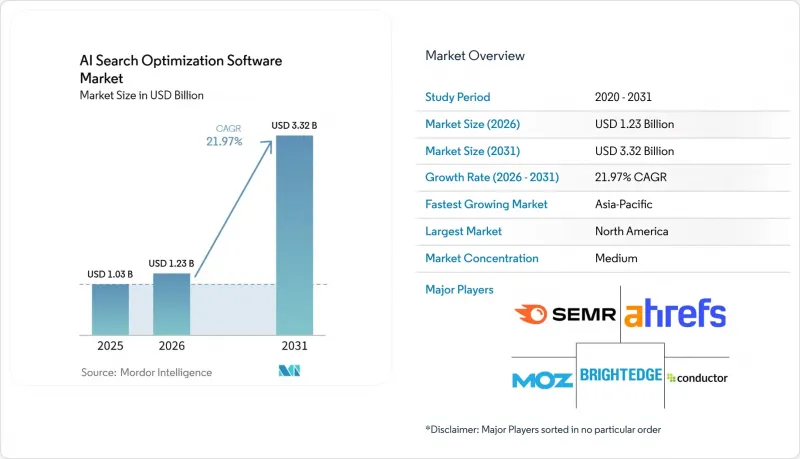
This report is Segmented by Component (Software, and Services), Deployment Mode (Cloud-Based, On-Premise, and Hybrid), Optimization Type (AI Search Visibility Optimization, and More), Enterprise Size (Large Enterprises, and Small and Medium Enterprises), End-User Industry (Retail and E-Commerce, BFSI, and More), and Geography. The Market Forecasts are Provided in Terms of Value (USD).
Global AI Search Optimization Software Market Trends and Insights
Rising Enterprise Demand for AI Search Visibility
Enterprise adoption has moved quickly because AI citation gaps are harder to detect than standard ranking gaps, and that makes the need for dedicated monitoring more urgent. The AI search optimization software market is benefiting from this shift because large marketing teams now treat a lack of AI visibility as an operating risk rather than just a growth issue. Semrush stated in June 2026 that its expanded AI Visibility Index analyzed 126 million U.S. AI search prompts and found wide variation in brand mention rates across competing brands in the same category. That kind of uneven citation exposure makes manual review a weak control process, especially in large organizations with many brands, products, and content teams. The result is a retention advantage for vendors that can provide repeatable visibility benchmarks, because buyers cannot clearly see these gaps with conventional analytics tools. This pattern supports recurring demand across the AI search optimization software market as enterprises move from testing to structured platform adoption.
Shift from Keyword Ranking to Answer Engine Optimization
The move from keyword ranking to answer engine optimization is changing what buyers expect from search software. The AI search optimization software market is gaining from this transition because citation presence matters more in answer environments than a single blue-link position. Enterprise contracts have also expanded as buyers pay for monitoring, competitive benchmarking, and response-surface intelligence rather than for simple keyword dashboards. Conductor reinforced this direction in April 2026, when it launched its next-generation AI Search Performance offer as a unified system of record for answer engine optimization. That move shows how incumbent platforms are recasting core product value around answer visibility, workflow execution, and performance management. As this shift continues, the AI search optimization software market is likely to reward vendors that can integrate search, content, technical signals, and citation control into a single operating layer.
Unclear Attribution Between AI Visibility And Revenue
The largest buying barrier is still attribution. Many finance teams want a direct line between an AI citation event and a later revenue event, and that link is often not visible at the prompt level. BrightEdge stated in 2025 that AI search was functioning as a research channel with near-zero direct conversions tracked at that stage of adoption. That makes it harder for vendors in the AI search optimization software market to justify budgets through last-click logic, even when marketing teams can see the strategic value. The problem is sharper in large enterprises because they have strict buying processes and stronger demands for audited performance evidence. Until vendors build better assisted-conversion and pipeline-influence models, attribution opacity will remain a meaningful restraint on faster category conversion.
Other drivers and restraints analyzed in the detailed report include:
- Need to Reduce Organic Traffic Volatility from AI Overviews
- Content Scale Requirements Across Multi-Property Brands
- Fast-Changing Search Interfaces and Ranking Signals
For complete list of drivers and restraints, kindly check the Table Of Contents.
Segment Analysis
Software accounted for 71.24% of the market in 2025, indicating that platform subscriptions formed the primary revenue base early in the category's development. The AI search optimization software market favored software-first because buyers needed dashboards, citation monitoring, technical diagnostics, and reporting systems before they could scale large service programs. This pattern also reflects the SaaS structure of the category, where platforms can roll out updates across many accounts as answer engines change. Enterprise teams adopted these tools faster than services-led models because visibility monitoring requires repeat use, not one-time project work. The software segment, therefore, anchored the commercial base of the AI search optimization software market in 2025.
Services are projected to grow at a 24.83% CAGR through 2031, making them the fastest-growing component over the forecast period. Growth in services comes from implementation complexity, since many teams still need help with strategy, integration, workflow setup, and managed execution. This is not a sign of software weakness; it shows that the category is moving from tool purchase to operational use. BrightEdge illustrated this combined approach in March 2026 when it launched AI Hyper Cube and also expanded related capabilities around AI agent monitoring and visibility analysis. Over time, service growth is likely to further support platform adoption, as buyers often start with guided delivery before shifting more activity into software-led workflows.
Cloud-based deployment accounted for 68.41% of the AI search optimization software market in 2025, leaving it well ahead of other deployment models. The cloud model fits the category because vendors need to update prompt libraries, integrations, and tracking logic frequently as answer engines change. It also supports shared benchmarking, faster onboarding, and lower deployment friction across distributed teams. These benefits made the cloud the default choice for enterprises that wanted speed and broad feature access. As a result, cloud remained the main delivery layer for the AI search optimization software market in 2025.
Hybrid deployment is expected to grow at a 23.19% CAGR through 2031, reflecting demand from sectors with stricter data and governance requirements. Healthcare, financial services, and public sector buyers often need tighter control over proprietary data, customer records, and internal testing environments. Hybrid models give these buyers a way to keep sensitive processes within their own infrastructure while still using cloud-based benchmarking or interface layers where needed. Botify supported the enterprise cloud security case in June 2025 by expanding its AI agents and MCP Server integration, and by joining the AWS ISV Accelerate Program. On-premise remains the smallest mode, but it still serves a narrow group of buyers that operate under strict sovereignty and security frameworks. The broader direction suggests that flexibility, not a single architecture, will shape deployment choices across the AI search optimization software market.
Complete Report Scope:
- By Component
- Software
- Services
- By Deployment Mode
- Cloud-Based
- On-Premise
- Hybrid
- By Optimization Type
- AI Search Visibility Optimization
- Content Optimization
- Technical SEO Automation
- AI Analytics and Performance Monitoring
- Reputation and Brand Presence Optimization
- By Enterprise Size
- Large Enterprises
- Small And Medium Enterprises
- By End-User Industry
- Retail and E-Commerce
- BFSI
- Healthcare and Life Sciences
- IT and Telecom
- Media and Entertainment
- Government and Public Administration
- Education and Research Institutions
- Transportation and Logistics
- Other End-User Industries
- By Geography
- North America
- United States
- Canada
- Mexico
- South America
- Brazil
- Argentina
- Rest of South America
- Europe
- Germany
- United Kingdom
- France
- Italy
- Spain
- Russia
- Rest of Europe
- Asia-Pacific
- China
- India
- Japan
- South Korea
- Australia
- Rest of Asia-Pacific
- Middle East and Africa
- Middle East
- Saudi Arabia
- United Arab Emirates
- Rest of Middle East
- Africa
- South Africa
- Nigeria
- Rest of Africa
- Middle East
- North America
Geography Analysis
North America held 34.62% of the AI search optimization software market share in 2025, making it the largest regional segment. The region led because major enterprise buyers, mature digital marketing budgets, and several core platform operators are concentrated in the United States. This made North America the earliest large-scale testing ground for answer engine optimization tools and operating workflows. Canada and Mexico were smaller contributors, but both supported regional demand through enterprise digital adoption and cross-border brand activity.
Europe remained a structurally important region for the AI search optimization software market, as Germany, the United Kingdom, and France accounted for the core of enterprise demand. The region also carries added importance because accuracy, transparency, and governance concerns are especially relevant in its business and policy environment. Buyers in Europe are more likely to value controlled workflows and documented response quality, which supports demand for software with monitoring and governance layers. Asia-Pacific is projected to grow at a 27.84% CAGR through 2031, making it the fastest-growing regional segment in the AI search optimization software market. This growth reflects a more fragmented answer-engine environment, which increases the need for multi-engine visibility tools rather than single-platform optimization approaches.
India is expanding with its digital enterprise base, while Japan and South Korea remain attractive markets for enterprise-grade software and managed execution. Semrush supported the case for broader regional demand in May 2026, when it expanded its AI Visibility Database to 32 countries and added 17 new regional markets, bringing the prompt base to more than 261 million LLM prompts. South America is still earlier in adoption, but Brazil and Argentina are building relevance as digital marketing maturity improves. The Middle East and Africa remain the smallest region, though Saudi Arabia and the United Arab Emirates stand out because of digital transformation spending. Nigeria and South Africa offer longer-term potential where cost-efficient tools can match less mature enterprise infrastructure. The OECD stated in December 2025 that AI adoption among small and medium-sized enterprises still lagged that of larger firms globally, indicating underpenetrated demand across South America, the Middle East, and Africa.
- Semrush Holdings, Inc.
- Ahrefs Pte. Ltd.
- Moz, Inc.
- Conductor, Inc.
- BrightEdge Technologies, Inc.
- Similarweb Ltd.
- seoClarity, LLC
- Surfer Sp. z o.o.
- MarketMuse, Inc.
- Clearscope, Inc.
- Botify SAS
- ContentKing B.V.
- AccuRanker ApS
- Mangools s.r.o.
- Profound
- Otterly.AI
- Advanced Web Ranking SRL
- Serpstat Limited
- Peec AI
- Authoritas
Additional Benefits:
- The market estimate (ME) sheet in Excel format
- 3 months of analyst support
TABLE OF CONTENTS
1 INTRODUCTION
- 1.1 Study Assumptions and Market Definition
- 1.2 Scope of the Study
2 RESEARCH METHODOLOGY
3 EXECUTIVE SUMMARY
4 MARKET LANDSCAPE
- 4.1 Market Overview
- 4.2 Market Drivers
- 4.2.1 Rising Enterprise Demand for AI Search Visibility
- 4.2.2 Shift From Keyword Ranking to Answer Engine Optimization
- 4.2.3 Need To Reduce Organic Traffic Volatility From AI Overviews
- 4.2.4 Content Scale Requirements Across Multi-Property Brands
- 4.2.5 Budget Reallocation Toward Measurable Organic Efficiency
- 4.2.6 Early-Mover Advantage In Proprietary Citation Tracking
- 4.3 Market Restraints
- 4.3.1 Unclear Attribution Between AI Visibility And Revenue
- 4.3.2 Fast-Changing Search Interfaces and Ranking Signals
- 4.3.3 Limited Access To Closed or Restricted AI Search Systems
- 4.3.4 Buyer Skepticism Around New Category ROI
- 4.4 Impact of Macroeconomic Factors on the Market
- 4.5 Industry Value Chain Analysis
- 4.6 Technology Outlook
- 4.7 Regulatory Landscape
- 4.8 Porter's Five Forces Analysis
- 4.8.1 Threat of New Entrants
- 4.8.2 Bargaining Power of Suppliers
- 4.8.3 Bargaining Power of Buyers
- 4.8.4 Threat of Substitutes
- 4.8.5 Intensity of Competitive Rivalry
5 MARKET SIZE AND GROWTH FORECASTS (VALUE)
- 5.1 By Component
- 5.1.1 Software
- 5.1.2 Services
- 5.2 By Deployment Mode
- 5.2.1 Cloud-Based
- 5.2.2 On-Premise
- 5.2.3 Hybrid
- 5.3 By Optimization Type
- 5.3.1 AI Search Visibility Optimization
- 5.3.2 Content Optimization
- 5.3.3 Technical SEO Automation
- 5.3.4 AI Analytics and Performance Monitoring
- 5.3.5 Reputation and Brand Presence Optimization
- 5.4 By Enterprise Size
- 5.4.1 Large Enterprises
- 5.4.2 Small And Medium Enterprises
- 5.5 By End-User Industry
- 5.5.1 Retail and E-Commerce
- 5.5.2 BFSI
- 5.5.3 Healthcare and Life Sciences
- 5.5.4 IT and Telecom
- 5.5.5 Media and Entertainment
- 5.5.6 Government and Public Administration
- 5.5.7 Education and Research Institutions
- 5.5.8 Transportation and Logistics
- 5.5.9 Other End-User Industries
- 5.6 By Geography
- 5.6.1 North America
- 5.6.1.1 United States
- 5.6.1.2 Canada
- 5.6.1.3 Mexico
- 5.6.2 South America
- 5.6.2.1 Brazil
- 5.6.2.2 Argentina
- 5.6.2.3 Rest of South America
- 5.6.3 Europe
- 5.6.3.1 Germany
- 5.6.3.2 United Kingdom
- 5.6.3.3 France
- 5.6.3.4 Italy
- 5.6.3.5 Spain
- 5.6.3.6 Russia
- 5.6.3.7 Rest of Europe
- 5.6.4 Asia-Pacific
- 5.6.4.1 China
- 5.6.4.2 India
- 5.6.4.3 Japan
- 5.6.4.4 South Korea
- 5.6.4.5 Australia
- 5.6.4.6 Rest of Asia-Pacific
- 5.6.5 Middle East and Africa
- 5.6.5.1 Middle East
- 5.6.5.1.1 Saudi Arabia
- 5.6.5.1.2 United Arab Emirates
- 5.6.5.1.3 Rest of Middle East
- 5.6.5.2 Africa
- 5.6.5.2.1 South Africa
- 5.6.5.2.2 Nigeria
- 5.6.5.2.3 Rest of Africa
- 5.6.5.1 Middle East
- 5.6.1 North America
6 COMPETITIVE LANDSCAPE
- 6.1 Market Concentration
- 6.2 Strategic Moves
- 6.3 Market Share Analysis
- 6.4 Company Profiles (includes Global Level Overview, Market Level Overview, Core Segments, Financials as available, Strategic Information, Market Rank/Share, Products and Services, Recent Developments)
- 6.4.1 Semrush Holdings, Inc.
- 6.4.2 Ahrefs Pte. Ltd.
- 6.4.3 Moz, Inc.
- 6.4.4 Conductor, Inc.
- 6.4.5 BrightEdge Technologies, Inc.
- 6.4.6 Similarweb Ltd.
- 6.4.7 seoClarity, LLC
- 6.4.8 Surfer Sp. z o.o.
- 6.4.9 MarketMuse, Inc.
- 6.4.10 Clearscope, Inc.
- 6.4.11 Botify SAS
- 6.4.12 ContentKing B.V.
- 6.4.13 AccuRanker ApS
- 6.4.14 Mangools s.r.o.
- 6.4.15 Profound
- 6.4.16 Otterly.ai
- 6.4.17 Advanced Web Ranking SRL
- 6.4.18 Serpstat Limited
- 6.4.19 Peec AI
- 6.4.20 Authoritas
7 MARKET OPPORTUNITIES AND FUTURE OUTLOOK
- 7.1 White-Space and Unmet-Need Assessment

