PUBLISHER: Mordor Intelligence | PRODUCT CODE: 2119231

PUBLISHER: Mordor Intelligence | PRODUCT CODE: 2119231
AI Creative Optimization Services - Market Share Analysis, Industry Trends & Statistics, Growth Forecasts (2026 - 2031)
According to Mordor Intelligence, the AI creative optimization services market size was valued at USD 3.29 billion in 2025 and estimated to grow from USD 4.02 billion in 2026 to reach USD 11.12 billion by 2031, at a CAGR of 22.57% during the forecast period (2026-2031).
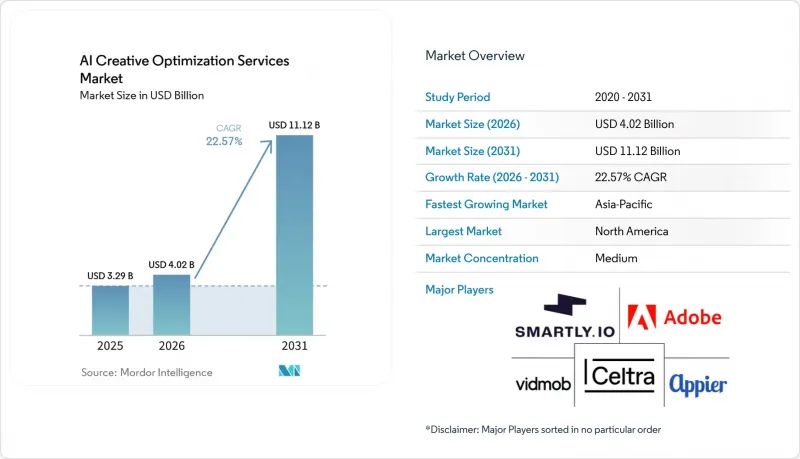
This report is Segmented by Service Type (Creative Strategy and Optimization Consulting Services, Managed Dynamic Creative Optimization (DCO) Services, Generative Creative Variant Development Services, Creative Performance Analytics and Insight Services, and More), End-User Industry (Retail and E-Commerce, and More), and Geography. The Market Forecasts are Provided in Terms of Value (USD).
Global AI Creative Optimization Services Market Trends and Insights
Generative AI Compression of Variant Production Time and Cost
The AI creative optimization services market is transforming production workflows as teams shift from manual development to AI-assisted asset creation. Brands that once produced 5-10 variants for a campaign can now deploy hundreds of channel-ready versions simultaneously, across different placements, audiences, products, and visual treatments. This capacity supports more frequent testing and refresh cycles across paid media, rather than limiting updates to major campaign launches. The IAB reported that AI-assisted production can reduce creative development cycle times by 80-90%, making continuous refresh programs more feasible for advertisers. Greater variation also gives delivery systems more creative signals to assess when allocating impressions. Google Performance Max and Meta Advantage+ use the quality and diversity of submitted assets in their delivery processes, making creative infrastructure more closely connected to media efficiency and campaign execution. Within the AI creative optimization services market, this changes the role of creative teams, who must manage asset volume, performance feedback, brand rules, and channel readiness as interconnected activities. The result is a workflow in which production speed supports both creative refresh and ongoing optimization work performed after a campaign is live.
Demand for Personalized Ads Across Paid Social, Display, and Connected TV
The AI creative optimization services market is supported by demand for personalized advertising across paid social, display, and connected TV. Personalized creative has moved beyond simple copy changes to the context-aware assembly of multiple visual and messaging elements for different audiences and placement conditions. In 2025, the IAB found that advertisers used generative AI to create audience-specific versions, change visual styles, and improve contextual relevance. Innovid reported a 60% increase in healthcare marketer allocation to connected TV, showing that personalization requirements are reaching formats once used mainly for broadcast-style delivery. Healthcare and financial services advertisers need version-level review processes as they apply personalized creative in regulated environments. Managed services can address this requirement by applying medical, legal, and regulatory checks to a larger set of versions while keeping approved messages and assets available for activation. The AI creative optimization services market, therefore, requires providers to treat personalization as an operational process rather than merely a creative option selected at the start of a campaign. This also makes reusable approval rules and orderly asset records useful when teams must produce many versions without changing approved claims.
Data Privacy and Signal Loss Limiting Personalization Inputs
The AI creative optimization services market faces limits due to the continued loss of behavioral signals used for personalization. Safari and Firefox protections, user-level ad blockers, consent choices, and mobile tracking limits reduce the observable audience data available to creative systems. Google changed its plan to fully remove third-party cookies from Chrome, but the quality of cross-site tracking remains constrained across the broader advertising environment. The IAB Tech Lab describes authenticated audience standards that seek to support more responsible addressability and data use. Advertisers can use clean-room environments such as Google Ads Data Hub and Amazon Marketing Cloud to work with some first-party data. These approaches require more integration and governance than older pixel-based workflows, raising the operating burden for personalized creative delivery, slowing the use of data in campaign planning, and shifting attention toward the quality and variety of assets that remain available within privacy-safe processes.
Other drivers and restraints analyzed in the detailed report include:
- Expansion of Performance Marketing Budgets Toward Creative-Led Optimization
- Retail Media Format Proliferation Raising Demand for Creative Orchestration
- Integration Complexity Across MarTech, AdTech, and Measurement Stacks
For complete list of drivers and restraints, kindly check the Table Of Contents.
Segment Analysis
Managed Dynamic Creative Optimization Services captured 27.38% of the AI creative optimization services market size in 2025. Enterprise advertisers use these services to coordinate personalization across programmatic, social, and connected TV inventory simultaneously. The operating model covers recurring data ingestion, creative assembly, A/B testing, and performance reporting. This differs from a one-time creative deployment because the service remains active as inventory, audiences, and campaign results change. The recurring nature of this work supports managed-service revenue and keeps providers involved after a campaign launches.
Generative Creative Variant Development Services is projected to expand at a 23.17% CAGR between 2026 and 2031. The AI creative optimization services market for this service type is advancing as brands build pipelines that can turn 1 brief into hundreds of channel-ready assets. Teams can use the process to create versions for placement, audience, language, product, and format needs without rebuilding every asset from the start. VidMob introduced a generative AI plugin for Adobe Premiere Pro and Adobe Illustrator in February 2025, illustrating the connection between creative tools and performance-oriented production workflows. Creative Performance Analytics and Insight Services also increasingly connect creative data with marketing intelligence systems, helping advertisers assess the asset features that support delivery and response outcomes.
Complete Report Scope:
- By Service Type
- Creative Strategy and Optimization Consulting Services
- Managed Dynamic Creative Optimization (DCO) Services
- Generative Creative Variant Development Services
- Creative Analytics and Insights
- Other Service Types
- By End-user Industry
- Retail and E-commerce
- Media and Entertainment
- IT and Telecom
- BFSI
- Healthcare and Life Sciences
- Automotive
- Other End-user Industries
- By Geography
- North America
- United States
- Canada
- Mexico
- South America
- Brazil
- Argentina
- Chile
- Rest of South America
- Europe
- Germany
- United Kingdom
- France
- Italy
- Spain
- Rest of Europe
- Asia-Pacific
- China
- Japan
- India
- South Korea
- Australia
- Rest of Asia-Pacific
- Middle East
- Saudi Arabia
- United Arab Emirates
- Qatar
- Rest of Middle East
- Africa
- South Africa
- Egypt
- Nigeria
- Rest of Africa
- North America
Geography Analysis
North America held 41.63% in 2025. The region has mature programmatic advertising infrastructure, experienced enterprise advertisers, and a concentration of major platform and service providers in the United States. These conditions support the use of managed creative systems across social, display, connected TV, and commerce media, where teams can connect asset production with activation and measurement. The region also has a large base of advertisers who can invest in data connections, creative testing, and measurement tools that support managed implementation models. South America is an emerging region, with Brazil serving as the main growth anchor as social video and e-commerce advertising continue to develop.
Europe held the second-largest regional position, supported by adoption in Germany, the United Kingdom, and France. The AI creative optimization services market in the region is shaped by advanced programmatic systems and demand for first-party data-led creative methods that can operate with stronger consent controls. GDPR consent and data minimization rules encourage advertisers to rely more on creative quality signals when behavioral targeting is limited, which makes asset relevance and controlled testing more useful. The EU AI Act is adding content governance requirements, with provisions expected to take effect progressively through 2027, and this is encouraging structured workflows for the review and documentation of AI-supported advertising content.
Asia-Pacific is projected to grow at a 23.94% CAGR between 2026 and 2031. India and China are the main growth engines, supported by retail media, short-form video, and large digital advertising ecosystems that require frequent and localized asset adaptation. Tencent, ByteDance, Baidu, Alibaba, and Douyin/TikTok integrate AI creative tools into their advertising stacks, which increases the need for advertisers to manage activity across several platforms with different data and format requirements. Appier launched AdCreative.ai in Thailand and Vietnam during 2026, extending generative creative capabilities to Southeast Asian markets. The AI creative optimization services market can develop in the region as advertisers navigate multiple languages, platforms, levels of creative infrastructure, and mobile-first media environments that require localized execution, while the United Arab Emirates and Saudi Arabia lead adoption in the Middle East and Egypt, Nigeria, and South Africa support mobile-first demand in Africa.
- Adobe Inc.
- Smartly.io Solutions Oy
- Celtra, Inc.
- VidMob, Inc.
- Appier Group Inc.
- Bannerflow AB
- Jivox Corporation
- Persado, Inc.
- Mediaocean LLC
- Adform A/S
- Criteo S.A.
- Quantcast Corporation
- Innovid Corp.
- Hunch Ads d.o.o.
- Marpipe, Inc.
- Creatopy Inc.
- CreativeX, Inc.
- Shuttlerock Limited
Additional Benefits:
- The market estimate (ME) sheet in Excel format
- 3 months of analyst support
TABLE OF CONTENTS
1 INTRODUCTION
- 1.1 Study Assumptions and Market Definition
- 1.2 Scope of the Study
2 RESEARCH METHODOLOGY
3 EXECUTIVE SUMMARY
4 MARKET LANDSCAPE
- 4.1 Market Overview
- 4.2 Market Drivers
- 4.2.1 Expansion of Performance Marketing Budgets Toward Creative-Led Optimization
- 4.2.2 Demand for Personalized Ads Across Paid Social, Display, and CTV
- 4.2.3 Generative AI Compression of Variant Production Time and Cost
- 4.2.4 Rising Creative Fatigue and Always-On Refresh Requirements
- 4.2.5 First-Party Creative Data and Predictive Scoring Becoming Media Inputs
- 4.2.6 Retail Media Format Proliferation Raising Demand for Creative Orchestration
- 4.3 Market Restraints
- 4.3.1 Data Privacy and Signal Loss Limiting Personalization Inputs
- 4.3.2 Integration Complexity Across MarTech, AdTech, and Measurement Stacks
- 4.3.3 AI Content Disclosure and Synthetic Performer Compliance Burdens
- 4.3.4 Native Platform Automation Compressing Standalone Vendor Differentiation
- 4.4 Industry Value Chain Analysis
- 4.5 Impact of Macroeconomic Factors on the Market
- 4.6 Regulatory Landscape
- 4.7 Technological Outlook
- 4.8 Porter's Five Forces Analysis
- 4.8.1 Threat of New Entrants
- 4.8.2 Bargaining Power of Buyers
- 4.8.3 Bargaining Power of Suppliers
- 4.8.4 Threat of Substitutes
- 4.8.5 Industry Rivalry
5 MARKET SIZE AND GROWTH FORECASTS (VALUE)
- 5.1 By Service Type
- 5.1.1 Creative Strategy and Optimization Consulting Services
- 5.1.2 Managed Dynamic Creative Optimization (DCO) Services
- 5.1.3 Generative Creative Variant Development Services
- 5.1.4 Creative Analytics and Insights
- 5.1.5 Other Service Types
- 5.2 By End-user Industry
- 5.2.1 Retail and E-commerce
- 5.2.2 Media and Entertainment
- 5.2.3 IT and Telecom
- 5.2.4 BFSI
- 5.2.5 Healthcare and Life Sciences
- 5.2.6 Automotive
- 5.2.7 Other End-user Industries
- 5.3 By Geography
- 5.3.1 North America
- 5.3.1.1 United States
- 5.3.1.2 Canada
- 5.3.1.3 Mexico
- 5.3.2 South America
- 5.3.2.1 Brazil
- 5.3.2.2 Argentina
- 5.3.2.3 Chile
- 5.3.2.4 Rest of South America
- 5.3.3 Europe
- 5.3.3.1 Germany
- 5.3.3.2 United Kingdom
- 5.3.3.3 France
- 5.3.3.4 Italy
- 5.3.3.5 Spain
- 5.3.3.6 Rest of Europe
- 5.3.4 Asia-Pacific
- 5.3.4.1 China
- 5.3.4.2 Japan
- 5.3.4.3 India
- 5.3.4.4 South Korea
- 5.3.4.5 Australia
- 5.3.4.6 Rest of Asia-Pacific
- 5.3.5 Middle East
- 5.3.5.1 Saudi Arabia
- 5.3.5.2 United Arab Emirates
- 5.3.5.3 Qatar
- 5.3.5.4 Rest of Middle East
- 5.3.6 Africa
- 5.3.6.1 South Africa
- 5.3.6.2 Egypt
- 5.3.6.3 Nigeria
- 5.3.6.4 Rest of Africa
- 5.3.1 North America
6 COMPETITIVE LANDSCAPE
- 6.1 Market Concentration
- 6.2 Strategic Moves
- 6.3 Market Share Analysis
- 6.4 Company Profiles (includes Global Level Overview, Market Level Overview, Core Segments, Financials as available, Strategic Information, Market Rank/Share, Products and Services, Recent Developments)
- 6.4.1 Adobe Inc.
- 6.4.2 Smartly.io Solutions Oy
- 6.4.3 Celtra, Inc.
- 6.4.4 VidMob, Inc.
- 6.4.5 Appier Group Inc.
- 6.4.6 Bannerflow AB
- 6.4.7 Jivox Corporation
- 6.4.8 Persado, Inc.
- 6.4.9 Mediaocean LLC
- 6.4.10 Adform A/S
- 6.4.11 Criteo S.A.
- 6.4.12 Quantcast Corporation
- 6.4.13 Innovid Corp.
- 6.4.14 Hunch Ads d.o.o.
- 6.4.15 Marpipe, Inc.
- 6.4.16 Creatopy Inc.
- 6.4.17 CreativeX, Inc.
- 6.4.18 Shuttlerock Limited
7 MARKET OPPORTUNITIES AND FUTURE OUTLOOK
- 7.1 White-Space and Unmet-Need Assessment

