PUBLISHER: Mordor Intelligence | PRODUCT CODE: 2099504

PUBLISHER: Mordor Intelligence | PRODUCT CODE: 2099504
Europe Customer Journey Analytics - Market Share Analysis, Industry Trends & Statistics, Growth Forecasts (2026 - 2031)
According to Mordor Intelligence, the Europe customer journey analytics market size is projected to be USD 4.81 billion in 2025, USD 5.75 billion in 2026, and reach USD 14.08 billion by 2031, growing at a CAGR of 19.60% from 2026 to 2031.
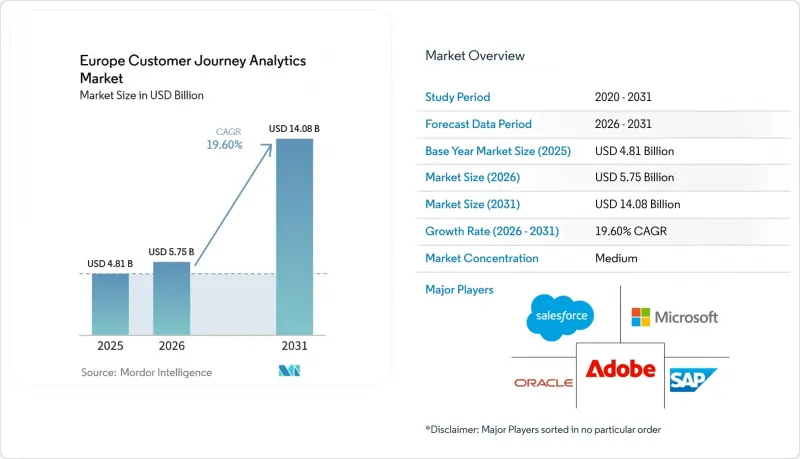
This report is Segmented by Component (Solutions, and Services), Deployment Mode (Cloud, On-Premises, and Hybrid), Application (Journey Mapping and Visualisation, and More), End-User Enterprise Size (Large Enterprises, and Small and Mid-Size Enterprises), End-User Industry (Information Technology and Telecom, and More), and Geography. The Market Forecasts are Provided in Terms of Value (USD).
Europe Customer Journey Analytics Market Trends and Insights
Rising Demand for Real-Time Journey Orchestration
Enterprises across Europe are replacing delayed journey reporting with systems that respond while the customer is still active, because static analysis no longer protects conversion or service outcomes. Adobe connected Customer Journey Analytics, Journey Optimizer, and Real-Time CDP within CX Enterprise Coworker in 2026, which shows how live decision support is moving into core customer workflows. Contentsquare also launched AI agent capabilities, prompt analytics, and conversation intelligence in 2026, which reflects the shift toward active journey monitoring rather than passive dashboards. FullStory added StoryAI Agents and Workflow Intelligence in June 2026, extending autonomous discovery and action into digital experience management. As buyers close this execution gap, the Europe customer journey analytics market is moving toward larger platform contracts that combine detection, recommendation, and activation into a single operating layer.
Expansion of First-Party Data Programs Across Privacy-Constrained Channels
Privacy restrictions and weaker third-party signal availability are pushing companies to depend more on owned behavioral data, CRM records, and loyalty interactions to rebuild a complete customer path. Adobe said in 2026 that its CX Analytics launch addressed enterprise demand for cross-channel journey measurement in a post-cookie environment, which shows how first-party data has become central to product design. Adobe also introduced the Customer Journey Analytics B2B Edition in 2025 to analyze journeys across individuals, buying groups, accounts, and opportunities, underscoring a broader need for durable, owned data models in complex decision-making cycles. In practical terms, this means the Europe customer journey analytics market is gaining momentum as organizations seek stronger visibility without relying on unstable external tracking methods. The result is a buying pattern in which data integration quality matters as much as dashboard depth, because poor first-party foundations limit the value of advanced modeling.
High Integration Complexity with Legacy CRM and Contact Center Systems
Customer journey analytics only works when data from CRM, contact center, billing, and digital channels can be connected consistently, and that remains difficult in many large organizations. The problem is not limited to the technology age, because many enterprises still operate business-unit systems with separate owners, different workflows, and inconsistent data definitions. Deutsche Telekom's migration case shows why companies are leaving behind heavy-preprocessing environments, yet it also highlights the scale of architectural work required before cloud analytics can operate smoothly. Vodafone Italy's modernization path points to the same issue, because moving customer data workflows into BigQuery required a staged transformation rather than a simple software installation. This keeps deployment cycles long in the Europe customer journey analytics market, especially where hidden dependencies in older systems are discovered only after integration begins.
Other drivers and restraints analyzed in the detailed report include:
- Wider Adoption of AI-Based Journey Next-Best-Action Models
- Migration to Cloud-Native CX and Analytics Stacks
- Data Privacy Consent Fragmentation across European Markets
For complete list of drivers and restraints, kindly check the Table Of Contents.
Segment Analysis
Solutions held 68.44% revenue share in 2025, while services are projected to grow at a 22.68% CAGR through 2031. The revenue lead shows that enterprise platform contracts still anchor the Europe customer journey analytics market, especially where large buyers already use broad software ecosystems. These contracts usually cover core analytics capabilities, identity management, reporting layers, and journey measurement across several business functions. That installed base keeps solutions in front of current revenue, because replacement cycles for enterprise platforms are long and procurement still favors established vendors in large accounts. It also explains why many organizations first secure the technology stack and then expand the operating model around it.
The faster service growth shows that software alone is no longer enough to deliver commercial results from journey data. Buyers increasingly need help with implementation, data model design, governance setup, dashboard tuning, and business adoption after go-live. This pattern is especially evident when cloud migration, AI workflows, and privacy controls must be coordinated simultaneously. As a result, the Europe customer journey analytics market is shifting toward longer vendor relationships that mix platform subscriptions with advisory and managed support. In practical terms, services are becoming a performance layer around the software rather than a basic post-sale add-on.
Cloud accounted for 70.86% of deployment-mode revenue in 2025, confirming that elastic infrastructure has become the default setting for new analytics investments. That lead reflects the need to process larger behavioral datasets, unify channels faster, and support AI functions without maintaining heavy local hardware. In the Europe customer journey analytics market, cloud adoption aligns with the broader shift toward API-based architectures and warehouse-connected workflows. Buyers see value in lower infrastructure friction and faster rollout of analytics updates, especially when customer volumes change across seasons or campaigns. This is why cloud has moved from an alternative deployment choice to the main architecture baseline across many large accounts.
On-premises deployments still matter in regulated or sovereignty-sensitive settings, particularly where public cloud processing remains a harder internal approval path. Hybrid models, therefore, retain a role because they allow organizations to modernize in stages rather than force an abrupt replacement of legacy systems. Deutsche Telekom's sovereign platform migration illustrates how cloud-scale analytics can be introduced while still respecting European data location requirements. Vodafone Italy's move to Google Cloud and BigQuery also shows that major enterprises are willing to modernize core customer data workflows when operational continuity can be protected. Together, these shifts are raising the standard for vendors competing in the Europe customer journey analytics market, because buyers now expect both scale and regional compliance support.
Complete Report Scope:
- By Component
- Solutions
- Services
- By Deployment Mode
- Cloud
- On-Premises
- Hybrid
- By Application
- Journey Mapping and Visualisation
- Campaign and Journey Orchestration
- Brand and Product Management
- Customer Behaviour and Attribution
- By End-User Enterprise Size
- Large Enterprises
- Small and Mid-Size Enterprises
- By End-User Industry
- Banking, Financial Services, and Insurance (BFSI)
- Retail and eCommerce
- Information Technology and Telecom
- Healthcare and Life-Sciences
- Media and Entertainment
- Travel and Hospitality
- Automotive and Mobility
- Other End-User Industries
- By Geography
- Germany
- United Kingdom
- France
- Italy
- Spain
- Rest of Europe
List of Companies Covered in this Report:
- Adobe Inc.
- Salesforce, Inc.
- Oracle Corporation
- Microsoft Corporation
- SAP SE
- IBM Corporation
- NICE Ltd.
- Verint Systems Inc.
- Contentsquare SA
- Glassbox Ltd.
- FullStory, Inc.
- Quantum Metric, Inc.
- Mixpanel, Inc.
- Amplitude, Inc.
- Medallia, Inc.
- Tealium, Inc.
- Genesys Telecommunications Laboratories, LLC
- Calabrio, Inc.
- Woopra, Inc.
- CSG Systems International, Inc.
Additional Benefits:
- The market estimate (ME) sheet in Excel format
- 3 months of analyst support
TABLE OF CONTENTS
1 INTRODUCTION
- 1.1 Study Assumptions and Market Definition
- 1.2 Scope of the Study
2 RESEARCH METHODOLOGY
3 EXECUTIVE SUMMARY
4 MARKET LANDSCAPE
- 4.1 Market Overview
- 4.2 Market Drivers
- 4.2.1 Rising Demand for Real-Time Journey Orchestration
- 4.2.2 Expansion of First-Party Data Programs across Privacy-Constrained Channels
- 4.2.3 Wider Adoption of AI-Based Journey Next-Best-Action Models
- 4.2.4 Migration to Cloud-Native CX and Analytics Stacks
- 4.2.5 Growth of Composable Customer Data Architectures
- 4.2.6 Need for Cross-Channel Attribution in Complex Buying Journeys
- 4.3 Market Restraints
- 4.3.1 High Integration Complexity With Legacy CRM and Contact Center Systems
- 4.3.2 Data Privacy Consent Fragmentation across European Markets
- 4.3.3 Shortage of Journey Analytics Talent and Data Engineering Capacity
- 4.3.4 Model Drift and Governance Risk in AI-Driven Journey Decisions
- 4.4 Industry Value Chain Analysis
- 4.5 Impact of Macroeconomic Factors on the Market
- 4.6 Technology Outlook
- 4.7 Regulatory Landscape
- 4.8 Porter's Five Forces Analysis
- 4.8.1 Threat of New Entrants
- 4.8.2 Bargaining Power of Suppliers
- 4.8.3 Bargaining Power of Buyers
- 4.8.4 Threat of Substitutes
- 4.8.5 Competitive Rivalry
5 MARKET SIZE AND GROWTH FORECASTS (VALUE)
- 5.1 By Component
- 5.1.1 Solutions
- 5.1.2 Services
- 5.2 By Deployment Mode
- 5.2.1 Cloud
- 5.2.2 On-Premises
- 5.2.3 Hybrid
- 5.3 By Application
- 5.3.1 Journey Mapping and Visualisation
- 5.3.2 Campaign and Journey Orchestration
- 5.3.3 Brand and Product Management
- 5.3.4 Customer Behaviour and Attribution
- 5.4 By End-User Enterprise Size
- 5.4.1 Large Enterprises
- 5.4.2 Small and Mid-Size Enterprises
- 5.5 By End-User Industry
- 5.5.1 Banking, Financial Services, and Insurance (BFSI)
- 5.5.2 Retail and eCommerce
- 5.5.3 Information Technology and Telecom
- 5.5.4 Healthcare and Life-Sciences
- 5.5.5 Media and Entertainment
- 5.5.6 Travel and Hospitality
- 5.5.7 Automotive and Mobility
- 5.5.8 Other End-User Industries
- 5.6 By Geography
- 5.6.1 Germany
- 5.6.2 United Kingdom
- 5.6.3 France
- 5.6.4 Italy
- 5.6.5 Spain
- 5.6.6 Rest of Europe
6 COMPETITIVE LANDSCAPE
- 6.1 Market Concentration
- 6.2 Strategic Moves
- 6.3 Market Share Analysis
- 6.4 Company Profiles (includes Global Level Overview, Market Level Overview, Core Segments, Financials as available, Strategic Information, Market Rank/Share, Products and Services, Recent Developments)
- 6.4.1 Adobe Inc.
- 6.4.2 Salesforce, Inc.
- 6.4.3 Oracle Corporation
- 6.4.4 Microsoft Corporation
- 6.4.5 SAP SE
- 6.4.6 IBM Corporation
- 6.4.7 NICE Ltd.
- 6.4.8 Verint Systems Inc.
- 6.4.9 Contentsquare SA
- 6.4.10 Glassbox Ltd.
- 6.4.11 FullStory, Inc.
- 6.4.12 Quantum Metric, Inc.
- 6.4.13 Mixpanel, Inc.
- 6.4.14 Amplitude, Inc.
- 6.4.15 Medallia, Inc.
- 6.4.16 Tealium, Inc.
- 6.4.17 Genesys Telecommunications Laboratories, LLC
- 6.4.18 Calabrio, Inc.
- 6.4.19 Woopra, Inc.
- 6.4.20 CSG Systems International, Inc.
7 MARKET OPPORTUNITIES AND FUTURE OUTLOOK
- 7.1 White-Space and Unmet-Need Assessment

