PUBLISHER: Mordor Intelligence | PRODUCT CODE: 2099511

PUBLISHER: Mordor Intelligence | PRODUCT CODE: 2099511
Middle East Milk Powder - Market Share Analysis, Industry Trends & Statistics, Growth Forecasts (2026 - 2031)
According to Mordor Intelligence, the Middle East milk powder market size is projected to grow from USD 3.93 billion in 2025 to USD 4.08 billion in 2026 and reach USD 5.17 billion by 2031, registering a CAGR of 4.86% during 2026-2031.
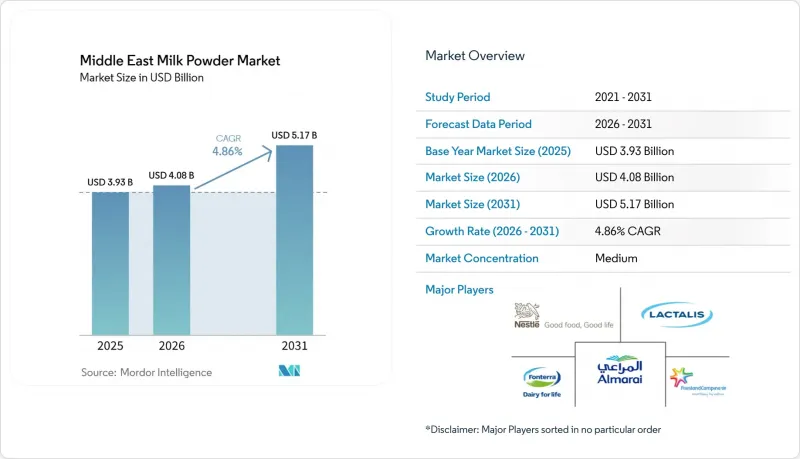
This report is Segmented by Type (Dairy, Non-Dairy/Plant-Based), Distribution Channel (Retail, Foodservice, Industrial), Packaging Format (Flexible Pouches, Cans and Tins, Bulk Bags, Single-Serve Sachets), and Geography (Bahrain, Kuwait, Oman, Qatar, Saudi Arabia, UAE, Yemen, Rest of Middle East and Africa). The Market Forecasts are Provided in Terms of Value (USD).
Middle East Milk Powder Market Trends and Insights
Rising Demand From Infant Nutrition
Infant nutrition remains one of the most reliable sources of demand for the Middle East milk powder market. The category benefits from steady household spending in Saudi Arabia, the United Arab Emirates, and Qatar, where consumers are willing to pay more for trusted formulations and certified products. It also favors suppliers that can meet stricter requirements for labeling, composition, and halal compliance. This gives large exporters and established regional distributors an advantage, as they already have the documentation and quality systems required by the trade. Fonterra is expected to strengthen this position in 2026 through a three-year supply agreement with a major Saudi distributor and by doubling its infant formula export volume to the Kingdom. This move shows that infant nutrition not only supports current volumes in the Middle East milk powder market but also influences long-term supplier commitments.
Growth In Health-Conscious Consumption
Health-led consumption is expanding the product mix in the Middle East milk powder market rather than replacing traditional dairy demand. High lactose intolerance in the region is increasing demand for easier-to-digest formulations and plant-based powder alternatives. Conventional milk powder remains important because consumers use it widely in cooked, blended, and processed products, where tolerance can differ from fresh milk. As a result, dairy powder and plant-based powder are growing side by side rather than following a direct substitution trend. Public policy also supports this shift, with the UAE's food security agenda and Saudi Arabia's support for local ingredient development giving plant-based formats more institutional visibility. The Middle East milk powder market is therefore expanding across formats, applications, and buyer profiles.
Climate Constraints On Dairy Farming
Climate pressure remains the key structural restraint on the Middle East milk powder market, as it limits the expansion of local raw milk production. Water stress is severe across the broader region, and agriculture already uses more than half of total water withdrawals in many MENA countries. This raises dairy farming costs and makes local supply more exposed to water policies, forage constraints, and feed dependence. The issue is long term because it affects the core economics of dairy farming in desert conditions. It also drives companies and governments to seek large-scale production capacity and powder supply outside core GCC markets. As a result, the Middle East milk powder market will continue to depend heavily on imported or externally produced dairy inputs, even as domestic champions expand.
Other drivers and restraints analyzed in the detailed report include:
- Long Shelf Life Advantage
- Growing E-Commerce And Modern Retail Availability
- Quality And Safety Compliance Requirements
For complete list of drivers and restraints, kindly check the Table Of Contents.
Segment Analysis
Dairy milk powder is expected to hold an 85% share in 2025, remaining the primary volume driver of the Middle East milk powder market. Its scale reflects the category's extensive use across bakeries, confectionery, infant formula blending, dairy beverages, and routine household consumption. Whole milk powder remains important in applications where fat content enhances the taste and texture of finished products. Skim milk powder also plays a strong role in blending and industrial applications, where processors require functional dairy solids without added fat. This large installed base keeps dairy powder at the center of the Middle East milk powder industry and limits the pace of rapid substitution.
Non-dairy and plant-based milk powder is the fastest-growing type and is projected to expand at a CAGR of 5.76% through 2031. Growth is driven by lactose intolerance, institutional support for plant-based options, and rising consumer acceptance of soy, almond, and oat formats. However, the segment remains much smaller than dairy powder, so its growth starts from a narrower commercial base. Price remains the key constraint, as plant-based powder often sells at a clear premium to conventional dairy products. Even so, the Middle East milk powder market is gradually expanding its category boundaries as regional buyers adopt plant-based products for wellness, sustainability, and menu diversification.
Complete Report Scope:
- By Type
- Dairy Milk Powder
- Whole Milk Powder (WMP)
- Skim Milk Powder (SMP)
- Others
- Non-Dairy/Plant-Based Milk Powder
- Soy Milk Powder
- Almond Milk Powder
- Coconut Milk Powder
- Oat and Other Cereal-Based Powders
- Dairy Milk Powder
- By Distribution Channel
- Retail
- Supermarkets/Hypermarkets
- Convenience and Grocery Stores
- Online Retail
- Other Distribution Channel
- Foodservice
- Industrial
- Infant and Follow-on Formula
- Bakery and Confectionery
- Dairy-based Beverages and Recombination
- Nutritional and Sports Supplements
- Others (Ready-Made Meals, cosmetics, etc.)
- Retail
- By Packaging Format
- Flexible Pouches
- Cans and Tins
- Bulk Bags
- Single-Serve Sachets
- By Geography
- Bahrain
- Kuwait
- Oman
- Qatar
- Saudi Arabia
- United Arab Emirates
- Yemen
- Rest of the Middle East
List of Companies Covered in this Report:
- Nestle S.A
- Danone
- Lactalis Group
- Fonterra Co-operative Group Limited
- FrieslandCampina
- Arla Foods
- Dairy Farmers of America, Inc.
- Saputo Inc.
- Almarai Company
- Al Ain Farms for Livestock Production
- Al Rawabi Dairy Company
- Baladna
- National Agricultural Development Company
- Saudi Dairy and Foodstuff Company
- IFFCO Group
- Al Ghurair Foods
- Bega Cheese Limited
- Synlait Milk Limited
- Open Country Dairy Limited
- Agropur Cooperative
Additional Benefits:
- The market estimate (ME) sheet in Excel format
- 3 months of analyst support
TABLE OF CONTENTS
1 INTRODUCTION
- 1.1 Study Assumptions and Market Definition
- 1.2 Scope of the Study
2 RESEARCH METHODOLOGY
3 EXECUTIVE SUMMARY
4 MARKET LANDSCAPE
- 4.1 Market Overview
- 4.2 Market Drivers
- 4.2.1 Rising demand from infant nutrition
- 4.2.2 Growth in health-conscious consumption
- 4.2.3 Expansion of convenience food usage
- 4.2.4 Strong food and feed industry demand
- 4.2.5 Long shelf life advantage
- 4.2.6 Growing e-commerce and modern retail availability
- 4.3 Market Restraints
- 4.3.1 Climate constraints on dairy farming
- 4.3.2 Quality and safety compliance requirements
- 4.3.3 Supply chain disruption risk
- 4.3.4 Competition from fresh and other dairy formats
- 4.4 Supply Chain Analysis
- 4.5 Regulatory Landscape
- 4.6 Technological Outlook
- 4.7 Porter's Five Forces
- 4.7.1 Bargaining Power of Suppliers
- 4.7.2 Bargaining Power of Buyers
- 4.7.3 Threat of New Entrants
- 4.7.4 Threat of Substitutes
- 4.7.5 Competitive Rivalry
5 MARKET SIZE AND GROWTH FORECASTS (VALUE)
- 5.1 By Type
- 5.1.1 Dairy Milk Powder
- 5.1.1.1 Whole Milk Powder (WMP)
- 5.1.1.2 Skim Milk Powder (SMP)
- 5.1.1.3 Others
- 5.1.2 Non-Dairy/Plant-Based Milk Powder
- 5.1.2.1 Soy Milk Powder
- 5.1.2.2 Almond Milk Powder
- 5.1.2.3 Coconut Milk Powder
- 5.1.2.4 Oat and Other Cereal-Based Powders
- 5.1.1 Dairy Milk Powder
- 5.2 By Distribution Channel
- 5.2.1 Retail
- 5.2.1.1 Supermarkets/Hypermarkets
- 5.2.1.2 Convenience and Grocery Stores
- 5.2.1.3 Online Retail
- 5.2.1.4 Other Distribution Channel
- 5.2.2 Foodservice
- 5.2.3 Industrial
- 5.2.3.1 Infant and Follow-on Formula
- 5.2.3.2 Bakery and Confectionery
- 5.2.3.3 Dairy-based Beverages and Recombination
- 5.2.3.4 Nutritional and Sports Supplements
- 5.2.3.5 Others (Ready-Made Meals, cosmetics, etc.)
- 5.2.1 Retail
- 5.3 By Packaging Format
- 5.3.1 Flexible Pouches
- 5.3.2 Cans and Tins
- 5.3.3 Bulk Bags
- 5.3.4 Single-Serve Sachets
- 5.4 By Geography
- 5.4.1 Bahrain
- 5.4.2 Kuwait
- 5.4.3 Oman
- 5.4.4 Qatar
- 5.4.5 Saudi Arabia
- 5.4.6 United Arab Emirates
- 5.4.7 Yemen
- 5.4.8 Rest of the Middle East
6 COMPETITIVE LANDSCAPE
- 6.1 Market Concentration
- 6.2 Strategic Moves
- 6.3 Market Ranking Analysis
- 6.4 Company Profiles (includes Global level Overview, Market level overview, Core Segments, Financials (if available), Strategic Information, Products, Recent Developments)
- 6.4.1 Nestle S.A
- 6.4.2 Danone
- 6.4.3 Lactalis Group
- 6.4.4 Fonterra Co-operative Group Limited
- 6.4.5 FrieslandCampina
- 6.4.6 Arla Foods
- 6.4.7 Dairy Farmers of America, Inc.
- 6.4.8 Saputo Inc.
- 6.4.9 Almarai Company
- 6.4.10 Al Ain Farms for Livestock Production
- 6.4.11 Al Rawabi Dairy Company
- 6.4.12 Baladna
- 6.4.13 National Agricultural Development Company
- 6.4.14 Saudi Dairy and Foodstuff Company
- 6.4.15 IFFCO Group
- 6.4.16 Al Ghurair Foods
- 6.4.17 Bega Cheese Limited
- 6.4.18 Synlait Milk Limited
- 6.4.19 Open Country Dairy Limited
- 6.4.20 Agropur Cooperative
7 MARKET OPPORTUNITIES AND FUTURE OUTLOOK

