PUBLISHER: Mordor Intelligence | PRODUCT CODE: 2099751

PUBLISHER: Mordor Intelligence | PRODUCT CODE: 2099751
Europe Milk Powder - Market Share Analysis, Industry Trends & Statistics, Growth Forecasts (2026 - 2031)
According to Mordor Intelligence, the Europe milk powder market size is projected to reach USD 8.18 billion in 2025 and USD 8.57 billion in 2026, before rising to USD 11.07 billion by 2031, registering a CAGR of 5.26% from 2026 to 2031.
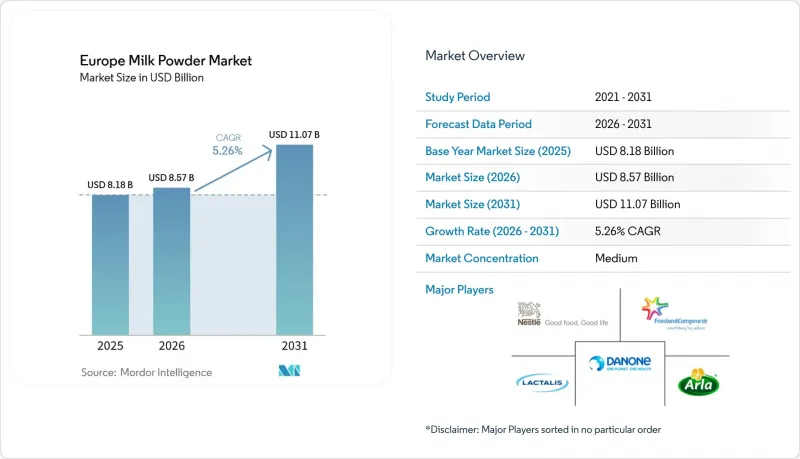
This report is Segmented by Type (Dairy Milk Powder, Non-Dairy/Plant-Based Milk Powder), Distribution Channel (Retail, Foodservice, Industrial), Packaging Format (Flexible Pouches, Cans and Tins, Bulk Bags, Single-Serve Sachets), and Geography (Germany, UK, France, Italy, Spain, Netherlands, Belgium, Poland, Denmark, Sweden, Rest of Europe). The Market Forecasts are Provided in Terms of Value (USD).
Europe Milk Powder Market Trends and Insights
Greater Use in Convenience Food Applications
The Europe milk powder market gets one of its most stable sources of demand from convenience food manufacturing, where dry dairy solids are easy to store, transport, and use in large-scale production. Bakery and starch-based product manufacturing accounted for 17.7% of the total value added by EU food and beverage processors, showing the strong role of this industrial base in supporting milk powder demand. Food manufacturers are using more milk powder in ready meals, soups, sauces, bakery fillings, and other processed foods because it reduces dependence on cold-chain logistics while helping maintain texture, flavor, shelf life, and protein content. This trend is especially important in growing processing markets such as Poland and Romania, where industrial output is increasing and cold-chain infrastructure remains less consistent than in Western Europe. As manufacturers continue to replace fresh dairy ingredients with milk powder in selected applications, the Europe milk powder market benefits from steady repeat industrial demand that is less affected by short-term changes in household consumption.
Increasing Demand Across Infant Nutrition Applications
Infant and follow-on formula remains one of the highest-value application areas in the Europe milk powder market because specification standards are strict and product consistency is critical. The European Commission adopted Delegated Regulation (EU) 2025/2017 in October 2025 and Delegated Regulation (EU) 2026/743 in March 2026, and both measures tightened protein-related requirements for infant and follow-on formula made from protein hydrolysates. These updates make it harder for commodity-grade suppliers to compete in formula applications because buyers need traceable inputs with tighter composition control. The Europe milk powder market therefore gains more value from premium dairy powders even when birth rates stay relatively stable. This supports suppliers that already operate with strong quality systems, protein fraction expertise, and long-established customer relationships in regulated nutrition categories.
Climate-Related Limitations Affecting Dairy Farming
Climate-related supply pressure is a structural restraint on the Europe milk powder market because it affects the raw milk base before processors make any product mix decisions. EU dairy herds are projected to shrink by 13% by 2035 under stricter environmental standards, and milk production is forecast to decline by 0.2% annually between 2023 and 2035 despite gradual yield gains per cow. Heat stress adds a second layer of pressure because research shows that milk yields fall once temperature and humidity pass critical thresholds, and cooling technology only offsets part of those losses. When milk becomes scarcer, processors tend to favor cheese and butter before directing residual volumes to powder drying, which places skim and whole milk powder output at a disadvantage. That pattern was already visible in 2025, when USDA data showed a 6% decline in EU whole milk powder production and a 3% decline in NFDM output.
Other drivers and restraints analyzed in the detailed report include:
- Rising Preference for Health-Focused Consumption
- Increasing Access Through E-commerce and Modern Retail Channels
- Quality and Safety Compliance Obligations
For complete list of drivers and restraints, kindly check the Table Of Contents.
Segment Analysis
Dairy milk powder is projected to hold 82.43% of the Europe milk powder market share in 2025, keeping the category central to value creation across food manufacturing, infant nutrition, and foodservice. Whole milk powder and skim milk powder remain key inputs for confectionery, bakery, and formula production because they provide standard quality, storage stability, and formulation flexibility. This dairy base continues to benefit from established cooperative collection networks across Germany, France, Ireland, and the Netherlands. However, whole milk powder faces tighter supply as processors shift milk toward cheese and butter, and USDA data indicate a 6% decline in EU whole milk powder production in 2025. Stricter infant formula regulations also support demand for high-purity dairy powders that meet tighter protein and traceability requirements.
The Europe milk powder market size for non-dairy and plant-based milk powder is projected to grow at a CAGR of 6.76% between 2026 and 2031, making it the fastest-growing type category. Oat-based powder is gaining traction in Northern and Western Europe, supported by its neutral taste, sustainability positioning, and foodservice use. Almond powder holds a stable shelf-stable position in Southern Europe, while soy powder remains relevant for food manufacturers focused on familiarity and cost control. Spray-dried and agglomerated plant-based formats are growing faster than liquid alternatives in many business settings because they are easier to store, last longer, and cost less to transport. This shift is expanding the Europe milk powder market and moving the industry toward more functional dry formats.
Complete Report Scope:
- By Type
- Dairy Milk Powder
- Whole Milk Powder (WMP)
- Skim Milk Powder (SMP)
- Others
- Non-Dairy/Plant-Based Milk Powder
- Soy Milk Powder
- Almond Milk Powder
- Coconut Milk Powder
- Oat and Other Cereal-Based Powders
- Dairy Milk Powder
- By Distribution Channel
- Retail
- Supermarkets/Hypermarkets
- Convenience and Grocery Stores
- Online Retail
- Other Distribution Channel
- Foodservice
- Industrial
- Infant and Follow-on Formula
- Bakery and Confectionery
- Dairy-based Beverages and Recombination
- Nutritional and Sports Supplements
- Others (Ready-Made Meals, cosmetics, etc.)
- Retail
- By Packaging Format
- Flexible Pouches
- Cans and Tins
- Bulk Bags
- Single-Serve Sachets
- By Geography
- Germany
- United Kingdom
- France
- Italy
- Spain
- Netherlands
- Belgium
- Poland
- Denmark
- Sweden
- Rest of Europe
List of Companies Covered in this Report:
- Arla Foods amba
- Royal FrieslandCampina N.V.
- Groupe Lactalis
- Danone S.A.
- Nestle S.A.
- Fonterra Co-operative Group Limited
- Saputo Inc.
- Schreiber Foods Inc.
- Dairy Farmers of America, Inc.
- Muller Group
- DMK Deutsches Milchkontor GmbH
- Glanbia PLC
- Hochdorf Swiss Nutrition AG
- Epi Ingredients
- Tetra Pak International S.A.
- Agropur cooperative
- FrieslandCampina Ingredients
- Parmalat S.p.A.
- Lactalis Ingredients
- Ornua Co-operative Limited
Additional Benefits:
- The market estimate (ME) sheet in Excel format
- 3 months of analyst support
TABLE OF CONTENTS
1 INTRODUCTION
- 1.1 Study Assumptions and Market Definition
- 1.2 Scope of the Study
2 RESEARCH METHODOLOGY
3 EXECUTIVE SUMMARY
4 MARKET LANDSCAPE
- 4.1 Market Overview
- 4.2 Market Drivers
- 4.2.1 Greater use in convenience food applications
- 4.2.2 Rising preference for health-focused consumption
- 4.2.3 Increasing demand across infant nutrition applications
- 4.2.4 Robust demand from the food and feed industries
- 4.2.5 Extended shelf-life benefit
- 4.2.6 Increasing access through e-commerce and modern retail channels
- 4.3 Market Restraints
- 4.3.1 Quality and safety compliance obligations
- 4.3.2 Climate-related limitations affecting dairy farming
- 4.3.3 Exposure to supply chain disruption risks
- 4.3.4 Competitive pressure from fresh and other dairy formats
- 4.4 Supply Chain Analysis
- 4.5 Regulatory Landscape
- 4.6 Technological Outlook
- 4.7 Porter's Five Forces
- 4.7.1 Bargaining Power of Suppliers
- 4.7.2 Bargaining Power of Buyers
- 4.7.3 Threat of New Entrants
- 4.7.4 Threat of Substitutes
- 4.7.5 Competitive Rivalry
5 MARKET SIZE AND GROWTH FORECASTS (VALUE)
- 5.1 By Type
- 5.1.1 Dairy Milk Powder
- 5.1.1.1 Whole Milk Powder (WMP)
- 5.1.1.2 Skim Milk Powder (SMP)
- 5.1.1.3 Others
- 5.1.2 Non-Dairy/Plant-Based Milk Powder
- 5.1.2.1 Soy Milk Powder
- 5.1.2.2 Almond Milk Powder
- 5.1.2.3 Coconut Milk Powder
- 5.1.2.4 Oat and Other Cereal-Based Powders
- 5.1.1 Dairy Milk Powder
- 5.2 By Distribution Channel
- 5.2.1 Retail
- 5.2.1.1 Supermarkets/Hypermarkets
- 5.2.1.2 Convenience and Grocery Stores
- 5.2.1.3 Online Retail
- 5.2.1.4 Other Distribution Channel
- 5.2.2 Foodservice
- 5.2.3 Industrial
- 5.2.3.1 Infant and Follow-on Formula
- 5.2.3.2 Bakery and Confectionery
- 5.2.3.3 Dairy-based Beverages and Recombination
- 5.2.3.4 Nutritional and Sports Supplements
- 5.2.3.5 Others (Ready-Made Meals, cosmetics, etc.)
- 5.2.1 Retail
- 5.3 By Packaging Format
- 5.3.1 Flexible Pouches
- 5.3.2 Cans and Tins
- 5.3.3 Bulk Bags
- 5.3.4 Single-Serve Sachets
- 5.4 By Geography
- 5.4.1 Germany
- 5.4.2 United Kingdom
- 5.4.3 France
- 5.4.4 Italy
- 5.4.5 Spain
- 5.4.6 Netherlands
- 5.4.7 Belgium
- 5.4.8 Poland
- 5.4.9 Denmark
- 5.4.10 Sweden
- 5.4.11 Rest of Europe
6 COMPETITIVE LANDSCAPE
- 6.1 Market Concentration
- 6.2 Strategic Moves
- 6.3 Market Ranking Analysis
- 6.4 Company Profiles (includes Global level Overview, Market level overview, Core Segments, Financials (if available), Strategic Information, Products, Recent Developments)
- 6.4.1 Arla Foods amba
- 6.4.2 Royal FrieslandCampina N.V.
- 6.4.3 Groupe Lactalis
- 6.4.4 Danone S.A.
- 6.4.5 Nestle S.A.
- 6.4.6 Fonterra Co-operative Group Limited
- 6.4.7 Saputo Inc.
- 6.4.8 Schreiber Foods Inc.
- 6.4.9 Dairy Farmers of America, Inc.
- 6.4.10 Muller Group
- 6.4.11 DMK Deutsches Milchkontor GmbH
- 6.4.12 Glanbia PLC
- 6.4.13 Hochdorf Swiss Nutrition AG
- 6.4.14 Epi Ingredients
- 6.4.15 Tetra Pak International S.A.
- 6.4.16 Agropur cooperative
- 6.4.17 FrieslandCampina Ingredients
- 6.4.18 Parmalat S.p.A.
- 6.4.19 Lactalis Ingredients
- 6.4.20 Ornua Co-operative Limited
7 MARKET OPPORTUNITIES AND FUTURE OUTLOOK

