PUBLISHER: Mordor Intelligence | PRODUCT CODE: 2099525

PUBLISHER: Mordor Intelligence | PRODUCT CODE: 2099525
Eye Glasses - Market Share Analysis, Industry Trends & Statistics, Growth Forecasts (2026 - 2031)
According to Mordor Intelligence, the eye glasses market size is projected to expand from USD 148 billion in 2025 and USD 158.73 billion in 2026 to USD 225.24 billion by 2031, registering a CAGR of 7.25% between 2026 to 2031.
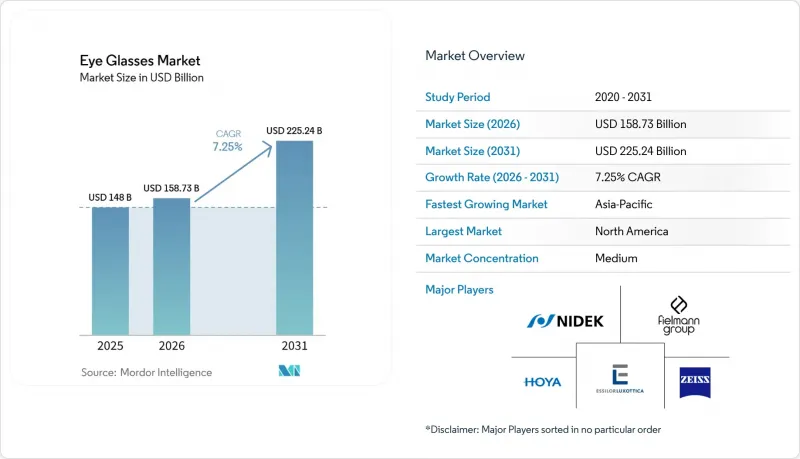
This report is Segmented by Product Type (Prescription Eyeglasses, Reading Glasses, and More), Frame Material (Plastic, Metal, Acetate, Others), Lens Type (Single Vision, Bifocal, Progressive, and More), Distribution Channel (Optical Stores, and More), End User (Adults, Children, Seniors), and Geography (North America, Europe, Asia-Pacific, MEA, South America). The Market Forecasts are Provided in Terms of Value (USD).
Global Eye Glasses Market Trends and Insights
Rising Myopia, Presbyopia, and Digital Eye Strain Burden
The clinical base of the eyeglasses market continues to strengthen as visual strain increases across younger and older age groups. A 2025 study in BMC Pediatrics reported global myopia prevalence of 31.4% among children using smartphones and 35.4% among children using television and computer games. A separate 2025 meta-analysis found that smart device screen time was associated with a 26% increase in the odds of myopia, reinforcing the link between digital habits and prescription demand. The International Myopia Institute noted in its 2025 digest that screen-time reduction alone and outdoor activity alone do not adequately control axial elongation, supporting specialty spectacle lenses as a longer-term management tool. EssilorLuxottica's myopia management portfolio grew 22% worldwide in 2025, indicating stronger premium lens demand within the eyeglasses market.
Growth in Premiumization and Fashion-Led Frame Replacement Cycles
The eyeglasses market is moving beyond vision correction, as purchases increasingly reflect style preferences, brand affinity, and a willingness to own more than one pair. Safilo reported resilient prescription frame demand across geographies in 2025, while sport, contemporary, and lifestyle frames delivered 2.6% organic growth, excluding the Lenti deconsolidation effect. Premiumization increases replacement frequency and average selling price, particularly in North America and Europe, where branded frames carry stronger lifestyle value. Prescription buyers in mature markets increasingly treat frames as wearable accessories, supporting second-pair and third-pair purchases within the same year. This behavior helps stabilize revenue even when unit growth slows, as consumers trade up in materials, brand labels, coatings, and design features.
High Prevalence of Substitution From Contact Lenses and Refractive Surgery
The eyeglasses market continues to face direct competition from contact lenses and laser-based corrective procedures across the same adult patient base. LASIK, SMILE, and related surgical options can limit frame demand among working-age consumers who prefer a one-time intervention over continued spectacle use. This pressure remains more visible in mature markets, where higher income levels and better access to elective procedures support a shift away from routine spectacle wear. However, this restraint does not affect the eyeglasses market uniformly, as surgery does not suit every patient and cannot address all use cases requiring ongoing visual support. Children provide a meaningful buffer because myopia management still relies heavily on spectacle-based treatment, and minors generally do not qualify for refractive surgery. This trend maintains a durable prescription pipeline for the eyeglasses market, from early diagnosis into adulthood.
Other drivers and restraints analyzed in the detailed report include:
- Expansion of Omnichannel Optical Retail and Online Try-On
- Smart Eyewear Convergence With AR, Audio, and Health Functions
- Counterfeit and Grey-Market Frames Eroding Premium Pricing
For complete list of drivers and restraints, kindly check the Table Of Contents.
Segment Analysis
Prescription eyeglasses are expected to lead the eye glasses market with a 58.94% share in 2025, reflecting the scale and persistence of global refractive errors. The segment remains the revenue anchor as corrective use is medically necessary, while repeat purchases are driven by updated prescriptions, frame wear, and evolving visual needs. Reading glasses continue to benefit from rising presbyopia across aging populations in North America, Europe, and East Asia. Sunglasses and safety or sports eyewear add demand across lifestyle and occupational applications, while prescription wear supports follow-on purchases in sun, protective, and performance frames.
Smart glasses are projected to grow at a 10.20% compound annual growth rate (CAGR) from 2026 to 2031, making them the fastest-growing product category in the eye glasses market. The category is shifting eyewear from a corrective product to a connected platform, especially as prescription compatibility removes a key adoption barrier. The June 2026 Meta Glasses launch at USD 299 in three Rx-able styles signals a move toward everyday use rather than niche technology positioning. EssilorLuxottica's sale of more than 7 million AI-glass units in 2025 shows that smart eyewear demand is expanding across regions, while safety and sports eyewear remain relevant through workplace and outdoor use cases.
Plastic frames are expected to account for 39.45% of the eye glasses market in 2025, supported by affordability, broad styling options, and strong availability across mass and mid-tier retail formats. Acetate continues to appeal to fashion-focused consumers in mature markets, while lighter plastic formats remain popular in price-sensitive and family-oriented purchases. The segment benefits from flexibility across age groups, prescription strengths, and design preferences. Plastic remains important as it balances manufacturing efficiency with a wide product assortment across clinical and lifestyle needs.
Titanium is expected to expand at a 9.67% CAGR through 2031, making it the fastest-growing material segment in the eye glasses market. Demand is rising as premium-category buyers prioritize low weight, durability, corrosion resistance, and hypoallergenic properties. Titanium also supports higher realized prices, helping premium optical brands improve revenue per frame rather than relying only on unit turnover. Metal frames remain relevant for precise fitting and structural rigidity, while bio-acetate is gaining traction in premium collections as sustainability becomes more visible in purchase decisions.
Complete Report Scope:
- By Product Type
- Prescription Eyeglasses
- Reading Glasses
- Sunglasses
- Smart Glasses
- Safety and Sports Eyewear
- By Frame Material
- Plastic
- Metal
- Acetate
- Titanium
- Other Frame Materials
- By Lens Type
- Single Vision
- Bifocal
- Progressive
- Photochromic
- Polarized
- Others
- By Distribution Channel
- Optical Stores
- Retail Chains
- E-Commerce
- Hospitals and Eye Care Clinics
- Others
- By End User
- Adults
- Children
- Seniors
- By Geography
- North America
- United States
- Canada
- Mexico
- Europe
- Germany
- United Kingdom
- France
- Italy
- Spain
- Rest of Europe
- Asia-Pacific
- China
- India
- Japan
- Australia
- South Korea
- Rest of Asia-Pacific
- Middle East and Africa
- GCC
- South Africa
- Rest of Middle East and Africa
- South America
- Brazil
- Argentina
- Rest of South America
- North America
Geography Analysis
North America is expected to hold 41.30% of the eyeglasses market in 2025, making it the largest regional contributor by value. High per-capita spending, established reimbursement structures, and strong adoption of premium lenses, coatings, and branded frames support the region's leadership. The Vision Council projects that the US optical industry will reach USD 69.5 billion in 2025, even as product volumes and eye exams decline, indicating stronger pricing and a richer product mix. Warby Parker plans to add 47 stores in 2025 and 50 more in 2026, reflecting continued confidence in integrated retail and clinical models. These factors strengthen North America's role in premium product adoption and early commercialization of connected eyewear.
Europe remains the second-largest regional bloc in the eyeglasses market, supported by independent optician networks, a strong premium frame culture, and ongoing retail consolidation. Fielmann expects record results for fiscal year 2025 and has guided for EUR 2.55 billion to EUR 2.60 billion in fiscal year 2026 sales, supported by the planned rollout of AI-enabled automated refraction across 300 European stores and 70 new store openings in 2026. Italy continues to hold strategic importance through the Belluno manufacturing base, which supports much of the premium frame supply chain for major eyewear groups. Europe also plays a major role in smart eyewear launches, as the June 2026 Meta Glasses rollout is expected to include the United Kingdom, France, Italy, Germany, and Spain. These factors keep the region central to premium design, manufacturing quality, and branded value capture in the eyeglasses market.
Asia-Pacific is forecast to register an 11.56% compound annual growth rate through 2031, making it the fastest-growing region in the eyeglasses market. The region has the world's highest myopia burden, and the World Health Organization Western Pacific office has described myopia as reaching epidemic levels, with prevalence near 50% among adolescents in China and Singapore and up to 80% among young adults in parts of East Asia. This trend creates a structurally strong correction base, especially among school-age and young adult populations entering long-term prescription cycles earlier than those in many other regions. India remains an important growth pocket, as organized optical retail continues to expand while disposable income and unmet correction needs rise.
- Bausch + Lomb Corporation
- Carl Zeiss
- Charmant Group
- De Rigo Vision S.p.A.
- EssilorLuxottica
- Fielmann Group AG
- HOYA
- HOYA
- JINS Holdings Inc.
- Kering Eyewear S.p.A.
- Lenskart Solutions Private Limited
- Marcolin S.p.A.
- Nidek
- Rodenstock
- Safilo Group S.p.A.
- Silhouette International Schmied AG
- Specsavers Optical Group Limited
- The Cooper Companies
- Warby Parker Inc.
- Zenni Optical, Inc.
Additional Benefits:
- The market estimate (ME) sheet in Excel format
- 3 months of analyst support
TABLE OF CONTENTS
1 INTRODUCTION
- 1.1 Study Assumptions and Market Definition
- 1.2 Scope of the Study
2 RESEARCH METHODOLOGY
3 EXECUTIVE SUMMARY
4 MARKET LANDSCAPE
- 4.1 Market Overview
- 4.2 Market Drivers
- 4.2.1 Rising Myopia, Presbyopia, and Digital Eye Strain Burden
- 4.2.2 Growth in Premiumization and Fashion-Led Frame Replacement Cycles
- 4.2.3 Expansion of Omnichannel Optical Retail and Online Try-On
- 4.2.4 Smart Eyewear Convergence With AR, Audio, and Health Functions
- 4.2.5 Rising Myopia Management Adoption in Children and Young Adults
- 4.2.6 Increased Employer and Insurer-Funded Vision Benefits in Mature Markets
- 4.3 Market Restraints
- 4.3.1 High Prevalence of Substitution From Contact Lenses and Refractive Surgery
- 4.3.2 Counterfeit and Grey-Market Frames Eroding Premium Pricing
- 4.3.3 Dependence on Skilled Optician Distribution and Fitting Infrastructure
- 4.3.4 Consumer Trade-Down During Discretionary Spending Slowdowns
- 4.4 Value / Supply-Chain Analysis
- 4.5 Regulatory Landscape
- 4.6 Technological Outlook
- 4.7 Porters Five Forces Analysis
- 4.7.1 Threat of New Entrants
- 4.7.2 Bargaining Power of Suppliers
- 4.7.3 Bargaining Power of Buyers
- 4.7.4 Threat of Substitutes
- 4.7.5 Intensity of Competitive Rivalry
5 MARKET SIZE AND GROWTH FORECASTS (VALUE, USD)
- 5.1 By Product Type
- 5.1.1 Prescription Eyeglasses
- 5.1.2 Reading Glasses
- 5.1.3 Sunglasses
- 5.1.4 Smart Glasses
- 5.1.5 Safety and Sports Eyewear
- 5.2 By Frame Material
- 5.2.1 Plastic
- 5.2.2 Metal
- 5.2.3 Acetate
- 5.2.4 Titanium
- 5.2.5 Other Frame Materials
- 5.3 By Lens Type
- 5.3.1 Single Vision
- 5.3.2 Bifocal
- 5.3.3 Progressive
- 5.3.4 Photochromic
- 5.3.5 Polarized
- 5.3.6 Others
- 5.4 By Distribution Channel
- 5.4.1 Optical Stores
- 5.4.2 Retail Chains
- 5.4.3 E-Commerce
- 5.4.4 Hospitals and Eye Care Clinics
- 5.4.5 Others
- 5.5 By End User
- 5.5.1 Adults
- 5.5.2 Children
- 5.5.3 Seniors
- 5.6 By Geography
- 5.6.1 North America
- 5.6.1.1 United States
- 5.6.1.2 Canada
- 5.6.1.3 Mexico
- 5.6.2 Europe
- 5.6.2.1 Germany
- 5.6.2.2 United Kingdom
- 5.6.2.3 France
- 5.6.2.4 Italy
- 5.6.2.5 Spain
- 5.6.2.6 Rest of Europe
- 5.6.3 Asia-Pacific
- 5.6.3.1 China
- 5.6.3.2 India
- 5.6.3.3 Japan
- 5.6.3.4 Australia
- 5.6.3.5 South Korea
- 5.6.3.6 Rest of Asia-Pacific
- 5.6.4 Middle East and Africa
- 5.6.4.1 GCC
- 5.6.4.2 South Africa
- 5.6.4.3 Rest of Middle East and Africa
- 5.6.5 South America
- 5.6.5.1 Brazil
- 5.6.5.2 Argentina
- 5.6.5.3 Rest of South America
- 5.6.1 North America
6 COMPETITIVE LANDSCAPE
- 6.1 Market Concentration
- 6.2 Market Share Analysis
- 6.3 Company Profiles (includes Global Level Overview, Market Level Overview, Core Segments, Financials as available, Strategic Information, Market Rank/Share, Products and Services, Recent Developments)
- 6.3.1 Bausch + Lomb Corporation
- 6.3.2 Carl Zeiss AG
- 6.3.3 Charmant Group
- 6.3.4 De Rigo Vision S.p.A.
- 6.3.5 EssilorLuxottica
- 6.3.6 Fielmann Group AG
- 6.3.7 Hoya Corporation
- 6.3.8 HOYA CORPORATION
- 6.3.9 JINS Holdings Inc.
- 6.3.10 Kering Eyewear S.p.A.
- 6.3.11 Lenskart Solutions Private Limited
- 6.3.12 Marcolin S.p.A.
- 6.3.13 NIDEK CO., LTD.
- 6.3.14 Rodenstock GmbH
- 6.3.15 Safilo Group S.p.A.
- 6.3.16 Silhouette International Schmied AG
- 6.3.17 Specsavers Optical Group Limited
- 6.3.18 The Cooper Companies, Inc.
- 6.3.19 Warby Parker Inc.
- 6.3.20 Zenni Optical, Inc.
7 MARKET OPPORTUNITIES AND FUTURE OUTLOOK
- 7.1 White-Space and Unmet-Need Assessment

