PUBLISHER: Mordor Intelligence | PRODUCT CODE: 2099744

PUBLISHER: Mordor Intelligence | PRODUCT CODE: 2099744
Europe Luggage - Market Share Analysis, Industry Trends & Statistics, Growth Forecasts (2026 - 2031)
According to Mordor Intelligence, the Europe luggage market was valued at USD 12.69 billion in 2025 and is estimated at USD 13.23 billion in 2026, projected to reach USD 16.82 billion by 2031, growing at a CAGR of 4.92% during 2026-2031.
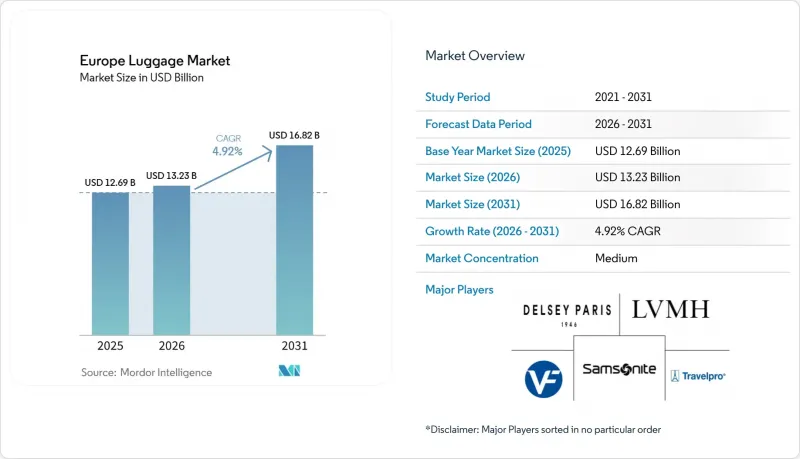
This report is Segmented by Product Type (Travel Luggage, Business Luggage, Sports Luggage, and Backpacks), Material (Hard Case and Soft Case), End-User (Adults and Kids/Children), Distribution Channel (Supermarkets/Hypermarkets, Specialty Stores, and More), and Geography (Germany, United Kingdom, Italy, France, Spain, and More). The Market Forecasts are Provided in Value (USD).
Europe Luggage Market Trends and Insights
Growing outbound and intra-European travel activity
The steady expansion of outbound and intra-European travel directly supports demand for new and replacement luggage. Higher volumes of leisure, business, and short-duration trips are encouraging consumers to purchase luggage that is lightweight, durable, and suited to different travel requirements. Frequent travel also accelerates product wear and tear, resulting in shorter replacement cycles and greater demand for upgraded luggage with improved mobility, storage efficiency, and security. Evolving travel patterns have also increased consumer preference for specialized luggage formats designed for varying trip durations and transport modes. According to Eurostat, tourist accommodation establishments across the European Union recorded nearly 3.1 billion overnight stays in 2024, representing a 2.2% increase compared with the previous year, highlighting the continued strength of regional travel activity that supports sustained growth in the Europe luggage market .
Accelerating adoption of smart luggage technologies
The adoption of smart luggage technologies is accelerating as consumers increasingly seek travel products that offer enhanced security, convenience, and connectivity. Manufacturers are integrating advanced features such as GPS tracking, Bluetooth-enabled location services, TSA-approved smart locking systems, USB charging ports, digital weighing systems, and app-based monitoring to improve the overall travel experience. These features help reduce the risk of lost baggage, simplify luggage management, and provide greater peace of mind for travelers. The growing emphasis on connected travel solutions is also encouraging consumers to upgrade from conventional luggage to technology-enabled alternatives with premium functionality. For instance, Safari offers the Trackr GPS Enabled Black Trolley Bag, featuring a BoAt smart tracking tag, TSA lock, dual-spinner wheels, and an organized interior with a dedicated wet pouch, reflecting the industry's increasing focus on integrating smart technologies into modern luggage solutions.
Rising threat of counterfeit and unbranded luggage products
The growing availability of counterfeit and unbranded luggage products is restraining the growth of the Europe luggage market by eroding consumer confidence and intensifying competition for established manufacturers. Counterfeit products often imitate premium designs at significantly lower prices while compromising on material quality, durability, and safety standards, making it difficult for branded companies to differentiate their offerings. The widespread circulation of counterfeit luggage also weakens brand equity, reduces legitimate sales, and discourages investment in product innovation and premium positioning. In addition, counterfeit products can negatively affect consumer perceptions of genuine brands when inferior-quality imitations fail to meet performance expectations. According to the European Union Intellectual Property Office (EUIPO), EU authorities intercepted approximately 112 million counterfeit goods in 2024, highlighting the persistent challenge posed by counterfeit products across consumer goods industries, including luggage .
Other drivers and restraints analyzed in the detailed report include:
- Strengthening demand for sustainable and recycled-material luggage
- Expanding participation in outdoor recreation and sports
- Stringent environmental regulations on synthetic materials
For complete list of drivers and restraints, kindly check the Table Of Contents.
Segment Analysis
Backpacks accounted for a 51.23% revenue share in 2025, supported by their dual utility across daily use and short-duration travel, making them one of the most versatile luggage formats. Their dominance reflects shifting consumer preferences toward lightweight, compact, and multifunctional travel solutions that offer convenience and comfort. Advancements in ergonomic design, organized storage systems, anti-theft features, RFID-protected compartments, integrated USB charging ports, and weather-resistant materials have enhanced product functionality and user experience. Manufacturers are also introducing premium finishes, sustainable recycled fabrics, and modular designs to meet consumer demand for durability, style, and environmental responsibility.
Travel luggage is projected to register the fastest CAGR of 5.58% during 2026-2031, driven by evolving consumer preferences toward purpose-built, durable, and convenience-oriented luggage solutions. Consumers are increasingly seeking products that combine lightweight construction, high storage efficiency, enhanced maneuverability, and advanced security features to support diverse travel needs. Product innovation in hard-shell materials, expandable storage, silent spinner wheels, TSA-approved locking systems, and impact-resistant designs is improving product performance and extending product lifespan. Growing consumer preference for premium luggage with modern aesthetics, sustainable materials, and smart organizational features is driving replacement purchases and value-added upgrades.
Soft case products held a 76.43% share of the Europe luggage market in 2025, driven by their flexibility, compressibility, and practical storage advantages. Their ability to accommodate irregularly shaped items and maximize packing capacity makes them well-suited for travelers who need adaptable luggage. Multiple external pockets, expandable compartments, and easy-access storage improve packing efficiency and convenience, while lighter construction enhances portability during transit. The availability of diverse sizes, styles, and price points has broadened consumer adoption across different travel occasions. Ongoing improvements in high-strength woven fabrics, water-repellent coatings, abrasion resistance, and reinforced stitching have enhanced durability, supporting the continued dominance of soft case luggage in the market.
Hard case luggage is projected to register the fastest CAGR of 6.54% during 2026-2031, supported by growing consumer preference for luggage that offers structural protection and long-term durability. Consumers increasingly value rigid-shell construction for its ability to protect fragile and high-value items against impact, pressure, and rough handling. Advancements in polycarbonate composites, lightweight shells, scratch-resistant finishes, and reinforced frame engineering are improving performance and product longevity without significantly increasing weight. Premium aesthetics, minimalist designs, and improved manufacturing technologies are further strengthening consumer appeal, while innovations in shell construction and surface finishes continue to position hard case luggage as a preferred choice for quality-focused buyers.
Complete Report Scope:
- By Product Type
- Travel Luggage
- Business Luggage
- Sports Luggage
- Back Pack
- By Material
- Hard Case
- Soft Case
- By End-User
- Adults
- Kids/Children
- By Distribution Channel
- Supermarkets/Hypermarkets
- Specialty Stores
- Online Retail Stores
- Other Distribution Channels
- By Geography
- Germany
- United Kingdom
- Italy
- France
- Spain
- Netherlands
- Poland
- Belgium
- Sweden
- Rest of Europe
List of Companies Covered in this Report:
- Samsonite International S.A.
- Delsey S.A.
- VF Corporation
- LVMH Moet Hennessy Louis Vuitton
- Travelpro Products, Inc.
- Tumi Holdings, Inc.
- Rimowa GmbH
- Victorinox AG
- Briggs & Riley Travelware, Inc.
- American Tourister
- Thule Group AB
- Bric's Industria Valigeria Fine Spa
- Horizn Studios GmbH
- Antler Ltd.
- IT Luggage
- Away
- Heys International Ltd.
- Calpak
- FPM Milano
- Decathlon S.A.
Additional Benefits:
- The market estimate (ME) sheet in Excel format
- 3 months of analyst support
TABLE OF CONTENTS
1 INTRODUCTION
- 1.1 Study Assumptions and Market Definition
- 1.2 Scope of the Study
2 RESEARCH METHODOLOGY
3 EXECUTIVE SUMMARY
4 MARKET LANDSCAPE
- 4.1 Market Overview
- 4.2 Market Drivers
- 4.2.1 Growing outbound and intra-European travel activity
- 4.2.2 Accelerating adoption of smart luggage technologies
- 4.2.3 Strengthening demand for sustainable and recycled-material luggage
- 4.2.4 Expanding participation in outdoor recreation and sports
- 4.2.5 Increasing influence of fashion and premium design trends
- 4.2.6 Rising business travel and hybrid work-related mobility
- 4.3 Market Restraints
- 4.3.1 Rising threat of counterfeit and unbranded luggage products
- 4.3.2 Stringent environmental regulations on synthetic materials
- 4.3.3 Volatility in raw material prices
- 4.3.4 Seasonal fluctuations in travel demand
- 4.4 Consumer Behavior Analysis
- 4.5 Regulatory Landscape
- 4.6 Technological Outlook
- 4.7 Porter's Five Forces Analysis
- 4.7.1 Threat of New Entrants
- 4.7.2 Bargaining Power of Buyers
- 4.7.3 Bargaining Power of Suppliers
- 4.7.4 Threat of Substitutes
- 4.7.5 Intensity of Competitive Rivalry
5 MARKET SIZE AND GROWTH FORECASTS (VALUE)
- 5.1 By Product Type
- 5.1.1 Travel Luggage
- 5.1.2 Business Luggage
- 5.1.3 Sports Luggage
- 5.1.4 Back Pack
- 5.2 By Material
- 5.2.1 Hard Case
- 5.2.2 Soft Case
- 5.3 By End-User
- 5.3.1 Adults
- 5.3.2 Kids/Children
- 5.4 By Distribution Channel
- 5.4.1 Supermarkets/Hypermarkets
- 5.4.2 Specialty Stores
- 5.4.3 Online Retail Stores
- 5.4.4 Other Distribution Channels
- 5.5 By Geography
- 5.5.1 Germany
- 5.5.2 United Kingdom
- 5.5.3 Italy
- 5.5.4 France
- 5.5.5 Spain
- 5.5.6 Netherlands
- 5.5.7 Poland
- 5.5.8 Belgium
- 5.5.9 Sweden
- 5.5.10 Rest of Europe
6 COMPETITIVE LANDSCAPE
- 6.1 Market Concentration
- 6.2 Strategic Moves
- 6.3 Market Share Analysis
- 6.4 Company Profiles (includes Global level Overview, Market level overview, Core Segments, Financials as available, Strategic Information, Market Rank/Share for key companies, Products and Services, and Recent Developments)
- 6.4.1 Samsonite International S.A.
- 6.4.2 Delsey S.A.
- 6.4.3 VF Corporation
- 6.4.4 LVMH Moet Hennessy Louis Vuitton
- 6.4.5 Travelpro Products, Inc.
- 6.4.6 Tumi Holdings, Inc.
- 6.4.7 Rimowa GmbH
- 6.4.8 Victorinox AG
- 6.4.9 Briggs & Riley Travelware, Inc.
- 6.4.10 American Tourister
- 6.4.11 Thule Group AB
- 6.4.12 Bric's Industria Valigeria Fine Spa
- 6.4.13 Horizn Studios GmbH
- 6.4.14 Antler Ltd.
- 6.4.15 IT Luggage
- 6.4.16 Away
- 6.4.17 Heys International Ltd.
- 6.4.18 Calpak
- 6.4.19 FPM Milano
- 6.4.20 Decathlon S.A.
7 MARKET OPPORTUNITIES AND FUTURE OUTLOOK

