PUBLISHER: Mordor Intelligence | PRODUCT CODE: 2099776

PUBLISHER: Mordor Intelligence | PRODUCT CODE: 2099776
Germany Turning Machine and Equipment - Market Share Analysis, Industry Trends & Statistics, Growth Forecasts (2026 - 2031)
According to Mordor Intelligence, the Germany turning machine and Equipment Market size is expected to grow from USD 0.6 billion in 2025 to USD 0.7 billion in 2026 and is forecast to reach USD 0.9 billion by 2031 at 5.20% CAGR over 2026-2031.
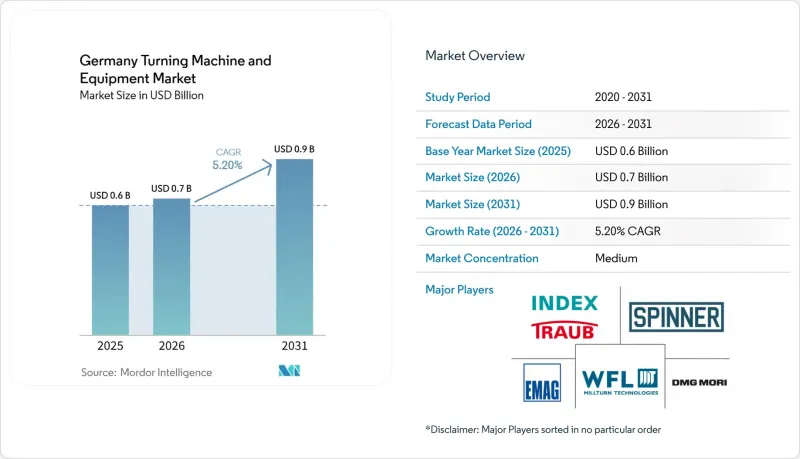
This report is Segmented by Product Type (Horizontal, Vertical, Swiss-Type, and More), by Automation Type (Manual, Semi-Automatic, and Fully Automatic CNC), and by End-User Industry (Automotive & Commercial Vehicles, Aerospace & Defense, Medical Devices & Surgical Instruments, Oil, Gas, & Energy, and More). The Market Forecasts are Provided in Terms of Value (USD) and Volume (Units).
Germany Turning Machine and Equipment Market Trends and Insights
Germany's Strong Machine Tool Manufacturing Base
Germany maintains one of the world's most advanced and integrated precision-engineering ecosystems, and that foundation continues to give Germany a structural advantage in the turning machine and equipment market. Germany maintains strong domestic engineering capabilities, supported by significant investment in machinery R&D and innovation ecosystems. Buyers in aerospace, medical technology, and defense continue to value domestic sourcing because local builders can provide application engineering, co-development, and certified process integration with shorter response times than distant suppliers. The concentration of OEMs, tooling specialists, automation suppliers, and training institutions in Baden-Wurttemberg and Bavaria also supports repeat investment, as manufacturers can resolve process issues more quickly and upgrade production lines with less disruption. That cluster effect helps sustain demand in the Germany turning machine and equipment market even as broader capital spending becomes more selective.
Industry 4.0-Driven Machine Replacement
Digital modernization is now a practical purchasing issue rather than a pilot-stage concept in the Germany turning machine and equipment market. Bitkom reported in 2025 that 80% of German manufacturing companies planned to maintain or increase their Industry 4.0 spending, with process monitoring, automation, and machine connectivity named as priority areas. Depending on the machine condition and the scope of upgrades, retrofit investments can account for a significant share of the cost of a new machine. The VDW also stated during EMO 2025 that retrofit activity had moved into a more strategic role because users want connectivity and data visibility on machines that still have usable mechanical life. Germany's installed base of older CNC lathes, therefore, creates a multi-year renewal pipeline for the Germany turning machine and equipment market, with demand coming from both new machine purchases and modular upgrade packages. Builders that can pair new platforms with automation cells, connectivity software, and retrofit support are gaining an edge, as customers seek lower integration risk and clearer productivity gains.
High Cost of Advanced Turning Systems
The cost of advanced CNC turning systems continues to limit broader adoption in the Germany turning machine and equipment market, especially among small and medium-sized manufacturers. VDW reported that high costs and weak planning security were the main reasons many German manufacturers did not invest in new machine tools during 2025. This burden rises further when buyers also have to manage energy costs, logistics pressure, and tighter margins, which extends replacement cycles well beyond the technical optimum. The problem is more acute in lower-volume environments, such as aerospace prototyping or specialized defense work, where machine utilization may not be high enough to support rapid payback. Compliance demands such as CE conformity and quality management requirements add to the total ownership burden and can delay projects even when production needs are clear. As a result, the Germany turning machine and equipment market often sees customers choose staged retrofits, partial automation, or delayed purchases rather than full turnkey investments.
Other drivers and restraints analyzed in the detailed report include:
- Strong Demand from Industrial Machinery Manufacturing
- Export-Oriented Manufacturing Competitiveness
- Shortage of Skilled CNC Workforce
For complete list of drivers and restraints, kindly check the Table Of Contents.
Segment Analysis
The horizontal segment held 47.8% of the Germany turning machine and equipment market in 2025, which kept them as the largest product category across shaft, sleeve, and disc machining in automotive, energy, and general industrial applications. Their scale reflects a broad machining range, an established tooling ecosystem, and easier integration with pallet handling and robotic loading systems. The conventional segment continues to serve low-volume job shops and training environments, though its role is narrowing as CNC adoption deepens. The vertical segment remains relevant for large-diameter and heavy workpieces, where floor space efficiency and stable workpiece support are critical. Swiss-type machines continue to serve the production of small precision parts for medical devices, electronic connectors, and defense-related applications.
Multi-tasking turning centers are projected to record the fastest growth at a 6.5% CAGR from 2026 to 2031. Their expansion is tied to single-setup machining that combines turning, milling, drilling, and grinding, helping reduce cycle time, handling steps, and fixturing errors. German suppliers are actively strengthening this category through new product launches and broader compatibility with automation systems. The category is also gaining from demand among manufacturers that want complete machining capability without adding multiple standalone machines. This keeps multitasking systems well-positioned for further adoption through the forecast period.
Complete Report Scope:
- By Product Type
- Horizontal
- Vertical
- Swiss-Type
- Multi-Tasking
- Conventional
- By Automation Type
- Manual
- Semi-Automatic
- Fully Automatic CNC
- By End-User Industry
- Automotive & Commercial Vehicles
- Aerospace & Defense
- Medical Devices & Surgical Instruments
- Oil, Gas, & Energy
- Electrical, Electronics & Semiconductor Equipment
- General Industrial Machinery
- Others (Consumer Goods, Defense Ordnance)
List of Companies Covered in this Report:
- DMG MORI
- INDEX-Werke
- EMAG GmbH & Co. KG
- Spinner
- WFL Millturn
- Mazak Corporation
- Okuma Corporation
- DN Solutions
- Citizen Machinery
- Tsugami Corporation
- Star Micronics Co., Ltd.
- Nakamura-Tome Precision Industry Co., Ltd
- Hyundai WIA
- Haas Automation
- Tornos Group
- Takisawa Machine Tool
- CMZ Machine Tool Manufacturer
- Biglia S.p.A.
- Hwacheon Machinery
- SMEC Co., Ltd.
Additional Benefits:
- The market estimate (ME) sheet in Excel format
- 3 months of analyst support
TABLE OF CONTENTS
1 Introduction
- 1.1 Study Assumptions & Market Definition
- 1.2 Scope of the Study
2 Research Methodology
3 Executive Summary
4 Market Landscape
- 4.1 Market Overview
- 4.2 Market Drivers
- 4.2.1 Germany's Strong Machine Tool Manufacturing Base
- 4.2.2 Industry 4.0-Driven Machine Replacement
- 4.2.3 Strong Demand from Industrial Machinery Manufacturing
- 4.2.4 Export-Oriented Manufacturing Competitiveness
- 4.2.5 European Supply Chain Regionalization Supporting Domestic Machining Capacity Expansion
- 4.2.6 Growth in Medical Technology Manufacturing
- 4.3 Market Restraints
- 4.3.1 High Cost of Advanced Turning Systems
- 4.3.2 Shortage of Skilled CNC Workforce
- 4.3.3 Competition from Asian Machine Tool Suppliers
- 4.3.4 Cyclical Nature of Manufacturing Capital Expenditure
- 4.4 Value / Supply-Chain Analysis
- 4.4.1 Raw Material & Component Suppliers
- 4.4.2 Turning Machine & Equipment Manufacturers & System Integrators
- 4.4.3 Distribution & Sales Channels
- 4.4.4 End Users & Industry Applications
- 4.4.5 Aftermarket & Lifecycle Services
- 4.5 Regulatory Landscape
- 4.6 Technological Outlook & Innovation Investment Landscape
- 4.6.1 Automation & Smart Manufacturing Integration
- 4.6.2 Advanced CNC Control & AI-Enabled Process Optimization
- 4.7 Pricing Analysis
- 4.7.1 Average Selling Price (ASP) Benchmarking of Key Market Participants
- 4.7.2 Average Selling Price (ASP) Analysis, by Product Type
- 4.7.3 Average Selling Price (ASP) Analysis, by Automation
- 4.8 Buying Criteria & Procurement Analysis
- 4.9 Emerging Growth Hotspots for Turning Machine & Equipment
- 4.10 Porter's Five Forces Analysis - Industry Attractiveness Scoring
- 4.10.1 Threat of New Entrants
- 4.10.2 Bargaining Power of Suppliers
- 4.10.3 Bargaining Power of Buyers
- 4.10.4 Threat of Substitutes
- 4.10.5 Industry Rivalry
- 4.11 Impact of Geopolitical Events on the Market
5 Market Size & Growth Forecasts
- 5.1 By Product Type
- 5.1.1 Horizontal
- 5.1.2 Vertical
- 5.1.3 Swiss-Type
- 5.1.4 Multi-Tasking
- 5.1.5 Conventional
- 5.2 By Automation Type
- 5.2.1 Manual
- 5.2.2 Semi-Automatic
- 5.2.3 Fully Automatic CNC
- 5.3 By End-User Industry
- 5.3.1 Automotive & Commercial Vehicles
- 5.3.2 Aerospace & Defense
- 5.3.3 Medical Devices & Surgical Instruments
- 5.3.4 Oil, Gas, & Energy
- 5.3.5 Electrical, Electronics & Semiconductor Equipment
- 5.3.6 General Industrial Machinery
- 5.3.7 Others (Consumer Goods, Defense Ordnance)
6 Competitive Landscape
- 6.1 Market Concentration
- 6.2 Strategic Moves
- 6.3 Market Share Analysis
- 6.4 Competitive Benchmarking Analysis
- 6.5 Company Profiles (Includes Global Level Overview, Market Level Overview, Core Segments, Financials as Available, Strategic Information, Products & Services, and Recent Developments)
- 6.5.1 DMG MORI
- 6.5.2 INDEX-Werke
- 6.5.3 EMAG GmbH & Co. KG
- 6.5.4 Spinner
- 6.5.5 WFL Millturn
- 6.5.6 Mazak Corporation
- 6.5.7 Okuma Corporation
- 6.5.8 DN Solutions
- 6.5.9 Citizen Machinery
- 6.5.10 Tsugami Corporation
- 6.5.11 Star Micronics Co., Ltd.
- 6.5.12 Nakamura-Tome Precision Industry Co., Ltd
- 6.5.13 Hyundai WIA
- 6.5.14 Haas Automation
- 6.5.15 Tornos Group
- 6.5.16 Takisawa Machine Tool
- 6.5.17 CMZ Machine Tool Manufacturer
- 6.5.18 Biglia S.p.A.
- 6.5.19 Hwacheon Machinery
- 6.5.20 SMEC Co., Ltd.
7 Market Opportunities & Future Outlook
- 7.1 White-Space & Unmet-Need Assessment

