PUBLISHER: Mordor Intelligence | PRODUCT CODE: 2099806

PUBLISHER: Mordor Intelligence | PRODUCT CODE: 2099806
India Turning Machine and Equipment - Market Share Analysis, Industry Trends & Statistics, Growth Forecasts (2026 - 2031)
According to Mordor Intelligence, the India turning machine and Equipment Market size is expected to grow from USD 1.10 billion in 2025 to USD 1.20 billion in 2026 and is forecast to reach USD 2.20 billion by 2031 at 12.90% CAGR over 2026-2031.
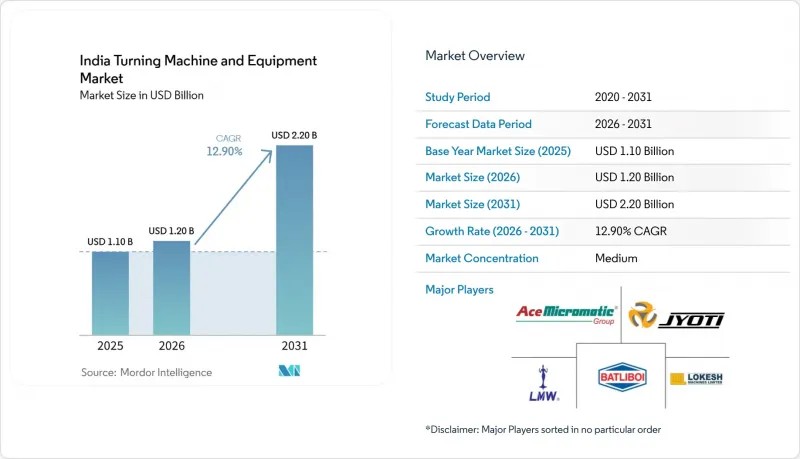
This report is Segmented by Product Type (Horizontal, Vertical, Swiss-Type, and More), by Automation Type (Manual, Semi-Automatic, and Fully Automatic CNC), and by End-User Industry (Automotive & Commercial Vehicles, Aerospace & Defense, Medical Devices & Surgical Instruments, Oil, Gas, & Energy, and More). The Market Forecasts are Provided in Terms of Value (USD) and Volume (Units).
India Turning Machine and Equipment Market Trends and Insights
Expansion of India's Auto Component Manufacturing Base
India's auto component base has moved well beyond domestic replacement demand and now serves as a broad manufacturing platform for both domestic and export programs. The sector generated USD 80.2 billion in FY2025 and grew by 14% between FY2020 and FY2025, underscoring the need to expand capacity for engine parts, transmission systems, suspension components, and steering components. Export demand has reinforced this pattern, as auto component exports rose 8% to USD 22.9 billion in FY2025, with Asia-bound shipments growing 15.1%. This means Indian suppliers need to sustain tighter process control and more repeatable machining output across large production runs. Smart factory adoption is also raising the role of CNC turning centers from a support asset to a core production asset, as an ACMA and BCG study released in 2025 showed that more than two-thirds of surveyed firms were already at the pilot, scale-up, or fully integrated stage of digital factory implementation. This shift matters because, even as electric vehicle localization changes the mix of combustion-linked parts, it still creates new demand for precision structural and drivetrain components that require comparable or tighter tolerances on the shop floor. H1 FY26 kept that momentum intact, as industry turnover reached INR 3.6 lakh crore (USD 40.0 billion), indicating that the auto-led capex cycle for the India turning machine and equipment market remains active.
Rapid CNC Penetration Across India's MSME Machining Ecosystem
India's MSME machining base is steadily shifting from conventional lathes toward CNC platforms as buyer expectations for repeatability, productivity, and contract compliance continue to rise across supplier tiers. This change is being supported by public funding, as the Capital Goods Sector Phase II program carries a total outlay of INR 12.07 billion (USD 134.3 million), including INR 9.75 billion in budgetary support, lowering technology-upgrade barriers for smaller machining units. The transition is also being reinforced by ecosystem support, as IMTMA's 2024-25 annual report highlighted industry efforts, such as the SAHAYOG initiative and discussions on shared testing infrastructure, aimed at improving access to advanced machine tool capabilities in northern clusters. Once an MSME installs its first CNC turning center, the operating model usually changes quickly because customer quality demands, machine utilization expectations, and depreciation cycles begin to favor additional CNC purchases over a return to conventional machine and equipment. That pattern widens the market's demand base because follow-on machine buying often comes from firms that started with one cautious upgrade and then moved toward a more stable CNC fleet. As a result, adoption is spreading from large organized buyers to smaller machining clusters, where even modest productivity gains can reshape order eligibility and supplier positioning over a few contract cycles.
High Cost Sensitivity Among MSME Manufacturers
Capital cost remains the biggest filter in buying behavior for many smaller workshops, even when productivity gains from CNC adoption are clear on paper. This matters because the India turning machine and equipment market depends heavily on MSME buyers by unit count, and many of those firms make purchase decisions based on cash flow visibility, financing access, and near-term order certainty rather than lifetime machine economics. Government support programs exist to lower that barrier, but their presence also underlines how real the affordability gap remains for sub-tier machining enterprises seeking modern turning capacity. When buyers place more weight on sticker price than on uptime, service response, or tooling life, lower-cost imported options gain traction, and domestic producers find it harder to defend pricing based solely on support quality. The challenge becomes sharper when firms are not confident that they can staff or fully utilize the machine they buy, because weak utilization stretches payback and delays the next replacement cycle. In that sense, affordability pressure is not only a financing issue, because it interacts directly with labor availability, utilization rates, and the willingness of smaller firms to move from conventional setups into full CNC workflows.
Other drivers and restraints analyzed in the detailed report include:
- Localization of High-Precision Manufacturing Under Import Substitution Initiatives
- Emergence of India as an Alternative Global Manufacturing Hub
- Shortage of Skilled CNC Programmers and Machinists
For complete list of drivers and restraints, kindly check the Table Of Contents.
Segment Analysis
The horizontal segment accounted for 65% of revenue in 2025, making it the largest product category in the India turning machine and equipment market by a wide margin. Their lead comes from deep use in automotive and general engineering, where crankshafts, axle shafts, flanges, valve bodies, and similar concentric parts still require reliable, high-volume turning performance. This installed-base advantage also reflects buyer familiarity, because many workshops expand first with a proven horizontal format before moving into more specialized configurations. Vertical machines, Swiss-type machines, multi-tasking systems, and conventional turning machines and equipment each serve narrower use cases that depend on workpiece geometry, tolerance requirements, and budget constraints. The conventional segment still has a role in cost-sensitive shops where moderate tolerances and lower batch sizes make full CNC economics less compelling for every operation.
The multi-tasking segment is projected to grow at a 15.2% CAGR through 2031, which makes it the fastest-growing product type in the India turning machine and equipment market. These systems combine turning, milling, and drilling in a single setup, reducing handling steps and improving dimensional consistency for complex parts. That capability is increasingly important in aerospace structures, surgical implants, and other precision jobs where one-clamp processing supports both tolerance control and traceability requirements. Swiss-type turning machines and equipment remain smaller in revenue terms, but they are gaining relevance as medical devices, electronics miniaturization, and export-oriented precision manufacturing expand in India. Over time, this mix shift is likely to push the India turning machine and equipment market toward a higher average selling price, as premium machines capture more value even when unit volumes remain smaller than those of mainstream horizontal platforms. The Indian turning machine and equipment market, therefore, keeps its volume base in horizontal machines, while more specialized categories are changing the revenue mix and the specification benchmark.
Complete Report Scope:
- By Product Type
- Horizontal
- Vertical
- Swiss-Type
- Multi-Tasking
- Conventional
- By Automation Type
- Manual
- Semi-Automatic
- Fully Automatic CNC
- By End-User Industry
- Automotive & Commercial Vehicles
- Aerospace & Defense
- Medical Devices & Surgical Instruments
- Oil, Gas, & Energy
- Electrical, Electronics & Semiconductor Equipment
- General Industrial Machinery
- Others (Consumer Goods, Defense Ordnance)
List of Companies Covered in this Report:
- Ace Micromatic Group
- Jyoti CNC Automation Limited
- Lakshmi Machine Works Limited
- Lokesh Machines Limited
- Batliboi Limited
- HMT Machine Tools Limited
- DMG MORI
- Mazak Corporation
- Okuma Corporation
- DN Solutions
- Hyundai WIA Corporation
- INDEX-Werke GmbH
- EMAG GmbH & Co. KG
- Citizen Machinery Co. Ltd
- Tsugami Corporation
- Star Micronics Co. Ltd
- Nakamura-Tome Precision Industry Co. Ltd
- Nidec Machine Tool Corporation
- Tornos Group
- Haas Automation Inc.
Additional Benefits:
- The market estimate (ME) sheet in Excel format
- 3 months of analyst support
TABLE OF CONTENTS
1 Introduction
- 1.1 Study Assumptions & Market Definition
- 1.2 Scope of the Study
2 Research Methodology
3 Executive Summary
4 Market Landscape
- 4.1 Market Overview
- 4.2 Market Drivers
- 4.2.1 Expansion of India's Auto Component Manufacturing Base
- 4.2.2 Rapid CNC Penetration Across India's MSME Machining Ecosystem
- 4.2.3 Localization of High-Precision Manufacturing Under Import Substitution Initiatives
- 4.2.4 Emergence of India as an Alternative Global Manufacturing Hub
- 4.2.5 Growth of Engineering Goods Exports Driving Investments in Precision Machining
- 4.2.6 Growth in Railway and Metro Rolling Stock Manufacturing
- 4.3 Market Restraints
- 4.3.1 High Cost Sensitivity Among MSME Manufacturers
- 4.3.2 Shortage of Skilled CNC Programmers and Machinists
- 4.3.3 Dependence on Imported CNC Controls and High-Precision Components
- 4.3.4 Intense Price Competition from Imported Asian Machine Tools
- 4.4 Value / Supply-Chain Analysis
- 4.4.1 Raw Material & Component Suppliers
- 4.4.2 Turning Machine & Equipment Manufacturers & System Integrators
- 4.4.3 Distribution & Sales Channels
- 4.4.4 End Users & Industry Applications
- 4.4.5 Aftermarket & Lifecycle Services
- 4.5 Regulatory Landscape
- 4.6 Technological Outlook & Innovation Investment Landscape
- 4.6.1 Automation & Smart Manufacturing Integration
- 4.6.2 Advanced CNC Control & AI-Enabled Process Optimization
- 4.7 Pricing Analysis
- 4.7.1 Average Selling Price (ASP) Benchmarking of Key Market Participants
- 4.7.2 Average Selling Price (ASP) Analysis, by Product Type
- 4.7.3 Average Selling Price (ASP) Analysis, by Automation
- 4.8 Buying Criteria & Procurement Analysis
- 4.9 Emerging Growth Hotspots for Turning Machine & Equipment
- 4.10 Porter's Five Forces Analysis - Industry Attractiveness Scoring
- 4.10.1 Threat of New Entrants
- 4.10.2 Bargaining Power of Suppliers
- 4.10.3 Bargaining Power of Buyers
- 4.10.4 Threat of Substitutes
- 4.10.5 Industry Rivalry
- 4.11 Impact of Geopolitical Events on the Market
5 Market Size & Growth Forecasts
- 5.1 By Product Type
- 5.1.1 Horizontal
- 5.1.2 Vertical
- 5.1.3 Swiss-Type
- 5.1.4 Multi-Tasking
- 5.1.5 Conventional
- 5.2 By Automation Type
- 5.2.1 Manual
- 5.2.2 Semi-Automatic
- 5.2.3 Fully Automatic CNC
- 5.3 By End-User Industry
- 5.3.1 Automotive & Commercial Vehicles
- 5.3.2 Aerospace & Defense
- 5.3.3 Medical Devices & Surgical Instruments
- 5.3.4 Oil, Gas, & Energy
- 5.3.5 Electrical, Electronics & Semiconductor Equipment
- 5.3.6 General Industrial Machinery
- 5.3.7 Others (Consumer Goods, Defense Ordnance)
6 Competitive Landscape
- 6.1 Market Concentration
- 6.2 Strategic Moves
- 6.3 Market Share Analysis
- 6.4 Company Profiles (Includes Global Level Overview, Market Level Overview, Core Segments, Financials as Available, Strategic Information, Products & Services, and Recent Developments)
- 6.4.1 Ace Micromatic Group
- 6.4.2 Jyoti CNC Automation Limited
- 6.4.3 Lakshmi Machine Works Limited
- 6.4.4 Lokesh Machines Limited
- 6.4.5 Batliboi Limited
- 6.4.6 HMT Machine Tools Limited
- 6.4.7 DMG MORI
- 6.4.8 Mazak Corporation
- 6.4.9 Okuma Corporation
- 6.4.10 DN Solutions
- 6.4.11 Hyundai WIA Corporation
- 6.4.12 INDEX-Werke GmbH
- 6.4.13 EMAG GmbH & Co. KG
- 6.4.14 Citizen Machinery Co. Ltd
- 6.4.15 Tsugami Corporation
- 6.4.16 Star Micronics Co. Ltd
- 6.4.17 Nakamura-Tome Precision Industry Co. Ltd
- 6.4.18 Nidec Machine Tool Corporation
- 6.4.19 Tornos Group
- 6.4.20 Haas Automation Inc.
7 Market Opportunities & Future Outlook
- 7.1 White-Space & Unmet-Need Assessment

