PUBLISHER: Mordor Intelligence | PRODUCT CODE: 2099783

PUBLISHER: Mordor Intelligence | PRODUCT CODE: 2099783
United States Grass Fed Beef - Market Share Analysis, Industry Trends & Statistics, Growth Forecasts (2026 - 2031)
According to Mordor Intelligence, the United States grass-fed beef market size is expected to be valued at USD 2.63 billion in 2025. This report is Segmented by Product Type (Fresh Beef, Processed Beef, Frozen/Chilled Beef, and Canned Beef), Cut Type (Steaks, Roasts, Minced Beef, and Other Cut Types), and Distribution Channel (Foodservice and Retail). The Market Forecasts are Provided in Terms of Value (USD).
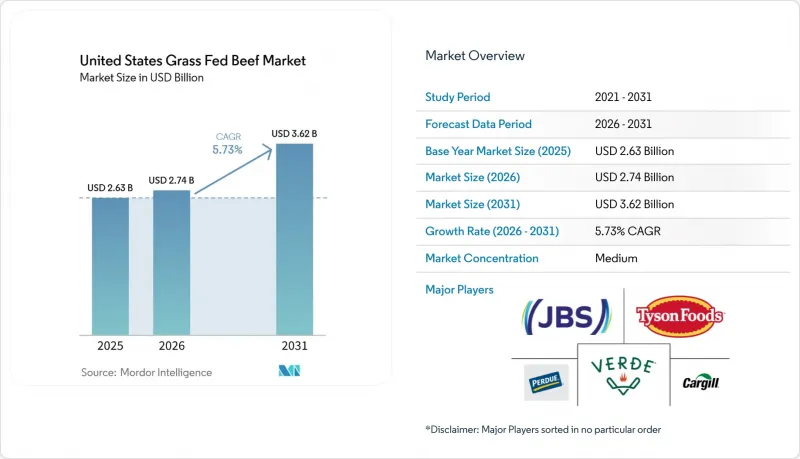
United States Grass Fed Beef Market Trends and Insights
Rising premium protein demand among health-focused buyers
The protein cycle shaping the United States dietary behavior is shifting toward quality differentiation rather than quantity. The June 2026 Pre Brands national survey is expected to indicate that 31% of Americans identify beef as their most functional protein for health and fitness goals, a positioning historically associated with chicken and fish. Grass-fed beef offers a measurable nutritional advantage: Mayo Clinic documentation confirms that it has lower total fat content, higher omega-3 fatty acid concentrations, and elevated antioxidant levels than conventional beef. A peer-reviewed metabolomics study scheduled for publication in npj Science of Food in 2025 is expected to show that rotational grazing in Southern US pasture-based systems directly improves nutrient density outcomes in finished beef, linking farming practices to a verifiable consumer benefit. Millennials are expected to surpass Boomers in meat category spending within two years and index significantly higher for claims-based protein purchases, according to the Power of Meat Report 2026. The demand signal is structural, not cyclical. Willingness to pay for premium protein has decoupled from headline beef price inflation, a dynamic that supports grass-fed premiums even as broader food costs moderate.
Expansion of traceability and provenance claims
Traceability is shifting from a regulatory requirement to a brand value driver in the United States grass-fed beef market. In August 2024, USDA FSIS published its updated guideline (FSIS-GD-2024-0006), which formalizes documentation requirements for animal-raising claims, including grass-fed and pasture-raised labels. This update raises the evidentiary burden for brands and creates a meaningful barrier to entry for unverified claimants. A 2025 study published in Agricultural and Food Economics (Springer Nature) identifies blockchain as a promising mechanism for end-to-end provenance documentation, noting that QR-accessible smart labels containing rotational grazing data, antibiotic records, and carbon footprint information can measurably improve consumer trust in premium claims. Verde Farms' May 2026 nutrient density study, benchmarked against competing grass-fed products, represents a new frontier in provenance evidence, where third-party substantiation of nutritional outcomes replaces origin-only storytelling. The USDA AMS Grass Fed Small and Very Small Producer Program provides a certified pathway for smaller operators, but uneven audit coverage creates label dilution risk and systematically benefits brands with robust verification infrastructure.
Premium price gap versus grain-fed beef
The price differential between grass-fed and conventional grain-fed beef remains the largest barrier to category scale. USDA AMS Quarterly Grass Fed Beef data for Q2 2026 indicates that grass-fed ground beef with 90%+ lean content averaged USD 13.63 per pound in direct-to-consumer sales, substantially higher than conventional equivalents. This gap widens further for premium steak cuts. The ongoing cattle supply contraction further amplifies price sensitivity. According to the USDA Cattle Inventory Report, the US cattle herd reached 86.2 million head on January 1, 2026, the lowest level in 75 years, tightening input costs across all beef supply chains, including grass-fed programs. The Angus Journal, released in April 2026, reported that approximately 57% of the US beef cow herd is concentrated in just 10 states, led by Texas, Oklahoma, and Missouri. As a result, grass-fed producers compete with grain-fed operations for the same regional supply pools without the benefit of comparable processing scale. Grain-fed beef benefits from established distribution infrastructure and volume pricing, allowing it to absorb market price increases more efficiently than grass-fed supply chains, which lack equivalent throughput. The price gap is likely to persist through the current cattle cycle recovery, which USDA ERS outlook data projects to extend into 2028-2029.
Other drivers and restraints analyzed in the detailed report include:
- Retailer and foodservice menu premiumization
- Regenerative grazing and soil health positioning
- Cold chain and last-mile fulfilment complexity
For complete list of drivers and restraints, kindly check the Table Of Contents.
Segment Analysis
Frozen/chilled beef is forecast to register the fastest CAGR among all product types, at 6.96% from 2026 to 2031. This growth reflects a structural shift toward e-commerce fulfillment, DTC subscription boxes, and foodservice bulk procurement, all of which favor the storage stability of frozen and chilled formats over the date constraints of fresh beef. Fresh beef is expected to account for 64.71% of the market in 2025, supported by its established retail positioning, a high share of premium steak cuts sold through supermarket meat cases, and consumer preference for visual quality inspection at the point of purchase. Despite its size advantage, the fresh format faces pressure from format diversification as online and subscription channels reshape purchasing behavior toward frozen shipments. A peer-reviewed study in npj Science of Food (2025) is expected to note that rotational grazing on Southern US pastures improves nutrient density in beef, a finding that, when communicated at the shelf, would disproportionately benefit branded fresh-format operators with traceable supply chains.
Processed beef and canned beef represent smaller but strategically notable segments. Processed formats are gaining traction through grass-fed beef jerky, hot dogs, and bacon, positioned as clean-label convenience proteins that bridge the gap between premium and mass-market offerings. Applegate's planned June 2026 launch of APPLEGATE NATURALS Natural Uncured Beef Bacon, made from 100% grass-fed, pasture-raised beef and set for immediate distribution to more than 3,000 Walmart stores, indicates that processed grass-fed beef is targeting mass-market scale rather than specialty channel positioning. Canned beef remains niche within the premium grass-fed category but benefits from pantry-stocking and emergency preparedness behavior among rural DTC consumers. Over the longer term, Fresh Beef's dominant share is expected to gradually decline as cold-chain infrastructure matures, subscription economics improve, and processed grass-fed products reach mass-retail scale.
Complete Report Scope:
- Product Type
- Fresh Beef
- Processed Beef
- Frozen/Chilled Beef
- Canned Beef
- Cut Type
- Steaks
- Roasts
- Minced Beef
- Other Cut Types
- Distribution Channel
- Foodservice
- Retail
- Supermarkets/Hypermarkets
- Specialty Stores
- Online Retail Stores
- Other Distribution Channels
List of Companies Covered in this Report:
- JBS S.A.
- Tyson Foods, Inc.
- Cargill, Incorporated
- Perdue Farms Inc.
- Verde Farms, LLC
- Strauss Brands LLC
- Thousand Hills Lifetime Grazed
- SunFed Ranch
- Organic Prairie
- Meyer Natural Foods
- Creekstone Farms Premium Beef LLC
- National Beef Packing Company, LLC
- Hormel Foods Corporation
- Applegate Farms, LLC
- Sysco Corporation
- Conagra Brands, Inc.
- Australian Agricultural Company Limited
- Silver Fern Farms Limited
- Teys Australia Pty Ltd
- Rain Crow Ranch
Additional Benefits:
- The market estimate (ME) sheet in Excel format
- 3 months of analyst support
TABLE OF CONTENTS
1 INTRODUCTION
- 1.1 Study Assumptions and Market Definition
- 1.2 Scope of the Study
2 RESEARCH METHODOLOGY
3 EXECUTIVE SUMMARY
4 MARKET LANDSCAPE
- 4.1 Market Overview
- 4.2 Market Drivers
- 4.2.1 Rising premium protein demand among health-focused buyers
- 4.2.2 Expansion of traceability and provenance claims
- 4.2.3 Retailer and foodservice menu premiumization
- 4.2.4 Regenerative grazing and soil health positioning
- 4.2.5 Direct-to-consumer subscription and box models
- 4.2.6 Carcass utilization improvements through niche cut monetization
- 4.3 Market Restraints
- 4.3.1 Premium price gap versus grain-fed beef
- 4.3.2 Cold chain and last-mile fulfilment complexity
- 4.3.3 Certification and label interpretation friction
- 4.3.4 Supply concentration in pasture-suitable regions
- 4.4 Consumer Demand Analysis
- 4.5 Regulatory Landscape
- 4.6 Technological Outlook
- 4.7 Porter's Five Forces
- 4.7.1 Threat of New Entrants
- 4.7.2 Bargaining Power of Buyers
- 4.7.3 Bargaining Power of Suppliers
- 4.7.4 Threat of Substitutes
- 4.7.5 Intensity of Competitive Rivalry
5 MARKET SIZE AND GROWTH FORECASTS (VALUE)
- 5.1 Product Type
- 5.1.1 Fresh Beef
- 5.1.2 Processed Beef
- 5.1.3 Frozen/Chilled Beef
- 5.1.4 Canned Beef
- 5.2 Cut Type
- 5.2.1 Steaks
- 5.2.2 Roasts
- 5.2.3 Minced Beef
- 5.2.4 Other Cut Types
- 5.3 Distribution Channel
- 5.3.1 Foodservice
- 5.3.2 Retail
- 5.3.2.1 Supermarkets/Hypermarkets
- 5.3.2.2 Specialty Stores
- 5.3.2.3 Online Retail Stores
- 5.3.2.4 Other Distribution Channels
6 COMPETITIVE LANDSCAPE
- 6.1 Market Concentration
- 6.2 Strategic Moves
- 6.3 Market Ranking Analysis
- 6.4 Company Profiles
- 6.4.1 JBS S.A.
- 6.4.2 Tyson Foods, Inc.
- 6.4.3 Cargill, Incorporated
- 6.4.4 Perdue Farms Inc.
- 6.4.5 Verde Farms, LLC
- 6.4.6 Strauss Brands LLC
- 6.4.7 Thousand Hills Lifetime Grazed
- 6.4.8 SunFed Ranch
- 6.4.9 Organic Prairie
- 6.4.10 Meyer Natural Foods
- 6.4.11 Creekstone Farms Premium Beef LLC
- 6.4.12 National Beef Packing Company, LLC
- 6.4.13 Hormel Foods Corporation
- 6.4.14 Applegate Farms, LLC
- 6.4.15 Sysco Corporation
- 6.4.16 Conagra Brands, Inc.
- 6.4.17 Australian Agricultural Company Limited
- 6.4.18 Silver Fern Farms Limited
- 6.4.19 Teys Australia Pty Ltd
- 6.4.20 Rain Crow Ranch
7 MARKET OPPORTUNITIES AND FUTURE OUTLOOK

