PUBLISHER: Mordor Intelligence | PRODUCT CODE: 2099827

PUBLISHER: Mordor Intelligence | PRODUCT CODE: 2099827
North America Organic Waste Collection Services - Market Share Analysis, Industry Trends & Statistics, Growth Forecasts (2026 - 2031)
According to Mordor Intelligence, the North America organic waste collection service market size was valued at USD 2.66 billion in 2025 and is estimated to grow from USD 2.80 billion in 2026 to reach USD 3.62 billion by 2031, at a CAGR of 5.25% during the forecast period (2026-2031).
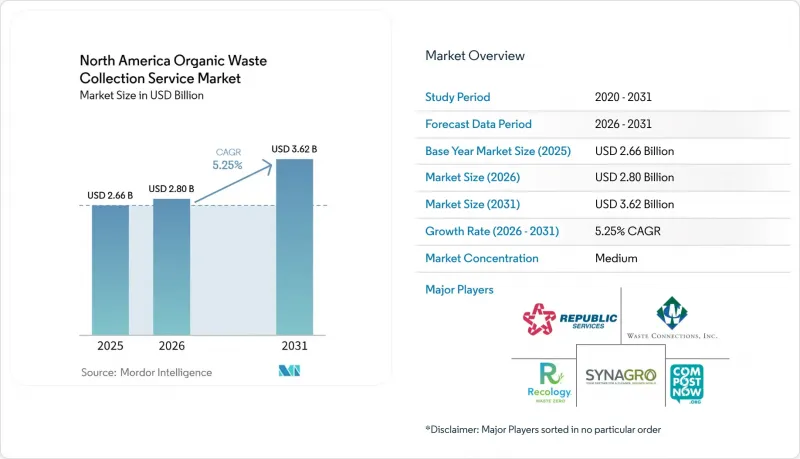
This report is Segmented by Waste Type (Food Waste, Yard & Landscape Waste, and More), by End-User (Residential, and More), by Collection Method (Door-To-Door Collection, and More), by Technology & Equipment (Manual Collection Systems, and More), and Geography (United States, Canada, Mexico). The Report Offers Market Size and Forecasts in Value (USD) for all the Above Segments.
North America Organic Waste Collection Services Market Trends and Insights
Low Carbon Fuel Standard Credits Supporting Organic Waste-to-Energy Projects
State-level Low Carbon Fuel Standard (LCFS) programs in California, Oregon, and Washington are driving the growth of the North America Organic Waste Collection Service market. These programs link financial incentives to renewable natural gas (RNG) and organic waste-to-energy projects. Through LCFS credit mechanisms, waste management operators are generating additional revenue by converting food, agricultural, and municipal organic waste into biogas and low-carbon transportation fuels. California, with its LCFS framework and Senate Bill 1383 mandates for organic waste diversion, is at the forefront. These initiatives motivate municipalities and private entities to bolster food waste collection and anaerobic digestion infrastructure. Meanwhile, Oregon and Washington's parallel clean fuel policies are spurring investments in organic waste recovery and renewable energy production. As LCFS credits are monetized, they enhance the financial viability of companies in organic waste collection and processing. This boost is hastening the adoption of source-separated organic waste programs, propelling short-term market growth across the western United States in the coming two years.
Federal and State Incentives for Renewable Natural Gas (RNG) Production from Organic Waste
Section 45Z provides production tax credits through 2029 for low-carbon transportation fuels, using a GREET (Greenhouse gases, Regulated Emissions, and Energy use in Transportation)-based model that includes organic waste digestion pathways, thereby strengthening project economics for dairies, wastewater, and landfill gas. Treasury guidance issued in February 2026 clarifies that emissions rates for manure pathways can be negative, increasing the credit value for livestock digesters and accelerating underwriting for new builds. Provincial support in Canada, such as Alberta's TIER grant to Taurus Canada RNG, demonstrates parallel policy alignment that de-risks capital for large-scale manure-to-RNG projects with defined offtake pathways. Private developers are moving to commercial operations, with Clean Energy Fuels commissioning a major Texas dairy RNG facility and achieving full RIN (Renewable Identification Number) eligibility under the Renewable Fuel Standard. Verification under ISO frameworks and RFS (Renewable Fuel Standard) Part 80 helps maintain integrity of credit generation, while California's schedule to phase down avoided methane crediting after 2029 creates a timing window that is front-loading development and procurement cycles.
High Collection and Processing Costs in Low-Density Suburban and Rural Areas
Some districts report sharp increases in processing fees and disposal costs since 2022, which raises rate pressure and limits service expansion without revenue adjustments. State mandates in California and zero-emission fleet rules add costs and compress the capital cycle, making it harder to absorb on sparse routes that lack density advantages. Urban routes can trim fuel and labor by removing unnecessary stops with data tools, yet rural deployment of sensors and route optimization yields smaller savings due to distance and participation variability. Federal grants help seed projects, but competition for limited funds can favor larger and more scalable proposals over isolated rural pilots. This cost structure slows program rollouts in lower-density markets within the North America organic waste collection service market.
Other drivers and restraints analyzed in the detailed report include:
- Municipal Climate Action Plans Aimed at Reducing Landfill Methane Emissions
- Infrastructure Investment Through Federal Climate and Infrastructure Funding Programs
- Limited Anaerobic Digestion and Composting Facility Capacity
For complete list of drivers and restraints, kindly check the Table Of Contents.
Segment Analysis
Yard and landscape waste accounted for 66.2% of 2025 collections, while food waste is set to grow at a 6.89% CAGR to 2031 as mandates and RNG credit values favor high-energy feedstocks. The North American organic waste collection service market benefits when food waste streams unlock avoided methane and fuel credits under the LCFS and RFS frameworks, thereby improving. Operators are investing in depackaging to improve contamination control and feed anaerobic digestion plants, thereby scaling fuel output and increasing certainty around offtake for digestate products and processing revenue. State-level organics separation mandates that apply to large generators continue to extend beyond early adopters, which builds a multi-year lift for commercial and institutional food waste diversion. Agricultural residues remain a small share due to dispersed supply and seasonality, though co-located manure projects supported by TIER grants add throughput and regional RNG supply.
Food waste's methane yield and credit intensity draw capital toward integrated depackaging and digestion facilities that can lock in offtake, stabilize tipping fees, and create long-term contracts for haulers in the North America organic waste collection service market. Niche biosolids and industrial byproducts are being valorized through advanced drying and conversion technologies that support power generation and carbon benefits. Yard waste programs remain the backbone of municipal services, but their growth pace is slower than food waste as fewer policy incentives attach to low-energy feedstocks. Over time, cross-contamination controls and education improve diversion quality, which supports lower processing costs and higher recovery in the North America organic waste collection service industry.
Residential collection accounted for 74.3% in 2025, reflecting municipal contracts and subscription density that anchor the North American organic waste collection service market, while commercial is projected to expand at a 7.62% CAGR through 2031. Regulations that require large generators to separate food scraps within defined distances of processing sites formalize demand and shift voluntary pilots into contracted service volumes. Commercial and institutional sites respond to standardized cart sizes and service levels with weight tracking and contamination metrics that guide behavior and fees. Large retailers and manufacturers are building direct processing and RNG offtake ties to secure environmental outcomes and cost predictability, which strengthens commercial pipeline visibility. Residential growth relies on convenience and outreach, and a program design that converts awareness into repeat set-outs can improve diversion performance in the North America organic waste collection service market.
Commercial volumes are also influenced by floor-plan density and back-of-house workflows that determine contamination patterns, service cadence, and viable container options. For industrial food processing, on-site depackaging and direct injection facilities can enable predictable throughput, supporting investment and stable tip rates. Residential programs remain core to local climate strategies. When bundled with yard waste and educational materials, they can deliver scale that improves route economics in the North America organic waste collection service industry. Over the forecast horizon, commercial momentum outpaces residential growth in percentage terms, but residential remains the largest contributor to total volumes.
Complete Report Scope:
- By Waste Type
- Food Waste (Pre and Post Consumer)
- Yard & Landscape Waste
- Agricultural Residues
- Others
- By End-User
- Residential
- Commercial (HoReCa, Retail)
- Industrial (Food Processing & Manufacturing)
- Others (Agri-waste)
- By Collection Method
- Door-to-Door Collection
- Drop-Off / Bring Systems
- Others
- By Technology & Equipment
- Manual Collection Systems
- Semi-Automated Systems
- Fully Automated Systems
- Others
- By Geography
- United States
- Canada
- Mexico
List of Companies Covered in this Report:
- Republic Services
- Waste Connections
- Recology
- Synagro
- CompostNow
- GFL Environmental Inc.
- Compost Crew
- Black Earth Compost
- Bootstrap Compost
- Denali
- Groot Industries
- Atlas Organics
- Rumpke Waste & Recycling
- Sanimax
- Veolia
- TerraCycle
- Convertus Group
- Remix Organics
- AgRecycle
- Action Carting Environmental Services, Inc
Additional Benefits:
- The market estimate (ME) sheet in Excel format
- 3 months of analyst support
TABLE OF CONTENTS
1 Introduction
- 1.1 Study Assumptions & Market Definition
- 1.2 Scope of the Study
2 Research Methodology
3 Executive Summary
4 Market Landscape
- 4.1 Market Overview
- 4.2 Market Drivers
- 4.2.1 Low Carbon Fuel Standard Credits Supporting Organic Waste-To-Energy Projects
- 4.2.2 Federal and State Incentives for Renewable Natural Gas Production from Organic Waste
- 4.2.3 Municipal Climate Action Plans Aimed at Reducing Landfill Methane Emissions
- 4.2.4 Infrastructure Investment Through Federal Climate and Infrastructure Funding Programs
- 4.2.5 Rising Consumer Awareness and Demand for Curbside Organic Waste Collection
- 4.2.6 Food Waste Donation Tax Incentives for Large Generators
- 4.3 Market Restraints
- 4.3.1 High Collection and Processing Costs in Low-Density Suburban and Rural Areas
- 4.3.2 Limited Anaerobic Digestion and Composting Facility Capacity
- 4.3.3 Municipal Budget Constraints and Competing Priorities
- 4.3.4 Low Participation Without Mandatory Collection Programs
- 4.4 Value / Supply-Chain Analysis
- 4.5 Regulatory Landscape
- 4.6 Technological Outlook
- 4.6.1 RFID Smart Bins for Waste Tracking
- 4.6.2 AI Revolutionizes Waste Sorting
- 4.6.3 IoT Optimizing for Fleet Routes
- 4.7 Porter's Five Forces
- 4.7.1 Threat of New Entrants
- 4.7.2 Bargaining Power of Suppliers
- 4.7.3 Bargaining Power of Buyers
- 4.7.4 Threat of Substitutes
- 4.7.5 Industry Rivalry
- 4.8 Fleet Modernization & Electrification in Waste Collection
- 4.9 Analysis of Biomethane Impact on Organic Waste Collection
- 4.10 Collaboration Between Municipalities and Private Operators Gaining Traction
- 4.11 Growing Focus on Methane Capture from Organic Waste to Meet Climate Targets
5 Market Size & Growth Forecasts (Value, In USD Billion)
- 5.1 By Waste Type
- 5.1.1 Food Waste (Pre and Post Consumer)
- 5.1.2 Yard & Landscape Waste
- 5.1.3 Agricultural Residues
- 5.1.4 Others
- 5.2 By End-User
- 5.2.1 Residential
- 5.2.2 Commercial (HoReCa, Retail)
- 5.2.3 Industrial (Food Processing & Manufacturing)
- 5.2.4 Others (Agri-waste)
- 5.3 By Collection Method
- 5.3.1 Door-to-Door Collection
- 5.3.2 Drop-Off / Bring Systems
- 5.3.3 Others
- 5.4 By Technology & Equipment
- 5.4.1 Manual Collection Systems
- 5.4.2 Semi-Automated Systems
- 5.4.3 Fully Automated Systems
- 5.4.4 Others
- 5.5 By Geography
- 5.5.1 United States
- 5.5.2 Canada
- 5.5.3 Mexico
6 Competitive Landscape
- 6.1 Market Concentration
- 6.2 Strategic Moves
- 6.3 Market Share Analysis
- 6.4 Company Profiles {(Includes Global Level Overview, Market Level Overview, Core Segments, Financials as Available, Strategic Information, Products & Services, and Recent Developments)}
- 6.4.1 Republic Services
- 6.4.2 Waste Connections
- 6.4.3 Recology
- 6.4.4 Synagro
- 6.4.5 CompostNow
- 6.4.6 GFL Environmental Inc.
- 6.4.7 Compost Crew
- 6.4.8 Black Earth Compost
- 6.4.9 Bootstrap Compost
- 6.4.10 Denali
- 6.4.11 Groot Industries
- 6.4.12 Atlas Organics
- 6.4.13 Rumpke Waste & Recycling
- 6.4.14 Sanimax
- 6.4.15 Veolia
- 6.4.16 TerraCycle
- 6.4.17 Convertus Group
- 6.4.18 Remix Organics
- 6.4.19 AgRecycle
- 6.4.20 Action Carting Environmental Services, Inc
7 Market Opportunities & Future Outlook
- 7.1 Smart Cities & IoT Integration
- 7.2 Producer Responsibility Expansion
- 7.3 Shift Toward Decentralized Organic Waste Processing

