
PUBLISHER: Mordor Intelligence | PRODUCT CODE: 2099851

PUBLISHER: Mordor Intelligence | PRODUCT CODE: 2099851
AI Copilot - Market Share Analysis, Industry Trends & Statistics, Growth Forecasts (2026 - 2031)
According to Mordor Intelligence, the AI copilot market size was valued at USD 21.45 billion in 2025, USD 27.25 billion in 2026, and is forecast to reach USD 96.05 billion by 2031 at a CAGR of 28.65% over 2026-2031.
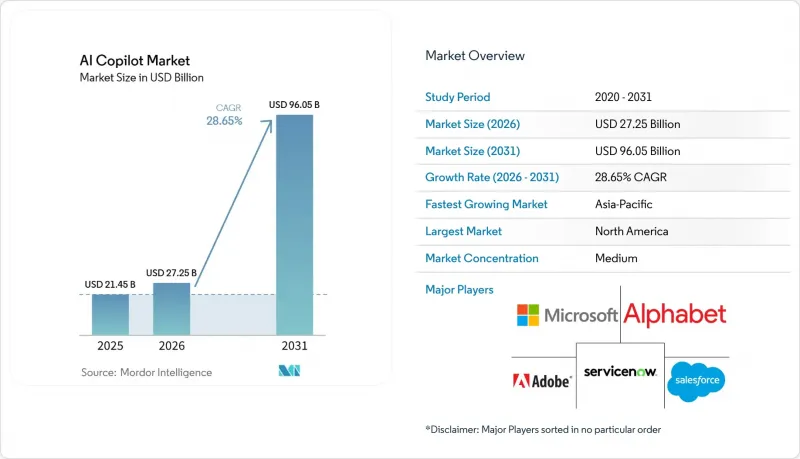
This report is Segmented by Copilot Type (Horizontal Productivity Copilots, and More), Deployment (Cloud-Based, Hybrid, and On-Premises), Organization Size (Large Enterprises, and Small and Medium Enterprises), Application (Knowledge Work and Productivity Assistance, and More), End-User Industry (IT and Telecommunication, BFSI, and More), and Geography. The Market Forecasts are Provided in Terms of Value (USD).
Global AI Copilot Market Trends and Insights
AI Native Productivity Benchmarks Reset Enterprise Seat Economics
Enterprise buyers are now evaluating Copilot software against measurable productivity benchmarks rather than treating it as an open-ended experiment. Microsoft disclosed that more than 20 million paid Microsoft 365 Copilot seats were in use by April 2026, and the company also reported very large enterprise deployments from Accenture, Bayer, Johnson and Johnson, Mercedes-Benz, and Roche. These deployments matter because they show that the AI Copilot Market is now being measured in enterprise-wide seat rollouts, not in narrow pilot groups. Once large employers make these commitments public, peer organizations face stronger internal pressure to justify slower adoption or smaller scope. GitHub Copilot also reached nearly 140,000 enterprise organizations by Q3 FY2026, which shows that the same benchmark logic is shaping technical teams as well as general productivity users. This is making seat economics more visible across the AI Copilot Market and supporting wider rollout decisions in which labor savings can be discussed in operational terms.
Embedded Copilot Workflows Reduce Switching Costs Across Saas Suites
Copilot tools gain traction faster when they are added to software that employees already use for much of the workday. ServiceNow announced in April 2026 that all customers would receive a complete AI package without an additional purchase and introduced Otto, a unified AI experience combining conversational AI, workflows, and enterprise search. This reduces the need for a separate purchase case, thereby shortening sales cycles and lowering adoption friction. The result is that the AI Copilot Market is increasingly rewarding vendors that can embed copilots deeply into productivity, service, and workflow platforms rather than selling a standalone assistant. Buyers also face lower switching costs when the copilot is tied to data, permissions, and workflows already in place within the main software stack. That dynamic increases platform stickiness and puts more pressure on point solutions that cannot match the integration depth of large-suite providers.
Hallucination Risk and Output Verification Costs Slow High-Stakes Adoption
Output reliability remains a core issue when copilots are used in legal, financial, healthcare, and public administration work. The EU AI Act places particular emphasis on human oversight and controlled use in higher-risk contexts, reflecting the need for traceable, reviewable outputs in sensitive workflows. This means the AI Copilot Market is not held back by curiosity or access, but by the cost of validating output before it can be used in high-consequence settings. Verification work reduces the time savings that buyers expect from deployment, especially where every response must be checked against policy, legal rules, or approved records. The issue is especially important for the fastest-growing regulated workflow use cases, because those applications depend on source attribution, defensible reasoning, and documented control. Until more vendors can combine speed with dependable governance, the AI Copilot Market will continue to face slower adoption in work where a single mistake can outweigh a large productivity gain.
Other drivers and restraints analyzed in the detailed report include:
- Agentic Task Execution Expands Copilot Use Beyond Text Generation
- Private Model Hosting Accelerates Regulated Enterprise Adoption
- Data Residency and Prompt Leakage Concerns Restrict Cloud-First Rollouts
For complete list of drivers and restraints, kindly check the Table Of Contents.
Segment Analysis
Horizontal Productivity Copilots held 40.12% of the AI Copilot Market share in 2025, which made them the largest copilot category by revenue. Their lead reflects the strength of tools that sit directly inside Microsoft 365, Google Workspace, and similar work environments, where users already spend a large part of the day. This placement shortens adoption cycles because organizations do not need to introduce a completely separate work surface or procurement category. It also helps large vendors bundle Copilot access into existing commercial agreements, making expansion easier once the first teams begin using the product. In the AI Copilot Market, this creates a self-reinforcing pattern where attention, integration, and procurement convenience all favor horizontal platforms.
Functional Workflow Copilots remained an important second tier because they support specific business processes in HR, finance, legal, and supply chain functions. Their value comes from task libraries and workflow alignment that connect more tightly with enterprise systems from providers such as SAP SE and Oracle. Technical and Engineering Copilots also advanced quickly, supported by GitHub Copilot momentum across nearly 140,000 enterprise organizations by Q3 FY2026. That trend suggests that engineering teams are becoming a second-scale engine for the AI Copilot Market, especially when coding, testing, and documentation tasks can be automated in controlled environments. Industry-Specific Copilots are projected to expand at a 30.84% CAGR through 2031 because healthcare, financial services, manufacturing, and legal buyers need domain-trained tools that can meet narrower accuracy and compliance expectations than a general assistant can support.
Cloud-Based deployment accounted for 71.24% of the AI Copilot Market size in 2025, making it the largest deployment mode by a wide margin. The lead came from ease of activation, faster access to updated models, and the fact that many enterprises already had working relationships with major cloud providers. Cloud delivery also lowers the technical barrier by having the vendor manage the inference infrastructure, updates, and service availability. In practical terms, this allowed the AI Copilot Market to scale rapidly across organizations that wanted speed and limited implementation friction. It also aligned well with broad productivity use cases where sensitivity levels were lower, and the goal was quick activation across office workflows.
On-Premises deployment remained relevant in defense, intelligence, and central banking environments where data egress limits were much stricter. Hybrid deployment is projected to grow at a 31.16% CAGR through 2031 because it enables organizations to balance convenience and control. Google positioned Distributed Cloud around customer-controlled inference, and Teradata introduced AI Factory for private AI deployment with full data custody needs. These offerings show that hybrid design is no longer a temporary compromise, but a practical architecture for enterprises that need cloud-based interfaces and tighter governance for regulated tasks. As a result, the AI Copilot Market is broadening beyond pure SaaS delivery and giving infrastructure control a stronger role in buying decisions.
Complete Report Scope:
- By Copilot Type
- Horizontal Productivity Copilots
- Functional Workflow Copilots
- Technical and Engineering Copilots
- Industry-Specific Copilots
- By Deployment
- Cloud-Based
- Hybrid
- On-Premises
- By Organization Size
- Large Enterprises
- Small and Medium Enterprises
- By Application
- Knowledge Work and Productivity Assistance
- Software Engineering and Technical Operations
- Customer and Employee Service Operations
- Sales, Marketing and Revenue Enablement
- Business Process and Enterprise Operations
- Regulated Industry Workflows
- By End-User Industry
- IT and Telecommunication
- BFSI
- Healthcare and Life Sciences
- Retail and E-Commerce
- Industrial Manufacturing
- Education and Research Institutions
- Media and Entertainment
- Government and administration
- Energy and Utilities
- Other End-User Industries
- By Geography
- North America
- United States
- Canada
- Mexico
- South America
- Brazil
- Argentina
- Rest of South America
- Europe
- Germany
- United Kingdom
- France
- Russia
- Spain
- Rest of Europe
- Asia-Pacific
- China
- Japan
- India
- South Korea
- Southeast Asia
- Rest of Asia-Pacific
- Middle East and Africa
- Middle East
- Saudi Arabia
- United Arab Emirates
- Turkey
- Rest of Middle East
- Africa
- South Africa
- Nigeria
- Egypt
- Rest of Africa
- Middle East
- North America
Geography Analysis
Asia-Pacific held 23.64% of the AI Copilot Market share in 2025, making it the largest regional market. The region benefited from public support for digital infrastructure, a large technology services workforce, and strong domestic competition in language model development. Country patterns within Asia-Pacific were not uniform, but large enterprise adoption in Japan showed that productivity pilots could move from the pilot stage to broad use when the deployment fit existing work habits. Microsoft customer stories showed that Nippon Steel expanded from an initial pilot to 11,000 enterprise licenses, while Mitsui and Co. maintained a very high monthly active utilization rate across nearly 5,000 users. These examples indicate that the AI Copilot Market in Asia-Pacific is supported by both workforce scale and a growing willingness to integrate copilots into core office and industrial workflows.
North America is projected to expand at a 31.38% CAGR through 2031, making it the fastest-growing regional market. The main reason is that procurement is shifting from departmental trials to multi-year commercial commitments that connect AI software with broader IT spending. Microsoft stated that new commercial bookings rose sharply in Q3 FY2026, suggesting a deeper pipeline of committed future AI and cloud expenditure. The AI Copilot Market in North America is also gaining support from state-level public-sector buying, as evidenced by California's statewide Anthropic agreement.
Europe, the Middle East, and Africa followed different demand paths in the AI Copilot Market. In Europe, the EU AI Act is reshaping supplier qualification by increasing the importance of compliance, human oversight, and infrastructure choices that fit regulated use cases. This favors vendors that already have data-residency-ready infrastructure and documented governance processes. In the Middle East and Africa, demand is building through public digital transformation programs and sovereign AI priorities, attracting greater vendor attention. South America remained earlier in the maturity cycle, with adoption still more concentrated in technology and financial services users who can access global platform offerings.
- Alphabet Inc.
- Salesforce, Inc.
- ServiceNow, Inc.
- Adobe Inc.
- GitHub, Inc.
- OpenAI, L.L.C.
- Anthropic PBC
- Amazon Web Services, Inc.
- Oracle Corporation
- SAP SE
- IBM Corporation
- Notion Labs, Inc.
- Writer, Inc.
- Glean Technologies, Inc.
- Moveworks, Inc.
- Aisera, Inc.
- Replit, Inc.
- Tabnine Ltd.
- Anysphere, Inc.
- Aisera, Inc.
Additional Benefits:
- The market estimate (ME) sheet in Excel format
- 3 months of analyst support
TABLE OF CONTENTS
1 INTRODUCTION
- 1.1 Study Assumptions and Market Definition
- 1.2 Scope of the Study
2 RESEARCH METHODOLOGY
3 EXECUTIVE SUMMARY
4 MARKET LANDSCAPE
- 4.1 Market Overview
- 4.2 Market Drivers
- 4.2.1 AI Native Productivity Benchmarks are Resetting Enterprise Seat Economics
- 4.2.2 Copilot Embedded Workflows are Reducing Switching Costs Across SaaS Suites
- 4.2.3 Private Model Hosting Demand is Accelerating Regulated Enterprise Adoption
- 4.2.4 Agentic Task Execution is Expanding Copilot Use Beyond Text Generation
- 4.2.5 Multi-Modal Copilots are Unlocking Higher-Value Knowledge Work Use Cases
- 4.2.6 AI Copilot Procurement is Moving From Pilot Budgets to Core IT and Transformation Budgets
- 4.3 Market Restraints
- 4.3.1 Hallucination Risk and Output Verification Costs Slow High-Stakes Adoption
- 4.3.2 Data Residency and Prompt Leakage Concerns Restrict Cloud-First Rollouts
- 4.3.3 Copilot Sprawl Is Creating Seat Overlap and Governance Friction
- 4.3.4 Model Refresh Cycles Are Compressing Differentiation and Pressuring Pricing
- 4.4 Impact of Macroeconomic Factors on the Market
- 4.5 Industry Value Chain Analysis
- 4.6 Technology Outlook
- 4.7 Regulatory Landscape
- 4.8 Porter's Five Forces Analysis
- 4.8.1 Threat of New Entrants
- 4.8.2 Bargaining Power of Suppliers
- 4.8.3 Bargaining Power of Buyers
- 4.8.4 Threat of Substitutes
- 4.8.5 Intensity of Competitive Rivalry
5 MARKET SIZE AND GROWTH FORECASTS (VALUE)
- 5.1 By Copilot Type
- 5.1.1 Horizontal Productivity Copilots
- 5.1.2 Functional Workflow Copilots
- 5.1.3 Technical and Engineering Copilots
- 5.1.4 Industry-Specific Copilots
- 5.2 By Deployment
- 5.2.1 Cloud-Based
- 5.2.2 Hybrid
- 5.2.3 On-Premises
- 5.3 By Organization Size
- 5.3.1 Large Enterprises
- 5.3.2 Small and Medium Enterprises
- 5.4 By Application
- 5.4.1 Knowledge Work and Productivity Assistance
- 5.4.2 Software Engineering and Technical Operations
- 5.4.3 Customer and Employee Service Operations
- 5.4.4 Sales, Marketing and Revenue Enablement
- 5.4.5 Business Process and Enterprise Operations
- 5.4.6 Regulated Industry Workflows
- 5.5 By End-User Industry
- 5.5.1 IT and Telecommunication
- 5.5.2 BFSI
- 5.5.3 Healthcare and Life Sciences
- 5.5.4 Retail and E-Commerce
- 5.5.5 Industrial Manufacturing
- 5.5.6 Education and Research Institutions
- 5.5.7 Media and Entertainment
- 5.5.8 Government and administration
- 5.5.9 Energy and Utilities
- 5.5.10 Other End-User Industries
- 5.6 By Geography
- 5.6.1 North America
- 5.6.1.1 United States
- 5.6.1.2 Canada
- 5.6.1.3 Mexico
- 5.6.2 South America
- 5.6.2.1 Brazil
- 5.6.2.2 Argentina
- 5.6.2.3 Rest of South America
- 5.6.3 Europe
- 5.6.3.1 Germany
- 5.6.3.2 United Kingdom
- 5.6.3.3 France
- 5.6.3.4 Russia
- 5.6.3.5 Spain
- 5.6.3.6 Rest of Europe
- 5.6.4 Asia-Pacific
- 5.6.4.1 China
- 5.6.4.2 Japan
- 5.6.4.3 India
- 5.6.4.4 South Korea
- 5.6.4.5 Southeast Asia
- 5.6.4.6 Rest of Asia-Pacific
- 5.6.5 Middle East and Africa
- 5.6.5.1 Middle East
- 5.6.5.1.1 Saudi Arabia
- 5.6.5.1.2 United Arab Emirates
- 5.6.5.1.3 Turkey
- 5.6.5.1.4 Rest of Middle East
- 5.6.5.2 Africa
- 5.6.5.2.1 South Africa
- 5.6.5.2.2 Nigeria
- 5.6.5.2.3 Egypt
- 5.6.5.2.4 Rest of Africa
- 5.6.5.1 Middle East
- 5.6.1 North America
6 COMPETITIVE LANDSCAPE
- 6.1 Market Concentration
- 6.2 Strategic Moves
- 6.3 Market Share Analysis
- 6.4 Company Profiles (includes Global Level Overview, Market Level Overview, Core Segments, Financials as available, Strategic Information, Market Rank/Share, Products and Services, Recent Developments)
- 6.4.1 Alphabet Inc.
- 6.4.2 Salesforce, Inc.
- 6.4.3 ServiceNow, Inc.
- 6.4.4 Adobe Inc.
- 6.4.5 GitHub, Inc.
- 6.4.6 OpenAI, L.L.C.
- 6.4.7 Anthropic PBC
- 6.4.8 Amazon Web Services, Inc.
- 6.4.9 Oracle Corporation
- 6.4.10 SAP SE
- 6.4.11 IBM Corporation
- 6.4.12 Notion Labs, Inc.
- 6.4.13 Writer, Inc.
- 6.4.14 Glean Technologies, Inc.
- 6.4.15 Moveworks, Inc.
- 6.4.16 Aisera, Inc.
- 6.4.17 Replit, Inc.
- 6.4.18 Tabnine Ltd.
- 6.4.19 Anysphere, Inc.
- 6.4.20 Aisera, Inc.
7 MARKET OPPORTUNITIES AND FUTURE OUTLOOK
- 7.1 White-Space and Unmet-Need Assessment

