PUBLISHER: Mordor Intelligence | PRODUCT CODE: 2099881

PUBLISHER: Mordor Intelligence | PRODUCT CODE: 2099881
Subscription Video-on-Demand (SVOD) - Market Share Analysis, Industry Trends & Statistics, Growth Forecasts (2026 - 2031)
According to Mordor Intelligence, the subscription video-on-demand market size was valued at USD 174.84 billion in 2025 and estimated to grow from USD 188.28 billion in 2026 to reach USD 262.74 billion by 2031, at a CAGR of 6.89% during the forecast period (2026-2031).
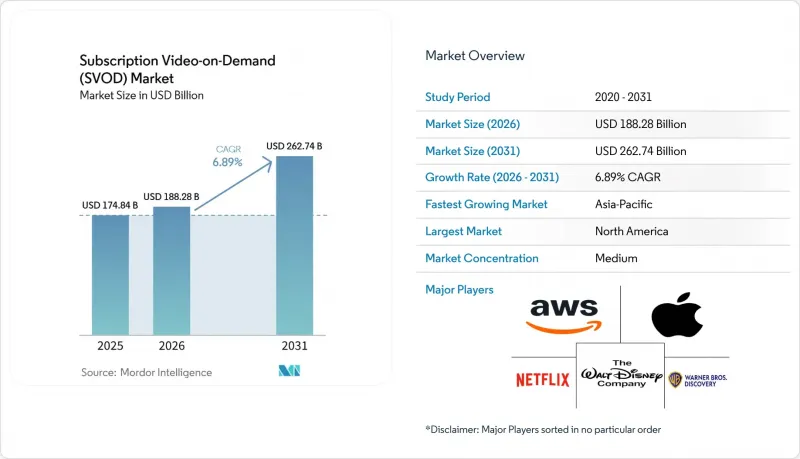
This report is Segmented by Content Type (Movies and Films, TV Shows and Episodic Content, Documentaries, Other Content Types), Device Type (Smartphones and Tablets, Smart TVs, Laptops and Desktops, Other Device Types), and Geography (North America, South America, Europe, Asia-Pacific, Middle East, and Africa). The Market Forecasts are Provided in Terms of Value (USD).
Global Subscription Video-on-Demand (SVOD) Market Trends and Insights
Rising Demand for Premium Original Content
Premium original programming remains a core growth lever in the subscription video-on-demand market because exclusive titles help platforms justify recurring payments. The strongest commercial value still sits in reusable intellectual property, where films and series can support sequels, spin-offs, merchandising, and deeper audience loyalty. Netflix's planned all-cash acquisition of Warner Bros. Discovery's streaming and studios assets showed how aggressively major players now value owned libraries and long-life franchises. European content rules reinforce this logic, because platforms that already invest in broad production pipelines are better placed to meet local catalog obligations without weakening release quality. This is pushing investment toward titles that can travel across regions while still being adapted for local audiences. As a result, the subscription video-on-demand market is rewarding platforms that can spread content spending across global franchises, local originals, and multi-year release slates.
Smart TV and Connected Device Ecosystem Expansion
Connected devices are reshaping the subscription video-on-demand market, because distribution is now built into the screens people use every day. Smart-TV operating systems matter more than before, since placement on home screens and recommendation rows can influence what households open first. Fox's agreement to acquire Roku showed that control of the device layer has become strategically important in its own right, not just as a route to third-party services. The same logic is visible in app pre-installation and interface partnerships, where platforms move closer to the household entry point before a user even chooses a service. This reduces sign-up friction, shortens the viewing path, and helps both premium and ad-supported services stay visible in crowded homes. For the subscription video-on-demand market, device expansion is no longer just a hardware trend; it is part of the customer acquisition and retention strategy.
Subscription Fatigue and Churn In Mature Households
Subscription fatigue is limiting the subscription video-on-demand market among mature households, where many users already pay for multiple services simultaneously. That makes cancellations easier to justify when a platform finishes a tentpole release cycle or loses a must-watch title. The problem is not a collapse in demand, but a more tactical pattern of joining, pausing, and returning. This behavior weakens revenue visibility and forces providers to spend more on programming and promotion just to hold the same household. It also raises the importance of release timing, pricing discipline, and bundled distribution inside the subscription video-on-demand market. Platforms with thinner catalogs or weaker local relevance are therefore more exposed to short-duration usage and inconsistent subscriber loyalty.
Other drivers and restraints analyzed in the detailed report include:
- Bundling With Telecom and Pay-TV Offers
- Ad-Supported Tier Expansion in Mature Markets
- Escalating Content Licensing and Sports Rights Costs
For complete list of drivers and restraints, kindly check the Table Of Contents.
Segment Analysis
Movies and Films held 44.13% of the subscription video-on-demand market share in 2025, making filmed entertainment the leading content anchor for paid streaming platforms. Their strength comes from repeatable franchise value, exclusive windows, and broad appeal across age groups and regions. In the subscription video-on-demand market, film libraries also help services maintain a visible pipeline of recognizable titles between major series launches. TV Shows and Episodic Content remained the second-largest segment because serial viewing supports habitual use and keeps subscribers returning across several weeks or months. European catalog rules reinforce the need for depth across both films and episodic content, since platforms must maintain a minimum 30% share of European works in their catalogs.
The other content types segment is the fastest-growing, projected to expand at a 7.32% CAGR through 2031 as platforms broaden their mix beyond scripted entertainment. Live sports, special events, and interactive formats create appointment viewing, which makes this part of the subscription video-on-demand industry especially useful for retention and differentiation. Documentaries remain smaller in scale, but they add credibility, subject variety, and catalog breadth at a lower production intensity than high-end scripted releases. In Europe, viewing of EU films retained a meaningful place in subscription catalog consumption, which supports the case for sustained investment in diverse local and regional libraries.
Complete Report Scope:
- By Content Type
- Movies and Films
- TV Shows and Episodic Content
- Documentaries
- Other Content Types
- By Device Type
- Smartphones and Tablets
- Smart TVs
- Laptops and Desktops
- Other Device Types
- By Geography
- North America
- United States
- Canada
- Mexico
- South America
- Brazil
- Argentina
- Chile
- Rest of South America
- Europe
- Germany
- United Kingdom
- France
- Italy
- Spain
- Rest of Europe
- Asia-Pacific
- China
- Japan
- India
- South Korea
- Australia
- Rest of Asia-Pacific
- Middle East
- Saudi Arabia
- United Arab Emirates
- Qatar
- Rest of Middle East
- Africa
- South Africa
- Egypt
- Nigeria
- Rest of Africa
- North America
Geography Analysis
North America held 39.61% of the subscription video-on-demand market share in 2025, maintaining its position as the largest regional revenue base. The region still benefits from a strong willingness to pay, broad service availability, and a mature ad-supported offering mix. Growth there is becoming more dependent on retention, bundling, and price realization than on first-time household adoption. South America remains a smaller base, but it offers meaningful headroom for unlocking wider paid use through local-language content and flexible pricing. For the subscription video-on-demand market, the region's opportunity lies in turning mobile and broadband adoption into longer-lasting paid relationships.
Asia-Pacific is the fastest-growing region in the subscription video-on-demand market, with a 7.86% CAGR projected through 2031. Demand in this region is being shaped by younger digital audiences, growing connected-device access, and strong acceptance of local-language storytelling. India stands out because scale depends on serving many languages and usage patterns rather than relying on a single national content formula. JioHotstar's rollout of voice-led discovery across 12 Indian languages reflected how product design is being tailored to this reality. Europe follows a different path, where growth is closely tied to content localization and regulatory compliance under the Audiovisual Media Services Directive.
The Middle East and Africa are growing from a smaller base in the SVOD market, with expansion shaped by youth demographics, mobile use, and distribution partnerships. In the Gulf states, paid streaming growth is supported by affluent digital consumers and a strong role for operator-led service packaging. Across Africa, infrastructure and currency volatility continue to slow wider adoption, keeping affordability and device access central to strategy. Canal+'s control of MultiChoice highlighted how scale in Africa is increasingly being built through regional platforms, local rights, and broader digital distribution.
- Netflix, Inc.
- Amazon.com, Inc.
- The Walt Disney Company
- Apple Inc.
- Warner Bros. Discovery, Inc.
- Paramount Skydance Corporation
- Comcast Corporation
- Alphabet Inc.
- Tencent Holdings Limited
- iQIYI, Inc.
- Alibaba Group Holding Limited
- Rakuten Group, Inc.
- Zee Entertainment Enterprises Limited
- JioStar India Private Limited
- DAZN Group Limited
- PCCW Limited
- MultiChoice Group Limited
- CANAL+ S.A.
- Globo Comunicacao e Participacoes S.A.
- Sony Group Corporation
- MBC Group
Additional Benefits:
- The market estimate (ME) sheet in Excel format
- 3 months of analyst support
TABLE OF CONTENTS
1 INTRODUCTION
- 1.1 Study Assumptions and Market Definition
- 1.2 Scope of the Study
2 RESEARCH METHODOLOGY
3 EXECUTIVE SUMMARY
4 MARKET LANDSCAPE
- 4.1 Market Overview
- 4.2 Market Drivers
- 4.2.1 Rising Demand for Premium Original Content
- 4.2.2 Smart TV and Connected Device Ecosystem Expansion
- 4.2.3 Bundling With Telecom and Pay-TV Offers
- 4.2.4 Ad-Supported Tier Expansion in Mature Markets
- 4.2.5 AI-Personalized Discovery and Retention Tools
- 4.2.6 Local-Language Library Expansion in High-Growth Markets
- 4.3 Market Restraints
- 4.3.1 Subscription Fatigue and Churn in Mature Households
- 4.3.2 Escalating Content Licensing and Sports Rights Costs
- 4.3.3 Fragmented Rights Windows Across Platforms
- 4.3.4 Privacy and Algorithm Transparency Compliance Burden
- 4.4 Impact of Macroeconomic Factors on the Market
- 4.5 Industry Value Chain Analysis
- 4.6 Regulatory Landscape
- 4.7 Technological Outlook
- 4.8 Porter's Five Forces Analysis
- 4.8.1 Bargaining Power of Buyers
- 4.8.2 Bargaining Power of Suppliers
- 4.8.3 Threat of New Entrants
- 4.8.4 Threat of Substitutes
- 4.8.5 Intensity of Competitive Rivalry
5 MARKET SIZE AND GROWTH FORECASTS (VALUE)
- 5.1 By Content Type
- 5.1.1 Movies and Films
- 5.1.2 TV Shows and Episodic Content
- 5.1.3 Documentaries
- 5.1.4 Other Content Types
- 5.2 By Device Type
- 5.2.1 Smartphones and Tablets
- 5.2.2 Smart TVs
- 5.2.3 Laptops and Desktops
- 5.2.4 Other Device Types
- 5.3 By Geography
- 5.3.1 North America
- 5.3.1.1 United States
- 5.3.1.2 Canada
- 5.3.1.3 Mexico
- 5.3.2 South America
- 5.3.2.1 Brazil
- 5.3.2.2 Argentina
- 5.3.2.3 Chile
- 5.3.2.4 Rest of South America
- 5.3.3 Europe
- 5.3.3.1 Germany
- 5.3.3.2 United Kingdom
- 5.3.3.3 France
- 5.3.3.4 Italy
- 5.3.3.5 Spain
- 5.3.3.6 Rest of Europe
- 5.3.4 Asia-Pacific
- 5.3.4.1 China
- 5.3.4.2 Japan
- 5.3.4.3 India
- 5.3.4.4 South Korea
- 5.3.4.5 Australia
- 5.3.4.6 Rest of Asia-Pacific
- 5.3.5 Middle East
- 5.3.5.1 Saudi Arabia
- 5.3.5.2 United Arab Emirates
- 5.3.5.3 Qatar
- 5.3.5.4 Rest of Middle East
- 5.3.6 Africa
- 5.3.6.1 South Africa
- 5.3.6.2 Egypt
- 5.3.6.3 Nigeria
- 5.3.6.4 Rest of Africa
- 5.3.1 North America
6 COMPETITIVE LANDSCAPE
- 6.1 Market Concentration
- 6.2 Strategic Moves
- 6.3 Vendor Positioning Analysis
- 6.4 Company Profiles (includes Global Level Overview, Market Level Overview, Core Segments, Financials as available, Strategic Information, Market Rank/Share, Products and Services, Recent Developments)
- 6.4.1 Netflix, Inc.
- 6.4.2 Amazon.com, Inc.
- 6.4.3 The Walt Disney Company
- 6.4.4 Apple Inc.
- 6.4.5 Warner Bros. Discovery, Inc.
- 6.4.6 Paramount Skydance Corporation
- 6.4.7 Comcast Corporation
- 6.4.8 Alphabet Inc.
- 6.4.9 Tencent Holdings Limited
- 6.4.10 iQIYI, Inc.
- 6.4.11 Alibaba Group Holding Limited
- 6.4.12 Rakuten Group, Inc.
- 6.4.13 Zee Entertainment Enterprises Limited
- 6.4.14 JioStar India Private Limited
- 6.4.15 DAZN Group Limited
- 6.4.16 PCCW Limited
- 6.4.17 MultiChoice Group Limited
- 6.4.18 CANAL+ S.A.
- 6.4.19 Globo Comunicacao e Participacoes S.A.
- 6.4.20 Sony Group Corporation
- 6.4.21 MBC Group
7 MARKET OPPORTUNITIES AND FUTURE OUTLOOK
- 7.1 White-Space and Unmet-Need Assessment

