PUBLISHER: Mordor Intelligence | PRODUCT CODE: 2099915

PUBLISHER: Mordor Intelligence | PRODUCT CODE: 2099915
Japan Fixed Wireless Access - Market Share Analysis, Industry Trends & Statistics, Growth Forecasts (2026 - 2031)
According to Mordor Intelligence, the Japan fixed wireless access market size was valued at USD 2.71 billion in 2025 and is projected to reach USD 6.10 billion by 2031, growing at a CAGR of 14.28% from 2026 to 2031.
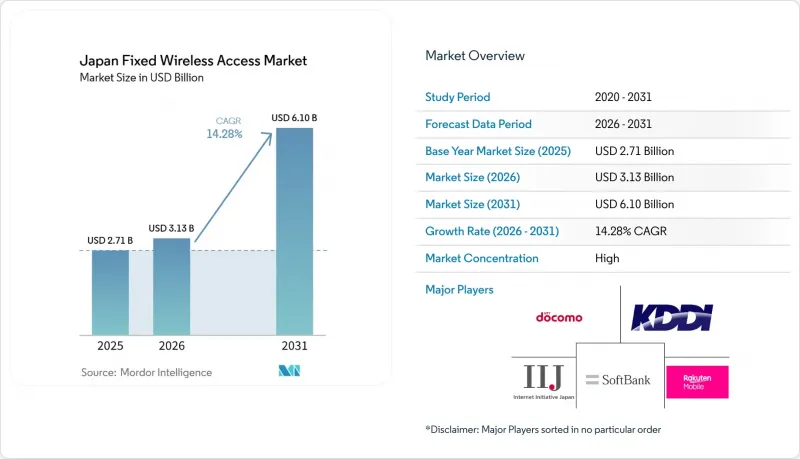
This report is Segmented by Type (Hardware [Access Units, and More], and Services), Application (Residential, Commercial, Industrial, and Government and Public Safety), Frequency Band (Sub-6 GHz, Mmwave (Above 24 GHz), and Unlicensed / Shared CBRS), and Deployment Mode (Indoor CPE, Outdoor CPE, and Self-Install Window-Mount CPE). The Market Forecasts are Provided in Terms of Value (USD).
Japan Fixed Wireless Access Market Trends and Insights
5G Standalone Rollout Expanding FWA Performance Headroom
The strongest growth support for the Japan fixed wireless access market comes from the shift toward more capable 5G Standalone networks. Ericsson's 2026 outlook placed Japan among the stronger FWA markets because high 5G maturity and speed-based tariff design are now moving together rather than separately. SoftBank and Ericsson also validated 5 network slices on a commercial 5G Standalone network at Suzuka Circuit, and one of those use cases relied on mmWave backhaul for public Wi-Fi in a fixed wireless access setting. That kind of network behavior matters because FWA performance in busy urban environments depends less on peak headline speeds alone and more on consistency, latency handling, and the ability to maintain service quality as traffic rises. The Japan fixed wireless access market is therefore gaining room for more differentiated service plans, especially where operators want to charge more for higher reliability, faster setup, or business continuity use cases. As 5G Standalone capabilities become more visible in live networks, the market gains a stronger basis for speed- and quality-tiered offers rather than simple replacement broadband plans.
Fiber Saturation in Dense Markets Opening a Backup and Second Line Use Case
A second major support for the Japan fixed wireless access market is that dense urban areas already have deep fixed broadband penetration, which changes how wireless broadband is sold. KDDI's December 2025 launch of a Wi-Fi 7 home gateway for au Hikari 10 Gbps and 5 Gbps services shows how advanced the fixed environment already is in Japanese homes with premium fiber access. In that setting, FWA does not always need to beat fiber on speed to win demand, because it can serve as a second line, a faster activation option, or a practical answer in buildings where wiring control sits with landlords or building associations. SoftBank's Air Terminal 6 launch also shows that operators continue to invest in home FWA hardware even as fiber remains strong, indicating that both technologies are now being positioned for different access priorities rather than a simple winner-takes-all outcome. This is why the Japan fixed wireless access market keeps finding room in urban cores where conventional fiber competition is already intense. The growth path is less about universal fiber substitution and more about backup, flexibility, and easier onboarding in settings where installation friction still matters.
Spectrum Availability and Mid-Band Contiguity Constraints
The clearest technical restraint on the Japan fixed wireless access market is that spectrum improvements have not fully eliminated performance bottlenecks in dense areas. MIC's 2024 approval in the 4.9 GHz band added capacity for SoftBank, but it did not resolve the broader need for deeper contiguous bandwidth across the high-demand parts of the 5G access layer. KDDI and NTT DOCOMO's shared mmWave repeater project in 2026 also underscores the significant engineering effort still required to extend high-band coverage efficiently in real urban environments. When operators still need shared repeaters, denser relay structures, and careful coverage design, scaling premium, high-throughput FWA becomes slower and more capital-intensive. The Japan fixed wireless access market can keep growing on Sub-6 GHz, but the path toward more fiber-like multi-gigabit performance remains narrower than the demand narrative suggests. This limitation matters most in dense buildings where usage demand is high, and signal conditions are hardest to optimize.
Other drivers and restraints analyzed in the detailed report include:
- SME Demand for Rapid Deploy, Failover Connectivity
- Japan Digital Infrastructure Push Supporting Non-Fiber Last-Mile Options
- Fiber Price Pressure Limiting Residential FWA Premiums
For complete list of drivers and restraints, kindly check the Table Of Contents.
Segment Analysis
Hardware accounted for 25.98% of market revenue in 2025, while services are projected to expand at a 14.76% CAGR from 2026 to 2031. That split shows that the Japan fixed wireless access market is led more by recurring access value than by one-time device sales. Operators still need hardware innovation because modem, router, and gateway upgrades directly influence customer satisfaction and network efficiency. SoftBank launched Air Terminal 6 in late 2024 as the first Wi-Fi 7-compatible home router offered by a domestic mobile network operator in Japan. KDDI followed with the HGW-BL4000HM gateway for high-speed home connectivity in December 2025, which kept pressure on the device benchmark for access performance inside Japanese homes.
The faster expansion of services reflects where operators can add more value through faster activation, support, quality assurance, and enterprise continuity. This is why the Japan fixed wireless access market keeps moving toward service-led pricing rather than hardware-led differentiation. SoftBank's BizCell is a good example because it frames wireless access as a practical communications environment for business and field locations rather than only a consumer router offer. In the Japan fixed wireless access industry, that model supports higher-value contracts because customers are buying uptime, rapid deployment, and operational coverage rather than just a device. The device layer still matters, but it is increasingly a tool for reducing activation friction and improving plan retention rather than the main source of revenue growth.
Residential held 67.88% of the Japan fixed wireless access market share in 2025, while government and public safety are projected to expand at a 15.41% CAGR through 2031. The residential base is large because plug-and-play wireless routers suit renters, temporary residents, and households that prefer not to wait for installation. That position gives Japan's fixed wireless access market a durable consumer foundation, even though the service still faces strong fiber competition in many urban neighborhoods. SoftBank's Air Terminal 6 launch shows how seriously operators continue to invest in the home access proposition through better Wi-Fi standards and improved in-home performance. The residential segment is therefore likely to remain the volume anchor even if its growth rate normalizes as penetration rises.
Government and public safety are expanding faster because communication continuity matters more in disaster response, event operations, and difficult terrain. SoftBank's BizCell service directly targets many of these requirements by supporting communications in tunnels, mountainous areas, and remote worksites where fixed infrastructure is limited. The Japan fixed wireless access market also benefits here, as the operational need is not only internet access but also resilience and the speed of restoration. That gives public-facing and emergency-sensitive deployments a stronger case for managed wireless solutions than ordinary household broadband. In the Japan fixed wireless access industry, this application mix should keep revenue growth tilted toward services that support continuity, temporary coverage, and mission-sensitive operations.
Complete Report Scope:
- By Type
- Hardware
- Consumer Premise Equipment (CPE)
- Access Units (Femto and Picocells)
- Services
- Hardware
- By Application
- Residential
- Commercial
- Industrial
- Government and Public Safety
- By Frequency Band
- Sub-6 GHz
- mmWave (Above 24 GHz)
- Unlicensed / Shared CBRS
- By Deployment Mode
- Indoor CPE
- Outdoor CPE
- Self-Install Window-Mount CPE
List of Companies Covered in this Report:
- NTT DOCOMO, INC.
- KDDI CORPORATION
- SoftBank Corp.
- Rakuten Mobile, Inc.
- Internet Initiative Japan Inc.
- Nippon Telegraph and Telephone Corporation
- NTT Communications Corporation
- NTT East Corporation
- NTT West Corporation
- NEC Corporation
- Fujitsu Limited
- Samsung Electronics Co. Ltd.
- Nokia Corporation
- Ericsson AB
- Huawei Technologies Co. Ltd.
- ZTE Corporation
- Qualcomm Technologies, Inc.
- Cambium Networks Corporation
- Tarana Wireless, Inc.
- Inseego Corp.
- NETGEAR, Inc.
- Airspan Networks Holdings Inc.
- Siklu Communication Ltd.
- Casa Systems, Inc.
Additional Benefits:
- The market estimate (ME) sheet in Excel format
- 3 months of analyst support
TABLE OF CONTENTS
1 INTRODUCTION
- 1.1 Study Assumptions and Market Definition
- 1.2 Scope of the Study
2 RESEARCH METHODOLOGY
3 EXECUTIVE SUMMARY
4 MARKET LANDSCAPE
- 4.1 Market Overview
- 4.2 Market Drivers
- 4.2.1 5G Standalone Rollout Expanding FWA Performance Headroom
- 4.2.2 Fiber Saturation In Dense Markets: Opening A Backup And Second-Line Use Case
- 4.2.3 SME Demand For Rapid Deploy, Failover Connectivity
- 4.2.4 Japan Digital Infrastructure Push Supporting Non-Fiber Last Mile Options
- 4.2.5 Self-Install CPE And Reduced Truck Rolls Improving Economics
- 4.2.6 Power-Efficient Wireless Access Supporting Operator Sustainability Goals
- 4.3 Market Restraints
- 4.3.1 Spectrum Availability And Mid-Band Contiguity Constraints
- 4.3.2 Fiber Price Pressure Limiting Residential FWA Premiums
- 4.3.3 Dense Urban Interference And Building Penetration Challenges
- 4.3.4 Weather Sensitivity For Higher Band Deployments
- 4.4 Industry Value-Chain Analysis
- 4.5 Regulatory Landscape
- 4.6 Technological Outlook
- 4.6.1 Key Enablers for FWA Adoption
- 4.6.2 Vendor Initiatives and Partnerships
- 4.6.3 Business Considerations and Prerequisites
- 4.6.4 FWA vs FTTH / FTTdp Comparison
- 4.6.5 Rural, Semi-Urban and Urban Use-Case Models
- 4.7 Impact of Macroeconomic Factors on the Market
- 4.8 Porter's Five Forces Analysis
- 4.8.1 Bargaining Power of Suppliers
- 4.8.2 Bargaining Power of Buyers
- 4.8.3 Threat of New Entrants
- 4.8.4 Threat of Substitutes
- 4.8.5 Competitive Rivalry
5 MARKET SIZE AND GROWTH FORECASTS (VALUE)
- 5.1 By Type
- 5.1.1 Hardware
- 5.1.1.1 Consumer Premise Equipment (CPE)
- 5.1.1.2 Access Units (Femto and Picocells)
- 5.1.2 Services
- 5.1.1 Hardware
- 5.2 By Application
- 5.2.1 Residential
- 5.2.2 Commercial
- 5.2.3 Industrial
- 5.2.4 Government and Public Safety
- 5.3 By Frequency Band
- 5.3.1 Sub-6 GHz
- 5.3.2 mmWave (Above 24 GHz)
- 5.3.3 Unlicensed / Shared CBRS
- 5.4 By Deployment Mode
- 5.4.1 Indoor CPE
- 5.4.2 Outdoor CPE
- 5.4.3 Self-Install Window-Mount CPE
6 COMPETITIVE LANDSCAPE
- 6.1 Market Concentration
- 6.2 Strategic Moves
- 6.3 Market Share Analysis
- 6.4 Company Profiles (includes Global Level Overview, Market Level Overview, Core Segments, Financials as Available, Strategic Information, Market Rank/Share for Key Companies, Products and Services, and Recent Developments)
- 6.4.1 NTT DOCOMO, INC.
- 6.4.2 KDDI CORPORATION
- 6.4.3 SoftBank Corp.
- 6.4.4 Rakuten Mobile, Inc.
- 6.4.5 Internet Initiative Japan Inc.
- 6.4.6 Nippon Telegraph and Telephone Corporation
- 6.4.7 NTT Communications Corporation
- 6.4.8 NTT East Corporation
- 6.4.9 NTT West Corporation
- 6.4.10 NEC Corporation
- 6.4.11 Fujitsu Limited
- 6.4.12 Samsung Electronics Co. Ltd.
- 6.4.13 Nokia Corporation
- 6.4.14 Ericsson AB
- 6.4.15 Huawei Technologies Co. Ltd.
- 6.4.16 ZTE Corporation
- 6.4.17 Qualcomm Technologies, Inc.
- 6.4.18 Cambium Networks Corporation
- 6.4.19 Tarana Wireless, Inc.
- 6.4.20 Inseego Corp.
- 6.4.21 NETGEAR, Inc.
- 6.4.22 Airspan Networks Holdings Inc.
- 6.4.23 Siklu Communication Ltd.
- 6.4.24 Casa Systems, Inc.
7 MARKET OPPORTUNITIES AND FUTURE OUTLOOK
- 7.1 White-Space and Unmet-Need Assessment

