PUBLISHER: Mordor Intelligence | PRODUCT CODE: 2118054

PUBLISHER: Mordor Intelligence | PRODUCT CODE: 2118054
United Kingdom Fixed Wireless Access - Market Share Analysis, Industry Trends & Statistics, Growth Forecasts (2026 - 2031)
According to Mordor Intelligence, the United Kingdom fixed wireless access market size is expected to increase from USD 1.60 billion in 2025 to USD 1.85 billion in 2026 and reach USD 3.63 billion by 2031, growing at a CAGR of 14.43% over 2026-2031.
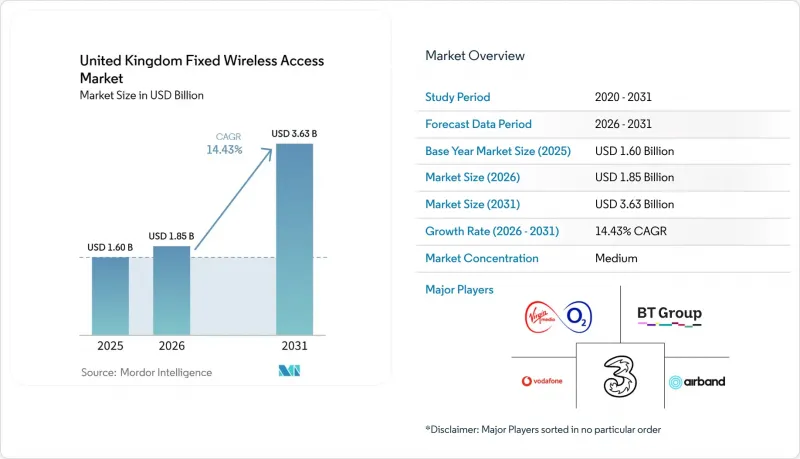
This report is Segmented by Type (Hardware and Services), Application (Residential, Commercial, Industrial, and Government and Public Safety), Frequency Band (Sub-6 GHz, Mmwave (Above 24 GHz), and Unlicensed/Shared CBRS), and Deployment Mode (Indoor CPE, Outdoor CPE, and Self-Install Window-Mount CPE). The Market Forecasts are Provided in Value (USD).
United Kingdom Fixed Wireless Access Market Trends and Insights
5G Roll-Out Expanding Gigabit-Grade Fixed Wireless Access Coverage
The shift toward 5G Standalone infrastructure is turning network capacity into services that can be sold and supported at scale across the UK fixed wireless access market. VodafoneThree said its GBP 11 billion (USD 14.8 billion) investment plan targets 99% 5G Standalone population coverage by 2030, and the company is using Multi Operator Core Network infrastructure across more than 10,000 shared sites to widen addressable fixed wireless access coverage without a matching rise in capital intensity. Virgin Media O2 activated 5G Standalone for large enterprise, public-sector, and SME customers across 500 UK towns and cities in February 2025, which improved the network baseline for enterprise-grade fixed wireless access use cases. Ofcom reported in Spring 2026 that 5G outdoor coverage from all major operators had moved to a 76%-94% range, up from 47%-65% in mid-2025, which materially increased the addressable premises base for the UK fixed wireless access market. This stage differs from earlier 4G-led cycles because operators are tying product launches to 5G Standalone capability, which supports service differentiation, lower latency, and more stable performance. The regulatory push behind the UK Wireless Infrastructure Strategy is also helping convert coverage obligations into commercial momentum, which strengthens the operating case for the UK fixed wireless access market.
Rural Broadband Gap Sustaining Demand for Rapid Last-Mile Deployment
The rural demand base remains important because public funding continues to recognize that many areas are expensive to connect with fixed-line infrastructure, thereby preserving a clear role for the UK fixed wireless access market. Building Digital UK allocated GBP 1.9 billion (USD 2.43 billion) in capital investment through 2029-2030, and the revised Project Gigabit target of 99% gigabit coverage by 2032 extends the demand window for fixed wireless access operators in underserved areas. BDUK also confirmed that 89% of all premises connected through subsidy in fiscal 2024/25 were in rural areas, indicating that these geographies still account for a large share of intervention-led broadband spending. Airband's network covered more than 440,000 premises across Wales and South West England by December 2025, and Quickline delivered 36,650 Project Gigabit connections during 2025 before passing more than 40,000 premises by early 2026, which shows that rural fixed wireless access can scale to meaningful volumes under live delivery programs. Ofcom also reported that 39,000 UK premises still could not access decent broadband from any fixed-line or fixed-wireless network in January 2026, leaving a priority group that is more likely to be served by wireless solutions than by expensive trenching projects. That backdrop keeps rural providers relevant even as larger operators expand, and it supports a longer runway for the UK fixed wireless access market in low-density areas.
Spectrum Availability Constraints and Licensing Uncertainty
Spectrum access remains one of the clearest structural limits on the UK fixed wireless access market, because the same regulatory system that opens bands for use also creates uneven access between national operators and smaller rural providers. Ofcom completed the mmWave auction in October 2025 and awarded EE, O2, and VodafoneThree each 800 MHz at 26 GHz and 1 GHz at 40 GHz for GBP 13 million (USD 16.64 million) per operator across 68 high-density areas, improving high-capacity urban availability but concentrating those assets among 3 large players. At the same time, the United Kingdom had 575 active shared access licenses in the 3.8-4.2 GHz band by October 2025, which increased interference management complexity and technical overhead for operators without exclusive holdings. A government-backed dynamic spectrum assignment research program led by Queen Mary University of London is exploring more flexible models in bands including 1.8 GHz, 3.8-4.2 GHz, and the upper 6 GHz, but the work remains in the research phase and has not provided immediate relief. Ofcom's October 2025 decision to make 5.8 GHz fixed wireless access equipment license-exempt helped reduce entry barriers for WISPs, but it only eased part of the pressure rather than resolving the broader access imbalance. This leaves spectrum strategy as a lasting competitive divider inside the UK fixed wireless access market, especially between scale operators and rural specialists.
Other drivers and restraints analyzed in the detailed report include:
- Fixed Wireless Access as a Cost-Effective Alternative to Fiber in Hard-to-Reach Locations
- Enterprise Backup Connectivity Demand From SMB And Branch Networks
- Weather Sensitivity Affecting High-Band Performance and Reliability
For complete list of drivers and restraints, kindly check the Table Of Contents.
Segment Analysis
Hardware accounted for 60.13% of the UK fixed wireless access market in 2025, while services are projected to expand at a 15.10% CAGR through 2031, indicating a clear shift in how value is expected to grow over time. Hardware remained dominant because consumer premise equipment volumes rose across residential and commercial deployments, especially indoor Wi-Fi 6 and Wi-Fi 7 routers and outdoor directional units tied to household broadband rollouts. Access units, including femtocells and picocells, are also gaining importance as operators densify service in multi-dwelling buildings and enterprise settings, and the source content identified Nokia and Ericsson as core suppliers in these buildouts. Services, however, are expanding faster because enterprise buyers increasingly want managed connectivity with service-level commitments, monitoring, and fault support rather than a device-only offer, and that aligns with the broader commercial preferences of operators in the UK fixed wireless access market.
The type mix is also changing because mobile operators are selling fixed wireless access as part of converged bundles that combine broadband, mobile, and media, which increases measured services revenue as subscriber bases mature. The source content also noted that Ericsson and Nokia's professional services businesses are supporting UK operators with network design, spectrum optimization, and managed CPE fleet operations, thereby shifting part of the value chain away from one-time equipment sales. Ofcom's performance expectations for fixed broadband add another reason for operators to favor managed service layers, as providers need to sustain quality commitments after installation rather than simply complete a hardware shipment. Over the forecast period, this should keep hardware central to volume while allowing services to capture a larger share of future value creation in the UK fixed wireless access market.
Residential accounted for 65.13% of the UK fixed wireless access market share in 2025, while government and public safety are projected to expand at a 15.76% CAGR through 2031, reflecting the divide between current scale and future momentum. Government demand is rising because public-sector digital programs need resilient connectivity for remote sites, emergency services, local authority operations, and field infrastructure where fixed-line deployment is slower or harder to justify. Virgin Media O2's February 2025 5G Standalone activation for public-sector and business customers across 500 towns and cities widened the quality baseline for those use cases. BDUK procurement frameworks also support this pattern because they can move faster on targeted connectivity needs than commercially led fiber rollouts in many rural or strategic locations.
Industrial applications remain small, but the segment is growing steadily as manufacturers and logistics operators use private 5G and shared-access spectrum for automation, IoT links, and process digitization. Residential scale still reflects the strength of branded consumer broadband products from Three UK, BT/EE, and VodafoneThree, which continue to carry the largest subscriber base in the UK fixed wireless access market. Three UK's Summer Sale 2026 priced 5G Home Broadband from GBP 18 (USD 22.86) per month on 24-month terms, which helped position fixed wireless access against lower-end fiber tariffs in coverage areas where performance expectations are comparable. Commercial applications sit between these two ends of demand, because they combine the volume logic of branch connectivity with a need for resilience that is stronger than in typical household use.
Complete Report Scope:
- By Type
- Hardware
- Consumer Premise Equipment (CPE)
- Access Units (Femto and Picocells)
- Services
- Hardware
- By Application
- Residential
- Commercial
- Industrial
- Government and Public Safety
- By Frequency Band
- Sub-6 GHz
- mmWave (Above 24 GHz)
- Unlicensed / Shared CBRS
- By Deployment Mode
- Indoor CPE
- Outdoor CPE
- Self-Install Window-Mount CPE
List of Companies Covered in this Report:
- BT Group plc
- Virgin Media O2 Limited
- Vodafone Group Plc
- Hutchison 3G UK Limited
- Airband Community Internet Limited
- Quickline Communications Limited
- Connexin Limited
- Voneus Limited
- Freshwave Group Limited
- Nokia Corporation
- Ericsson AB
- Mavenir Systems, Inc.
- Qualcomm Technologies, Inc.
- Samsung Electronics Co., Ltd.
- ADTRAN Holdings, Inc.
- Cambium Networks Corporation
- DZS Inc.
- Airspan Networks Holdings Inc.
- Arcadyan Technology Corporation
- Sercomm Corporation
- Ceragon Networks Ltd.
Additional Benefits:
- The market estimate (ME) sheet in Excel format
- 3 months of analyst support
TABLE OF CONTENTS
1 INTRODUCTION
- 1.1 Study Assumptions and Market Definition
- 1.2 Scope of the Study
2 RESEARCH METHODOLOGY
3 EXECUTIVE SUMMARY
4 MARKET LANDSCAPE
- 4.1 Market Overview
- 4.2 Market Drivers
- 4.2.1 5G Roll-Out Expanding Gigabit-Grade Fixed Wireless Access Coverage
- 4.2.2 Rural Broadband Gap Sustaining Demand for Rapid Last-Mile Deployment
- 4.2.3 Fixed Wireless Access as a Cost-Effective Alternative to Fiber in Hard-to-Reach Locations
- 4.2.4 Enterprise Backup Connectivity Demand from SMB and Branch Networks
- 4.2.5 Private 5G and Edge Use Cases Expanding Enterprise Fixed Wireless Access Adoption
- 4.2.6 Self-Install Customer Premises Equipment Reducing Installation Friction and Truck Rolls
- 4.3 Market Restraints
- 4.3.1 Spectrum Availability Constraints and Licensing Uncertainty
- 4.3.2 Weather Sensitivity Affecting High-Band Performance and Reliability
- 4.3.3 Fiber Substitution and Aggressive Broadband Pricing Limiting Premium Uptake
- 4.3.4 Planning, Backhaul, and Rooftop Access Constraints Slowing Network Densification
- 4.4 Industry Value-Chain Analysis
- 4.5 Regulatory Landscape
- 4.6 Technological Outlook
- 4.6.1 Key Enablers for FWA Adoption
- 4.6.2 Vendor Initiatives and Partnerships
- 4.6.3 Business Considerations and Prerequisites
- 4.6.4 FWA vs FTTH / FTTdp Comparison
- 4.6.5 Rural, Semi-Urban and Urban Use-Case Models
- 4.7 Impact of Macroeconomic Factors on the Market
- 4.8 Porter's Five Forces Analysis
- 4.8.1 Bargaining Power of Suppliers
- 4.8.2 Bargaining Power of Buyers
- 4.8.3 Threat of New Entrants
- 4.8.4 Threat of Substitutes
- 4.8.5 Competitive Rivalry
5 MARKET SIZE AND GROWTH FORECASTS (VALUE)
- 5.1 By Type
- 5.1.1 Hardware
- 5.1.1.1 Consumer Premise Equipment (CPE)
- 5.1.1.2 Access Units (Femto and Picocells)
- 5.1.2 Services
- 5.1.1 Hardware
- 5.2 By Application
- 5.2.1 Residential
- 5.2.2 Commercial
- 5.2.3 Industrial
- 5.2.4 Government and Public Safety
- 5.3 By Frequency Band
- 5.3.1 Sub-6 GHz
- 5.3.2 mmWave (Above 24 GHz)
- 5.3.3 Unlicensed / Shared CBRS
- 5.4 By Deployment Mode
- 5.4.1 Indoor CPE
- 5.4.2 Outdoor CPE
- 5.4.3 Self-Install Window-Mount CPE
6 COMPETITIVE LANDSCAPE
- 6.1 Market Concentration
- 6.2 Strategic Moves
- 6.3 Market Share Analysis
- 6.4 Company Profiles (includes Global Level Overview, Market Level Overview, Core Segments, Financials as Available, Strategic Information, Market Rank/Share for Key Companies, Products and Services, and Recent Developments)
- 6.4.1 BT Group plc
- 6.4.2 Virgin Media O2 Limited
- 6.4.3 Vodafone Group Plc
- 6.4.4 Hutchison 3G UK Limited
- 6.4.5 Airband Community Internet Limited
- 6.4.6 Quickline Communications Limited
- 6.4.7 Connexin Limited
- 6.4.8 Voneus Limited
- 6.4.9 Freshwave Group Limited
- 6.4.10 Nokia Corporation
- 6.4.11 Ericsson AB
- 6.4.12 Mavenir Systems, Inc.
- 6.4.13 Qualcomm Technologies, Inc.
- 6.4.14 Samsung Electronics Co., Ltd.
- 6.4.15 ADTRAN Holdings, Inc.
- 6.4.16 Cambium Networks Corporation
- 6.4.17 DZS Inc.
- 6.4.18 Airspan Networks Holdings Inc.
- 6.4.19 Arcadyan Technology Corporation
- 6.4.20 Sercomm Corporation
- 6.4.21 Ceragon Networks Ltd.
7 MARKET OPPORTUNITIES AND FUTURE OUTLOOK
- 7.1 White-Space and Unmet-Need Assessment

