PUBLISHER: Mordor Intelligence | PRODUCT CODE: 2099938

PUBLISHER: Mordor Intelligence | PRODUCT CODE: 2099938
Printed Medical Devices - Market Share Analysis, Industry Trends & Statistics, Growth Forecasts (2026 - 2031)
According to Mordor Intelligence, the printed medical devices market is projected to expand from USD 5.17 billion in 2025 and USD 5.92 billion in 2026 to USD 12.15 billion by 2031, registering a CAGR of 15.47% between 2026 and 2031.
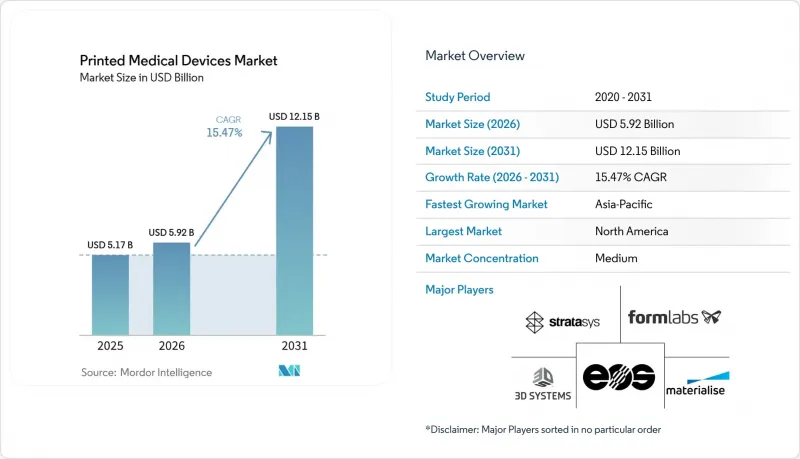
This report is Segmented by Product Type (Printed Implants, Printed Prosthetics and Orthotics, and Others), Technology (Stereolithography (SLA), and Others), Application (Orthopedics, Dentistry, and Others), End-User (Hospitals and Clinics, Dental Clinics and Laboratories, and Others), and Geography (North America, Europe, Asia-Pacific, and Others). The Market Forecasts are Provided in Terms of Value (USD).
Global Printed Medical Devices Market Trends and Insights
Rising Demand for Patient-Matched Medical Devices
Patient-matched design has become one of the strongest demand anchors in the printed medical devices market because it addresses a direct clinical need rather than a manufacturing preference. Surgeons in orthopedic and craniofacial procedures increasingly depend on image-based workflows that translate scans into components built for a single anatomy, which reduces the need for intraoperative adjustment and supports more precise fit. Restor3d's December 2025 rollout of the iTotal Identity CR 3DP Porous system showed how fully personalized and cementless knee replacement designs are moving into formal product roadmaps instead of remaining bespoke side offerings. As this evidence base builds, the printed medical devices market gains a stronger case for wider adoption because the value proposition is tied to clinical performance, revision risk, and operating room efficiency rather than to production novelty alone.
Expanding Clinical Use of Surgical Guides and Templates
Surgical guides and patient-specific templates are becoming a routine extension of digital surgical planning in the printed medical devices market. Their role has moved beyond preoperative visualization because they now help convert imaging data into actionable procedure steps that can be manufactured close to the treatment site. The March 2025 point-of-care facial implant case at University Hospital Basel demonstrated that on-site production can support same-day manufacture and implantation within an MDR-compliant workflow, which is a meaningful operational shift for time-sensitive reconstruction procedures. This platform has been used across more than 80 cranial implant surgeries at partner hospitals, which shows that hospital-based additive production is functioning at repeated clinical volume rather than as a one-time demonstration. That pattern matters for the printed medical devices market because vendors with validated applications and site-ready regulatory workflows have a clearer route to adoption than suppliers that still sell hardware without clinical implementation depth.
High Validation Burden for Personalized Medical Products
The same customization that supports demand in the printed medical devices market also raises the burden of proof for manufacturers. Patient-specific devices do not fit the same review rhythm as standardized product families because each variation must still meet requirements for structural performance, biocompatibility, and sterilization within a controlled process. This increases time, cost, and documentation work in direct proportion to design complexity and the degree of personalization. As a result, the printed medical devices market favors companies that already operate certified manufacturing infrastructure and established quality systems, while smaller innovators face a steeper path to routine clinical commercialization. This restraint is especially relevant for bioprinting and tissue engineering programs because they need strong validation packages before demand can convert into scalable procurement.
Other drivers and restraints analyzed in the detailed report include:
- Growth in Point-of-Care Manufacturing Inside Hospitals
- Regulatory Clarity for Additively Manufactured Medical Devices
- Limited Clinical Scale-Up for Complex Bioprinted Products
For complete list of drivers and restraints, kindly check the Table Of Contents.
Segment Analysis
Printed implants held 38.74% of revenue in 2025, which made them the main revenue base of the printed medical devices market through demand in orthopedic, spinal, and craniofacial reconstruction. This segment benefits from a direct clinical match between additive manufacturing and porous metallic structures, where design freedom supports osseointegration and procedure-specific fit. The printed medical devices industry also continues to rely on implants because this category already fits established surgical pathways, hospital purchasing behavior, and surgeon familiarity across high-volume procedures. The strength of implants gives the printed medical devices market a stable revenue core even as newer categories move through earlier adoption stages.
Bioprinted medical devices and tissue constructs are projected to grow at an 18.92% CAGR through 2031, which makes them the fastest-expanding product group in the printed medical devices market. Printed surgical instruments and guides continue to benefit each time a hospital installs or validates a point-of-care workflow, since these applications connect clearly to imaging, planning, and same-site production. Other product types such as dental restorations, hearing-related devices, CPAP masks, and prosthetics are also advancing as material portfolios broaden for patient-specific use cases.
Stereolithography held 35.92% of 2025 revenue, which kept it in the volume lead within the printed medical devices market. Its position reflects strong use in high-resolution parts such as dental devices, surgical planning models, and anatomical phantoms where surface finish and dimensional accuracy are critical. SLA near imaging and simulation workflows, where printed structures support research, calibration, and preparation rather than permanent implantation. Fused deposition modeling remains important for institutions entering the printed medical devices industry because it lowers the initial barrier for selected models and prosthetic components, even if its finish and material range limit broader clinical use.
Bioprinting technologies are forecasted to expand at a 16.17% CAGR through 2031, which gives them the fastest growth profile among the technology groups in the printed medical devices market. This reflects rising clinical activity in regenerative medicine and a widening expectation that advanced platforms must align with formal quality and validation frameworks before large institutions will scale purchases. Material jetting and related methods are carving out a place in anatomical modeling where multi-material and tissue-mimicking output improves training and procedural planning. The technology mix in the printed medical devices market is therefore widening, but adoption still follows clinical use case strength, materials validation, and the quality burden attached to each workflow.
Complete Report Scope:
- By Product Type
- Printed Implants
- Printed Prosthetics and Orthotics
- Printed Surgical Instruments and Guides
- Bioprinted Medical Devices and Tissue Constructs
- Other Product Types
- By Technology
- Stereolithography (SLA)
- Fused Deposition Modeling (FDM)
- Selective Laser Sintering (SLS)
- Electron Beam Melting (EBM)
- Bioprinting Technologies
- Other Technologies
- By Application
- Orthopedics
- Dentistry
- Cardiovascular Applications
- Surgical Planning and Training
- Tissue Engineering and Regenerative Medicine
- Other Applications
- By End-User
- Hospitals and Clinics
- Dental Clinics and Laboratories
- Academic and Research Institutes
- Medical Device Manufacturers
- Biotechnology and Pharmaceutical Companies
- By Geography
- North America
- United States
- Canada
- Mexico
- Europe
- Germany
- United Kingdom
- France
- Italy
- Spain
- Rest of Europe
- Asia-Pacific
- China
- Japan
- India
- Australia
- South Korea
- Rest of Asia-Pacific
- Middle East and Africa
- GCC
- South Africa
- Rest of Middle East and Africa
- South America
- Brazil
- Argentina
- Rest of South America
- North America
Geography Analysis
North America accounted for 43.71% of the printed medical devices market in 2025, which made it the leading regional contributor by a clear margin. The region benefits from a dense base of FDA-registered additive manufacturing capacity, mature surgical supply chains, and hospitals that have moved further into operational use of point-of-care production. The United States remains the center of regional demand because it combines large procedure volumes with major academic health systems, VA facilities, and specialized orthopedic centers that can support validated additive workflows. Canada and Mexico remain smaller sub-markets, but position them around dental production and selected orthopedic use cases within the wider regional ecosystem.
Europe remained the second-largest regional block in the printed medical devices market and stood out for its structured regulatory environment. The region's framework for in-hospital manufacturing is creating higher documentation demands, but it is also pushing institutions toward more standardized and auditable workflows. Germany, the United Kingdom, and France continue to lead regional deployment of certified hospital-based additive capabilities. Italy and France also retain a strong position in dental device activity because existing CAD and CAM capability provides a practical bridge into broader additive adoption.
Asia-Pacific is projected to expand at a 19.23% CAGR through 2031, making it the fastest-growing geography in the printed medical devices market. The region's growth base is broad, with China supported by large surgical volumes, Japan supported by advanced care quality and aging demographics, India supported by expanding manufacturing interest, and South Korea supported by digital dentistry depth. The printed medical devices market is still less mature in much of Asia-Pacific than in North America or Western Europe, but growth is being reinforced by domestic manufacturing ambitions and wider digital health infrastructure investment. Middle East and Africa and South America remain earlier-stage opportunities in the printed medical devices market, with GCC healthcare investment and Brazil's dental and orthopedic demand providing the clearest starting points for future expansion.
- 3D Systems
- 3T Additive Manufacturing Ltd.
- Axial3D
- Carbon, Inc.
- EnvisionTEC
- EOS GmbH
- Formlabs Inc.
- Formlabs Inc.
- GE Additive
- HP Development Company, L.P.
- Materialise
- Medtronic
- Nano3D Biosciences Inc.
- Nanofabrica Ltd.
- Prodways Group
- Renishaw plc
- SLM Solutions Group AG
- Stratasys
- Stryker
- Zimmer Biomet
Additional Benefits:
- The market estimate (ME) sheet in Excel format
- 3 months of analyst support
TABLE OF CONTENTS
1 Introduction
- 1.1 Study Assumptions and Market Definition
- 1.2 Scope of the Study
2 Research Methodology
3 Executive Summary
4 Market Landscape
- 4.1 Market Overview
- 4.2 Market Drivers
- 4.2.1 Rising Demand for Patient-Matched Medical Devices
- 4.2.2 Expanding Clinical Use of Surgical Guides and Templates
- 4.2.3 Growth in Point-of-Care Manufacturing Inside Hospitals
- 4.2.4 Regulatory Clarity for Additively Manufactured Medical Devices
- 4.2.5 Broader Adoption of Biocompatible Polymers, Metals, and Bioinks
- 4.2.6 Digital Workflow Integration Across Imaging, CAD, and Printing
- 4.3 Market Restraints
- 4.3.1 High Validation Burden for Personalized Medical Products
- 4.3.2 Capital Intensity of Medical Grade Printers and Post-Processing
- 4.3.3 Fragmented Reimbursement for Custom Printed Devices
- 4.3.4 Limited Clinical Scale-Up for Complex Bioprinted Products
- 4.4 Supply/Value Chain Analysis
- 4.5 Regulatory Landscape
- 4.6 Technological Outlook
- 4.7 Porter's Five Forces Analysis
- 4.7.1 Threat of New Entrants
- 4.7.2 Bargaining Power of Suppliers
- 4.7.3 Bargaining Power of Buyers
- 4.7.4 Threat of Substitutes
- 4.7.5 Competitive Rivalry
5 Market Size & Growth Forecasts (Value, USD)
- 5.1 By Product Type
- 5.1.1 Printed Implants
- 5.1.2 Printed Prosthetics and Orthotics
- 5.1.3 Printed Surgical Instruments and Guides
- 5.1.4 Bioprinted Medical Devices and Tissue Constructs
- 5.1.5 Other Product Types
- 5.2 By Technology
- 5.2.1 Stereolithography (SLA)
- 5.2.2 Fused Deposition Modeling (FDM)
- 5.2.3 Selective Laser Sintering (SLS)
- 5.2.4 Electron Beam Melting (EBM)
- 5.2.5 Bioprinting Technologies
- 5.2.6 Other Technologies
- 5.3 By Application
- 5.3.1 Orthopedics
- 5.3.2 Dentistry
- 5.3.3 Cardiovascular Applications
- 5.3.4 Surgical Planning and Training
- 5.3.5 Tissue Engineering and Regenerative Medicine
- 5.3.6 Other Applications
- 5.4 By End-User
- 5.4.1 Hospitals and Clinics
- 5.4.2 Dental Clinics and Laboratories
- 5.4.3 Academic and Research Institutes
- 5.4.4 Medical Device Manufacturers
- 5.4.5 Biotechnology and Pharmaceutical Companies
- 5.5 By Geography
- 5.5.1 North America
- 5.5.1.1 United States
- 5.5.1.2 Canada
- 5.5.1.3 Mexico
- 5.5.2 Europe
- 5.5.2.1 Germany
- 5.5.2.2 United Kingdom
- 5.5.2.3 France
- 5.5.2.4 Italy
- 5.5.2.5 Spain
- 5.5.2.6 Rest of Europe
- 5.5.3 Asia-Pacific
- 5.5.3.1 China
- 5.5.3.2 Japan
- 5.5.3.3 India
- 5.5.3.4 Australia
- 5.5.3.5 South Korea
- 5.5.3.6 Rest of Asia-Pacific
- 5.5.4 Middle East and Africa
- 5.5.4.1 GCC
- 5.5.4.2 South Africa
- 5.5.4.3 Rest of Middle East and Africa
- 5.5.5 South America
- 5.5.5.1 Brazil
- 5.5.5.2 Argentina
- 5.5.5.3 Rest of South America
- 5.5.1 North America
6 Competitive Landscape
- 6.1 Market Concentration
- 6.2 Market Share Analysis
- 6.3 Company Profiles (includes Global level Overview, Market level overview, Core Segments, Financials as available, Strategic Information, Market Rank/Share for key companies, Products & Services, Recent Developments)
- 6.3.1 3D Systems Corporation
- 6.3.2 3T Additive Manufacturing Ltd.
- 6.3.3 Axial3D
- 6.3.4 Carbon, Inc.
- 6.3.5 EnvisionTEC
- 6.3.6 EOS GmbH
- 6.3.7 Formlabs Inc.
- 6.3.8 Formlabs Inc.
- 6.3.9 GE Additive
- 6.3.10 HP Development Company, L.P.
- 6.3.11 Materialise NV
- 6.3.12 Medtronic plc
- 6.3.13 Nano3D Biosciences Inc.
- 6.3.14 Nanofabrica Ltd.
- 6.3.15 Prodways Group
- 6.3.16 Renishaw plc
- 6.3.17 SLM Solutions Group AG
- 6.3.18 Stratasys Ltd.
- 6.3.19 Stryker Corporation
- 6.3.20 Zimmer Biomet Holdings, Inc.
7 Market Opportunities & Future Outlook
- 7.1 White-space & Unmet-need Assessment

