PUBLISHER: Mordor Intelligence | PRODUCT CODE: 2114430

PUBLISHER: Mordor Intelligence | PRODUCT CODE: 2114430
3D Printed Medical Devices - Market Share Analysis, Industry Trends & Statistics, Growth Forecasts (2026 - 2031)
According to Mordor Intelligence, the 3D printed medical devices market size is expected to grow from USD 2.76 billion in 2025 to USD 3.24 billion in 2026 and is forecast to reach USD 7.16 billion by 2031 at 17.22% CAGR over 2026-2031.
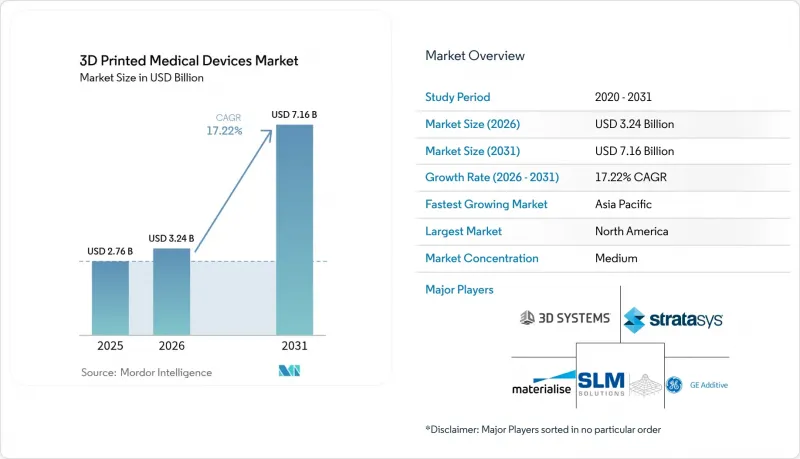
This report is Segmented by Offerings (Hardware and Software), Type (Surgical Guides, Surgical Instruments, Prosthetics and Implants, and More), Material (Plastics, and More), Technology (Laser Beam Melting, Photopolymerization (UV), Electron Beam Melting, and More), End User (Hospitals and Surgical Centers, Specialty Clinics, and More), and Geography. The Market Forecasts are Provided in Terms of Value (USD).
Global 3D Printed Medical Devices Market Trends and Insights
Easy Mass-Customization Capability
Patient-specific printing removes the constraint of one-size-fits-all devices. Since August 2024, 3D Systems' EXT 220 MED platform has supported over 60 cranioplasties, each precisely matched to the patient's anatomy. Basel surgeons implanted the first MDR-compliant 3D-printed PEEK facial implant in March 2025, bypassing prolonged external supply chains. Operating rooms now generate surgical guides with 100% dimensional accuracy, eliminating the need for iterative template revisions. Complex trabecular structures printed in titanium or PEEK foster osseointegration and mitigate stress shielding, directly improving orthopedic outcomes. The shift from mass production to mass customization underpins higher clinical value and supports premium reimbursement models.
Rising Transplant Waiting Lists
More than 100,000 Americans remain on transplant lists, spurring investment in tissue and organ bioprinting. Bioprinting firms secured a record amount of funding in 2024, and the related market is projected to grow at a 11.8% CAGR through 2034. Galway researchers in 2025 printed contractile heart tissue that morphs under cell-generated forces, bringing functional organs closer to clinical reality.As vascularization techniques mature, bioprinted constructs are transitioning from research to regulated therapy, positioning the segment as a long-term solution to organ shortages.
Stringent FDA Class-III Device Clearance Pathway
Implantable devices often default to class-III, demanding exhaustive biocompatibility and clinical evidence. ISO 10993-1 guidance can stretch review cycles 12-18 months longer than for traditional forgings. Still, the agency's 510(k) database logged notable 2024 wins: Curiteva's PEEK lumbar fusion and Restor3D's cementless knee replacement gained clearance, illustrating that equivalence arguments are possible even for additively manufactured implants. Achieving predicate alignment remains complex when lattice structures or gradient compositions have no historical analogs.
Other drivers and restraints analyzed in the detailed report include:
- Cost and Lead-Time Reduction vs. Subtractive Manufacturing
- Surge in Hospital-Owned Point-of-Care Print Labs
- High Material Qualification Costs
For complete list of drivers and restraints, kindly check the Table Of Contents.
Segment Analysis
Hardware generated 60.32% of the 3D printed medical devices market size in 2025, as hospitals and service bureaus initially invest in printers and clean-room modifications. Industrial bioprinters cost USD 200,000 to USD 500,000, reinforcing the up-front capital intensity. Printer utilization subsequently generates recurring revenue through polymers, metal powders, and cell-laden hydrogels, a pattern evident as Stratasys posted record consumables revenue despite total sales slipping in 2024.
Printers alone are no longer the sole differentiator of suppliers; workflow software now shortens design iterations, automates support generation, and links directly to sterilization logs. However, Software grows at a rapid rate of 17.64% CAGR during the forecast period (2026-2031). AI-driven platforms cut complex anatomical model preparation from 100 hours to 18 hours, lifting throughput for overstretched clinical engineers. Service offerings remain fragmented, yet health-system buyers increasingly demand integrated ecosystems that combine hardware, validated materials, cloud rendering, and on-site support contracts.
Prosthetics and implants accounted for 38.55% of the 3D printed medical devices market share in 2025, driven primarily by demand in cranio-maxillofacial and orthopedic applications. Surgeons value latticed titanium hip cups or PEEK skull plates that reduce stress shielding and enable imaging clarity. Regenerative medicine pushes tissue engineering forward at an 18.45% CAGR, outpacing traditional implant growth as scaffold vascularization and immune modulation mature.
Printed surgical guides and instruments further expand the application mix, reducing intraoperative time and enhancing resection accuracy. University Hospital Basel proved regulatory viability when its team implanted the first MDR-compliant facial PEEK device on-site in March 2025. Tissue engineering is expected to register the fastest growth of 18.45% from 2026 to 2031. Tissue engineering will expand into organ-on-chip platforms that support drug discovery, reinforcing the convergence between device and pharmaceutical workflows.
Complete Report Scope:
- By Offerings
- Hardware
- 3D Printers
- FDM Printers
- SLS Printers
- SLA/DLP Printers
- Bioprinters
- Materials
- 3D Printers
- Software
- Hardware
- By Type
- Surgical Guides
- Surgical Instruments
- Prosthetics and Implants
- Orthopedic
- Dental
- Cranio-maxillofacial
- Tissue Engineering Products
- By Materials
- Plastics
- Metal and Metal Alloy Powders
- Biocompatible Polymers
- Ceramics
- By Technology
- Laser Beam Melting
- Photopolymerization (UV)
- Electron Beam Melting
- Extrusion-based
- Binder Jetting
- By End User
- Hospitals and Surgical Centers
- Specialty Clinics
- Academic and Research Institutes
- Others
- By Geography
- North America
- United States
- Canada
- Mexico
- South America
- Brazil
- Argentina
- Rest of South America
- Europe
- Germany
- United Kingdom
- France
- Italy
- Spain
- Russia
- Rest of Europe
- Asia-Pacific
- China
- Japan
- India
- South Korea
- Rest of Asia-Pacific
- Middle East
- Gulf Cooperation Council (GCC)
- Turkey
- Israel
- Rest of Middle East
- Africa
- South Africa
- Egypt
- Rest of Africa
- North America
Geography Analysis
North America contributed 45.42% of global revenue in 2025, reflecting early FDA guidance, mature reimbursement codes, and heavy hospital infrastructure investment. The region's ecosystem deepens as DARPA channels grants into battlefield bioprinting and smart bandages that merge additive electronics with antimicrobial delivery. Consolidation continues; Enovis paid EUR 800 million for LimaCorporate, expanding its 3D-printed titanium hip portfolio.
Asia-Pacific outpaced the global CAGR with 18.05% during the forecast period. China's NMPA approved 61 innovative devices in 2024, representing an 11% year-over-year increase that shortens the time-to-market for domestic startups. Japan's medical device sector is growing at a significant rate annually, driven by aging demographics that demand minimally invasive implants. India harmonizes its regulatory code with IMDRF principles, attracting foreign direct investment for local printer assembly and powder atomization.
Europe balances strict MDR requirements with robust R&D incentives. Germany invests in additive qualifications that transfer know-how from automotive firms to orthopedic suppliers, while UK universities spin out software startups specializing in generative implant design. Sustainability policies that emphasize circular manufacturing favor additive techniques, which reuse powders and eliminate machining waste.
- 3D Systems
- Stratasys
- Materialise
- EOS GmbH
- SLM Solutions
- Renishaw
- GE Additive
- Carbon
- Desktop Metal
- Organovo
- PrintBio
- Prodways Group
- Curiteva
- Formlabs
- Concept Laser
- Arcam AB
- Dentsply Sirona
- Zimmer Biomet
- Johnson and Johnson (DePuy Synthes)
- Medtronic
Additional Benefits:
- The market estimate (ME) sheet in Excel format
- 3 months of analyst support
TABLE OF CONTENTS
1 INTRODUCTION
- 1.1 Study Assumptions and Market Definition
- 1.2 Scope of the Study
2 RESEARCH METHODOLOGY
3 EXECUTIVE SUMMARY
4 MARKET LANDSCAPE
- 4.1 Market Overview
- 4.2 Market Drivers
- 4.2.1 Easy mass-customization capability
- 4.2.2 Rising transplant waiting lists
- 4.2.3 Cost and lead-time reduction vs. subtractive manufacturing
- 4.2.4 Surge in hospital-owned point-of-care print labs
- 4.2.5 ISO/ASTM 52931 biocompatibility standard unlocking new polymers
- 4.2.6 Defense-funded battlefield bioprinting programs
- 4.3 Market Restraints
- 4.3.1 Stringent FDA class-III device clearance pathway
- 4.3.2 High material qualification costs
- 4.3.3 Shortage of GMP-grade bio-inks
- 4.3.4 Cyber-sabotage risks in distributed print files
- 4.4 Industry Value Chain Analysis
- 4.5 Regulatory Landscape
- 4.6 Technological Outlook
- 4.7 Porter'ss Five Forces
- 4.7.1 Threat of New Entrants
- 4.7.2 Bargaining Power of Buyers
- 4.7.3 Bargaining Power of Suppliers
- 4.7.4 Threat of Substitutes
- 4.7.5 Competitive Rivalry
5 MARKET SIZE AND GROWTH FORECASTS (VALUE)
- 5.1 By Offerings
- 5.1.1 Hardware
- 5.1.1.1 3D Printers
- 5.1.1.1.1 FDM Printers
- 5.1.1.1.2 SLS Printers
- 5.1.1.1.3 SLA/DLP Printers
- 5.1.1.1.4 Bioprinters
- 5.1.1.2 Materials
- 5.1.1.1 3D Printers
- 5.1.2 Software
- 5.1.1 Hardware
- 5.2 By Type
- 5.2.1 Surgical Guides
- 5.2.2 Surgical Instruments
- 5.2.3 Prosthetics and Implants
- 5.2.3.1 Orthopedic
- 5.2.3.2 Dental
- 5.2.3.3 Cranio-maxillofacial
- 5.2.4 Tissue Engineering Products
- 5.3 By Materials
- 5.3.1 Plastics
- 5.3.2 Metal and Metal Alloy Powders
- 5.3.3 Biocompatible Polymers
- 5.3.4 Ceramics
- 5.4 By Technology
- 5.4.1 Laser Beam Melting
- 5.4.2 Photopolymerization (UV)
- 5.4.3 Electron Beam Melting
- 5.4.4 Extrusion-based
- 5.4.5 Binder Jetting
- 5.5 By End User
- 5.5.1 Hospitals and Surgical Centers
- 5.5.2 Specialty Clinics
- 5.5.3 Academic and Research Institutes
- 5.5.4 Others
- 5.6 By Geography
- 5.6.1 North America
- 5.6.1.1 United States
- 5.6.1.2 Canada
- 5.6.1.3 Mexico
- 5.6.2 South America
- 5.6.2.1 Brazil
- 5.6.2.2 Argentina
- 5.6.2.3 Rest of South America
- 5.6.3 Europe
- 5.6.3.1 Germany
- 5.6.3.2 United Kingdom
- 5.6.3.3 France
- 5.6.3.4 Italy
- 5.6.3.5 Spain
- 5.6.3.6 Russia
- 5.6.3.7 Rest of Europe
- 5.6.4 Asia-Pacific
- 5.6.4.1 China
- 5.6.4.2 Japan
- 5.6.4.3 India
- 5.6.4.4 South Korea
- 5.6.4.5 Rest of Asia-Pacific
- 5.6.5 Middle East
- 5.6.5.1 Gulf Cooperation Council (GCC)
- 5.6.5.2 Turkey
- 5.6.5.3 Israel
- 5.6.5.4 Rest of Middle East
- 5.6.6 Africa
- 5.6.6.1 South Africa
- 5.6.6.2 Egypt
- 5.6.6.3 Rest of Africa
- 5.6.1 North America
6 COMPETITIVE LANDSCAPE
- 6.1 Market Concentration
- 6.2 Strategic Moves
- 6.3 Market Share Analysis
- 6.4 Company Profiles (includes Global level Overview, Market level overview, Core Segments, Financials as available, Strategic Information, Market Rank/Share for key companies, Products and Services, Recent Developments)
- 6.4.1 3D Systems
- 6.4.2 Stratasys
- 6.4.3 Materialise
- 6.4.4 EOS GmbH
- 6.4.5 SLM Solutions
- 6.4.6 Renishaw
- 6.4.7 GE Additive
- 6.4.8 Carbon
- 6.4.9 Desktop Metal
- 6.4.10 Organovo
- 6.4.11 PrintBio
- 6.4.12 Prodways Group
- 6.4.13 Curiteva
- 6.4.14 Formlabs
- 6.4.15 Concept Laser
- 6.4.16 Arcam AB
- 6.4.17 Dentsply Sirona
- 6.4.18 Zimmer Biomet
- 6.4.19 Johnson and Johnson (DePuy Synthes)
- 6.4.20 Medtronic
7 MARKET OPPORTUNITIES AND FUTURE OUTLOOK
- 7.1 White-space and Unmet-need Assessment

