PUBLISHER: Mordor Intelligence | PRODUCT CODE: 2099966

PUBLISHER: Mordor Intelligence | PRODUCT CODE: 2099966
Quantum Computing Vertical Applications BFSI - Market Share Analysis, Industry Trends & Statistics, Growth Forecasts (2026 - 2031)
According to Mordor Intelligence, the quantum computing vertical applications BFSI market size was USD 0.58 billion in 2025 and is forecast to reach USD 3.23 billion by 2031 at a CAGR of 33.91% from 2026 to 2031.
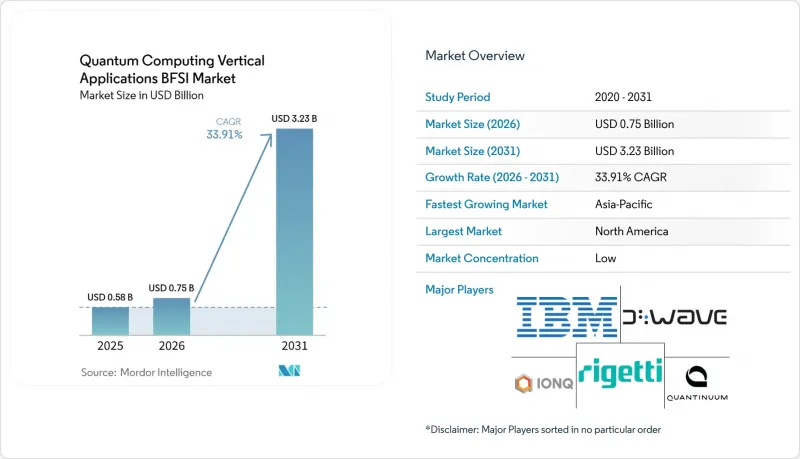
This report is Segmented by Solution (Software and Services), Deployment (Cloud-Based, Hybrid, and On-Premises), Quantum Computing Paradigm (Gate-Based Quantum Computing, Quantum Annealing, and More), Application (Portfolio and Wealth Management, and More), End-User (Banking, Insurance, and More), and Geography. The Market Forecasts are Provided in Terms of Value (USD).
Global Quantum Computing Vertical Applications BFSI Market Trends and Insights
Surging Demand for Quantum Risk Modeling and Portfolio Optimization
Financial institutions continue to face long compute cycles when running large Monte Carlo simulations across multi-factor portfolios, which keeps risk analytics at the forefront of enterprise quantum demand. ESMA stated in May 2026 that quantum Monte Carlo integration offers a theoretical quadratic speedup over classical approaches for financial workloads, which keeps the use case commercially relevant even before full hardware maturity arrives. Credit Agricole CIB and Pasqal advanced their partnership in June 2026 with a production roadmap focused on capital markets applications and risk-weighted asset monitoring, which shows that the quantum computing vertical applications BFSI market is moving beyond isolated technical tests in selected institutions. Banks also recognize that better optimization and scenario modeling can influence pricing quality, capital efficiency, and response times within the same operating framework. This creates a practical incentive to build internal algorithm knowledge now, because institutions that learn earlier will be better placed when production-grade systems become more dependable.
Rising Need for Post-Quantum Cryptography Readiness in Financial Networks
Post-quantum cryptography has moved from a research topic to an infrastructure planning issue, as financial institutions now have formal standards and clearer migration guidance. NIST finalized ML-KEM, ML-DSA, and SLH-DSA in August 2024, giving banks and payment operators a concrete baseline for transition work rather than a loose technical target. The G7 Cyber Expert Group reinforced this direction in January 2026 with a coordinated roadmap that pointed to 2030-2032 as a critical deadline window for high-priority systems and 2035 as the broader endpoint for migration. The urgency is stronger than it appears because harvest-now-decrypt-later exposure means sensitive financial data captured today can remain vulnerable long before a mature attack capability is deployed. In the quantum computing vertical applications BFSI market, that pressure is pushing security budgets, network reviews, and procurement calendars toward crypto-agile architectures earlier than many institutions had originally planned.
No Fault-Tolerant Quantum Systems for Production Finance Workloads
The biggest near-term brake on the quantum computing vertical applications BFSI market is hardware readiness, not customer awareness. ESMA noted in May 2026 that current quantum hardware capabilities are still limited for real-world, industry-scale financial problems, which keeps most institutions from using quantum outputs in high-stakes production environments. Banks, therefore, continue to treat many quantum results as advisory, experimental, or pre-production material that must be checked against classical methods. Those extra validation steps weaken the speed and efficiency gains that make quantum adoption attractive in the first place. Until error-corrected systems become more practical for financial workloads, a large part of demand will remain tied to pilots, sandboxes, and controlled research engagements rather than scaled deployment.
Other drivers and restraints analyzed in the detailed report include:
- Growing Bank Adoption of Hybrid Quantum-Classical Workflows
- Public-Private Funding for Financial-Grade Quantum Pilots
- Model Validation Risk for Quantum-Derived Financial Outputs
For complete list of drivers and restraints, kindly check the Table Of Contents.
Segment Analysis
Software accounted for 68.42% of revenue in 2025, making it the largest solution segment in the quantum computing vertical applications BFSI market. This lead reflects how most financial institutions access quantum capabilities through development kits, simulation tools, cloud interfaces, and application programming layers rather than through direct hardware ownership. The spending pattern also shows that buyers want usable environments for modeling, testing, and workflow integration before they commit to more specialized infrastructure decisions. Services are projected to expand at a 36.84% CAGR through 2031, indicating rising demand for managed pilots, application tuning, migration work, and implementation support. In the current phase of the quantum computing vertical applications BFSI market, software remains the easiest commercial entry point because it fits more naturally into established enterprise buying patterns.
The second layer of demand is forming around execution support, since institutions need help connecting quantum methods to real business processes rather than isolated demonstrations. Vendors with reusable libraries for valuation, optimization, fraud analytics, and cryptographic transition work can scale more effectively than firms that depend only on bespoke advisory assignments. This is one reason the quantum computing vertical applications BFSI industry is rewarding providers that combine tools, domain knowledge, and integration capabilities in a single offering. Pasqal's deeper work with Credit Agricole CIB shows why financial clients value suppliers that can stay engaged from technical exploration into structured delivery planning.
Cloud-based deployment captured 71.26% of revenue in 2025, which shows that the quantum computing vertical applications BFSI market still depends heavily on remote access models. This structure suits regulated institutions because it limits upfront capital commitments while preserving flexibility for research-stage work. It also reflects the reality that very few firms are prepared to own, operate, and maintain specialized quantum infrastructure on premises. Hybrid deployment is projected to expand at 35.19% CAGR through 2031 as users begin to connect quantum tools more directly with classical analytics, data pipelines, and enterprise controls. The result is a market where access convenience supports current scale, while integration depth shapes future differentiation.
The hybrid model is gaining ground because it better aligns with the operating logic of financial institutions than a pure quantum environment does. Banks and other users can keep sensitive governance steps, validation routines, and failover logic inside classical systems while allowing quantum components to handle selected compute tasks. This lowers organizational friction across the quantum computing vertical applications BFSI market because technical experimentation does not require a full rewrite of existing architecture. On-premises deployment will remain limited to cases where control, sovereignty, or infrastructure policy outweighs cost and flexibility.
Complete Report Scope:
- By Solution
- Software
- Services
- By Deployment
- Cloud-Based
- Hybrid
- On-Premises
- By Quantum Computing Paradigm
- Gate-Based Quantum Computing
- Quantum Annealing
- Hybrid Quantum-Classical Computing
- By Application
- Portfolio and Wealth Management
- Risk Management and Scenario Analysis
- Fraud Detection and Financial Crime Prevention
- Algorithmic and High-Frequency Trading
- Derivatives Pricing
- Credit Scoring and Loan Assessment
- Cybersecurity and Post-Quantum Cryptography
- Customer Analytics and Personalization
- Other Applications
- By End-User
- Banking
- Insurance
- Capital Markets and Investment Firms
- FinTech
- Payment and Digital Financial Services
- By Geography
- North America
- United States
- Canada
- Mexico
- South America
- Brazil
- Argentina
- Rest of South America
- Europe
- Germany
- United Kingdom
- France
- Russia
- Spain
- Rest of Europe
- Asia-Pacific
- China
- Japan
- India
- South Korea
- Southeast Asia
- Rest of Asia-Pacific
- Middle East and Africa
- Middle East
- Saudi Arabia
- United Arab Emirates
- Turkey
- Rest of Middle East
- Africa
- South Africa
- Nigeria
- Egypt
- Rest of Africa
- Middle East
- North America
Geography Analysis
North America accounted for 36.41% of revenue in 2025, giving it the largest regional position in the quantum computing vertical applications BFSI market. The region benefits from a dense concentration of Tier-1 banks, payment operators, capital markets firms, and quantum vendors with established enterprise relationships. The United States also has a clear advantage in cryptographic preparedness, as NIST finalized the first post-quantum cryptography standards in August 2024, providing financial institutions with a formal technical basis for migration planning. That standard-setting role supports earlier procurement activity across security, infrastructure review, and pilot work in the quantum computing vertical applications BFSI market. South America remains much smaller in scale, but the region is still relevant as cloud delivery and service-led adoption lower the barriers for financial firms seeking selective quantum exposure.
Europe forms a substantial secondary demand center in the quantum computing vertical applications BFSI market, with the United Kingdom, Germany, France, and Spain standing out as active markets. ESMA highlighted that DORA and the NIS 2 framework are turning quantum-related cryptographic vulnerability planning into a more structured compliance issue for European financial entities. That matters because regulatory timing gives vendors a clearer demand path than in markets where adoption depends only on voluntary experimentation. Erste Group's February 2026 integration of entangled quantum key distribution into existing banking fiber infrastructure in Vienna also shows that Europe is testing physical network security use cases, not only software-led pilots.
Asia-Pacific is projected to expand at 36.92% CAGR through 2031, making it the fastest-growing regional segment in the quantum computing vertical applications BFSI market. Public funding, large national technology programs, institutional research activity, and rising interest from banks and financial infrastructure players are supporting growth. The roadmap for Qubitra Technologies, announced by Fujitsu and SC Ventures in January 2026, shows how the region is building application-led pathways into fraud detection and trading use cases rather than waiting only for hardware maturity. The Middle East and Africa remain smaller in absolute terms, but sovereign programs and financial institutions in the region are beginning to explore derivatives pricing and payments security as early entry points.
- International Business Machines Corporation
- D-Wave Quantum Inc.
- IonQ, Inc.
- Rigetti Computing, Inc.
- Quantinuum Ltd.
- Xanadu Quantum Technologies Inc.
- Pasqal SAS
- IQM Quantum Computers Oy
- Oxford Quantum Circuits Ltd.
- Alice and Bob SAS
- Alpine Quantum Technologies GmbH
- QuEra Computing Inc.
- Quantum Computing Inc.
- Infleqtion, Inc.
- SEEQC, Inc.
- Quix Quantum B.V.
- Origin Quantum Computing Technology Co., Ltd.
- Shenzhen SpinQ Technology Co., Ltd.
- Anyon Systems Inc.
- Riverlane Ltd.
- Google LLC
- Cambridge Quantum Computing Ltd.
- Intel Corporation
- Fujitsu Limited
- Honeywell International Inc.
Additional Benefits:
- The market estimate (ME) sheet in Excel format
- 3 months of analyst support
TABLE OF CONTENTS
1 INTRODUCTION
- 1.1 Study Assumptions and Market Definition
- 1.2 Scope of the Study
2 RESEARCH METHODOLOGY
3 EXECUTIVE SUMMARY
4 MARKET LANDSCAPE
- 4.1 Market Overview
- 4.2 Market Drivers
- 4.2.1 Surging Demand for Quantum Risk Modeling and Portfolio Optimization
- 4.2.2 Rising Need for Post-Quantum Cryptography Readiness in Financial Networks
- 4.2.3 Growing Bank Adoption of Hybrid Quantum-Classical Workflows
- 4.2.4 Public-Private Funding for Financial-Grade Quantum Pilots
- 4.2.5 Quantum-As-A-Service Lowering Entry Barriers for Mid-Tier BFSI Firms
- 4.2.6 Regulatory Pressure to Modernize Cryptographic Infrastructure
- 4.3 Market Restraints
- 4.3.1 No Fault-Tolerant Quantum Systems for Production Finance Workloads
- 4.3.2 Model Validation Risk for Quantum-Derived Financial Outputs
- 4.3.3 Specialized Talent Shortage in Quantum Finance Stack Integration
- 4.3.4 Long PQC Migration Cycles can Delay Procurement Decisions
- 4.4 Impact of Macroeconomic Factors on the Market
- 4.5 Industry Value Chain Analysis
- 4.6 Technology Outlook
- 4.7 Regulatory Landscape
- 4.8 Porter's Five Forces Analysis
- 4.8.1 Threat of New Entrants
- 4.8.2 Bargaining Power of Suppliers
- 4.8.3 Bargaining Power of Buyers
- 4.8.4 Threat of Substitutes
- 4.8.5 Intensity of Competitive Rivalry
5 MARKET SIZE AND GROWTH FORECASTS (VALUE)
- 5.1 By Solution
- 5.1.1 Software
- 5.1.2 Services
- 5.2 By Deployment
- 5.2.1 Cloud-Based
- 5.2.2 Hybrid
- 5.2.3 On-Premises
- 5.3 By Quantum Computing Paradigm
- 5.3.1 Gate-Based Quantum Computing
- 5.3.2 Quantum Annealing
- 5.3.3 Hybrid Quantum-Classical Computing
- 5.4 By Application
- 5.4.1 Portfolio and Wealth Management
- 5.4.2 Risk Management and Scenario Analysis
- 5.4.3 Fraud Detection and Financial Crime Prevention
- 5.4.4 Algorithmic and High-Frequency Trading
- 5.4.5 Derivatives Pricing
- 5.4.6 Credit Scoring and Loan Assessment
- 5.4.7 Cybersecurity and Post-Quantum Cryptography
- 5.4.8 Customer Analytics and Personalization
- 5.4.9 Other Applications
- 5.5 By End-User
- 5.5.1 Banking
- 5.5.2 Insurance
- 5.5.3 Capital Markets and Investment Firms
- 5.5.4 FinTech
- 5.5.5 Payment and Digital Financial Services
- 5.6 By Geography
- 5.6.1 North America
- 5.6.1.1 United States
- 5.6.1.2 Canada
- 5.6.1.3 Mexico
- 5.6.2 South America
- 5.6.2.1 Brazil
- 5.6.2.2 Argentina
- 5.6.2.3 Rest of South America
- 5.6.3 Europe
- 5.6.3.1 Germany
- 5.6.3.2 United Kingdom
- 5.6.3.3 France
- 5.6.3.4 Russia
- 5.6.3.5 Spain
- 5.6.3.6 Rest of Europe
- 5.6.4 Asia-Pacific
- 5.6.4.1 China
- 5.6.4.2 Japan
- 5.6.4.3 India
- 5.6.4.4 South Korea
- 5.6.4.5 Southeast Asia
- 5.6.4.6 Rest of Asia-Pacific
- 5.6.5 Middle East and Africa
- 5.6.5.1 Middle East
- 5.6.5.1.1 Saudi Arabia
- 5.6.5.1.2 United Arab Emirates
- 5.6.5.1.3 Turkey
- 5.6.5.1.4 Rest of Middle East
- 5.6.5.2 Africa
- 5.6.5.2.1 South Africa
- 5.6.5.2.2 Nigeria
- 5.6.5.2.3 Egypt
- 5.6.5.2.4 Rest of Africa
- 5.6.5.1 Middle East
- 5.6.1 North America
6 COMPETITIVE LANDSCAPE
- 6.1 Market Concentration
- 6.2 Strategic Moves
- 6.3 Market Share Analysis
- 6.4 Company Profiles (includes Global Level Overview, Market Level Overview, Core Segments, Financials as available, Strategic Information, Market Rank/Share, Products and Services, Recent Developments)
- 6.4.1 International Business Machines Corporation
- 6.4.2 D-Wave Quantum Inc.
- 6.4.3 IonQ, Inc.
- 6.4.4 Rigetti Computing, Inc.
- 6.4.5 Quantinuum Ltd.
- 6.4.6 Xanadu Quantum Technologies Inc.
- 6.4.7 Pasqal SAS
- 6.4.8 IQM Quantum Computers Oy
- 6.4.9 Oxford Quantum Circuits Ltd.
- 6.4.10 Alice and Bob SAS
- 6.4.11 Alpine Quantum Technologies GmbH
- 6.4.12 QuEra Computing Inc.
- 6.4.13 Quantum Computing Inc.
- 6.4.14 Infleqtion, Inc.
- 6.4.15 SEEQC, Inc.
- 6.4.16 Quix Quantum B.V.
- 6.4.17 Origin Quantum Computing Technology Co., Ltd.
- 6.4.18 Shenzhen SpinQ Technology Co., Ltd.
- 6.4.19 Anyon Systems Inc.
- 6.4.20 Riverlane Ltd.
- 6.4.21 Google LLC
- 6.4.22 Cambridge Quantum Computing Ltd.
- 6.4.23 Intel Corporation
- 6.4.24 Fujitsu Limited
- 6.4.25 Honeywell International Inc.
7 MARKET OPPORTUNITIES AND FUTURE OUTLOOK
- 7.1 White-Space and Unmet-Need Assessment

