
PUBLISHER: Mordor Intelligence | PRODUCT CODE: 2100009

PUBLISHER: Mordor Intelligence | PRODUCT CODE: 2100009
Polyurethane for Footwear Applications - Market Share Analysis, Industry Trends & Statistics, Growth Forecasts (2026 - 2031)
According to Mordor Intelligence, the polyurethane market size For Footwear Applications market is expected to grow from USD 10.98 billion in 2025 to USD 11.67 billion in 2026 and is forecast to reach USD 15.82 billion by 2031 at 6.28% CAGR over 2026-2031.
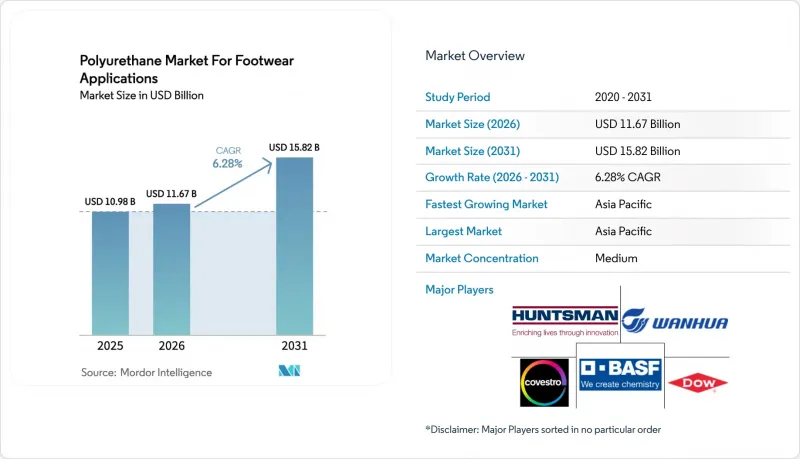
This report Segments the Industry by Material (PU Foam, PU Adhesives, and Other Materials), Application (Athletic Footwear, Leather Footwear, Sneakers, Textile and Other Footwear), and Geography (Asia-Pacific, North America, Europe, South America, and Middle East and Africa). The Market Forecasts are Provided in Terms of Value (USD).
Global Polyurethane for Footwear Applications Market Trends and Insights
Rising global footwear production volumes
Escalating factory output in Vietnam, India, and coastal China continues to support the Polyurethane for Footwear Applications Market by widening the installed base of direct-injection lines. Producers like ZhongJie-KY are scaling capacity targets to 80 million pairs annually, funded by USD 60 million in multi-country capex programs. High-volume runs improve fixed-cost absorption, letting suppliers buffer MDI and TDI price swings without sacrificing margins. Vietnam's supportive tax holidays and cluster-driven infrastructure upgrades enhance its appeal as brands look to diversify beyond single-country sourcing models.
Superior lightweight cushioning properties of PU soles
Polyurethane rebounds efficiently after compression, retains structural integrity over 11 million flexes, and delivers higher energy return than EVA. Brooks Running switched half of its lineup to DNA AMP polyurethane midsoles, citing longer-lasting responsiveness that appeals to serious runners. In premium European markets, consumers increasingly equate durability with value, reinforcing demand for PU-based cushioning that outperforms legacy foams over time.
Stringent EU & US regulations on di-isocyanate exposure
New training and workplace labeling rules in the European Union, in force since 2024, add compliance costs for companies still operating legacy "free" monomer lines. LANXESS already markets low-free prepolymers that satisfy the directive and has highlighted regulatory readiness as a post-sale advantage after transferring its urethanes unit to UBE. U.S. OSHA is reviewing similar exposure thresholds, signaling higher overhead for converters that postpone upgrading ventilation and monitoring systems.
Other drivers and restraints analyzed in the detailed report include:
- Shift toward athleisure & performance footwear in emerging markets
- Adoption of bio-based polyols to lower PU carbon footprint
- Collection & recycling challenges for post-consumer PU soles
For complete list of drivers and restraints, kindly check the Table Of Contents.
Segment Analysis
PU foam generated 72.56% of the Polyurethane for Footwear Applications Market revenue in 2025 and is forecast to advance in lock-step with total footwear output. The segment benefits from massive installed capacity, extensive operator know-how, and well-understood injection parameters that keep defect rates low.
However, thermoplastic polyurethanes and bio-based variants within the Other Materials grouping are expanding at a 6.92% CAGR. These materials attract brands that want transparent end-of-life recyclability, solvent-free bonding, or enhanced slip resistance in wet conditions. BASF's Elastollan TPU delivers both recyclability and wet-grip advantages, positioning specialty grades to nibble share where occupational safety rules are tightening. With brand roadmaps increasingly linking material selection to public carbon disclosures, specialty resins are expected to secure incremental contracts in high-visibility product lines even as PU foam remains the industry workhorse.
Complete Report Scope:
- By Material
- PU Foam
- PU Adhesives
- Other Materials (PU Elastomers, etc.)
- By Application
- Athletic Footwear
- Leather Footwear
- Sneakers
- Textile and Other Footwear
- By Geography
- Asia-Pacific
- China
- India
- Japan
- South Korea
- Rest of Asia-Pacific
- North America
- United States
- Canada
- Mexico
- Europe
- Germany
- United Kingdom
- France
- Italy
- Rest of Europe
- South America
- Brazil
- Argentina
- Rest of South America
- Middle East and Africa
- Saudi Arabia
- South Africa
- Rest of Middle East and Africa
- Asia-Pacific
Geography Analysis
Asia-Pacific controlled 48.62% of global revenue in 2025 and is projected to advance at 6.79% through 2031, ensuring that the Polyurethane for Footwear Applications Market continues to gravitate toward its manufacturing heartland. Policy-backed industrial parks in Tamil Nadu, India, are creating integrated clusters that cut outbound logistics costs and compress prototype-to-launch timelines for global brands. China retains the broadest tooling base, yet labor-intensive shops in Fujian and Guangdong are automating to offset rising wage floors and power-supply constraints.
North America remains integral for innovation pilots and limited-run releases. Reebok's Liquid Factory concept uses polyurethane drawn by multi-axis robots to build midsoles without aluminum molds, slashing tooling cost and enabling domestic production at consumer-accepted price points. Brands leverage such projects to test hyper-personalized fits and then shift mature designs to Asia for scale manufacture once demand stabilizes.
Europe exerts global influence through regulatory leadership. The region's push for circular economy legislation encourages suppliers to introduce take-back schemes and mono-material constructions. Covestro's INSQIN waterborne, partly bio-based PU coatings help European tanneries comply with VOC limits while unlocking breathable, chrome-free laminates. Although operating costs are higher than in Asia, brand-owned factories in Portugal, Germany, and Italy keep select production local to showcase rapid design-turn speeds and high craft quality.
- BASF SE
- Coim Group
- Covestro AG
- Dow
- Era Polymers Pty Ltd
- Huafeng Group
- Huntsman International LLC
- INOAC Corporation
- LANXESS
- Manali Petrochemicals Ltd
- NUI
- OrthoLite
- Rogers Corporation
- The Lubrizol Corporation
- Trelleborg
- Wanhua
Additional Benefits:
- The market estimate (ME) sheet in Excel format
- 3 months of analyst support
TABLE OF CONTENTS
1 Introduction
- 1.1 Study Assumptions and Market Definition
- 1.2 Scope of the Study
2 Research Methodology
3 Executive Summary
4 Market Landscape
- 4.1 Market Overview
- 4.2 Market Drivers
- 4.2.1 Rising global footwear production volumes
- 4.2.2 Superior lightweight cushioning properties of PU soles
- 4.2.3 Shift toward athleisure and performance footwear in emerging markets
- 4.2.4 Automation of PU sole injection molding in low or mid tier factories
- 4.2.5 Adoption of bio-based polyols to lower PU carbon footprint
- 4.3 Market Restraints
- 4.3.1 Volatile MDI orTDI feedstock prices tightening margins
- 4.3.2 Stringent EU and US regulations on di-isocyanate exposure
- 4.3.3 Collection and recycling challenges for post-consumer PU soles
- 4.4 Value Chain Analysis
- 4.5 Porter's Five Forces
- 4.5.1 Bargaining Power of Suppliers
- 4.5.2 Bargaining Power of Buyers
- 4.5.3 Threat of New Entrants
- 4.5.4 Threat of Substitutes
- 4.5.5 Degree of Competition
5 Market Size and Growth Forecasts (Value)
- 5.1 By Material
- 5.1.1 PU Foam
- 5.1.2 PU Adhesives
- 5.1.3 Other Materials (PU Elastomers, etc.)
- 5.2 By Application
- 5.2.1 Athletic Footwear
- 5.2.2 Leather Footwear
- 5.2.3 Sneakers
- 5.2.4 Textile and Other Footwear
- 5.3 By Geography
- 5.3.1 Asia-Pacific
- 5.3.1.1 China
- 5.3.1.2 India
- 5.3.1.3 Japan
- 5.3.1.4 South Korea
- 5.3.1.5 Rest of Asia-Pacific
- 5.3.2 North America
- 5.3.2.1 United States
- 5.3.2.2 Canada
- 5.3.2.3 Mexico
- 5.3.3 Europe
- 5.3.3.1 Germany
- 5.3.3.2 United Kingdom
- 5.3.3.3 France
- 5.3.3.4 Italy
- 5.3.3.5 Rest of Europe
- 5.3.4 South America
- 5.3.4.1 Brazil
- 5.3.4.2 Argentina
- 5.3.4.3 Rest of South America
- 5.3.5 Middle East and Africa
- 5.3.5.1 Saudi Arabia
- 5.3.5.2 South Africa
- 5.3.5.3 Rest of Middle East and Africa
- 5.3.1 Asia-Pacific
6 Competitive Landscape
- 6.1 Market Concentration
- 6.2 Strategic Moves
- 6.3 Market Share(%)/Ranking Analysis
- 6.4 Company Profiles (includes Global level Overview, Market level overview, Core Segments, Financials as available, Strategic Information, Market Rank/Share, Products and Services, Recent Developments)
- 6.4.1 BASF SE
- 6.4.2 Coim Group
- 6.4.3 Covestro AG
- 6.4.4 Dow
- 6.4.5 Era Polymers Pty Ltd
- 6.4.6 Huafeng Group
- 6.4.7 Huntsman International LLC
- 6.4.8 INOAC Corporation
- 6.4.9 LANXESS
- 6.4.10 Manali Petrochemicals Ltd
- 6.4.11 NUI
- 6.4.12 OrthoLite
- 6.4.13 Rogers Corporation
- 6.4.14 The Lubrizol Corporation
- 6.4.15 Trelleborg
- 6.4.16 Wanhua
7 Market Opportunities and Future Outlook
- 7.1 White-space and Unmet-Need Assessment

