PUBLISHER: Mordor Intelligence | PRODUCT CODE: 2100017

PUBLISHER: Mordor Intelligence | PRODUCT CODE: 2100017
Refurbished Computers and Laptops - Market Share Analysis, Industry Trends & Statistics, Growth Forecasts (2026 - 2031)
According to Mordor Intelligence, the refurbished computers and laptops market size is expected to grow from USD 9.61 billion in 2025 to USD 10.54 billion in 2026 and is forecast to reach USD 16.71 billion by 2031 at 9.68% CAGR over 2026-2031.
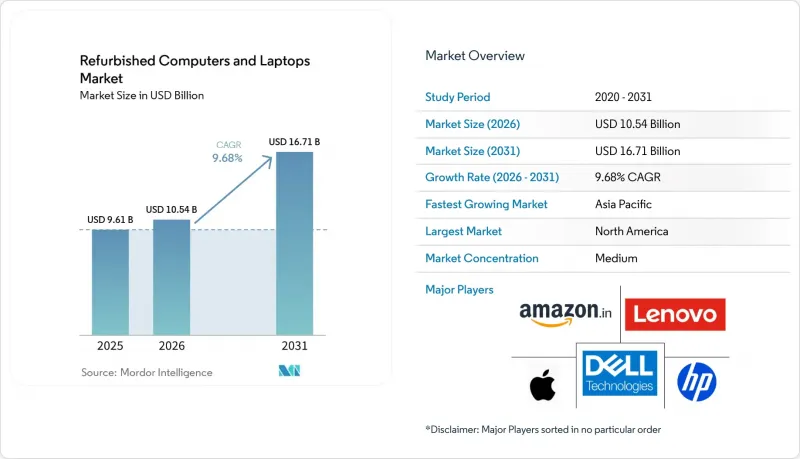
This report is Segmented by Device Type (Desktop Computers, Laptops, and More), Product Grade (Grade A, Grade B, Grade C), Operating System (Windows, Macos, and More), End-User (Corporate Enterprises, Educational Institutions, and More), Distribution Channel (Online Marketplaces, Manufacturer/Certified Refurb Stores, and More), and Geography. The Market Forecasts are Provided in Terms of Value (USD).
Global Refurbished Computers and Laptops Market Trends and Insights
Cost-savings and affordability of refurbished devices
Price-positioning remained the strongest near-term catalyst. Refurbished products typically carried a 30-70% discount versus new equivalents, delivering immediate budget relief for households and organizations alike. Enterprises managing multi-thousand-unit deployments reported that refurbished fleets generated equivalent user satisfaction with 20-40% lower total cost of ownership, once depreciation, warranty, and servicing were included. Schools leveraged the pricing gap to broaden one-to-one device ratios without exceeding public-funding envelopes. Marketplaces reinforced the value proposition by layering standardized condition grading and a one-year default warranty, limiting perceived downside risk. As inflationary pressures relaxed, affordability continued to underpin uptake in price-sensitive emerging markets, especially where financing options remained limited.
Corporate ESG mandates favouring circular IT procurement
Environmental scorecards moved from voluntary disclosure to mandatory reporting across many stock exchanges, incentivizing companies to quantify product-life extension. Dell pledged to reuse or recycle device volume equal to all new sales by 2030, a benchmark that formalized device take-back as a core KPI rather than a marketing pledge . Lenovo disclosed that 71% of collected devices were refurbished or redeployed rather than shredded, underscoring rapid operationalization of circular metrics. Corporate buyers incorporated lifecycle-carbon calculators into request-for-proposal templates, systematically rewarding vendors that supplied refurbished alternatives. The practice spread to global subsidiaries in Asia-Pacific, underpinning the region's double-digit growth outlook and reinforcing the refurbished computers and laptops market as a pillar of enterprise climate strategy.
Warranty and quality-perception gaps
Historical inconsistencies in condition grading left lingering doubts among risk-averse buyers, and 68% of hesitant shoppers still cited warranty length as the primary barrier. Coverage varied from 90 days at smaller refurbishers to 12 months at brand-aligned outlets. Apple's decision to match its new-product one-year warranty on Certified Refurbished devices nudged industry norms upward, yet disparity persisted across the long tail of vendors. To protect brand equity, premium marketplaces implemented strict seller scorecards, suspending partners whose defect rate exceeded 5%. Over time, clearer battery-health metrics and third-party inspection audits have narrowed perception gaps, but sustained marketing investments remain vital to accelerate broad enterprise adoption.
Other drivers and restraints analyzed in the detailed report include:
- End-of-Windows-10 support expands "Windows-11-ready" used stock
- AI-PC upgrade cycle generates higher trade-in volumes
- High data-sanitisation compliance costs
For complete list of drivers and restraints, kindly check the Table Of Contents.
Segment Analysis
Laptops maintained leadership, delivering 73.55% of refurbished computers and laptops market share in 2025 and remaining the cornerstone of multiyear corporate refresh cycles. Their portability, integrated battery, and uniform component ecosystem simplified large-scale redeployment, enabling refurbishers to secure higher recovery values than desktops. The refurbished computers and laptops market revealed that 2-year-old premium notebooks retained 60-70% of original RAM and SSD configurations, reducing rework costs and supporting a healthy resale premium. Thin clients and mini PCs represented the fastest-growing niche at a 10.35% CAGR through 2031, reflecting enterprise migration toward virtualized desktops and tighter energy budgets. Dell's Wyse 5070 showcased how compact designs offered enterprise-grade performance with a 50% lower power draw.
Desktop towers preserved relevance where PCI-e expansion or raw processing power outweighed spatial constraints. Their share declined but stabilised in call-centre and engineering labs, where refurbishment economics delivered a compelling price-performance edge. All-in-One PCs expanded modestly as libraries and reception areas prioritised clutter-free workstations. Energy-efficiency certification emerged as a new differentiator; ENERGY STAR-labelled refurbished stock fetched 15-20% premiums and delivered measurable operating-cost savings, particularly attractive to procurement teams accountable for scope-2 emissions. Overall, device mix diversification strengthened supply continuity and allowed the refurbished computers and laptops market to satisfy budget, form-factor, and ESG criteria simultaneously.
Grade A inventory accounted for 47.95% of the refurbished computers and laptops market size in 2025, expanding 9.92% annually as transparent grading systems improved buyer trust. The refurbished computers and laptops market established three broad quality tiers: pristine-cosmetic Grade A, value-balanced Grade B, and function-first Grade C. Dell's explicit "New and Unused," "Like New," and "Scratch and Dent" labelling scheme illustrated best practice in expectation management. Premium positioning rested on multi-point diagnostics, battery-health assurances above 85%, and Microsoft-issued fresh operating-system licences, justifying a 25-35% higher average selling price relative to Grade B.
Grade B maintained steady traction among small and midsize businesses seeking resilient hardware at accessible pricing. Uniform performance testing reduced return rates below 4%, narrowing functional disparity between Grades A and B and ensuring low total cost of ownership. Grade C units met demand in cash-constrained settings, particularly vocational training centres, where cosmetic wear held minimal relevance. Emerging battery-health metrics and expansion of component warranties to 12 months even in Grade B stock signalled a sector-wide shift toward quality parity, further elevating the refurbished computers and laptops market's reputation.
Complete Report Scope:
- By Device Type
- Desktop Computers
- Laptops
- All-in-One PCs
- Thin Clients / Mini PCs
- By Product Grade
- Grade A (Like New)
- Grade B (Good)
- Grade C (Functional)
- By Operating System
- Windows
- macOS
- Chrome OS
- Linux / Other
- By End-user
- Corporate Enterprises
- Small and Mid-sized Businesses
- Educational Institutions
- Government and Public Sector
- Personal / Home Users
- Other End-users
- By Distribution Channel
- Online Marketplaces
- Manufacturer / Certified Refurb Stores
- Independent Retailers
- Offline Wholesalers and VARs
- By Geography
- North America
- United States
- Canada
- Mexico
- South America
- Brazil
- Argentina
- Rest of South America
- Europe
- Germany
- United Kingdom
- France
- Italy
- Spain
- Russia
- Rest of Europe
- Asia-Pacific
- China
- Japan
- India
- South Korea
- ASEAN
- Rest of Asia-Pacific
- Middle East and Africa
- Middle East
- Saudi Arabia
- United Arab Emirates
- Turkey
- Rest of Middle East
- Africa
- South Africa
- Nigeria
- Kenya
- Rest of Africa
- Middle East
- North America
Geography Analysis
North America preserved leadership with 32.18% of global sales in 2025. Mature IT asset disposition infrastructure ensured predictable inflows of ex-corporate devices, while stringent e-waste regulations aligned economic incentives with environmental targets. The growth of the North America IT Asset Disposition Market continues to strengthen refurbishment supply chains by facilitating secure device recovery, data sanitization, and remarketing of enterprise hardware. United States school districts used refurbished fleets to narrow connectivity gaps; nonprofit Digitunity alone distributed over 41,000 units to learners between 2021-2024, illustrating market scale. Canada's federal-procurement guidelines mandated environmental-benefit scoring, fuelling institutional demand. Mexican SMBs accelerated adoption as e-commerce logistics improved cross-border supply and peer warranties.
Europe operated under the world's most advanced circular-economy framework, driving both supply quality and end-user confidence. The United Kingdom and Germany spearheaded refurbishment centres certified to ISO 14001 environmental standards. France's repairability-index labelling raised consumer awareness, nudging buyers toward refurbished alternatives with visible sustainability scores. Regional preference for premium Grade A stock enabled higher average selling prices, sustaining margins despite intense competition. EU-wide green public procurement directives stipulated minimum recycled or refurbished content, institutionalising demand that will underpin long-term growth of the refurbished computers and laptops market.
Asia-Pacific emerged as the fastest-expanding territory at a 9.86% CAGR from 2026-2031. Japan and South Korea's sophisticated reverse-logistics operations supplied high-grade devices to domestic and export markets. India's Digital India initiative catalysed public-private programmes that equipped rural schools with affordable refurbished laptops, and local platforms such as Budli.in elevated grading and warranty standards. China balanced vast domestic refurbishment capacity with restrictive import rules, compelling global refurbishers to partner with licensed local operators. Multinational corporations rolled out uniform circular-IT KPIs, injecting consistent procurement volumes and accelerating regional professionalism across the refurbished computers and laptops market.
- Apple Certified Refurbished
- Dell Refurbished
- Lenovo Renew
- HP Renew
- Amazon Renewed
- Best Buy Outlet
- Microsoft Authorized Refurbishers (MAR)
- Acer Recertified
- Budli.in
- Back Market
- Refurb.io
- PC Liquidations
- Arrow Electronics - Value Recovery
- Sims Lifecycle Services
- TES Sustainable IT Solutions
- Insight Systems (UK) Ltd.
- Kimbrer Computer ApS
- Reboot IT Electronics Pvt Ltd
- Recompute Ltd
- Encore IT Solutions Pvt. Ltd.
- PCS Wireless Inc.
- Renewed Macs
Additional Benefits:
- The market estimate (ME) sheet in Excel format
- 3 months of analyst support
TABLE OF CONTENTS
1 INTRODUCTION
- 1.1 Study Assumptions and Market Definition
- 1.2 Scope of the Study
2 RESEARCH METHODOLOGY
3 EXECUTIVE SUMMARY
4 MARKET LANDSCAPE
- 4.1 Market Overview
- 4.2 Market Drivers
- 4.2.1 Cost-savings and affordability of refurbished devices
- 4.2.2 Corporate ESG mandates favouring circular IT procurement
- 4.2.3 End-of-Windows-10 support expands "Windows-11-ready" used stock
- 4.2.4 AI-PC upgrade cycle generates higher trade-in volumes
- 4.2.5 Growing e-waste regulations and consumer eco-awareness
- 4.2.6 Government green-procurement preferences
- 4.3 Market Restraints
- 4.3.1 Warranty and quality-perception gaps
- 4.3.2 Tight supply of premium-grade inventory (lease extensions)
- 4.3.3 Cross-border tariff and customs uncertainties on used IT
- 4.3.4 High data-sanitisation compliance costs
- 4.4 Value Chain Analysis
- 4.5 Regulatory Landscape
- 4.6 Technological Outlook
- 4.7 Porter's Five Forces Analysis
- 4.7.1 Bargaining Power of Buyers
- 4.7.2 Bargaining Power of Suppliers
- 4.7.3 Threat of New Entrants
- 4.7.4 Threat of Substitutes
- 4.7.5 Intensity of Competitive Rivalry
- 4.8 Investment and Funding Landscape
- 4.9 Impact of Macroeconomic factors
5 MARKET SIZE AND GROWTH FORECASTS (VALUE)
- 5.1 By Device Type
- 5.1.1 Desktop Computers
- 5.1.2 Laptops
- 5.1.3 All-in-One PCs
- 5.1.4 Thin Clients / Mini PCs
- 5.2 By Product Grade
- 5.2.1 Grade A (Like New)
- 5.2.2 Grade B (Good)
- 5.2.3 Grade C (Functional)
- 5.3 By Operating System
- 5.3.1 Windows
- 5.3.2 macOS
- 5.3.3 Chrome OS
- 5.3.4 Linux / Other
- 5.4 By End-user
- 5.4.1 Corporate Enterprises
- 5.4.2 Small and Mid-sized Businesses
- 5.4.3 Educational Institutions
- 5.4.4 Government and Public Sector
- 5.4.5 Personal / Home Users
- 5.4.6 Other End-users
- 5.5 By Distribution Channel
- 5.5.1 Online Marketplaces
- 5.5.2 Manufacturer / Certified Refurb Stores
- 5.5.3 Independent Retailers
- 5.5.4 Offline Wholesalers and VARs
- 5.6 By Geography
- 5.6.1 North America
- 5.6.1.1 United States
- 5.6.1.2 Canada
- 5.6.1.3 Mexico
- 5.6.2 South America
- 5.6.2.1 Brazil
- 5.6.2.2 Argentina
- 5.6.2.3 Rest of South America
- 5.6.3 Europe
- 5.6.3.1 Germany
- 5.6.3.2 United Kingdom
- 5.6.3.3 France
- 5.6.3.4 Italy
- 5.6.3.5 Spain
- 5.6.3.6 Russia
- 5.6.3.7 Rest of Europe
- 5.6.4 Asia-Pacific
- 5.6.4.1 China
- 5.6.4.2 Japan
- 5.6.4.3 India
- 5.6.4.4 South Korea
- 5.6.4.5 ASEAN
- 5.6.4.6 Rest of Asia-Pacific
- 5.6.5 Middle East and Africa
- 5.6.5.1 Middle East
- 5.6.5.1.1 Saudi Arabia
- 5.6.5.1.2 United Arab Emirates
- 5.6.5.1.3 Turkey
- 5.6.5.1.4 Rest of Middle East
- 5.6.5.2 Africa
- 5.6.5.2.1 South Africa
- 5.6.5.2.2 Nigeria
- 5.6.5.2.3 Kenya
- 5.6.5.2.4 Rest of Africa
- 5.6.5.1 Middle East
- 5.6.1 North America
6 COMPETITIVE LANDSCAPE
- 6.1 Market Concentration
- 6.2 Strategic Moves
- 6.3 Market Share Analysis
- 6.4 Company Profiles (includes Global level Overview, Market level overview, Core Segments, Financials as available, Strategic Information, Market Rank/Share for key companies, Products and Services, and Recent Developments)
- 6.4.1 Apple Certified Refurbished
- 6.4.2 Dell Refurbished
- 6.4.3 Lenovo Renew
- 6.4.4 HP Renew
- 6.4.5 Amazon Renewed
- 6.4.6 Best Buy Outlet
- 6.4.7 Microsoft Authorized Refurbishers (MAR)
- 6.4.8 Acer Recertified
- 6.4.9 Budli.in
- 6.4.10 Back Market
- 6.4.11 Refurb.io
- 6.4.12 PC Liquidations
- 6.4.13 Arrow Electronics - Value Recovery
- 6.4.14 Sims Lifecycle Services
- 6.4.15 TES Sustainable IT Solutions
- 6.4.16 Insight Systems (UK) Ltd.
- 6.4.17 Kimbrer Computer ApS
- 6.4.18 Reboot IT Electronics Pvt Ltd
- 6.4.19 Recompute Ltd
- 6.4.20 Encore IT Solutions Pvt. Ltd.
- 6.4.21 PCS Wireless Inc.
- 6.4.22 Renewed Macs
7 MARKET OPPORTUNITIES AND FUTURE OUTLOOK
- 7.1 White-space and Unmet-Need Assessment

