PUBLISHER: Mordor Intelligence | PRODUCT CODE: 2100029

PUBLISHER: Mordor Intelligence | PRODUCT CODE: 2100029
America Cancer Immunotherapy - Market Share Analysis, Industry Trends & Statistics, Growth Forecasts (2026 - 2031)
According to Mordor Intelligence, america cancer immunotherapy market size in 2026 is estimated at USD 82.84 billion, growing from 2025 value of USD 76.26 billion with 2031 projections showing USD 125.32 billion, growing at 8.63% CAGR over 2026-2031.
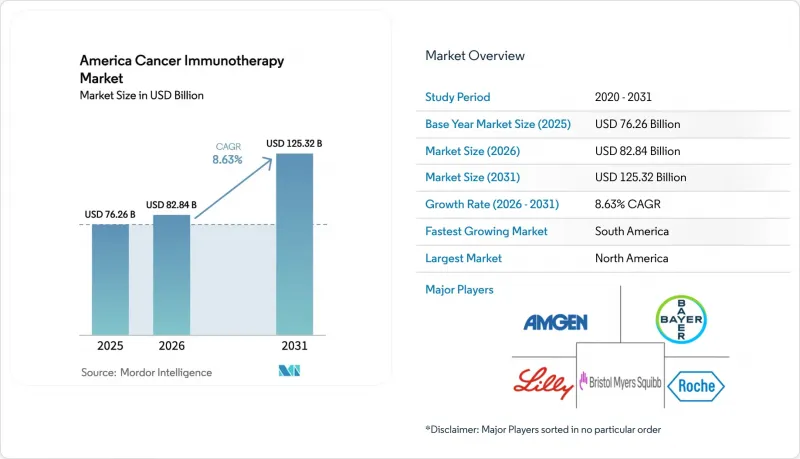
This report is Segmented by Therapy Type (Monoclonal Antibodies, Immunomodulators, and More), Cancer Type (Prostate Cancer, Breast Cancer, Lung Cancer, and More), End Users (Hospitals and Clinics, Cancer Research Centers, and More), Route of Administration (Intravenous and More), and Geography (North America and South America). The Market Forecasts are Provided in Terms of Value (USD).
America Cancer Immunotherapy Market Trends and Insights
Rapid R&D Productivity Gains
AI-enhanced biomarker analytics, adaptive trial protocols, and automated cell-therapy production lines shorten clinical development cycles. Merck and Moderna secured FDA Breakthrough Therapy Designation for their mRNA-4157/V940 personalized vaccine in high-risk melanoma just two years after first-in-human dosing, underscoring this acceleration. As late-stage failure risk falls, capital efficiency improves and more novel assets progress into pivotal studies. Automated cell-therapy platforms, such as Cellares' system reserved by Bristol Myers Squibb for USD 380 million, further compress production timelines. This virtuous cycle positions the America cancer immunotherapy market to bring first-in-class therapies to patients in 5-7 years instead of the historical decade-plus horizon.
High & Rising Cancer Incidence
An aging North American population and shifting lifestyle patterns across South America propel immunotherapy demand. Viral-infection-linked cancers among younger South Americans increase suitability for vaccine-based immunotherapies. Tumors with high mutational burden create abundant neoantigens, enhancing immunotherapy responsiveness. Health systems respond by adding immuno-oncology units and expanding diagnostic capacity, especially in urban centers with elevated environmental risk factors. As incidence grows faster than population, long-term service demand stays resilient, reinforcing revenue visibility for therapy developers.
Immune-Related Adverse Events
Combination regimens heighten risk of grade 3-4 irAEs, recorded in 52.8% of checkpoint-inhibitor recipients during 2025 studies. Hospitals must deploy multidisciplinary teams and predictive biomarkers to minimize morbidity. Prolonged hospitalization and immunosuppressant use inflate direct costs, potentially delaying adoption in smaller centers. Early-warning algorithms and tighter monitoring protocols are central to sustaining therapy uptake without compromising safety.
Other drivers and restraints analyzed in the detailed report include:
- Expansion of FDA/ANVISA Approvals
- Uptake of Immune-Checkpoint Inhibitors
- High Therapy & Management Costs
For complete list of drivers and restraints, kindly check the Table Of Contents.
Segment Analysis
Monoclonal antibodies held 44.90% of America cancer immunotherapy market share in 2025, retaining frontline status in solid tumors and hematologic malignancies. Cell-based therapies commanded the fastest 17.70% CAGR on expanding CAR-T indications and next-generation NK-cell products. Automated manufacturing alliances, including Bristol Myers Squibb's USD 380 million reservation with Cellares, address historical supply shortfalls and position the modality for broader commercial scale. Personalized neoantigen vaccines emerge as complementary prophylactic-therapeutic tools, buoyed by AI-enabled target discovery. Oncolytic viruses deliver localized immunogenic cell death, enhancing checkpoint-inhibitor synergy in cold tumors.
Combination regimens integrate monoclonal antibodies, cell therapies, and immunomodulators to overcome resistance. Bispecific platforms such as BNT327 illustrate convergence of antibody engineering with multi-pathway blockade in solid tumors. Manufacturing efficiency gains lower cost per dose, supporting payer acceptance. Regulatory bodies craft specific CMC guidance for complex biologics, smoothing licensure pathways while ensuring safety. Consequently, the America cancer immunotherapy market anticipates steady diversification of mechanism portfolios through 2031.
Lung cancer represented 26.23% of the America cancer immunotherapy market size in 2025, driven by checkpoint-inhibitor dominance in non-small-cell subtypes. Hematologic malignancies post the highest 16.64% CAGR as CAR-T and bispecific T-cell engagers secure durable responses in refractory blood cancers. Phase 1 PSCA-CAR-T data in metastatic prostate cancer broadens the therapeutic scope beyond classical B-cell targets. Melanoma remains a testbed for tumor-infiltrating lymphocyte therapy; lifileucel plus pembrolizumab continues to show promising efficacy.
Advances in tumor biology elucidate neoantigen landscapes, improving precision matching of immunotherapies to indications with high mutational burden. Biomarker-driven trial enrollment trims attrition rates and supports earlier-line use. Expanding into adjuvant and neoadjuvant settings elevates total addressable patients, ensuring the America cancer immunotherapy market sustains multi-cycle revenue gains.
Complete Report Scope:
- By Therapy Type
- Monoclonal Antibodies
- Cancer Vaccines
- Immunomodulators (Cytokines, Adjuvants)
- Cell-based Therapies
- Oncolytic Virus Therapies
- Combination Regimens
- By Cancer Type
- Lung Cancer
- Breast Cancer
- Melanoma & Skin Cancers
- Prostate Cancer
- Hematologic Malignancies (Leukemia, Lymphoma, Myeloma)
- Others (CRC, Gastric, Renal, etc.)
- By End User
- Hospitals & Clinics
- Cancer Research Centres
- Speciality Oncology Centres
- Other End-Users
- By Route of Administration
- Intravenous
- Sub-cutaneous / Intratumoral
- Geography
- North America
- United States
- Canada
- Mexico
- South America
- Brazil
- Argentina
- Rest of South America
- North America
List of Companies Covered in this Report:
- Amgen
- Astellas Pharma
- AstraZeneca
- Bayer
- Bristol-Myers Squibb
- Eli Lilly and Company
- Roche
- Merck
- Novartis
- Pfizer
- Gilead Sciences
- GlaxoSmithKline
- Y-mAbs Therapeutics
- Bluebird Bio
- Regeneron Pharmaceuticals
- Incyte
- BeiGene Ltd.
- Seagen
- Exelixis
- Adaptimmune Therapeutics
- Arcus Biosciences
Additional Benefits:
- The market estimate (ME) sheet in Excel format
- 3 months of analyst support
TABLE OF CONTENTS
1 Introduction
- 1.1 Study Assumptions & Market Definition
- 1.2 Scope of the Study
2 Research Methodology
3 Executive Summary
4 Market Landscape
- 4.1 Market Overview
- 4.2 Market Drivers
- 4.2.1 Rapid R&D Productivity Gains
- 4.2.2 High & Rising Cancer Incidence
- 4.2.3 Expansion of FDA/ANVISA Approvals
- 4.2.4 Uptake of Immune-Checkpoint Inhibitors
- 4.2.5 Personalised Neoantigen Vaccines Pipeline
- 4.2.6 AI-Driven Biomarker Discovery For Responder ID
- 4.3 Market Restraints
- 4.3.1 Immune-Related Adverse Events
- 4.3.2 High Therapy & Management Costs
- 4.3.3 Reimbursement Uncertainty In LATAM
- 4.3.4 Tumour-Micro-Environment Resistance Heterogeneity
- 4.4 Porter's Five Forces
- 4.4.1 Threat of New Entrants
- 4.4.2 Bargaining Power of Buyers
- 4.4.3 Bargaining Power of Suppliers
- 4.4.4 Threat of Substitutes
- 4.4.5 Intensity of Competitive Rivalry
5 Market Size & Growth Forecasts (Value, USD)
- 5.1 By Therapy Type
- 5.1.1 Monoclonal Antibodies
- 5.1.2 Cancer Vaccines
- 5.1.3 Immunomodulators (Cytokines, Adjuvants)
- 5.1.4 Cell-based Therapies
- 5.1.5 Oncolytic Virus Therapies
- 5.1.6 Combination Regimens
- 5.2 By Cancer Type
- 5.2.1 Lung Cancer
- 5.2.2 Breast Cancer
- 5.2.3 Melanoma & Skin Cancers
- 5.2.4 Prostate Cancer
- 5.2.5 Hematologic Malignancies (Leukemia, Lymphoma, Myeloma)
- 5.2.6 Others (CRC, Gastric, Renal, etc.)
- 5.3 By End User
- 5.3.1 Hospitals & Clinics
- 5.3.2 Cancer Research Centres
- 5.3.3 Speciality Oncology Centres
- 5.3.4 Other End-Users
- 5.4 By Route of Administration
- 5.4.1 Intravenous
- 5.4.2 Sub-cutaneous / Intratumoral
- 5.5 Geography
- 5.5.1 North America
- 5.5.1.1 United States
- 5.5.1.2 Canada
- 5.5.1.3 Mexico
- 5.5.2 South America
- 5.5.2.1 Brazil
- 5.5.2.2 Argentina
- 5.5.2.3 Rest of South America
- 5.5.1 North America
6 Competitive Landscape
- 6.1 Market Concentration
- 6.2 Market Share Analysis
- 6.3 Company Profiles (includes Global level Overview, Market level overview, Core Segments, Financials as available, Strategic Information, Market Rank/Share for key companies, Products & Services, and Recent Developments)
- 6.3.1 Amgen Inc.
- 6.3.2 Astellas Pharma Inc.
- 6.3.3 AstraZeneca plc
- 6.3.4 Bayer AG
- 6.3.5 Bristol-Myers Squibb Co.
- 6.3.6 Eli Lilly and Company
- 6.3.7 F. Hoffmann-La Roche Ltd.
- 6.3.8 Merck & Co., Inc.
- 6.3.9 Novartis AG
- 6.3.10 Pfizer Inc.
- 6.3.11 Gilead Sciences, Inc.
- 6.3.12 GSK plc
- 6.3.13 Y-mAbs Therapeutics, Inc.
- 6.3.14 bluebird bio, Inc.
- 6.3.15 Regeneron Pharmaceuticals
- 6.3.16 Incyte Corporation
- 6.3.17 BeiGene Ltd.
- 6.3.18 Seagen Inc.
- 6.3.19 Exelixis Inc.
- 6.3.20 Adaptimmune Therapeutics
- 6.3.21 Arcus Biosciences
7 Market Opportunities & Future Outlook
- 7.1 White-space & Unmet-Need Assessment

