PUBLISHER: Mordor Intelligence | PRODUCT CODE: 2100491

PUBLISHER: Mordor Intelligence | PRODUCT CODE: 2100491
Moving Bed Bioreactor - Market Share Analysis, Industry Trends & Statistics, Growth Forecasts (2026 - 2031)
According to Mordor Intelligence, the moving bed bioreactor market size is expected to increase from USD 3.99 billion in 2025 to USD 4.62 billion in 2026 and reach USD 9.61 billion by 2031, growing at a CAGR of 15.78% over 2026-2031.
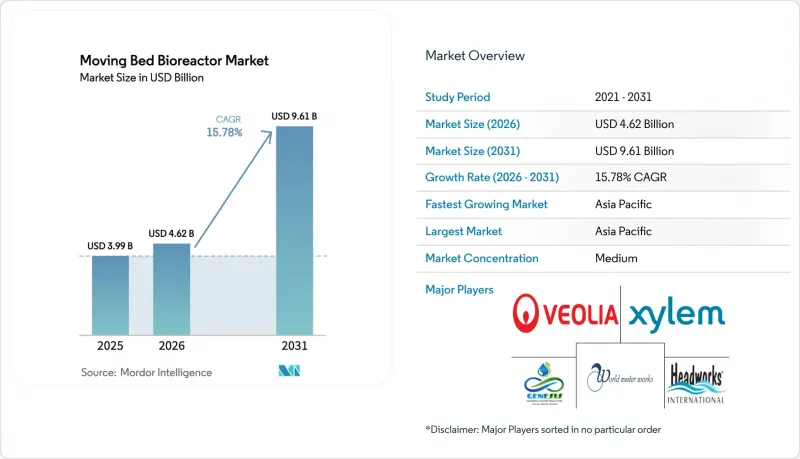
This report is Segmented by Application (BOD/COD Removal, Nitrification/Denitrification, and Other Applications), End-User Industry (Municipal Wastewater Treatment, Poultry and Aquaculture, Marine and Offshore, and Other End-User Industries), and Geography (Asia-Pacific, North America, Europe, South America, and Middle East and Africa). The Market Forecasts are Provided in Terms of Value (USD).
Global Moving Bed Bioreactor Market Trends and Insights
Scarcity of Freshwater Resources in Water-Stressed Regions
More than 2.3 billion people live in basins where renewable supply falls below 500 m3 per capita, forcing municipalities to view treated wastewater as a strategic water source[1]. The moving bed bioreactor market is benefiting from this shift, as carriers that achieve BOD below 5 mg/L without tertiary clarifiers cut pre-reverse-osmosis conditioning steps, trimming membrane replacement costs by up to 40%. India's Jal Jeevan Mission piloted 12 rural MBBR gray-water modules in Rajasthan and Gujarat in 2025 to offset wells that now sit 300 m below grade, where diesel extraction costs top USD 0.80 per m3. Singapore's NEWater program has relied on biofilm pre-conditioning since 2024, sustaining membrane flux above 60 L m-2 h-1 in tropical feedwater. In regions where desalination averages USD 0.50 per m3, MBBR-polished effluent can be delivered for USD 0.20 - 0.35 per m3, creating a tangible price spread for utility bond prospectuses.
Stringent Global and Regional Wastewater-Discharge Regulations
The European Union lowered total nitrogen limits from 10 mg/L to 6 mg/L for agglomerations above 10,000 PE in January 2025, affecting 4,200 plants that cannot meet targets with conventional activated sludge alone. China's Class 1A standard now caps ammonia-nitrogen at 1.5 mg/L in the Yangtze Economic Belt, with automatic suspension of industrial discharge permits for municipal laggards. The U.S. EPA set a seasonal 0.07 mg/L phosphorus threshold in the Great Lakes basin in 2025, steering retrofit budgets toward biofilm nitrifiers that avoid alum sludge haul-off. India's bathing-water rules require fecal coliform under 100 MPN per 100 mL; field data from 14 MBBR pilots showed log-3 pathogen reduction without chlorination, eliminating disinfection-by-product risks. Multilateral lenders have begun referencing ISO 24511 process-resilience metrics in tender documents, effectively making shock-load-tolerant platforms a prerequisite for funding.
High Upfront Capital Expenditure for Full-Scale Installations
Greenfield 50,000-PE plants price out at USD 8 - 15 million, a 25 - 40% premium to conventional sludge lines once carriers, fine-bubble blowers, and retention screens are specified. Emerging-market bond caps of 3 - 5% of annual utility budgets delay procurement, leaving municipalities liable for interim discharge penalties. Brazil's sanitation plan shows 47% of sub-100 k municipalities lack concessional funding for nutrient removal, stalling 23 Amazon basin projects despite total nitrogen limits of 5 mg/L. In Sub-Saharan Africa, capital intensity of USD 600 - 900 m-3 dwarfs the USD 300 - 450 m-3 cost of waste-stabilization ponds even though ponds demand 50-fold more land. Blended-finance models are emerging - Kenya's Lake Victoria South Water Board closed a USD 42 million deal in 2025 under a 60/40 public-private split, but currency hedges add 120-180 bps to debt service, limiting replication.
Other drivers and restraints analyzed in the detailed report include:
- Rising Industrial Wastewater Volumes from Pulp and Paper Industry
- Integration With Anaerobic Digestion for Energy-Positive Plants
- Bio-Film Carrier Fouling and Maintenance Complexity
For complete list of drivers and restraints, kindly check the Table Of Contents.
Segment Analysis
BOD/COD removal commanded 73.44% of the Moving Bed Bioreactor market size in 2025 and will retain momentum with a 15.87% CAGR through 2031. High-strength effluent from breweries, distilleries, and dairy plants, often exceeding 1,000 mg/L BOD, can be polished in 4 - 8 h hydraulic retention times, compared with 18 - 24 h for legacy sludge lines, unlocking surcharge relief that pays back capital in three to five years. Hybrid chemistries that couple carriers with ultrafiltration now meet direct potable reuse specifications, evident in California's 130 MGD Groundwater Replenishment System upgrade that cut membrane change-outs by three years.
The nitrification/denitrification niche is widening as coastal permits drop total nitrogen below 3 mg/L, illustrated by 18 Chesapeake Bay plants that installed MBBR modules in 2025 to avoid USD 1.2 billion in clarifier construction. Anaerobic variants remain under 10% share yet are pulling attention from food and beverage processors monetizing captured methane; Danone's 1,200 m3 d-1 whey system in Argentina offsets 420 kW of grid power, demonstrating biogas value stacking. Across applications, the Moving Bed Bioreactor market presents a resilient pathway for utilities balancing load shocks, energy intensity, and land scarcity.
Complete Report Scope:
- By Application
- BOD/COD Removal
- Nitrification / Denitrification
- Other Applications (Anaerobic Treatment, etc.)
- By End-user Industry
- Municipal Wastewater Treatment
- Poultry and Aquaculture
- Food and Beverage
- Pulp and Paper
- Healthcare Industry
- Marine and Offshore
- Other End- user Industries (Chemical and Petrochemical, Textile and Dyeing, etc.)
- By Geography
- Asia-Pacific
- China
- India
- Japan
- South Korea
- ASEAN Countries
- Rest of Asia-Pacific
- North America
- United States
- Canada
- Mexico
- Europe
- Germany
- United Kingdom
- France
- Italy
- Spain
- NORDIC Countries
- Rest of Europe
- South America
- Brazil
- Argentina
- Rest of South America
- Middle East and Africa
- Saudi Arabia
- South Africa
- Rest of Middle East and Africa
- Asia-Pacific
Geography Analysis
Asia-Pacific owned 30.04% of the Moving Bed Bioreactor market share in 2025 and is tracking an 18.04% CAGR through 2031, buoyed by China's CNY 240 billion county-sewage fund and India's Namami Gange awards for 1,240 MLD capacity. ASEAN industrial corridors, where effluent grew 11% in 2025, installed centralized biofilm hubs; Vietnam's Dong Nai province alone commissioned 85,000 m3 d-1 of dye effluent capacity to protect drinking intakes downstream.
North America continues a retrofit-heavy cycle as 40% of its 14,780 plants pre-date 1980; Milwaukee's Jones Island saved USD 180 million by choosing a 60 MGD MBBR line over new clarifiers and hit a 0.06 mg/L P effluent in 2025. Canada's regulations drive containerized adoption in remote Arctic towns; Nunavut installed five skid units sized for 800 - 2,000 residents, discharging safely into marine waters under ice cover. Mexico's border cities tapped federal grants for 18 units to cut cross-border BOD to 30 mg/L, meeting binational treaties with the United States.
Europe's circular-economy playbook prioritizes nutrient recovery; 47 Bavarian plants coupled MBBR with struvite reactors in 2025, selling 8,200 t fertilizer at EUR 450-600 t-1, offsetting 12-18% of OPEX. Nordic plants integrate heat pumps that pulled 180 GWh from effluent in Stockholm in 2025, lowering natural-gas imports by 18 million m3. South America leans on biofilm digesters at Brazil's sugar mills, where 12 units displaced 34,000 MWh of grid electricity in 2025. Middle Eastern oil fields deploy containerized skids; Saudi Aramco's Shaybah field polished 4,200 m3 d-1 for aquifer reinjection, ending USD 12 per m3 freshwater trucking costs, supporting the moving bed bioreactor market.
- Aqseptence Group
- Aquapoint Inc.
- Aquatech
- Biowater Technology AS
- EnviroChemie GmbH
- Fluence Corporation Limited
- Genesis Water Solution Pvt. Ltd.
- Headworks International
- Kubota Corporation
- Kurita Water Industries Ltd.
- Mitsubishi Chemical Group Corporation
- OVIVO USA LLC.
- SUSBIO
- Veolia
- Wock-Oliver Inc.
- World Water Works
- Xylem
Additional Benefits:
- The market estimate (ME) sheet in Excel format
- 3 months of analyst support
TABLE OF CONTENTS
1 Introduction
- 1.1 Study Assumptions and Market Definition
- 1.2 Scope of the Study
2 Research Methodology
3 Executive Summary
4 Market Landscape
- 4.1 Market Overview
- 4.2 Market Drivers
- 4.2.1 Scarcity of Freshwater Resources in Water-Stressed Regions
- 4.2.2 Stringent Global and Regional Wastewater-Discharge Regulations
- 4.2.3 Rising Industrial Wastewater Volumes from Pulp and Paper Industry
- 4.2.4 Integration With Anaerobic Digestion for Energy-Positive Plants
- 4.2.5 Uptake in Decentralized Containerized Treatment For Remote Sites
- 4.3 Market Restraints
- 4.3.1 High Upfront Capital Expenditure for Full-Scale Installations
- 4.3.2 Bio-Film Carrier Fouling and Maintenance Complexity
- 4.3.3 Shortage Of Skilled Operators for Biofilm-Based Processes
- 4.4 Value Chain Analysis
- 4.5 Porter's Five Forces Analysis
- 4.5.1 Bargaining Power of Suppliers
- 4.5.2 Bargaining Power of Buyers
- 4.5.3 Threat of New Entrants
- 4.5.4 Threat of Substitutes
- 4.5.5 Degree of Competition
5 Market Size and Growth Forecasts (Value)
- 5.1 By Application
- 5.1.1 BOD/COD Removal
- 5.1.2 Nitrification / Denitrification
- 5.1.3 Other Applications (Anaerobic Treatment, etc.)
- 5.2 By End-user Industry
- 5.2.1 Municipal Wastewater Treatment
- 5.2.2 Poultry and Aquaculture
- 5.2.3 Food and Beverage
- 5.2.4 Pulp and Paper
- 5.2.5 Healthcare Industry
- 5.2.6 Marine and Offshore
- 5.2.7 Other End- user Industries (Chemical and Petrochemical, Textile and Dyeing, etc.)
- 5.3 By Geography
- 5.3.1 Asia-Pacific
- 5.3.1.1 China
- 5.3.1.2 India
- 5.3.1.3 Japan
- 5.3.1.4 South Korea
- 5.3.1.5 ASEAN Countries
- 5.3.1.6 Rest of Asia-Pacific
- 5.3.2 North America
- 5.3.2.1 United States
- 5.3.2.2 Canada
- 5.3.2.3 Mexico
- 5.3.3 Europe
- 5.3.3.1 Germany
- 5.3.3.2 United Kingdom
- 5.3.3.3 France
- 5.3.3.4 Italy
- 5.3.3.5 Spain
- 5.3.3.6 NORDIC Countries
- 5.3.3.7 Rest of Europe
- 5.3.4 South America
- 5.3.4.1 Brazil
- 5.3.4.2 Argentina
- 5.3.4.3 Rest of South America
- 5.3.5 Middle East and Africa
- 5.3.5.1 Saudi Arabia
- 5.3.5.2 South Africa
- 5.3.5.3 Rest of Middle East and Africa
- 5.3.1 Asia-Pacific
6 Competitive Landscape
- 6.1 Market Concentration
- 6.2 Strategic Moves
- 6.3 Market Share(%)/Ranking Analysis
- 6.4 Company Profiles {includes Global level Overview, Market level overview, Core Segments, Financials as available, Strategic Information, Market Rank/Share for key companies, Products and Services, and Recent Developments}
- 6.4.1 Aqseptence Group
- 6.4.2 Aquapoint Inc.
- 6.4.3 Aquatech
- 6.4.4 Biowater Technology AS
- 6.4.5 EnviroChemie GmbH
- 6.4.6 Fluence Corporation Limited
- 6.4.7 Genesis Water Solution Pvt. Ltd.
- 6.4.8 Headworks International
- 6.4.9 Kubota Corporation
- 6.4.10 Kurita Water Industries Ltd.
- 6.4.11 Mitsubishi Chemical Group Corporation
- 6.4.12 OVIVO USA LLC.
- 6.4.13 SUSBIO
- 6.4.14 Veolia
- 6.4.15 Wock-Oliver Inc.
- 6.4.16 World Water Works
- 6.4.17 Xylem
7 Market Opportunities and Future Outlook
- 7.1 White-space and Unmet-need Assessment
- 7.2 Emerging Trends and Innovation in Manufacturing Technology

