PUBLISHER: Mordor Intelligence | PRODUCT CODE: 2100506

PUBLISHER: Mordor Intelligence | PRODUCT CODE: 2100506
Asia Pacific Smart Manufacturing - Market Share Analysis, Industry Trends & Statistics, Growth Forecasts (2026 - 2031)
According to Mordor Intelligence, the Asia-Pacific smart manufacturing market size was valued at USD 58.47 billion in 2025 and estimated to grow from USD 63.12 billion in 2026 to reach USD 92.56 billion by 2031, at a CAGR of 7.96% during the forecast period (2026-2031).
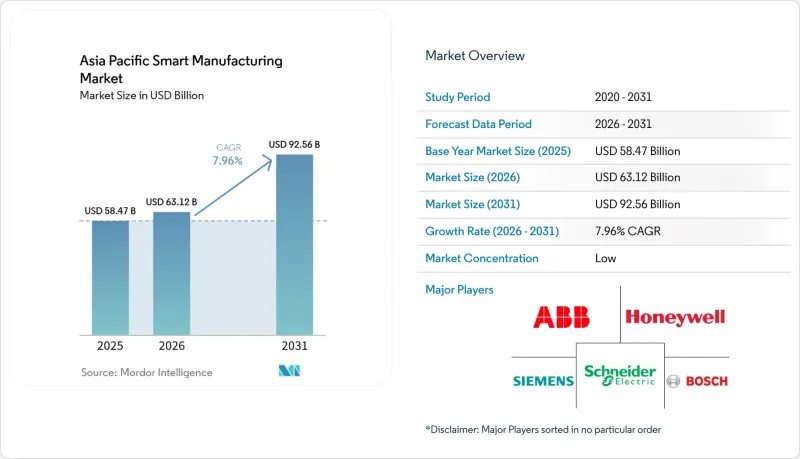
This report is Segmented by Enabling Technology (Industrial Control Systems, Industrial Robotics, and More), Component (Hardware, Software, and More), Deployment Mode (On-Premise, Cloud, and More), End-User Industry (Automotive, Semiconductor and Electronics, and More), Enterprise Size (Small Enterprises, and More), and Geography. The Market Forecasts are Provided in Terms of Value (USD).
Asia Pacific Smart Manufacturing Market Trends and Insights
Government-backed digital transformation incentives
Malaysia's Industry4WRD fund, Singapore's Digital Transformation Support Pilot Programme, Japan's Asia Digital Transformation initiative, and India's SAMARTH Udyog Bharat 4.0 collectively subsidize equipment, training, and cross-border R&D collaborations to accelerate Asia Pacific Digital Transformation initiatives. Matching grants in Malaysia have already disbursed RM 109.2 million to 299 SMEs, lowering automation entry barriers. Singapore offers HKD 50,000 per SME for pre-approved solutions that can be installed within nine months. METI sponsors joint projects that link Japanese system integrators with Southeast Asian manufacturers to co-develop use cases. India's demonstration centers have trained 9,800 individuals and validated plug-and-play kits suitable for resource-constrained factories. Collectively, these policies de-risk investments, compress learning curves, and shorten time to scale, driving the Asia-Pacific smart manufacturing market toward sustained double-digit expansion.
Labor cost inflation and skill shortages
Average Chinese manufacturing wages more than doubled between 2015 and 2024, eroding the historical cost advantage and pushing firms toward lights-out production lines. Japan's precision-machining workforce shrank by roughly 100,000 over two decades, spurring AI-enabled CAM software that slashes programming time from hours to minutes. Singapore's tight labour pool forces its 2,700 precision-engineering firms to blend collaborative robots with human operators to keep uptime high. Cisco Networking Academy has already trained 20 million learners, helping bridge digital-skills gaps that slow automation projects. Rising personnel costs, coupled with demographic pressures, are therefore accelerating capex reallocation from headcount to smart equipment across the Asia-Pacific smart manufacturing market.
High upfront CAPEX and ROI uncertainty
Full-scale smart factory conversions often require USD 2-5 million per mid-sized site, deterring family-owned workshops and contract assemblers. Telstra surveys found 67% of respondents delay IoT projects due to cost concerns. Benefits accrue across energy, quality, and logistics, making single-metric ROI approvals challenging. Honeywell data show 45% of executives postpone predictive-maintenance rollouts because financial models cannot isolate the contribution of downtime reduction. Government grants offset only a fraction of total budgets, and many programs apply strict eligibility filters, leaving smaller firms to self-fund investments that may take three to five years to break even. Until financing models mature, this restraint will shave near-term growth off the Asia-Pacific smart manufacturing market.
Other drivers and restraints analyzed in the detailed report include:
- Post-COVID reshoring and supply-chain resilience
- Rapid 5G private-network rollouts in factories
- Cybersecurity vulnerabilities in OT-IT convergence
For complete list of drivers and restraints, kindly check the Table Of Contents.
Segment Analysis
Industrial control systems generated 40.62 % of the Asia-Pacific smart manufacturing market share in 2025, underscoring their role as the real-time backbone for thousands of discrete and process plants. PLCs and SCADA remain procurement mainstays because they guarantee deterministic operation under harsh shop-floor conditions. Manufacturers, however, increasingly overlay these controls with cloud dashboards that unify OEE, energy, and quality KPIs. The Asia-Pacific smart manufacturing market is consequently witnessing hybrid architectures where edge gateways stream encrypted data to AI engines that detect anomalies well before alarms fire.
Cloud, analytics and platforms are growing at a 9.76 % CAGR as firms migrate from isolated historians to predictive-maintenance models that cut unplanned downtime by up to 20 %. Machine-vision systems, once limited to single-camera checks, now integrate deep-learning libraries that flag sub-micron defects in semiconductors. Industrial robotics adoption is moving beyond automotive paint lines into low-volume high-mix sectors such as medical devices. Connectivity stacks ranging from Time-Sensitive Networking to Wi-Fi 6E sustain these intelligence layers. Vendors that package controls, analytics, and cybersecurity into subscription tiers are broadening addressable budgets within the Asia-Pacific smart manufacturing market.
Hardware accounted for 53.78 % of the Asia-Pacific smart manufacturing market size in 2025, reflecting demand for robots, sensors, and controllers that automate repetitive tasks. Nevertheless, services are scaling faster at 10.91 % CAGR as brownfield plants seek turnkey upgrades rather than do-it-yourself rollouts. System integrators now bundle consulting, commissioning, and managed-security operations in multiyear contracts that shift spending from capex to opex.
Software stakes continue rising because algorithmic differentiation such as adaptive path planning for collaborative robots delivers productivity boosts impossible with hardware tweaks alone. Edge-to-cloud service engagements let SMEs pilot features without owning entire stacks, accelerating democratization across the Asia-Pacific smart manufacturing market. The blurring line between software and services means vendors must maintain continuous improvement roadmaps, not just versioned releases, to keep renewal rates high.
Complete Report Scope:
- By Enabling Technology
- Industrial Control Systems
- Programmable Logic Controller (PLC)
- Supervisory Control and Data Acquisition (SCADA)
- Distributed Control System (DCS)
- Human Machine Interface (HMI)
- Manufacturing Execution System (MES)
- Product Lifecycle Management (PLM)
- Industrial Robotics
- Machine Vision Systems
- Cloud, Analytics and Platforms
- Cybersecurity
- Sensors and Transmitters
- Connectivity and Communication
- Other Field, Control and Safety Solutions
- Industrial Control Systems
- By Component
- Hardware
- Software
- Services
- By Deployment Mode
- On-premise
- Cloud
- Hybrid
- Edge-to-Cloud
- By End-user Industry
- Automotive
- Semiconductor and Electronics
- Oil and Gas
- Chemical and Petrochemical
- Pharmaceutical and Biotechnology
- Aerospace and Defense
- Food and Beverages
- Metals and Mining
- Logistics and Warehousing
- Other End-User Industries
- By Enterprise Size
- Small Enterprises
- Medium Enterprises
- Large Enterprises
- By Country
- China
- India
- Japan
- South Korea
- Taiwan
- Singapore
- Thailand
- Vietnam
- Australia
- Rest of Asia-Pacific
List of Companies Covered in this Report:
- ABB Ltd.
- Honeywell International Inc.
- Fanuc Corporation
- Mitsubishi Electric Corporation
- Emerson Electric Company
- Rockwell Automation Inc.
- Schneider Electric SE
- Robert Bosch GmbH
- Siemens AG
- Yokogawa Electric Corporation
- Cisco Systems Inc.
- Keyence Corporation
- Delta Electronics Inc.
- Omron Corporation
- Panasonic Corporation
- Advantech Co., Ltd.
- Fuji Electric Co., Ltd.
- Beckhoff Automation GmbH and Co. KG
- Huawei Technologies Co., Ltd.
- Hitachi, Ltd.
Additional Benefits:
- The market estimate (ME) sheet in Excel format
- 3 months of analyst support
TABLE OF CONTENTS
1 INTRODUCTION
- 1.1 Study Assumptions and Market Definition
- 1.2 Scope of the Study
2 RESEARCH METHODOLOGY
3 EXECUTIVE SUMMARY
4 MARKET LANDSCAPE
- 4.1 Market Overview
- 4.2 Market Drivers
- 4.2.1 Government-backed digital transformation incentives
- 4.2.2 Labor cost inflation and skill shortages
- 4.2.3 Post-COVID reshoring and supply-chain resilience
- 4.2.4 Rapid 5G private-network rollouts in factories
- 4.2.5 Semiconductor capacity race driving automation
- 4.2.6 Carbon-neutrality mandates pushing energy-efficient operations
- 4.3 Market Restraints
- 4.3.1 High upfront CAPEX and ROI uncertainty
- 4.3.2 Fragmented vendor ecosystem and integration complexity
- 4.3.3 Cybersecurity vulnerabilities in OT-IT convergence
- 4.3.4 Legacy equipment interoperability gaps
- 4.4 Industry Value-Chain Analysis
- 4.5 Regulatory Landscape
- 4.6 Technological Outlook
- 4.7 Impact of Macroeconomic Factors
- 4.8 Porter's Five Forces Analysis
- 4.8.1 Threat of New Entrants
- 4.8.2 Bargaining Power of Suppliers
- 4.8.3 Bargaining Power of Consumers
- 4.8.4 Threat of Substitute Products
- 4.8.5 Intensity of Competitive Rivalry
5 MARKET SIZE AND GROWTH FORECASTS (VALUE)
- 5.1 By Enabling Technology
- 5.1.1 Industrial Control Systems
- 5.1.1.1 Programmable Logic Controller (PLC)
- 5.1.1.2 Supervisory Control and Data Acquisition (SCADA)
- 5.1.1.3 Distributed Control System (DCS)
- 5.1.1.4 Human Machine Interface (HMI)
- 5.1.1.5 Manufacturing Execution System (MES)
- 5.1.1.6 Product Lifecycle Management (PLM)
- 5.1.2 Industrial Robotics
- 5.1.3 Machine Vision Systems
- 5.1.4 Cloud, Analytics and Platforms
- 5.1.5 Cybersecurity
- 5.1.6 Sensors and Transmitters
- 5.1.7 Connectivity and Communication
- 5.1.8 Other Field, Control and Safety Solutions
- 5.1.1 Industrial Control Systems
- 5.2 By Component
- 5.2.1 Hardware
- 5.2.2 Software
- 5.2.3 Services
- 5.3 By Deployment Mode
- 5.3.1 On-premise
- 5.3.2 Cloud
- 5.3.3 Hybrid
- 5.3.4 Edge-to-Cloud
- 5.4 By End-user Industry
- 5.4.1 Automotive
- 5.4.2 Semiconductor and Electronics
- 5.4.3 Oil and Gas
- 5.4.4 Chemical and Petrochemical
- 5.4.5 Pharmaceutical and Biotechnology
- 5.4.6 Aerospace and Defense
- 5.4.7 Food and Beverages
- 5.4.8 Metals and Mining
- 5.4.9 Logistics and Warehousing
- 5.4.10 Other End-User Industries
- 5.5 By Enterprise Size
- 5.5.1 Small Enterprises
- 5.5.2 Medium Enterprises
- 5.5.3 Large Enterprises
- 5.6 By Country
- 5.6.1 China
- 5.6.2 India
- 5.6.3 Japan
- 5.6.4 South Korea
- 5.6.5 Taiwan
- 5.6.6 Singapore
- 5.6.7 Thailand
- 5.6.8 Vietnam
- 5.6.9 Australia
- 5.6.10 Rest of Asia-Pacific
6 COMPETITIVE LANDSCAPE
- 6.1 Market Concentration
- 6.2 Strategic Moves
- 6.3 Market Share Analysis
- 6.4 Company Profiles (includes Global level Overview, Market level overview, Core Segments, Financials as available, Strategic Information, Market Rank/Share for key companies, Products and Services, and Recent Developments)
- 6.4.1 ABB Ltd.
- 6.4.2 Honeywell International Inc.
- 6.4.3 Fanuc Corporation
- 6.4.4 Mitsubishi Electric Corporation
- 6.4.5 Emerson Electric Company
- 6.4.6 Rockwell Automation Inc.
- 6.4.7 Schneider Electric SE
- 6.4.8 Robert Bosch GmbH
- 6.4.9 Siemens AG
- 6.4.10 Yokogawa Electric Corporation
- 6.4.11 Cisco Systems Inc.
- 6.4.12 Keyence Corporation
- 6.4.13 Delta Electronics Inc.
- 6.4.14 Omron Corporation
- 6.4.15 Panasonic Corporation
- 6.4.16 Advantech Co., Ltd.
- 6.4.17 Fuji Electric Co., Ltd.
- 6.4.18 Beckhoff Automation GmbH and Co. KG
- 6.4.19 Huawei Technologies Co., Ltd.
- 6.4.20 Hitachi, Ltd.
7 MARKET OPPORTUNITIES AND FUTURE OUTLOOK
- 7.1 White-space and Unmet-need Assessment

