PUBLISHER: Mordor Intelligence | PRODUCT CODE: 2100508

PUBLISHER: Mordor Intelligence | PRODUCT CODE: 2100508
North America Clinical Data Analytics In Healthcare - Market Share Analysis, Industry Trends & Statistics, Growth Forecasts (2026 - 2031)
According to Mordor Intelligence, the North America clinical data analytics in healthcare market size is expected to grow from USD 14.70 billion in 2025 to USD 16.79 billion in 2026 and is forecast to reach USD 32.63 billion by 2031 at 14.21% CAGR over 2026-2031.
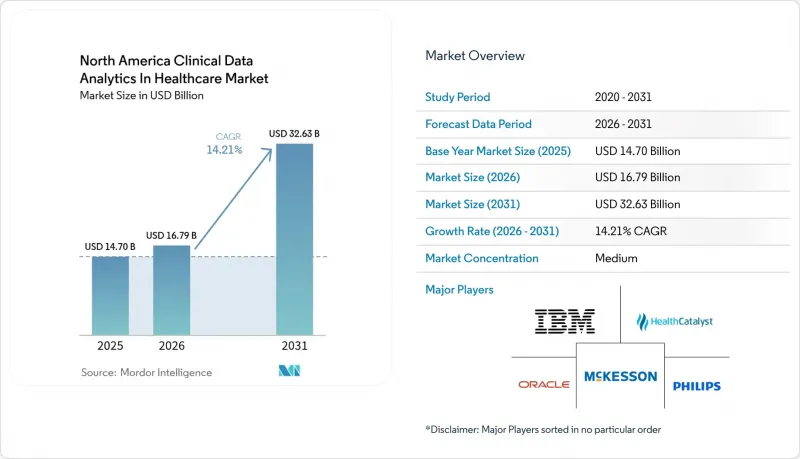
This report is Segmented by Mode of Delivery (Cloud, On-Premise), Type (Descriptive Analytics, Diagnostic Analytics, Predictive Analytics, Prescriptive Analytics), Application (Operations Management, Financial Management, Population Health Management, Clinical Management), End-User (Payers, Providers), and Geography. The Market Forecasts are Provided in Terms of Value (USD).
North America Clinical Data Analytics In Healthcare Market Trends and Insights
Cloud-first EHR Modernization Initiatives
Large-scale migrations to cloud-based EHRs shorten analytics deployment cycles, shifting capital expenses to operational budgets that better align with fluctuating healthcare revenues. The Veterans Health Administration's USD 16 billion Oracle Cerner rollout moved data processing from 18-24 months to 6-9 months, producing 40% faster queries and 60% lower data-prep overhead. Centralized data lakes emerging from such projects enable regional health systems to benchmark outcomes across multiple facilities, accelerating evidence-based practice adoption. Vendors with HIPAA-compliant cloud templates capture a disproportionate share as buyers favor turnkey security controls over custom builds. This dynamic magnifies the addressable market for prescriptive analytics and reinforces the appeal of hybrid architectures that retain sensitive data on-premise while performing compute-intensive tasks in the public cloud.
AI-assisted Clinical Decision Support Demand
Clinical decision support tools powered by AI improve diagnostic accuracy and reduce adverse events, catalyzing rapid uptake among tertiary centers and community hospitals alike. Mayo Clinic's sepsis risk model trimmed mortality by 18% and shortened average stays by 1.5 days, generating USD 1.5 million in annual savings per 100-bed unit. Emergency departments deploying AI-driven triage cut door-to-provider times 23%, an early indicator of improved throughput. The FDA's clearance of 521 AI-enabled devices by 2024 provides regulatory confidence, yet adoption varies by specialty: surgeons and radiologists embrace algorithmic support at 73%, whereas family physicians lag at 41%. Vendors that address integration pain points-single-sign-on, structured data capture, and liability protections-earn faster renewals and larger enterprise deals.
Persistent Data Quality and Interoperability Gaps
Sixty-eight percent of providers cite data inconsistencies-divergent lab units, missing timestamps, or non-standard terminologies-as root causes of analytic inaccuracies. Although the 21st Century Cures Act compels data exchange, semantic interoperability remains elusive, forcing organizations to allocate 60-70% of project budgets to cleansing tasks rather than insight generation. Rural hospitals endure added strain since limited IT staff hinder data governance investments, stretching implementation timelines and dampening returns. Vendors offering pre-mapped vocabularies and automated normalization tools win contracts faster, but overall market penetration slows until system-level data hygiene improves.
Other drivers and restraints analyzed in the detailed report include:
- Value-based-Care Reimbursement Mandates
- Rapid Growth of Real-world Evidence Trials
- Skills Shortage of Healthcare Data Scientists
For complete list of drivers and restraints, kindly check the Table Of Contents.
Segment Analysis
Cloud deployment captured 64.10% of 2025 revenue, underlining its centrality to the North America clinical data analytics in the healthcare market. The segment is forecast to expand at a 15.78% CAGR through 2031, propelled by elastic compute economics and off-premise security accreditation from hyperscale providers. Hybrid configurations add resilience, storing sensitive data locally while routing high-volume computation to the cloud-an architecture endorsed by 85% of AWS healthcare analytics clients. In contrast, on-premise systems persist in academic research labs requiring ultra-low latency or strict data residency. These dual pathways give vendors a roadmap for modular offerings, supporting incremental migrations rather than rip-and-replace exercises.
Second-wave adopters increasingly evaluate cloud partners on pre-certified compliance artifacts and out-of-the-box interoperability. Analytics providers that layer prescriptive applications atop managed data lakes offer healthcare executives a rapid pathway to clinical ROI, minimizing internal IT lift. As a result, the cloud's share of the North America clinical data analytics in the healthcare market is projected to cross 70% by 2028, cementing its position as the dominant delivery paradigm.
Prescriptive analytics recorded the fastest trajectory, advancing at 15.20% CAGR to 2031, though descriptive analytics still accounted for 33.20% of 2025 revenue. Hospitals use descriptive dashboards for compliance but pivot to predictive and prescriptive layers for initiatives tied to financial upside, such as staffing optimization and sepsis prevention. Cleveland Clinic's prescriptive workload module saved 12% in labor costs without diminishing quality indicators. These successes steer budget re-allocation toward advanced algorithms, boosting segment contribution to the North America clinical data analytics in the healthcare market share over the forecast window.
Investment barriers remain: prescriptive models demand clean data and workflow redesign that not all providers can manage. Vendors incorporating no-code interfaces and real-time explainability features lower adoption hurdles, encouraging mid-tier health systems to leapfrog directly from descriptive reports to action-oriented recommendations.
Complete Report Scope:
- By Mode of Delivery
- Cloud
- On-premise
- By Type
- Descriptive Analytics
- Diagnostic Analytics
- Predictive Analytics
- Prescriptive Analytics
- By Application
- Operations Management
- Financial Management
- Population Health Management
- Clinical Management
- By End-user
- Payers
- Providers
- By Country
- United States
- Canada
- Mexico
List of Companies Covered in this Report:
- Allscripts Healthcare Solutions, LLC
- Cerner Corporation (Oracle Cerner)
- Health Catalyst, Inc.
- International Business Machines Corporation
- Koninklijke Philips N.V.
- McKesson Corporation
- Oracle Corporation
- Siemens Healthineers AG
- Epic Systems Corporation
- Optum, Inc.
- Medidata Solutions, Inc.
- Qventus, Inc.
- SAS Institute Inc.
- GE HealthCare Technologies Inc.
- InterSystems Corporation
- athenahealth, Inc.
- CitiusTech Healthcare Technology Pvt Ltd
- MedeAnalytics, Inc.
- Arcadia Solutions, LLC
- WellSky Corporation
Additional Benefits:
- The market estimate (ME) sheet in Excel format
- 3 months of analyst support
TABLE OF CONTENTS
1 INTRODUCTION
- 1.1 Study Assumptions and Market Definition
- 1.2 Scope of the Study
2 RESEARCH METHODOLOGY
3 EXECUTIVE SUMMARY
4 MARKET LANDSCAPE
- 4.1 Market Overview
- 4.2 Market Drivers
- 4.2.1 Cloud-first EHR modernisation initiatives
- 4.2.2 AI-assisted clinical decision support demand
- 4.2.3 Value-based-care reimbursement mandates
- 4.2.4 Rapid growth of real-world-evidence (RWE) trials
- 4.2.5 Rise of retail-health entrants leveraging analytics
- 4.2.6 Escalating cyber-insurance premiums tied to analytics maturity
- 4.3 Market Restraints
- 4.3.1 Persistent data-quality and interoperability gaps
- 4.3.2 Skills shortage of healthcare data scientists
- 4.3.3 Stringent state-level privacy regulations (e.g., CCPA)
- 4.3.4 Capital-budget freezes at rural providers
- 4.4 Industry Value / Supply-Chain Analysis
- 4.5 Regulatory Landscape and Standards
- 4.6 Technological Outlook (Edge and AI analytics)
- 4.7 Porter's Five Forces Analysis
- 4.7.1 Threat of New Entrants
- 4.7.2 Bargaining Power of Buyers
- 4.7.3 Bargaining Power of Suppliers
- 4.7.4 Threat of Substitute Products
- 4.7.5 Intensity of Competitive Rivalry
- 4.8 Assessment of COVID-19 Impact on the Industry
5 MARKET SIZE AND GROWTH FORECASTS (VALUE)
- 5.1 By Mode of Delivery
- 5.1.1 Cloud
- 5.1.2 On-premise
- 5.2 By Type
- 5.2.1 Descriptive Analytics
- 5.2.2 Diagnostic Analytics
- 5.2.3 Predictive Analytics
- 5.2.4 Prescriptive Analytics
- 5.3 By Application
- 5.3.1 Operations Management
- 5.3.2 Financial Management
- 5.3.3 Population Health Management
- 5.3.4 Clinical Management
- 5.4 By End-user
- 5.4.1 Payers
- 5.4.2 Providers
- 5.5 By Country
- 5.5.1 United States
- 5.5.2 Canada
- 5.5.3 Mexico
6 COMPETITIVE LANDSCAPE
- 6.1 Market Concentration
- 6.2 Strategic Moves
- 6.3 Market Share Analysis
- 6.4 Company Profiles (includes Global level Overview, Market level overview, Core Segments, Financials as available, Strategic Information, Market Rank/Share for key companies, Products and Services, and Recent Developments)
- 6.4.1 Allscripts Healthcare Solutions, LLC
- 6.4.2 Cerner Corporation (Oracle Cerner)
- 6.4.3 Health Catalyst, Inc.
- 6.4.4 International Business Machines Corporation
- 6.4.5 Koninklijke Philips N.V.
- 6.4.6 McKesson Corporation
- 6.4.7 Oracle Corporation
- 6.4.8 Siemens Healthineers AG
- 6.4.9 Epic Systems Corporation
- 6.4.10 Optum, Inc.
- 6.4.11 Medidata Solutions, Inc.
- 6.4.12 Qventus, Inc.
- 6.4.13 SAS Institute Inc.
- 6.4.14 GE HealthCare Technologies Inc.
- 6.4.15 InterSystems Corporation
- 6.4.16 athenahealth, Inc.
- 6.4.17 CitiusTech Healthcare Technology Pvt Ltd
- 6.4.18 MedeAnalytics, Inc.
- 6.4.19 Arcadia Solutions, LLC
- 6.4.20 WellSky Corporation
7 MARKET OPPORTUNITIES AND FUTURE OUTLOOK
- 7.1 White-space and Unmet-need Assessment

