PUBLISHER: Mordor Intelligence | PRODUCT CODE: 2100509

PUBLISHER: Mordor Intelligence | PRODUCT CODE: 2100509
Germany Industrial Coatings - Market Share Analysis, Industry Trends & Statistics, Growth Forecasts (2026 - 2031)
According to Mordor Intelligence, the Germany industrial coatings market size was valued at USD 1.09 billion in 2025 and is estimated to grow from USD 1.13 billion in 2026 to reach USD 1.32 billion by 2031, at a CAGR of 3.22% during the forecast period (2026-2031).
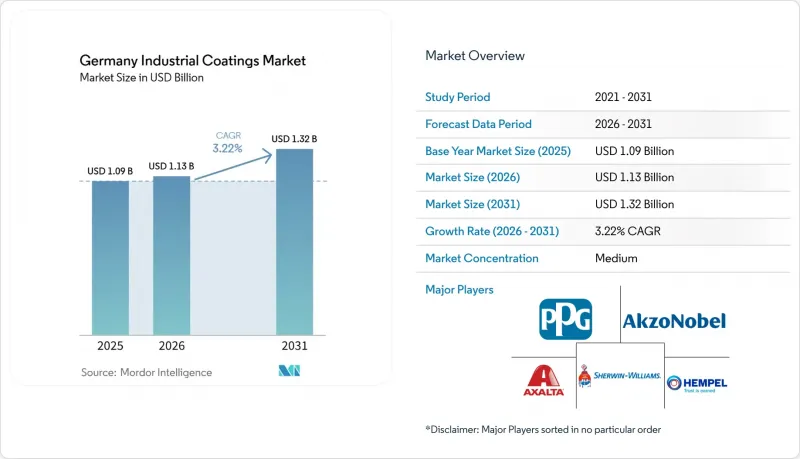
This report is Segmented by Resin Type (Epoxy, Polyurethane, Acrylic, Polyester, Other Resins), Technology (Water-Borne, Solvent-Borne, Powder Coatings, Other Technologies), and End-User Industry (General Industrial, Protective Coatings). The Market Forecasts are Provided in Terms of Value (USD).
Germany Industrial Coatings Market Trends and Insights
Growing Demand for Corrosion-Protection in German Manufacturing
Aging plants and deferred capital expenditures force German manufacturers to extend asset lifecycles, increasing the cost of unplanned downtime. Specialized epoxy-polyurethane hybrids extend equipment life by 40-60% compared with traditional coatings, helping industry address an estimated EUR 400 billion maintenance backlog. Chemical producers alone-responsible for one-quarter of EU output-require high-build protective systems that meet ISO 12944 standards in the face of aggressive chemical exposure. The push to safeguard critical machinery is thus a structural, not cyclical, growth engine for the German industrial coatings market.
Momentum in Renewable-Energy Infrastructure Coatings
Germany's pledge to achieve 80% renewable electricity by 2030 accelerates demand for coatings that can withstand harsh offshore wind environments for 25 years or more. Coating failures account for up to 20% of turbine maintenance budgets, motivating operators to specify zinc-rich primers and fluoropolymer topcoats with superior cathodic-disbondment resistance. Solar farms add further pull-through, as anti-soiling and UV-stable layers ensure sustained module efficiency across 70 GW of installed capacity. These needs underpin long-term growth for the German industrial coatings market.
Stringent VOC and REACH Chemical Restrictions
More than 2,000 substances face usage restrictions under REACH, resulting in research and development costs exceeding EUR 1 million per chemical and extending product approval cycles to four years. Around 40% of German coating plants must retrofit lines to hit 2024 VOC thresholds at capital outlays of EUR 0.5-2 million per site. The phase-out of chromate-based primers squeezes the aerospace and marine niches, trimming near-term volume and margin potential for the German industrial coatings market.
Other drivers and restraints analyzed in the detailed report include:
- Expansion of Water-borne and Powder Tech Under VOC Rules
- Adoption of Digital Color-Matching/On-Site Mixing Systems
- Raw-Material Price Volatility (Epoxy, Solvents, Energy)
For complete list of drivers and restraints, kindly check the Table Of Contents.
Segment Analysis
Epoxy resins accounted for 26.78% of 2025 revenue, reflecting their dependable adhesion and cost efficiency in heavy-duty steel protection. They thus remain the largest slice of the German industrial coatings market. Polyurethane's 3.84% CAGR through 2031, however, outpaces overall sector growth by leveraging flexibility and chemical resilience prized in wind-turbine blades and hydrogen pipelines.
Epoxy demand endures on factory floors and tank linings, where compressive strength and chemical resistance are most critical. Yet, innovation is tilting toward bio-based polyols, aligning polyurethane systems with Germany's circular economy targets. Covestro's EUR 1.5 billion, or USD 1.72 billion, spend on sustainable raw materials exemplifies how strategic research and development reallocations could erode epoxy's dominance over the forecast horizon.
Complete Report Scope:
- By Resin Type
- Epoxy
- Polyurethane
- Acrylic
- Polyester
- Other Resins (Alkyd, Fluoropolymer)
- By Technology
- Water-borne
- Solvent-borne
- Powder Coatings
- Other Technologies (UV-/EB-Cured and High Solids)
- By End-user Industry
- General Industrial
- Protective Coatings
- Oil and Gas
- Power Generation
- Infrastructure
- Mining
- Other Protective Coatings
List of Companies Covered in this Report:
- Akzo Nobel N.V.
- Axalta Coating Systems
- Beckers Group
- Berger-Seidle GmbH
- DAW SE (Caparol Industrial)
- Hempel A/S
- Hesse Lignal GmbH
- Jotun
- KANSAI HELIOS
- MIPA SE
- PPG Industries Inc.
- RPM International Inc.
- Teknos Deutschland GmbH
- The Sherwin-Williams Company
Additional Benefits:
- The market estimate (ME) sheet in Excel format
- 3 months of analyst support
TABLE OF CONTENTS
1 Introduction
- 1.1 Study Assumptions and Market Definition
- 1.2 Scope of the Study
2 Research Methodology
3 Executive Summary
4 Market Landscape
- 4.1 Market Overview
- 4.2 Market Drivers
- 4.2.1 Growing demand for corrosion-protection in German manufacturing
- 4.2.2 Momentum in renewable-energy infrastructure coatings
- 4.2.3 Expansion of water-borne and powder tech under VOC rules
- 4.2.4 Adoption of digital colour-matching/on-site mixing systems
- 4.2.5 Hydrogen-economy pilot projects needing H2-compatible linings
- 4.3 Market Restraints
- 4.3.1 Stringent VOC and REACH chemical restrictions
- 4.3.2 Raw-material price volatility (epoxy, solvents, energy)
- 4.3.3 Skilled labour shortage in precision coating application
- 4.4 Value Chain Analysis
- 4.5 Porter's Five Forces
- 4.5.1 Bargaining Power of Suppliers
- 4.5.2 Bargaining Power of Buyers
- 4.5.3 Threat of New Entrants
- 4.5.4 Threat of Substitute Products
- 4.5.5 Degree of Competition
5 Market Size and Growth Forecasts (Value)
- 5.1 By Resin Type
- 5.1.1 Epoxy
- 5.1.2 Polyurethane
- 5.1.3 Acrylic
- 5.1.4 Polyester
- 5.1.5 Other Resins (Alkyd, Fluoropolymer)
- 5.2 By Technology
- 5.2.1 Water-borne
- 5.2.2 Solvent-borne
- 5.2.3 Powder Coatings
- 5.2.4 Other Technologies (UV-/EB-Cured and High Solids)
- 5.3 By End-user Industry
- 5.3.1 General Industrial
- 5.3.2 Protective Coatings
- 5.3.2.1 Oil and Gas
- 5.3.2.2 Power Generation
- 5.3.2.3 Infrastructure
- 5.3.2.4 Mining
- 5.3.2.5 Other Protective Coatings
6 Competitive Landscape
- 6.1 Market Concentration
- 6.2 Strategic Moves
- 6.3 Market Share/Ranking Analysis
- 6.4 Company Profiles (includes Global level Overview, Market level overview, Core Segments, Financials as available, Strategic Information, Market Rank/Share for key companies, Products and Services, and Recent Developments)
- 6.4.1 Akzo Nobel N.V.
- 6.4.2 Axalta Coating Systems
- 6.4.3 Beckers Group
- 6.4.4 Berger-Seidle GmbH
- 6.4.5 DAW SE (Caparol Industrial)
- 6.4.6 Hempel A/S
- 6.4.7 Hesse Lignal GmbH
- 6.4.8 Jotun
- 6.4.9 KANSAI HELIOS
- 6.4.10 MIPA SE
- 6.4.11 PPG Industries Inc.
- 6.4.12 RPM International Inc.
- 6.4.13 Teknos Deutschland GmbH
- 6.4.14 The Sherwin-Williams Company
7 Market Opportunities and Future Outlook
- 7.1 White-space and Unmet-need Assessment

