PUBLISHER: Mordor Intelligence | PRODUCT CODE: 2116869

PUBLISHER: Mordor Intelligence | PRODUCT CODE: 2116869
India Industrial Coatings - Market Share Analysis, Industry Trends & Statistics, Growth Forecasts (2026 - 2031)
According to Mordor Intelligence, the India industrial coatings market size is expected to grow from USD 2.93 billion in 2025 to USD 3.09 billion in 2026 and is forecast to reach USD 4.05 billion by 2031 at 5.52% CAGR over 2026-2031.
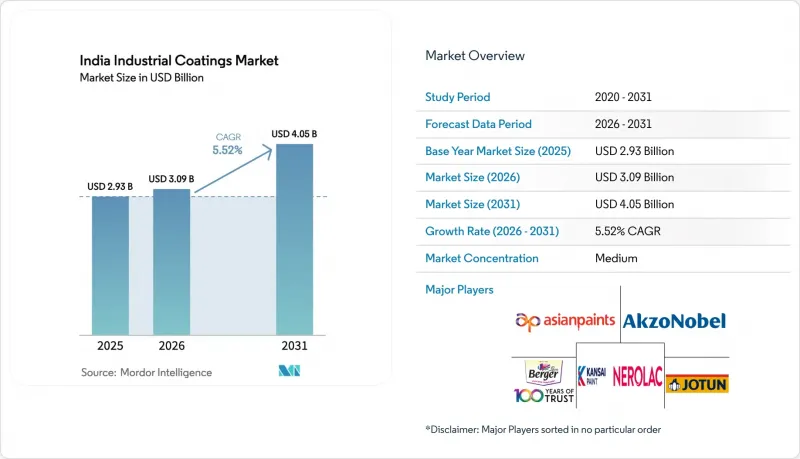
This report is Segmented by Resin Type (Epoxy, Polyurethane, Acrylic, Polyester, and Other Resins (Alkyd and More)), Technology (Water-Borne, Solvent-Borne, Powder Coatings, and Other Technologies (UV-/EB-Cured and More)), and End-User Industry (General Industrial and Protective Coatings (Oil and Gas, Power Generation, and More)). The Market Forecasts are Provided in Terms of Value (USD).
India Industrial Coatings Market Trends and Insights
Expanding Manufacturing and Infrastructure Projects
Large-scale petrochemical, mining, and transportation corridors are providing multi-year visibility into the India Industrial Coatings market, as EPC contractors specify higher build and longer-life systems for harsh on-site conditions. State-led chemical parks in Gujarat and Odisha simplify feedstock logistics, supporting plant-level just-in-time deliveries for epoxy primers and polyurethane finishes. Coaters that colocate service centers near these clusters lower freight costs and provide faster turnaround for in-process quality audits. Integrated steel plants, wind-tower yards, and port facilities require surface-tolerant coatings with rapid recoat windows, which shorten project schedules. The resulting shift from single-pack to two-pack systems is lifting average selling prices and strengthening margins for formulators that have backward-integrated resin assets.
Rising Automotive Production and Refurbishment Demand
India's vehicle output rebound and sustained growth in the car parc are expanding paint-shop throughput and refinish activities, lifting consumption across pretreatment, primer-surfacer, basecoat, and clearcoat stages. Battery-electric vehicles require highly insulative and thermally conductive coatings on packs and power-electronics, nearly tripling coating grams per vehicle compared with internal-combustion equivalents. OEM tier-1 suppliers are migrating to powder for chassis and suspension arms, citing 98% transfer efficiency and zero solvent emissions. Refinish shops in Tier-2 cities are upgrading to low-VOC polyurethane clearcoats to comply with local pollution-control board checks, creating a ripple effect in demand for matched hardeners and thinners.
Stringent VOC and Solvent-Emission Regulations
Rule 123-M of the Model Factory Rules enforces closed-loop transfer of Class-I solvents, prompting capex on vapor recovery and explosion-proof motors. Plants lacking regenerative thermal oxidizers are limited by batch size and are shifting toward high-solids or water-reducible binders. Formulators must re-qualify systems with customers when replacing xylene or MEK, stretching R&D resources and lengthening commercialization timelines. Smaller job shops are outsourcing finishing to larger toll coaters, consolidating demand among players that can finance environmental upgrades. The regulation also caps shift-time exposure levels for painters, intensifying demand for faster-curing coatings that reduce booth occupancy.
Other drivers and restraints analyzed in the detailed report include:
- Growing Demand for Corrosion-Protection in Oil and Gas Pipelines
- Government Push for High-Performance Coatings in Strategic Sectors
- Volatility in Crude-Oil Based Raw-Material Prices
For complete list of drivers and restraints, kindly check the Table Of Contents.
Segment Analysis
The epoxy resin type had the largest share of 30.92% in the India Industrial Coatings Market in 2025, reflecting its entrenched status in infrastructure and marine protection. The market share of polyurethane resin types is growing at the fastest CAGR of 6.01% during the forecast period (2026-2031) due to OEM uptake in automotive trim, electric-vehicle battery packs, and wind-blade shells. Epoxy's low permeation and strong adhesion continue to outperform in acidic or alkaline environments; however, two-component polyurethanes now deliver comparable salt-spray performance with superior flexibility. Non-isocyanate polyurethane (NIPU) is emerging as an eco-friendlier alternative, delivering 30-50% higher chemical resistance than traditional polyurethane without the hazards of free isocyanate.
Resin formulators with vertical integration into liquid epoxy monomer (LEM) and polyether polyol production capture better margins and supply reliability. The India Industrial Coatings market share of acrylics remains niche in heavy-duty services but dominates in applications such as appliances, HVAC, and facade panels, where color retention is paramount. Polyester dominates interior furniture powder lines, supported by rising demand for modular kitchens and office furniture. Suppliers are pilot-running bio-based epoxies from lignin and soybean-oil routes to cut carbon footprints while preserving mechanical performance.
Complete Report Scope:
- By Resin Type
- Epoxy
- Polyurethane
- Acrylic
- Polyester
- Other Resins (Alkyd, Fluoropolymer)
- By Technology
- Water-borne
- Solvent-borne
- Powder Coatings
- Other Technologies (UV-/EB-Cured and High Solids)
- By End-user Industry
- General Industrial
- Protective Coatings
- Oil and Gas
- Power Generation
- Infrastructure
- Mining
- Other Protective Coatings
List of Companies Covered in this Report:
- AkzoNobel India Ltd.
- Asian Paints PPG Pvt. Ltd
- Axalta Coating Systems
- BASF SE
- Beckers Group
- Berger Paints India Ltd.
- Carboline India Pvt Ltd
- Chugoku Marine Paints Ltd.
- Fosroc, Inc.
- Hempel A/S
- Jotun
- Kansai Nerolac Paints Limited
- Nippon Paint (India) Private Limited.
- RPM International Inc.
- Shalimar Paints LTD (Mumbai)
- Sika AG
- The Sherwin-Williams Company
- Wacker Chemie AG
Additional Benefits:
- The market estimate (ME) sheet in Excel format
- 3 months of analyst support
TABLE OF CONTENTS
1 Introduction
- 1.1 Study Assumptions & Market Definition
- 1.2 Scope of the Study
2 Research Methodology
3 Executive Summary
4 Market Landscape
- 4.1 Market Overview
- 4.2 Market Drivers
- 4.2.1 Expanding manufacturing and infrastructure projects
- 4.2.2 Rising automotive production and refurbishment demand
- 4.2.3 Growing demand for corrosion-protection in oil and gas pipelines
- 4.2.4 Government push for high-performance coatings in strategic sectors
- 4.2.5 Renewable-energy installations requiring specialized coatings
- 4.3 Market Restraints
- 4.3.1 Stringent VOC and solvent-emission regulations
- 4.3.2 Volatility in crude-oil based raw-material prices
- 4.3.3 Lack of skilled industrial-coating applicators
- 4.4 Value Chain Analysis
- 4.5 Porter's Five Forces
- 4.5.1 Bargaining Power of Suppliers
- 4.5.2 Bargaining Power of Buyers
- 4.5.3 Threat of New Entrants
- 4.5.4 Threat of Substitutes
- 4.5.5 Degree of Competition
5 Market Size & Growth Forecasts (Value)
- 5.1 By Resin Type
- 5.1.1 Epoxy
- 5.1.2 Polyurethane
- 5.1.3 Acrylic
- 5.1.4 Polyester
- 5.1.5 Other Resins (Alkyd, Fluoropolymer)
- 5.2 By Technology
- 5.2.1 Water-borne
- 5.2.2 Solvent-borne
- 5.2.3 Powder Coatings
- 5.2.4 Other Technologies (UV-/EB-Cured and High Solids)
- 5.3 By End-user Industry
- 5.3.1 General Industrial
- 5.3.2 Protective Coatings
- 5.3.2.1 Oil and Gas
- 5.3.2.2 Power Generation
- 5.3.2.3 Infrastructure
- 5.3.2.4 Mining
- 5.3.2.5 Other Protective Coatings
6 Competitive Landscape
- 6.1 Market Concentration
- 6.2 Strategic Moves
- 6.3 Market Share/Ranking Analysis
- 6.4 Company Profiles (includes Global level Overview, Market level overview, Core Segments, Financials as available, Strategic Information, Market Rank/Share for key companies, Products & Services, Recent Developments)
- 6.4.1 AkzoNobel India Ltd.
- 6.4.2 Asian Paints PPG Pvt. Ltd
- 6.4.3 Axalta Coating Systems
- 6.4.4 BASF SE
- 6.4.5 Beckers Group
- 6.4.6 Berger Paints India Ltd.
- 6.4.7 Carboline India Pvt Ltd
- 6.4.8 Chugoku Marine Paints Ltd.
- 6.4.9 Fosroc, Inc.
- 6.4.10 Hempel A/S
- 6.4.11 Jotun
- 6.4.12 Kansai Nerolac Paints Limited
- 6.4.13 Nippon Paint (India) Private Limited.
- 6.4.14 RPM International Inc.
- 6.4.15 Shalimar Paints LTD (Mumbai)
- 6.4.16 Sika AG
- 6.4.17 The Sherwin-Williams Company
- 6.4.18 Wacker Chemie AG
7 Market Opportunities & Future Outlook
- 7.1 White-space and Unmet-Need Assessment

