PUBLISHER: Mordor Intelligence | PRODUCT CODE: 2100529

PUBLISHER: Mordor Intelligence | PRODUCT CODE: 2100529
Caustic Soda - Market Share Analysis, Industry Trends & Statistics, Growth Forecasts (2026 - 2031)
According to Mordor Intelligence, the caustic soda market size is estimated at 98.90 Million tons in 2026, and is expected to reach 121.42 Million tons by 2031, at a CAGR of 4.19% during the forecast period (2026-2031).
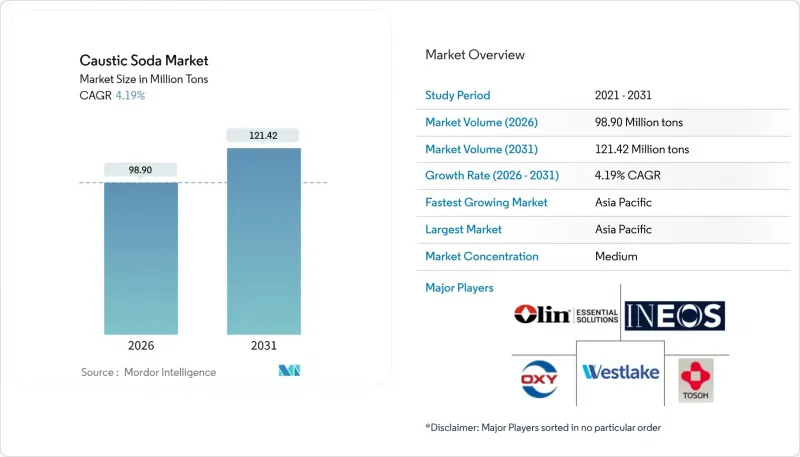
This report is Segmented by Production Process (Membrane Cell, Diaphragm Cell, and Other Processes), Form (Liquid and Solid), Concentration Grade (32 Wt%, 50 Wt%, and 73 Wt% and Higher), Application (Pulp and Paper, Organic Chemicals, and More), and Geography (Asia-Pacific, North America, Europe, South America, and Middle-East and Africa). Market Forecasts are Provided in Terms of Volume (Tons).
Global Caustic Soda Market Trends and Insights
Accelerated Alumina Refinery Expansions
Between 2025 and 2028, China's demand for alumina is set to rise significantly. This surge is largely fueled by smelting expansions in India, Indonesia, and the Gulf, which are channeling bauxite flows towards Asia. Australian trihydrate ore, which requires less NaOH to produce alumina, is increasingly replacing monohydrate deposits with higher consumption. In India, refiners are adopting sophisticated liquor controls, reducing caustic losses. This advancement not only curtails unit consumption but also accommodates an increase in absolute volume. As a result, the close-knit relationship between bauxite procurement and Bayer-process refinement boosts regional output while simultaneously reducing caustic intensity.
Surging Soap and Detergent Production
Annual detergent demand in India and Southeast Asia is rising as disposable income rises, but the caustic intensity per finished ton drops because manufacturers substitute synthetic surfactants for traditional soap saponification. Organized players in the caustic soda industry add LABS and alcohol ethoxylate lines that need caustic only for pH control, whereas small African plants still rely on full saponification, preserving higher NaOH loadings. Fast-growing detergent markets see a muted gain in caustic volume, which modestly contributes to the overall CAGR.
Volatile Electricity Prices in Europe
Electricity constitutes a significant portion of the total cost in the chlor-alkali industry. In 2024, industrial rates in Europe placed European producers at a disadvantage compared to their U.S. counterparts. Responding to prolonged margin pressures, INEOS decided to mothball its Tavaux downstream unit in 2025 and subsequently reduced its chlor-alkali output. This move underscores the industry's struggle with elevated power prices, leading to capacity adjustments and a heightened reliance on imports. The industry anticipates a concentrated negative impact in the short term, coinciding with contract expirations and the retirement of older plants.
Other drivers and restraints analyzed in the detailed report include:
- Expansion of Pulp and Paper Capacity
- Increasing Demand from Water Treatment Industry
- Energy-Intensive and CO2-Heavy Production Process
For complete list of drivers and restraints, kindly check the Table Of Contents.
Segment Analysis
Membrane units delivered 84.17% of the 2025 volume on an energy advantage over diaphragm lines. OxyChem is converting its LaPorte diaphragm plant to capture that saving and comply with asbestos limits. Although membrane dominance holds, diaphragm capacity still grows at a 5.67% CAGR as North American operators upgrade mercury or asbestos assets rather than close them, ensuring chlorine supply for integrated PVC complexes. The caustic soda market size for membrane cell output will therefore move in line with overall growth, while diaphragm gains a modest share from retrofits. Producers that finish conversions also qualify for renewable power agreements and low-carbon product badges that fetch a premium from sustainability-minded customers.
Liquid caustic carried 65.86% of 2025 demand, sustained by pipeline grids on the U.S. Gulf Coast and within large petrochemical corridors in China. Olin's network minimizes freight distances, securing the most competitive supply costs. Solid flakes and prills expand at a 4.89% CAGR because remote mines and decentralized water plants choose higher density and spill-free handling, especially in Australia's metals sector and African municipal projects. The caustic soda market share of solid grades, therefore, widens despite their higher production cost, indicating that logistics dictates form differentiation more than conversion expense.
Complete Report Scope:
- By Production Process
- Membrane Cell
- Diaphragm Cell
- Other Processes
- By Form
- Liquid
- Solid
- By Concentration Grade
- 32 wt %
- 50 wt %
- 73 wt % and Higher
- By Application
- Pulp and Paper
- Organic Chemicals
- Inorganic Chemicals
- Soap and Detergent
- Alumina
- Water Treatment
- Textile (Viscose Fibre, Dyeing)
- Others (Food and Pharmaceutical Processing, Mining and metallurgy)
- By Geography
- Asia-Pacific
- China
- India
- Japan
- South Korea
- ASEAN
- Rest of Asia-Pacific
- North America
- United States
- Canada
- Mexico
- Europe
- Germany
- United Kingdom
- Italy
- France
- Nordics
- Rest of Europe
- South America
- Brazil
- Argentina
- Rest of South America
- Middle-East and Africa
- Saudi Arabia
- United Arab Emirates
- Turkey
- South Africa
- Egypt
- Rest of Middle-East and Africa
- Asia-Pacific
Geography Analysis
Asia-Pacific held 65.17% of the 2025 volume and is set to climb at a 5.91% CAGR through 2031, driven by China's chemical integration, India's burgeoning alumina and textile sectors, and pulp investments sprouting in Indonesia and Vietnam. China's Five-Year Plan mandates energy caps, pushing upgrades to membrane technology. This move not only consolidates marginal players but also enhances overall efficiency. In 2024, India ramped up its caustic capacity and rolled out new evaporation systems. These systems are designed for high-concentration outputs, catering to both alumina refiners and viscose production lines.
North America, buoyed by competitively priced shale gas electricity, commands a significant share of the global volume. The US caustic soda market plays a major role in this regional leadership. In a strategic shift, operators are phasing out high-cost diaphragm lines, redirecting production to state-of-the-art membrane sites. This transition bolsters North America's stature as a premier low-carbon supply hub. Europe, while holding a notable volume share, is witnessing a contraction. Escalating power costs are prompting a rationalization, with imports now constituting a growing portion of consumption. Producers in the Middle East leverage subsidized electricity, catering to local petrochemical and water projects. They also export their surplus to Europe and Africa, where a freight cost advantage supports their competitiveness. In South America, demand is on the rise, spurred by Brazil's pulp expansion. However, local chlor-alkali producers face mounting pressures. As they phase out asbestos diaphragms, capital constraints tighten, heightening the chances of renewed imports.
- AGC Inc.
- Atul Ltd
- BorsodChem (Wanhua Chemical Group)
- Covestro AG
- DCW Ltd.
- Dow
- Formosa Plastics Corporation
- GHCL Limited
- Grasim Industries Limited (India) and Aditya Birla Chemicals (Thailand) Pvt. Ltd
- Gujarat Alkalies and Chemicals Limited
- Hanwha Solutions Corp.
- INEOS
- National Organic Chemical Industries Ltd.
- Nouryon
- Occidental Petroleum Corporation
- Olin Corporation
- SABIC
- Shin-Etsu Chemical Co. Ltd.
- Tata Chemicals Ltd.
- Tosoh Corporation
- Westlake Corporation
- Xinjiang Zhongtai Chemical Co. Ltd.
Additional Benefits:
- The market estimate (ME) sheet in Excel format
- 3 months of analyst support
TABLE OF CONTENTS
1 Introduction
- 1.1 Study Assumptions and Market Definition
- 1.2 Scope of the Study
2 Research Methodology
3 Executive Summary
4 Market Landscape
- 4.1 Market Overview
- 4.2 Market Drivers
- 4.2.1 Accelerated alumina refinery expansions in Asia-Pacific
- 4.2.2 Surging soap and detergent production in emerging economies
- 4.2.3 Expansion of pulp and paper capacity
- 4.2.4 Increasing demand from the water treatment industry
- 4.2.5 Scale-up of sodium-ion battery cathode manufacturing
- 4.3 Market Restraints
- 4.3.1 Volatile electricity prices, especially in Europe
- 4.3.2 Energy-intensive and CO2-heavy production process
- 4.3.3 Availability of alumina digestion alternatives (HF-based) reducing caustic intensity
- 4.4 Value Chain Analysis
- 4.5 Porter's Five Forces
- 4.5.1 Bargaining Power of Suppliers
- 4.5.2 Bargaining Power of Buyers
- 4.5.3 Threat of New Entrants
- 4.5.4 Threat of Substitutes
- 4.5.5 Degree of Competition
5 Market Size and Growth Forecasts (Value and Volume)
- 5.1 By Production Process
- 5.1.1 Membrane Cell
- 5.1.2 Diaphragm Cell
- 5.1.3 Other Processes
- 5.2 By Form
- 5.2.1 Liquid
- 5.2.2 Solid
- 5.3 By Concentration Grade
- 5.3.1 32 wt %
- 5.3.2 50 wt %
- 5.3.3 73 wt % and Higher
- 5.4 By Application
- 5.4.1 Pulp and Paper
- 5.4.2 Organic Chemicals
- 5.4.3 Inorganic Chemicals
- 5.4.4 Soap and Detergent
- 5.4.5 Alumina
- 5.4.6 Water Treatment
- 5.4.7 Textile (Viscose Fibre, Dyeing)
- 5.4.8 Others (Food and Pharmaceutical Processing, Mining and metallurgy)
- 5.5 By Geography
- 5.5.1 Asia-Pacific
- 5.5.1.1 China
- 5.5.1.2 India
- 5.5.1.3 Japan
- 5.5.1.4 South Korea
- 5.5.1.5 ASEAN
- 5.5.1.6 Rest of Asia-Pacific
- 5.5.2 North America
- 5.5.2.1 United States
- 5.5.2.2 Canada
- 5.5.2.3 Mexico
- 5.5.3 Europe
- 5.5.3.1 Germany
- 5.5.3.2 United Kingdom
- 5.5.3.3 Italy
- 5.5.3.4 France
- 5.5.3.5 Nordics
- 5.5.3.6 Rest of Europe
- 5.5.4 South America
- 5.5.4.1 Brazil
- 5.5.4.2 Argentina
- 5.5.4.3 Rest of South America
- 5.5.5 Middle-East and Africa
- 5.5.5.1 Saudi Arabia
- 5.5.5.2 United Arab Emirates
- 5.5.5.3 Turkey
- 5.5.5.4 South Africa
- 5.5.5.5 Egypt
- 5.5.5.6 Rest of Middle-East and Africa
- 5.5.1 Asia-Pacific
6 Competitive Landscape
- 6.1 Market Concentration
- 6.2 Strategic Moves
- 6.3 Market Share(%)/Ranking Analysis
- 6.4 Company Profiles {(includes Global level Overview, Market level overview, Core Segments, Financials as available, Strategic Information, Market Rank/Share for key companies, Products and Services, and Recent Developments)}
- 6.4.1 AGC Inc.
- 6.4.2 Atul Ltd
- 6.4.3 BorsodChem (Wanhua Chemical Group)
- 6.4.4 Covestro AG
- 6.4.5 DCW Ltd.
- 6.4.6 Dow
- 6.4.7 Formosa Plastics Corporation
- 6.4.8 GHCL Limited
- 6.4.9 Grasim Industries Limited (India) and Aditya Birla Chemicals (Thailand) Pvt. Ltd
- 6.4.10 Gujarat Alkalies and Chemicals Limited
- 6.4.11 Hanwha Solutions Corp.
- 6.4.12 INEOS
- 6.4.13 National Organic Chemical Industries Ltd.
- 6.4.14 Nouryon
- 6.4.15 Occidental Petroleum Corporation
- 6.4.16 Olin Corporation
- 6.4.17 SABIC
- 6.4.18 Shin-Etsu Chemical Co. Ltd.
- 6.4.19 Tata Chemicals Ltd.
- 6.4.20 Tosoh Corporation
- 6.4.21 Westlake Corporation
- 6.4.22 Xinjiang Zhongtai Chemical Co. Ltd.
7 Market Opportunities and Future Outlook
- 7.1 Shift toward energy-efficient, zero-mercury chlor-alkali technologies
- 7.2 White-space and unmet-need assessment

