PUBLISHER: Mordor Intelligence | PRODUCT CODE: 2124098

PUBLISHER: Mordor Intelligence | PRODUCT CODE: 2124098
Europe Caustic Soda - Market Share Analysis, Industry Trends & Statistics, Growth Forecasts (2026 - 2031)
According to Mordor Intelligence, the Europe caustic soda market size is expected to grow from 11 Million tons in 2025 to 11.32 Million tons in 2026 and is forecast to reach 13.19 Million tons by 2031 at 3.09% CAGR over 2026-2031.
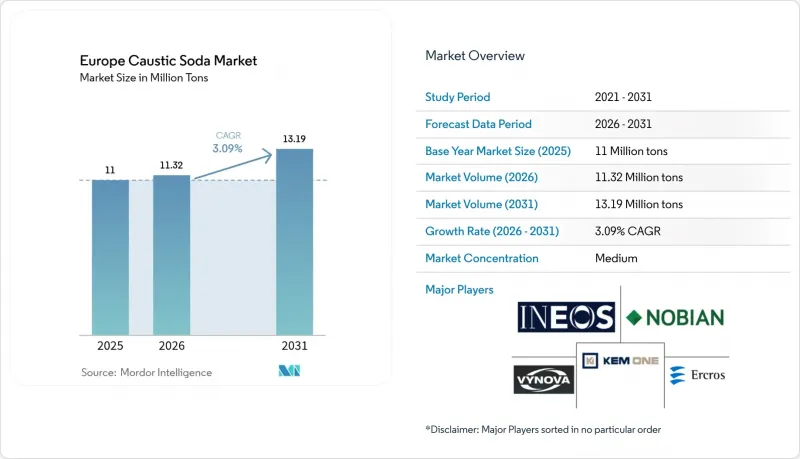
This report is Segmented by Production Process (Membrane Cell, Diaphragm Cell, and Other Production Processes), Form (Solid and Liquid), Application (Pulp and Paper, Organic Chemicals, Inorganic Chemicals, Soap and Detergents, Alumina, and More), and Geography (Germany, United Kingdom, France, Italy, Spain, Russia, and Rest of Europe). The Market Forecasts are Provided in Terms of Volume (Tons).
Europe Caustic Soda Market Trends and Insights
Increasing Demand from Water Treatment Application
Municipal and industrial wastewater plants must now satisfy the 2024/3019 revision of the Urban Wastewater Treatment Directive, widening tertiary treatment to towns above 1,000 population equivalents and calling for net-zero-energy operations by 2045. This mandates EUR 257 billion of upgrades by 2050, lifting caustic-soda use for nutrient removal and pH control by 15-20% over the outlook period. Germany and France, together holding roughly 35% of installed treatment capacity, earmarked EUR 3.2 billion and EUR 2.1 billion, respectively, in 2025 budgets for phosphorus-cut programs. Spain and Italy are channeling cohesion funds into coastal schemes, while Poland and the Czech Republic are decentralizing small-scale units that favor bagged solid NaOH. Suppliers of liquid 50% grades are winning multi-year supply contracts as utilities automate dosing and tighten occupational-safety protocols.
Rising Alumina Demand from EV-Battery Supply Chain
Alcoa opened negotiations in 2024 to revive its 465 kiloton/year San Ciprian refinery and is exploring a partial restart of the 800 kiloton/year Portovesme asset, contingent on sub-EUR 50/MWh renewable-power agreements. Both projects hinge on sodium hydroxide at 50-80 kg per ton of alumina, with battery-grade specifications lifting purity thresholds. Norway-based Norsk Hydro pledged 100% renewable inputs across European alumina and aluminum operations by 2030, establishing co-location prospects for membrane-cell plants near wind and solar clusters. Sodium-ion cathode chemistries referenced in the IEA Critical Minerals Outlook further expand long-term caustic requirements.
High European Energy Costs
Electricity makes up more than half of total chlor-alkali cash costs in Europe. Despite the retreat from 2023 peaks, 2024 industrial tariffs averaged 197 EUR/MWh, still 85% over the 2020 base. France, shielded by ARENH, pays 32-46 EUR/MWh, but Dutch and German producers contend with triple-digit quotes. Natural-gas parity against Henry Hub stays adverse. Consequently, Ercros saw average selling prices plunge 41% year-on-year, and margins compressed to 6.5% in H1 2024. Covestro's 1.2 GW renewable-power deal with RWE, effective 2026, aims to cap delivered electricity below 60 EUR/MWh for a decade.
Other drivers and restraints analyzed in the detailed report include:
- Growth of Fiber-Based Packaging
- Expansion of Soap and Detergent Manufacturing Hubs
- REACH and Occupational-Safety Compliance
For complete list of drivers and restraints, kindly check the Table Of Contents.
Segment Analysis
Membrane technology held 78.18% of 2025 volume, while other production processes segment is growing at a faster CAGR of 3.22%. The Europe caustic soda market size for membrane output is poised to benefit as every diaphragm retrofit delivers 20-30% electricity savings. Emerging routes such as oxygen-depolarized cathode cells could cut power draw under 2,000 kWh/t, and Horizon Europe earmarked EUR 45 million to pilot this technology.
Legacy diaphragm share, still near 10-12% in Poland, the Czech Republic, and Romania, will narrow as 2028 conversion deadlines approach. Producers that delay upgrades risk REACH penalties and customer flight toward low-carbon NaOH. Mercury cells have already vanished after the Minamata Convention. The Europe caustic soda market thus rotates firmly around membrane capacity, and any new build is expected to deploy next-generation cell rooms compatible with green hydrogen valorization.
Complete Report Scope:
- By Production Process
- Membrane Cell
- Diaphragm Cell
- Other Production Processes (Mercury Cell (legacy), Emerging Electro-electrodialysis and Direct Electro-synthesis)
- By Form
- Solid
- Liquid
- By Application
- Pulp and Paper
- Organic Chemicals
- Inorganic Chemicals
- Soap and Detergents
- Alumina
- Water Treatment
- Other Applications (Food and Feed Processing, etc.)
- By Geography
- Germany
- United Kingdom
- France
- Italy
- Spain
- Russia
- Rest of Europe
List of Companies Covered in this Report:
- BASF
- Covestro
- Dow
- Ercros
- INEOS
- Kem One
- Nobian
- Olin Corporation
- PCC SE
- Spolchemie
- Vynova Group
- Westlake Corporation
- WeylChem International GmbH
Additional Benefits:
- The market estimate (ME) sheet in Excel format
- 3 months of analyst support
TABLE OF CONTENTS
1 Introduction
- 1.1 Study Assumptions and Market Definition
- 1.2 Scope of the Study
2 Research Methodology
3 Executive Summary
4 Market Landscape
- 4.1 Market Overview
- 4.2 Market Drivers
- 4.2.1 Increasing Demand from Water Treatment Application
- 4.2.2 Rising Alumina Demand from EV-Battery Supply Chain
- 4.2.3 Growth of Fiber-Based Packaging
- 4.2.4 Expansion of Soap and Detergent Manufacturing Hubs
- 4.2.5 Growing Requirement for Chemical Synthesis
- 4.3 Market Restraints
- 4.3.1 High European Energy Costs
- 4.3.2 REACH and Occupational-Safety Compliance
- 4.3.3 Chlorine-Balance-Driven Rate Cuts
- 4.4 Value Chain Analysis
- 4.5 Porter's Five Forces
- 4.5.1 Bargaining Power of Suppliers
- 4.5.2 Bargaining Power of Buyers
- 4.5.3 Threat of New Entrants
- 4.5.4 Threat of Substitutes
- 4.5.5 Degree of Competition
- 4.6 Trade Analysis
- 4.7 Price Trends
- 4.8 Production Analysis
5 Market Size and Growth Forecasts (Value and Volume)
- 5.1 By Production Process
- 5.1.1 Membrane Cell
- 5.1.2 Diaphragm Cell
- 5.1.3 Other Production Processes (Mercury Cell (legacy), Emerging Electro-electrodialysis and Direct Electro-synthesis)
- 5.2 By Form
- 5.2.1 Solid
- 5.2.2 Liquid
- 5.3 By Application
- 5.3.1 Pulp and Paper
- 5.3.2 Organic Chemicals
- 5.3.3 Inorganic Chemicals
- 5.3.4 Soap and Detergents
- 5.3.5 Alumina
- 5.3.6 Water Treatment
- 5.3.7 Other Applications (Food and Feed Processing, etc.)
- 5.4 By Geography
- 5.4.1 Germany
- 5.4.2 United Kingdom
- 5.4.3 France
- 5.4.4 Italy
- 5.4.5 Spain
- 5.4.6 Russia
- 5.4.7 Rest of Europe
6 Competitive Landscape
- 6.1 Market Concentration
- 6.2 Strategic Moves
- 6.3 Market Share(%)/Ranking Analysis
- 6.4 Company Profiles (includes Global level Overview, Market level overview, Core Segments, Financials as available, Strategic Information, Products and Services, and Recent Developments)
- 6.4.1 BASF
- 6.4.2 Covestro
- 6.4.3 Dow
- 6.4.4 Ercros
- 6.4.5 INEOS
- 6.4.6 Kem One
- 6.4.7 Nobian
- 6.4.8 Olin Corporation
- 6.4.9 PCC SE
- 6.4.10 Spolchemie
- 6.4.11 Vynova Group
- 6.4.12 Westlake Corporation
- 6.4.13 WeylChem International GmbH
7 Market Opportunities and Future Outlook
- 7.1 White-space and Unmet-need Assessment

