
PUBLISHER: Mordor Intelligence | PRODUCT CODE: 2100538

PUBLISHER: Mordor Intelligence | PRODUCT CODE: 2100538
Digital Transformation In Retail Industry - Market Share Analysis, Industry Trends & Statistics, Growth Forecasts (2026 - 2031)
According to Mordor Intelligence, the digital transformation in retail market size is expected to grow from USD 285.76 billion in 2025 to USD 317.34 billion in 2026 and is forecast to reach USD 535.94 billion by 2031 at 11.05% CAGR over 2026-2031.
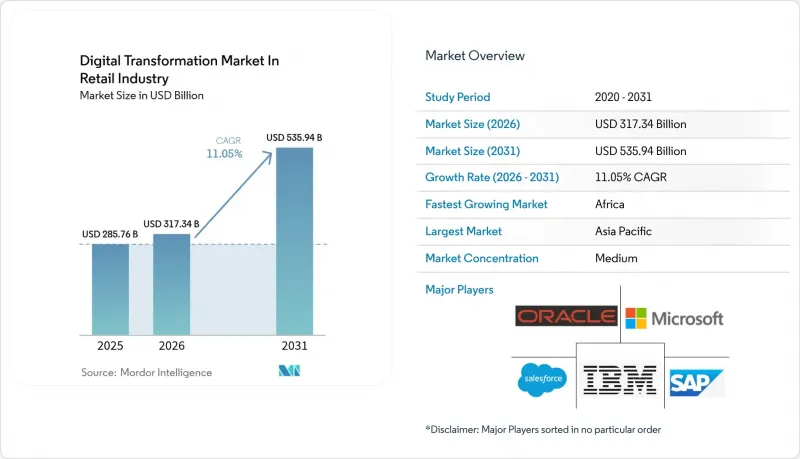
This report is Segmented by Accessibility (Mobile Application, Website, and More), Product Category (Consumer Electronics, and More), Technology (Cloud Computing, and More), Deployment Mode (On-Premise, Cloud, and More), Retail Format (E-Commerce-Only Retailers, and More), Organization Size (Large Enterprises, and More), and Geography. The Market Forecasts are Provided in Terms of Value (USD).
Insights and Trends of Digital Transformation Market In Retail Industry
Increased Usage of Smart Devices
Smartphones and tablets now anchor daily shopping journeys, turning biometric sign-ins, location prompts, and camera-based search into table-stakes functionality. Target generated double-digit digital sales growth after embedding Store Companion AI to surface on-shelf availability and tailored offers inside its app. Walmart processes more than one-fifth of its online volume through a mobile platform that runs edge-hosted search and pricing logic to keep latency under 300 milliseconds. Retailers that harness sensors and AR overlays inside apps not only lower return rates but also expand average basket sizes, reinforcing network effects that feed smarter personalization engines and higher lifetime value.
Rapid Uptake of Cloud-Native POS and OMS Platforms
Cutting-edge POS and order management stacks run on microservices that sync inventory, pricing, and loyalty data in real time. EE's deployment of Aptos cloud POS across 600 stores logged 99.9% uptime and trimmed checkout steps by two-fifths, unlocking cross-channel stock visibility at scale. The Vitamin Shoppe realized a 15% rise in fulfillment accuracy after moving to Jumpmind's cloud OMS, with inventory carrying costs falling by one-quarter. Such API-first systems simplify the addition of curbside pickup, ship-from-store, and buy-online-return-in-store capabilities without code rewrites, accelerating the digital transformation market's pivot toward unified commerce.
Legacy Store Infrastructure Compatibility Challenges
Decade-old POS terminals often lack APIs, forcing rip-and-replace projects before omnichannel features can launch. Red Hat notes that six in ten retailers face 18-24 month modernization timelines with integration costs running 40% above cloud-native deployments. Physical retrofits add wiring, cooling, and edge enclosures, stretching payback beyond four years and limiting smaller chains' ability to keep pace.
Other drivers and restraints analyzed in the detailed report include:
- Proliferation of Real-Time Inventory Visibility Through Edge IoT Sensors
- Explosion of Retail Media Networks Monetizing First-Party Data
- High Upfront Capex for End-to-End Omnichannel Integration
For complete list of drivers and restraints, kindly check the Table Of Contents.
Segment Analysis
Mobile apps owned 46.58% of the digital transformation market in 2025, reflecting their lead role in discovery, checkout, and post-purchase engagement. In-store kiosks are tracking a 11.86% CAGR as retailers embed them to extend digital catalogs and self-service returns. Website traffic steadies as responsive design narrows the usability gap with native apps.
High-intent shoppers that toggle between app and kiosk inside a single visit spend 40% more per trip at Best Buy, proving the multiplier effect of seamless channel handoffs. Kiosks fitted with AR mirrors support virtual fittings and personalized cross-sells, while QR-based app logins hand-off customer profiles to shared in-store screens, closing attribution loops and boosting engagement metrics.
Apparel captured 24.05% of the digital transformation market share in 2025, underpinned by size-and-fit algorithms and 3D visualization. Beauty and personal care, expanding at a 13.06% CAGR, leverages AR try-ons to reduce product hesitancy. Electronics players add comparison engines and live-stream demos, and food retailers roll out smart ordering and real-time inventory displays.
Sephora's Virtual Artist drives 200% higher conversion than static browsing by overlaying shades on customer selfies. Frequent repurchase cycles in beauty amplify the impact of personalized recs and subscription replenishment. In furniture, 3D room planners offset the tactile barrier of large-ticket items, while media retailers optimize streaming bundles and content discovery to lock in recurring revenue.
Complete Report Scope:
- By Accessibility
- Mobile Application
- Website
- In-Store Interactive Kiosks
- By Product Category
- Consumer Electronics
- Media and Entertainment
- Apparel
- Food and Beverage
- Furniture and Home Decor
- Beauty and Personal Care
- By Technology
- Cloud Computing
- Big Data and Analytics
- Artificial Intelligence
- Internet of Things
- Augmented Reality and Virtual Reality
- By Deployment Mode
- On-Premise
- Cloud
- Hybrid
- By Retail Format
- E-Commerce-Only Retailers
- Omnichannel Retailers
- Brick-and-Mortar Specialty Stores
- By Organization Size
- Large Enterprises
- Small and Medium Enterprises
- Geography
- North America
- United States
- Canada
- South America
- Brazil
- Mexico
- Argentina
- Europe
- Germany
- United Kingdom
- France
- Rest of Europe
- Asia Pacific
- China
- Japan
- India
- Rest of Asia Pacific
- Middle East
- Saudi Arabia
- United Arab Emirates
- Rest of Middle East
- Africa
- South Africa
- Nigeria
- Rest of Africa
- North America
Geography Analysis
Asia Pacific commanded 34.72% of the digital transformation market in 2025 as mobile-first consumers embraced super apps that fuse payments, social feeds, and logistics. Alibaba, Tencent, and Grab illustrate how integrated ecosystems compress the purchase funnel into a single screen tap. Government incentives for cashless economies accelerate QR-based payment penetration, while domestic cloud providers localize compliance. India and Southeast Asia stage double-digit growth by leapfrogging to mobile wallets and social commerce, delivering 25% higher digital transformation ROI than the global mean.
North America and Europe together capture a sizable share by pioneering retail media networks, labor automation, and compliance-driven digital receipts. The EU's e-receipt mandates ignite POS refresh cycles, while strict privacy codes push zero-party data strategies. U.S. majors scale in-house ad tech and computer vision checkout, setting operational benchmarks for the digital transformation market.
Africa is on course for a 12.09% CAGR through 2031, fueled by mobile money platforms such as M-Pesa and Flutterwave that bypass card networks. Mastercard projects regional digital payments of USD 1.5 trillion by 2030. South Africa and Nigeria lead with fintech ecosystems that dovetail with social commerce and agent networks, enabling micro-retailers to accept digital wallets without legacy POS hardware.
- SAP SE
- Oracle Corporation
- IBM Corporation
- Microsoft Corporation
- Salesforce Inc.
- Alibaba Group Holding Limited
- Amazon.com Inc.
- Accenture plc
- Capgemini SE
- Lightspeed Commerce Inc.
- Clover Network Inc.
- NCR Voyix Corporation
- Shopify Inc.
- Fujitsu Limited
- Zebra Technologies Corporation
- Lightspeed Commerce Inc.
- Diebold Nixdorf Incorporated
- Tencent Holdings Limited
- Flipkart Internet Private Limited
- Infosys Limited
Additional Benefits:
- The market estimate (ME) sheet in Excel format
- 3 months of analyst support
TABLE OF CONTENTS
1 INTRODUCTION
- 1.1 Study Assumptions and Market Definition
- 1.2 Scope of the Study
2 RESEARCH METHODOLOGY
3 EXECUTIVE SUMMARY
4 MARKET LANDSCAPE
- 4.1 Market Overview
- 4.2 Market Drivers
- 4.2.1 Increased Usage of Smart Devices
- 4.2.2 Rapid Uptake of Cloud-Native POS and OMS Platforms
- 4.2.3 Proliferation of Real-Time Inventory Visibility Through Edge IoT Sensors
- 4.2.4 Explosion of Retail Media Networks Monetizing First-Party Data
- 4.2.5 Mandatory e-receipt Regulations in EU Driving Paperless Checkout
- 4.2.6 Retail Workforce Optimization via Generative AI Assistants
- 4.3 Market Restraints
- 4.3.1 Legacy Store Infrastructure Compatibility Challenges
- 4.3.2 High Upfront Capex for End-to-End Omnichannel Integration
- 4.3.3 Heightened Cybersecurity Exposure with API-First Architectures
- 4.3.4 Data Governance Complexities Across Jurisdictions
- 4.4 Industry Ecosystem Analysis
- 4.5 Regulatory Landscape
- 4.6 Technological Outlook
- 4.7 Impact of Macroeconomic Factors
- 4.8 Porter's Five Forces Analysis
- 4.8.1 Threat of New Entrants
- 4.8.2 Bargaining Power of Buyers
- 4.8.3 Bargaining Power of Suppliers
- 4.8.4 Threat of Substitute Products
- 4.8.5 Intensity of Competitive Rivalry
- 4.9 Investment Analysis
5 MARKET SIZE AND GROWTH FORECASTS (VALUE)
- 5.1 By Accessibility
- 5.1.1 Mobile Application
- 5.1.2 Website
- 5.1.3 In-Store Interactive Kiosks
- 5.2 By Product Category
- 5.2.1 Consumer Electronics
- 5.2.2 Media and Entertainment
- 5.2.3 Apparel
- 5.2.4 Food and Beverage
- 5.2.5 Furniture and Home Decor
- 5.2.6 Beauty and Personal Care
- 5.3 By Technology
- 5.3.1 Cloud Computing
- 5.3.2 Big Data and Analytics
- 5.3.3 Artificial Intelligence
- 5.3.4 Internet of Things
- 5.3.5 Augmented Reality and Virtual Reality
- 5.4 By Deployment Mode
- 5.4.1 On-Premise
- 5.4.2 Cloud
- 5.4.3 Hybrid
- 5.5 By Retail Format
- 5.5.1 E-Commerce-Only Retailers
- 5.5.2 Omnichannel Retailers
- 5.5.3 Brick-and-Mortar Specialty Stores
- 5.6 By Organization Size
- 5.6.1 Large Enterprises
- 5.6.2 Small and Medium Enterprises
- 5.7 Geography
- 5.7.1 North America
- 5.7.1.1 United States
- 5.7.1.2 Canada
- 5.7.2 South America
- 5.7.2.1 Brazil
- 5.7.2.2 Mexico
- 5.7.2.3 Argentina
- 5.7.3 Europe
- 5.7.3.1 Germany
- 5.7.3.2 United Kingdom
- 5.7.3.3 France
- 5.7.3.4 Rest of Europe
- 5.7.4 Asia Pacific
- 5.7.4.1 China
- 5.7.4.2 Japan
- 5.7.4.3 India
- 5.7.4.4 Rest of Asia Pacific
- 5.7.5 Middle East
- 5.7.5.1 Saudi Arabia
- 5.7.5.2 United Arab Emirates
- 5.7.5.3 Rest of Middle East
- 5.7.6 Africa
- 5.7.6.1 South Africa
- 5.7.6.2 Nigeria
- 5.7.6.3 Rest of Africa
- 5.7.1 North America
6 COMPETITIVE LANDSCAPE
- 6.1 Market Concentration
- 6.2 Strategic Moves
- 6.3 Market Share Analysis
- 6.4 Company Profiles (includes Global level Overview, Market level overview, Core Segments, Financials as available, Strategic Information, Market Rank/Share for key companies, Products and Services, and Recent Developments)
- 6.4.1 SAP SE
- 6.4.2 Oracle Corporation
- 6.4.3 IBM Corporation
- 6.4.4 Microsoft Corporation
- 6.4.5 Salesforce Inc.
- 6.4.6 Alibaba Group Holding Limited
- 6.4.7 Amazon.com Inc.
- 6.4.8 Accenture plc
- 6.4.9 Capgemini SE
- 6.4.10 Lightspeed Commerce Inc.
- 6.4.11 Clover Network Inc.
- 6.4.12 NCR Voyix Corporation
- 6.4.13 Shopify Inc.
- 6.4.14 Fujitsu Limited
- 6.4.15 Zebra Technologies Corporation
- 6.4.16 Lightspeed Commerce Inc.
- 6.4.17 Diebold Nixdorf Incorporated
- 6.4.18 Tencent Holdings Limited
- 6.4.19 Flipkart Internet Private Limited
- 6.4.20 Infosys Limited
7 MARKET OPPORTUNITIES AND FUTURE OUTLOOK
- 7.1 White-Space and Unmet-Need Assessment

