PUBLISHER: Mordor Intelligence | PRODUCT CODE: 2100541

PUBLISHER: Mordor Intelligence | PRODUCT CODE: 2100541
Injectable Drug Delivery Devices - Market Share Analysis, Industry Trends & Statistics, Growth Forecasts (2026 - 2031)
According to Mordor Intelligence, the injectable drug delivery devices market size is projected to be USD 0.75 trillion in 2025, USD 0.81 trillion in 2026, and reach USD 1.20 trillion by 2031, growing at a CAGR of 8.21% from 2026 to 2031.
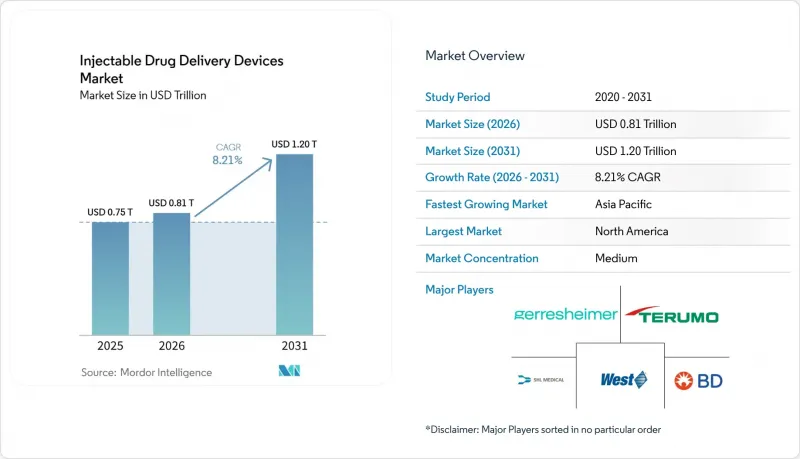
This report is Segmented by Devices Type (Conventional Drug Delivery Devices and Advanced Drug Delivery Devices), Therapeutic Application (Diabetes, Oncology and More), Usability (Disposbales and Re-Usable Injectors), Route of Administration (Subcutaneous, Intravenous, and More), End User (Home Care Setting and More) and Geography. The Market and Forecasts are Provided in Terms of Value (USD).
Global Injectable Drug Delivery Devices Market Trends and Insights
Rising popularity of self-administration supported by digital adherence aids
Smart connected injectors now track dosing, push reminders, and sync data with care teams, lifting adherence by up to 32% and cutting clinic visits by 41%. Home use reduces hospitalisation in chronic disease management by as much as 30%, which appeals to payers. Early movers such as Enable Injections have shown that convenient hands-free wearables improve persistence without sacrificing drug stability. Technology costs are falling, broadening uptake beyond premium biologics. As a result, the injectable drug delivery devices market gains incremental volume while shifting revenue mixes toward value-added software and data services.
Expansion of large-molecule biologics pipeline requiring parenteral delivery
Seven of the ten top-selling medicines in 2024 were biologics delivered by injection, and forecasts see nine of ten by 2029 with a combined pipeline value of USD 168 billion. Viscous monoclonal antibodies and antibody-drug conjugates need larger-volume or on-body devices, fuelling innovation in materials and drive mechanisms. Because delivery choice now influences formulary access, drug sponsors are partnering early with device specialists to co-develop turnkey platforms, thereby increasing switching costs for competitors and extending product life cycles.
Risk of infections and other complications for usage
Healthcare workers still report 385,000 sharps injuries per year in the United States. Wearable injectors show complication rates of 5-8% owing to skin reactions, prompting regulators to demand post-market surveillance. Device firms now dedicate USD 1.2 billion annually to safety innovation, with antimicrobial coatings and needle-free prototypes aimed at mitigating these risks.
Other drivers and restraints analyzed in the detailed report include:
- Shift of care from hospital to home driving demand for wearable injectors
- High burden of chronic diseases
- Stringent regulatory requirements
For complete list of drivers and restraints, kindly check the Table Of Contents.
Segment Analysis
Advanced drug delivery devices account for 35.90% of the injectable drug delivery devices market in 2025, driven by versatility across therapy classes and a 60% error-reduction advantage over vial-and-syringe systems. Glass is gradually ceding share to cyclic olefin polymers that resist breakage and minimise silicone-oil interactions, traits valued in oncology and autoimmune biologics. Unit demand flexes upward as biosimilars widen patient access. The shift to polymers also eases manufacturing scale-up due to lower break rates during fill-finish operations. Advanced drug delivery devices, though smaller in 2025, are scaling at an 11.77% CAGR. These on-body systems handle high-viscosity formulations and volumes up to 20 mL, allowing subcutaneous dosing of drugs once limited to intravenous infusion. Connectivity modules record time-stamped adherence data, opening pay-for-performance contracts.
The competitive battleground turns on human-factors engineering. Companies showcase intuitive presses, audible clicks, or tactile feedback that confirm dose completion. Smart variants log dosing events and integrate with electronic health records, creating data assets that fortify payer negotiations. Tailored wearables tied to single-drug licences tighten ecosystem control, keeping users inside the original brand and extending life-cycle revenue. Collectively, these dynamics keep the injectable drug delivery devices market expanding even as alternative routes arise.
Diabetes commands 31.23% of 2025 revenue as injectable insulin and GLP-1 receptor agonists remain core to glycaemic control. Emerging hydrogel depots could reduce injection frequency to quarterly, boosting adherence and broadening global uptake. Obesity indications further lift volume as semaglutide prescriptions climb. Oncology, registering an 11.47% CAGR, benefits from a swelling pipeline of monoclonal antibodies and antibody-drug conjugates. Subcutaneous reformulations shorten clinic dwell times and improve patient quality of life, reinforcing the growth arc of the injectable drug delivery devices market size in this segment.
Autoimmune conditions such as rheumatoid arthritis follow closely, as injectable biologics shift from hospital to home. Long-acting antivirals like injectable lenacapavir are poised to transform HIV prevention by condensing daily pills into twice-yearly shots. Cardiology's resurgence pivots on lipid-lowering PCSK9 inhibitors administered every two to four weeks, offering alternatives for statin-intolerant patients. This breadth supports steady device utilisation even as individual therapy areas fluctuate.
Complete Report Scope:
- By Device Type
- Conventional Drug Delivery Devices
- Syringes and Needles
- Vials and Ampoules
- Advanced Drug Delivery Devices
- Prefilled Syringes
- Glass Barrel
- Polymer Barrel
- Pen Injectors
- Auto-Injectors
- Disposable Auto-Injectors
- Re-usable Auto-Injectors
- Needle-Free Injectors
- Wearable Injectors
- Other Advanced Types
- Prefilled Syringes
- Conventional Drug Delivery Devices
- By Therapeutic Application
- Diabetes
- Oncology
- Auto-Immune Disorders
- Cardiovascular Diseases
- Infectious Diseases (Hepatitis, HIV, etc.)
- Pain Management
- Others (Hormonal disorders, Rare and Orphan Diseases and others)
- By Usability
- Disposable Injectors
- Re-usable Injectors
- By Route of Administration
- Sub-cutaneous
- Intramuscular
- Intravenous
- Others (Intradermal, Intravitreal, etc.)
- By End User
- Hospitals and ASCs
- Home-Care Settings
- Specialty Clinics
- By Geography
- North America
- United States
- Canada
- Mexico
- Europe
- Germany
- United Kingdom
- France
- Italy
- Spain
- Rest of Europe
- Asia-Pacific
- China
- Japan
- India
- South Korea
- Australia
- Rest of Asia-Pacific
- Middle East and Africa
- GCC
- South Africa
- Rest of Middle East and Africa
- South America
- Brazil
- Argentina
- Rest of South America
- North America
Geography Analysis
North America holds 42.63% of global revenue in 2025, supported by robust reimbursement, strong device R&D, and the FDA's approval of 50 novel drugs that mostly require advanced delivery. Recent CMS payment rules add a 2.9% rate increase for eligible devices, further lifting uptake. Investment momentum is visible in Novo Nordisk's acquisition of three fill-finish plants to secure GLP-1 capacity. These moves confirm sustained leadership in the injectable drug delivery devices market.
Europe sits second by revenue, distinguished by sustainability mandates that accelerate the shift toward reusable injectors and low-carbon materials. Implementation of the EU Medical Device Regulation strengthens quality assurance but lengthens launch timelines. The European Medicines Agency will make shortage reporting on its central platform mandatory from February 2025, heightening supply-chain transparency. The United Kingdom and Germany spearhead growth, aided by strong diabetes technology adoption.
Asia-Pacific is the fastest-growing region at 9.30% CAGR through 2031. Prevalence of diabetes and cardiovascular disease escalates with urbanization and ageing. China and India channel policy incentives into domestic biologics and injector manufacture, shifting the competitive centre of gravity eastward. Japan capitalises on precision engineering to supply premium wearables. Regional private insurance expansion widens patient access to higher-priced connected devices, reinforcing momentum in the injectable drug delivery devices market.
- Beckton Dickinson
- West Pharmaceutical Services
- Terumo
- Gerresheimer
- Baxter
- SHL Medical AG
- Ypsomed
- Owen Mumford
- Haselmeier GmbH (Sonceboz)
- Halozyme Therapeutics
- AptarGroup Inc.
- Novo Nordisk
- Sanofi
- Eli Lilly and Company
- Pfizer
- Teva Pharmaceutical Industries
- Roche
- Johnson & Johnson Services Inc. (Janssen)
- Novartis
- SCHOTT
Additional Benefits:
- The market estimate (ME) sheet in Excel format
- 3 months of analyst support
TABLE OF CONTENTS
1 Introduction
- 1.1 Study Assumptions and Market Definition
- 1.2 Scope of the Study
2 Research Methodology
3 Executive Summary
4 Market Landscape
- 4.1 Market Overview
- 4.2 Market Drivers
- 4.2.1 Rising Popularity of Self-Administration Supported by Digital Adherence Aids
- 4.2.2 Expansion of Large-Molecule Biologics Pipeline Requiring Parenteral Delivery
- 4.2.3 Shift of Care from Hospital to Home Driving Demand for Wearable Injectors
- 4.2.4 High Burden of Chronic Diseases
- 4.2.5 Devlopment of Advanced Technology Injectable Devices
- 4.2.6 Escalating Global Vaccination Initiatives
- 4.3 Market Restraints
- 4.3.1 Risk of Infections and Other Complications for Usage
- 4.3.2 Stringent Regulatory Requirements
- 4.3.3 Availability of Alternative Drug Delivery Methods
- 4.3.4 Price Volatility and Periodic Shortages of Medical-Grade Cyclic-olefin Polymers and Borosilicate Glass
- 4.4 Value / Supply-Chain Analysis
- 4.5 Regulatory and Technological Outlook
- 4.6 Porter's Five Forces Analysis
- 4.6.1 Bargaining Power of Suppliers
- 4.6.2 Bargaining Power of Buyers
- 4.6.3 Threat of New Entrants
- 4.6.4 Threat of Substitutes
- 4.6.5 Intensity of Competitive Rivalry
5 Market Size and Growth Forecasts (Value-USD)
- 5.1 By Device Type
- 5.1.1 Conventional Drug Delivery Devices
- 5.1.1.1 Syringes and Needles
- 5.1.1.2 Vials and Ampoules
- 5.1.2 Advanced Drug Delivery Devices
- 5.1.2.1 Prefilled Syringes
- 5.1.2.1.1 Glass Barrel
- 5.1.2.1.2 Polymer Barrel
- 5.1.2.2 Pen Injectors
- 5.1.2.3 Auto-Injectors
- 5.1.2.3.1 Disposable Auto-Injectors
- 5.1.2.3.2 Re-usable Auto-Injectors
- 5.1.2.4 Needle-Free Injectors
- 5.1.2.5 Wearable Injectors
- 5.1.2.6 Other Advanced Types
- 5.1.2.1 Prefilled Syringes
- 5.1.1 Conventional Drug Delivery Devices
- 5.2 By Therapeutic Application
- 5.2.1 Diabetes
- 5.2.2 Oncology
- 5.2.3 Auto-Immune Disorders
- 5.2.4 Cardiovascular Diseases
- 5.2.5 Infectious Diseases (Hepatitis, HIV, etc.)
- 5.2.6 Pain Management
- 5.2.7 Others (Hormonal disorders, Rare and Orphan Diseases and others)
- 5.3 By Usability
- 5.3.1 Disposable Injectors
- 5.3.2 Re-usable Injectors
- 5.4 By Route of Administration
- 5.4.1 Sub-cutaneous
- 5.4.2 Intramuscular
- 5.4.3 Intravenous
- 5.4.4 Others (Intradermal, Intravitreal, etc.)
- 5.5 By End User
- 5.5.1 Hospitals and ASCs
- 5.5.2 Home-Care Settings
- 5.5.3 Specialty Clinics
- 5.6 By Geography
- 5.6.1 North America
- 5.6.1.1 United States
- 5.6.1.2 Canada
- 5.6.1.3 Mexico
- 5.6.2 Europe
- 5.6.2.1 Germany
- 5.6.2.2 United Kingdom
- 5.6.2.3 France
- 5.6.2.4 Italy
- 5.6.2.5 Spain
- 5.6.2.6 Rest of Europe
- 5.6.3 Asia-Pacific
- 5.6.3.1 China
- 5.6.3.2 Japan
- 5.6.3.3 India
- 5.6.3.4 South Korea
- 5.6.3.5 Australia
- 5.6.3.6 Rest of Asia-Pacific
- 5.6.4 Middle East and Africa
- 5.6.4.1 GCC
- 5.6.4.2 South Africa
- 5.6.4.3 Rest of Middle East and Africa
- 5.6.5 South America
- 5.6.5.1 Brazil
- 5.6.5.2 Argentina
- 5.6.5.3 Rest of South America
- 5.6.1 North America
6 Competitive Landscape
- 6.1 Market Concentration
- 6.2 Market Share Analysis
- 6.3 Company profiles (includes Global level Overview, Market level overview, Core Segments, Financials as available, Strategic Information, Market Rank/Share for key companies, Products and Services, and Recent Developments)
- 6.3.1 Becton, Dickinson and Company (BD)
- 6.3.2 West Pharmaceutical Services Inc.
- 6.3.3 Terumo Corporation
- 6.3.4 Gerresheimer AG
- 6.3.5 Baxter International Inc.
- 6.3.6 SHL Medical AG
- 6.3.7 Ypsomed AG
- 6.3.8 Owen Mumford Ltd
- 6.3.9 Haselmeier GmbH (Sonceboz)
- 6.3.10 Halozyme Therapeutics
- 6.3.11 AptarGroup Inc.
- 6.3.12 Novo Nordisk A/S
- 6.3.13 Sanofi SA
- 6.3.14 Eli Lilly and Company
- 6.3.15 Pfizer Inc.
- 6.3.16 Teva Pharmaceutical Industries Ltd
- 6.3.17 F. Hoffmann-La Roche Ltd
- 6.3.18 Johnson & Johnson Services Inc. (Janssen)
- 6.3.19 Novartis AG
- 6.3.20 Schott AG
7 Market Opportunities and Future Outlook
- 7.1 White-Space and Unmet-Need Assessment

