PUBLISHER: Mordor Intelligence | PRODUCT CODE: 2113456

PUBLISHER: Mordor Intelligence | PRODUCT CODE: 2113456
Europe Injectable Drug Delivery - Market Share Analysis, Industry Trends & Statistics, Growth Forecasts (2026 - 2031)
According to Mordor Intelligence, the Europe injectable drug delivery market size was valued at USD 213.80 billion in 2025 and is estimated to grow from USD 232 billion in 2026 to reach USD 349.10 billion by 2031, at a CAGR of 8.52% during the forecast period (2026-2031).
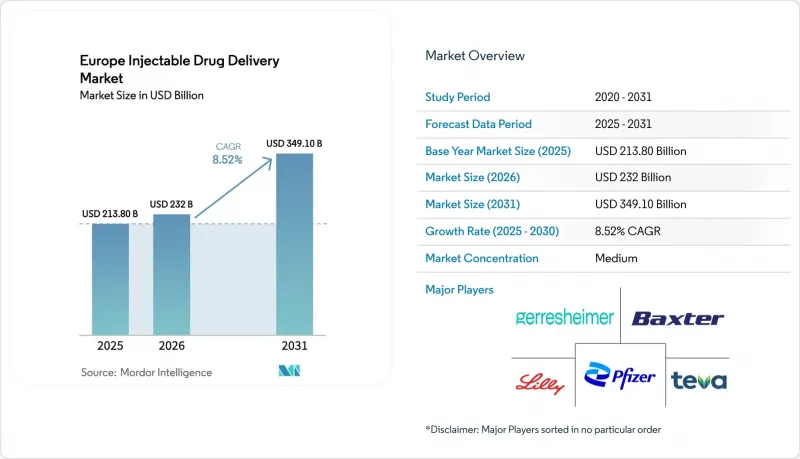
This report is Segmented by Device Type (Conventional, Self-Injectable, Implantable, and More), Therapeutic Application (Cardiovascular, Diabetes, Oncology, and More), End User (Hospitals, Specialty Clinics, Home Healthcare, and More), Raw Material (Borosilicate Glass, Plastics, Sustainable Polymers), and Geography (Germany, and More). Market Forecasts are Provided in Terms of Value (USD).
Europe Injectable Drug Delivery Market Trends and Insights
Rising Prevalence of Chronic Diseases
Cardiovascular disease, diabetes, and cancer together account for 60% of European mortality, creating persistent demand for injectable biologics that cannot survive gastrointestinal degradation. Type 2 diabetes prevalence reached 9.2% among European adults in 2025, with incidence rising fastest in Eastern Europe, where preventive infrastructure lags. Oncology incidence climbed to 2.7 million new cases in 2025; subcutaneous trastuzumab and pembrolizumab now cut chair time by 75%, easing ambulatory-unit bottlenecks. Autoimmune disease burden is also climbing: biologic penetration in rheumatology surpassed 40% by 2025, buoyed by tumor-necrosis-factor and interleukin blockers in prefilled syringes. The European Commission's 2024 Pharmaceutical Strategy harmonizes cross-border reimbursement, widening patient access to high-cost injectables.
Preference for Self-Injectable Devices
A 2024 survey of 3,200 European biologic users reported that 68% preferred self-injection over clinic visits, citing schedule flexibility and lower infection risk. Statutory insurers in Germany and the Netherlands reimburse home infusions at rates up to 40% below hospital tariffs, financially incentivizing adoption of auto-injectors and portable pumps. Ypsomed's YpsoMate 2.5 autoinjector integrates Bluetooth sensors that transmit dose and time stamps, supporting value-based contracts that penalize non-adherence. UCB's rozanolixizumab enables patient-controlled subcutaneous delivery for generalized myasthenia gravis, eliminating routine hospital infusions. Compliance with ISO 11608 standards facilitates drug-device interoperability, further lowering switching costs for biosimilar substitution.
Shift to Non-Invasive Delivery Routes
Oral, transdermal, and inhaled formulations are eating into injectable volumes in segments where adequate bioavailability has been achieved. Novo Nordisk's oral semaglutide captured 15% of German GLP-1 prescriptions by late 2025, despite lower bioavailability, reflecting strong needle aversion among patients. Transdermal microneedle patches from 3M entered Phase III insulin trials in 2025 and deliver 85% bioequivalence relative to subcutaneous injection, while eliminating sharps waste. Inhaled insulin (Afrezza) regained EU authorization in 2024 and targets the 12% of type 1 diabetics unwilling to inject. Transmucosal opioid films are now preferred in palliative care, further curbing demand for injectable opioids. The restraint is most pronounced in pediatric and geriatric cohorts, where injection anxiety and manual-dexterity issues are common.
Other drivers and restraints analyzed in the detailed report include:
- Growth of Biologics & Biosimilars
- Integration of Smart Injectors with eHealth
- EMA Combination-Product Hurdles & Cost
For complete list of drivers and restraints, kindly check the Table Of Contents.
Segment Analysis
Self-injectable devices generated 42.55% of 2025 revenue and are on track to expand at an 11.85% CAGR through 2031, outpacing all other formats within the Europe Injectable Drug Delivery market. Prefilled syringe demand is anchored by Stevanato Group's EZ-fill polymer barrels that curb protein aggregation, supporting high-concentration biologics above 150 mg/mL. Auto-injectors such as YpsoMate 2.5 embed Bluetooth sensors for dose confirmation, opening the door to adherence-linked reimbursement models. Wearable injectors are disrupting infusion paradigms; BD's Libertas can deliver 5 mL subcutaneously in 30 minutes, displacing multihour intravenous infusions for immunoglobulins. Needle-free jet injectors remain niche due to patient discomfort, yet PharmaJet's Tropis system gained EMA clearance for intradermal vaccines, a sign of gradual acceptance.
Smart connected injectors are the fastest-moving subsegment of the Europe Injectable Drug Delivery market. Biocorp's Mallya adapts legacy insulin pens for real-time data capture, an affordable retrofit sought by cost-conscious payers in Eastern Europe. Conventional glass syringes, vials, and ampoules still meet hospital demands where multi-dose vials lower per-unit antibiotic costs. Implantable pumps, such as Medtronic's SynchroMed II, maintain niche roles in refractory pain management. Subcutaneous home-infusion pumps like Baxter's Homepump Eclipse reduce cystic-fibrosis readmissions by 40% in UK pilots. Microneedle patches, currently in late-stage insulin trials, hold future promise for needle-phobic populations.
Oncology applications are poised to advance at a 9.75% CAGR between 2026-2031, the fastest of any indication tracked within the Europe Injectable Drug Delivery industry. Subcutaneous pembrolizumab, approved in 2024, administers 600 mg in only five minutes, cutting infusion-suite utilization and freeing thousands of chair-hours annually. Trastuzumab biosimilars now command 62% share of HER2-positive breast-cancer starts in Germany, illustrating payer appetite for cost-saving injectables. Diabetes held 38.53% of 2025 revenue; however, oral semaglutide's rise limits incremental injection growth. Autoimmune disorders such as rheumatoid arthritis and Crohn's disease are robust, supported by quarterly wearable-injector formulations that simplify dosing schedules.
Cardiovascular injectables, led by Amgen's evolocumab prefilled pen, hold steady as guideline updates broaden PCSK9 inhibitor usage for high-risk LDL profiles. Hepatitis injectables are waning as direct-acting antivirals migrate to oral formats. Pain-management injections face tighter opioid controls, while vaccine volumes normalize post-COVID-19. Fertility hormones and growth factors sustain stable demand as subcutaneous methotrexate transitions to autoinjectors in Nordic markets.
Complete Report Scope:
- By Device Type
- Conventional Drug Delivery Devices
- Self-injectable Drug Delivery Devices
- Prefilled Syringes
- Injection Pens
- Auto-injectors
- Needle-free Injectors
- Wearable Injectors
- Smart Connected Injectors
- Implantable Drug Delivery Devices
- Infusion Pumps (Sub-Q)
- Microneedle Systems
- By Therapeutic Application
- Cardiovascular Disease
- Diabetes
- Oncology
- Autoimmune Disorders
- Hepatitis
- Pain Management
- Infectious Diseases & Vaccines
- Others
- By End User
- Hospitals
- Specialty Clinics
- Home Healthcare Settings
- Ambulatory Surgery Centers
- Online Pharmacies
- By Raw Material
- Borosilicate Glass
- Plastics (COP/COC, PP, PC)
- Sustainable/Biodegradable Polymers
- Country
- Germany
- United Kingdom
- France
- Italy
- Spain
- Rest of Europe
List of Companies Covered in this Report:
- Antares Pharma (Halozyme)
- Baxter
- Beckton Dickinson
- Catalent Pharma Solutions
- Eli Lilly and Company
- Gerresheimer
- Haselmeier GmbH
- Medtronic
- Nipro
- Novo Nordisk
- Owen Mumford
- Pfizer
- Recipharm
- SCHOTT
- SHL Medical AG
- Stevanato Group
- Terumo Corp.
- Teva Pharmaceutical Industries
- Vetter Pharma International
- West Pharmaceutical Services
- Ypsomed
Additional Benefits:
- The market estimate (ME) sheet in Excel format
- 3 months of analyst support
TABLE OF CONTENTS
1 Introduction
- 1.1 Study Assumptions & Market Definition
- 1.2 Scope of the Study
2 Research Methodology
3 Executive Summary
4 Market Landscape
- 4.1 Market Overview
- 4.2 Market Drivers
- 4.2.1 Rising prevalence of chronic diseases
- 4.2.2 Preference for self-injectable devices
- 4.2.3 Growth of biologics & biosimilars
- 4.2.4 Regulatory push for safety syringes
- 4.2.5 EU eco-design rules spurring polymer syringes
- 4.2.6 Integration of smart injectors with eHealth
- 4.3 Market Restraints
- 4.3.1 Shift to non-invasive delivery routes
- 4.3.2 EMA combination-product hurdles & cost
- 4.3.3 EU pharma-in-water producer liability
- 4.3.4 Shortages of borosilicate glass/resins
- 4.4 Supply-Chain Analysis
- 4.5 Regulatory Landscape
- 4.6 Technological Outlook
- 4.7 Porter's Five Forces
- 4.7.1 Threat of New Entrants
- 4.7.2 Bargaining Power of Buyers
- 4.7.3 Bargaining Power of Suppliers
- 4.7.4 Threat of Substitutes
- 4.7.5 Intensity of Competitive Rivalry
5 Market Size & Growth Forecasts (Value, USD)
- 5.1 By Device Type
- 5.1.1 Conventional Drug Delivery Devices
- 5.1.2 Self-injectable Drug Delivery Devices
- 5.1.2.1 Prefilled Syringes
- 5.1.2.2 Injection Pens
- 5.1.2.3 Auto-injectors
- 5.1.2.4 Needle-free Injectors
- 5.1.2.5 Wearable Injectors
- 5.1.2.6 Smart Connected Injectors
- 5.1.3 Implantable Drug Delivery Devices
- 5.1.4 Infusion Pumps (Sub-Q)
- 5.1.5 Microneedle Systems
- 5.2 By Therapeutic Application
- 5.2.1 Cardiovascular Disease
- 5.2.2 Diabetes
- 5.2.3 Oncology
- 5.2.4 Autoimmune Disorders
- 5.2.5 Hepatitis
- 5.2.6 Pain Management
- 5.2.7 Infectious Diseases & Vaccines
- 5.2.8 Others
- 5.3 By End User
- 5.3.1 Hospitals
- 5.3.2 Specialty Clinics
- 5.3.3 Home Healthcare Settings
- 5.3.4 Ambulatory Surgery Centers
- 5.3.5 Online Pharmacies
- 5.4 By Raw Material
- 5.4.1 Borosilicate Glass
- 5.4.2 Plastics (COP/COC, PP, PC)
- 5.4.3 Sustainable/Biodegradable Polymers
- 5.5 Country
- 5.5.1 Germany
- 5.5.2 United Kingdom
- 5.5.3 France
- 5.5.4 Italy
- 5.5.5 Spain
- 5.5.6 Rest of Europe
6 Competitive Landscape
- 6.1 Market Concentration
- 6.2 Market Share Analysis
- 6.3 Company Profiles (includes Global level Overview, Market level overview, Core Segments, Financials as available, Strategic Information, Market Rank/Share for key companies, Products & Services, and Recent Developments)
- 6.3.1 Antares Pharma (Halozyme)
- 6.3.2 Baxter
- 6.3.3 Becton, Dickinson and Company
- 6.3.4 Catalent Pharma Solutions
- 6.3.5 Eli Lilly and Company
- 6.3.6 Gerresheimer AG
- 6.3.7 Haselmeier GmbH
- 6.3.8 Medtronic plc
- 6.3.9 Nipro Corporation
- 6.3.10 Novo Nordisk A/S
- 6.3.11 Owen Mumford Ltd
- 6.3.12 Pfizer Inc.
- 6.3.13 Recipharm AB
- 6.3.14 SCHOTT AG
- 6.3.15 SHL Medical AG
- 6.3.16 Stevanato Group
- 6.3.17 Terumo Corp.
- 6.3.18 Teva Pharmaceutical Industries Ltd
- 6.3.19 Vetter Pharma International
- 6.3.20 West Pharmaceutical Services Inc.
- 6.3.21 Ypsomed Holding AG
7 Market Opportunities & Future Outlook
- 7.1 White-space & Unmet-Need Assessment

