PUBLISHER: Mordor Intelligence | PRODUCT CODE: 2100562

PUBLISHER: Mordor Intelligence | PRODUCT CODE: 2100562
Protective Coatings - Market Share Analysis, Industry Trends & Statistics, Growth Forecasts (2026 - 2031)
According to Mordor Intelligence, the global protective coatings market size is expected to increase from USD 15.86 billion in 2025 to USD 16.5 billion in 2026 and reach USD 20.11 billion by 2031, and is expected to grow at a CAGR of 4.04% over 2026-2031.
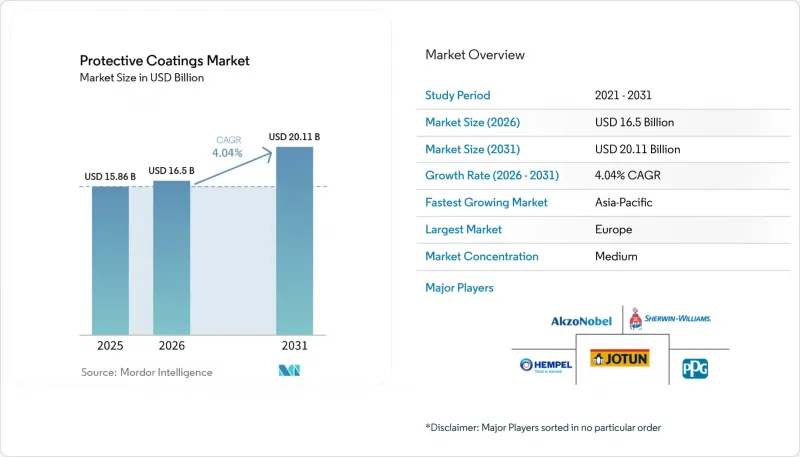
This report is Segmented by Resin Type (Epoxy, Polyurethane, Vinyl Ester, and More), Technology (Solvent-Borne, Water-Borne, and More), Substrate (Metal, Concrete, and More), End-Use Industry (Oil and Gas, Mining, Power, Infrastructure, and More), and Geography (Asia-Pacific, North America, Europe, South America, and Middle-East and Africa). The Market Forecasts are Provided in Terms of Value (USD).
Global Protective Coatings Market Trends and Insights
Public-Sector Megaproject Pipeline in APAC and GCC
Governments across Asia-Pacific and the GCC have earmarked USD 2.8 trillion for rail, port, and energy infrastructure through 2030, a program that creates a steady pull for epoxy-polyamide primers, zinc-silicate bases, and polyurethane topcoats that survive humidity above 85% and chloride levels above 500 ppm. India's National Infrastructure Pipeline alone set aside USD 1.4 trillion for metro-rail extensions in 16 cities, requiring coatings compliant with IS 15489 coastal durability classes. Saudi Arabia's NEOM and Red Sea Project encompass more than 50 million m2 of structural steel, each specified to ISO 12944 C5-M, thereby favoring three-coat zinc-epoxy-polyurethane sequences. Belt-and-Road rail corridors in Pakistan and Indonesia have also standardized fusion-bonded epoxy for rebar and water-borne acrylics for concrete tunnels. GCC desalination upgrades, 12 million m3/day of new capacity by 2028, demand phenolic-epoxy linings certified to NSF/ANSI 61, underlining the need for chemical resistance in hypochlorite service.
Accelerating Shift from Solvent-Borne to Low/Zero-VOC Systems
The European Union slashed VOC ceilings to 250 g/L for confined-space applications in January 2024, effectively retiring long-oil alkyds without add-on oxidizers. California's South Coast Rule 1107 dropped metal-coating limits to 100 g/L in 2025, catalyzing water-borne epoxy uptake despite 20% longer flash-off times. Powder coatings, which emit zero VOCs, captured 8% of the protective coatings market in 2025 but remain confined to substrates tolerating 180-200°C cure cycles. Meanwhile, a 2025 explosion at a European ester plant squeezed coalescent availability, complicating the water-borne transition. Hybrid high-solids epoxies with <150 g/L VOC are filling specification gaps where field temperatures sit below 15°C.
Escalating Epoxy and TiO2 Price Volatility
Titanium dioxide spot prices climbed 12% in Q1 2025 after capacity cuts in Sichuan, while epoxy pricing remains 18% above 2023 levels owing to propylene-oxide shortages in the protective coatings industry. Smaller regional formulators lack hedging scale and are exposed to 15% quarterly price swings, prompting end-users to negotiate fixed contracts indexed to published resin benchmarks. Switching to water-borne acrylics or polyurethane dispersions offers partial shelter but demands USD 0.5 million per product line and over a year of field validation. Cash-flow strain is already forcing some mid-tier suppliers to exit solvent-borne alkyd lines.
Other drivers and restraints analyzed in the detailed report include:
- Spike in Offshore-Wind Foundation Demand
- Surge in EV-Battery Gigafactory Construction
- Tightening Global VOC & PFAS Bans
For complete list of drivers and restraints, kindly check the Table Of Contents.
Segment Analysis
Polyurethane captured a 30.44% protective coatings market share in 2025 and is on track to widen at a 4.78% CAGR through 2031. Two-component aliphatic grades safeguard offshore towers by holding Delta E (ΔE) color change below 2.0 after 5,000 hours of QUV-A exposure. Epoxies remain indispensable primers thanks to abrasive-blast adhesion metrics that hit Sa 2.5, yet UV chalking limits their use as topcoats. Alkyds, squeezed by VOC limits, retreat to niche dry-climate repair. Vinyl esters defend chemical reactors against 98% sulfuric acid at elevated temperatures, while polyester gel coats extend service life in composite clarifiers that bypass cathodic protection. Hybrid zinc-rich epoxies beneath polyurethane finishes now dominate ISO 12944 C5-M specifications, rewarding formulators adept at multi-chemistry systems.
Growth within the resin slate also mirrors raw-material inflation in the protective coatings market. Rising bisphenol-A and isocyanate costs encourage high-solids formulations that trim solvent volumes by 30% and cut titanium-dioxide usage. Suppliers injecting graphene nanoplatelets into epoxy matrices report 25% lower cathodic-protection current requirements, unlocking value in offshore retrofits. The innovation race is further fueled by patent filings for microcapsule-based self-healing systems, which extend service intervals by autonomously sealing 50-µm scratches. Collectively, these advances keep polyurethane at the forefront, while allowing specialty chemistries to claim high-margin niches where corrosion and chemical resistance converge.
Solvent-borne systems still accounted for 71.39% of the protective coatings market size in 2025 because they cure quickly in humid 85% conditions and exhibit proven field reliability. Yet regulators pushing VOC ceilings below 250 g/L make further share loss inevitable, and water-borne demand therefore rises at a 4.68% CAGR despite 20% longer recoat intervals observed in cool 15°C field work. High-solids epoxies, falling under other technologies, achieve <150 g/L VOC by boosting molecular weight, but they require heated plural-component spray rigs and skilled operators to avoid sag on vertical steel.
UV-cured coatings open sub-60-second through-cure for small parts, yet photoinitiator cost and line-of-sight constraints limit wide adoption in the protective coatings market. ISO 12944-5 finally endorsed water-borne systems for C5-M sites in 2024 if they equal solvent-borne salt-spray and cathodic-disbondment benchmarks. That change widens the specification window, particularly in Europe, where REACH pressure and corporate ESG targets converge. Suppliers that marry hybrid emulsions with solvent-like flow are achieving 5B cross-hatch adhesion on blasted steel and gloss retention rivaling polysiloxanes, proving that production efficiency and compliance can coexist.
Complete Report Scope:
- By Resin Type
- Epoxy
- Polyurethane
- Vinyl Ester
- Polyester
- Alkyd
- Other Resins (Acrylic. Zinc-Rich, etc.)
- By Technology
- Solvent-borne
- Water-borne
- Powder
- Other Technologies (High-Solids, UV-Cured, etc.)
- By Substrate
- Metal
- Concrete
- Plastic and Composites
- Other Substrates (Wood, Glass, etc)
- By End-use Industry
- Oil and Gas
- Mining
- Power
- Infrastructure
- Other End-User Industries(Water Treatment, Chemicals and Petrochemicals, Automotive, Marine)
- By Geography
- Asia-Pacific
- China
- India
- Japan
- South Korea
- Rest of Asia-Pacific
- North America
- United States
- Canada
- Mexico
- Europe
- Germany
- United Kingdom
- France
- Italy
- Rest of Europe
- South America
- Brazil
- Argentina
- Rest of South America
- Middle-East and Africa
- Saudi Arabia
- South Africa
- Rest of Middle-East and Africa
- Asia-Pacific
Geography Analysis
Europe contributed 50.17% of global revenue in 2025 as North Sea asset maintenance, automotive OEM output, and stringent REACH rules converged, strengthening the protective coatings market. The revised Industrial Emissions Directive capped confined-space VOCs at 250 g/L, accelerating water-borne epoxies. Germany's chemical sector is migrating to PFAS-free tank linings ahead of a 2027 cutoff, incurring EUR 2 million per product line in R&D outlays. UK Round 5 offshore leasing unleashed demand for 1,260 monopiles coated to NORSOK M-501, each using up to 15 t of three-layer systems. France and Italy's metro expansions likewise specify sub-100 g/L water-borne acrylics, sidelining solvent-borne rivals.
Asia-Pacific is advancing at 5.33% CAGR in the protective coatings market on the back of China's USD 900 billion infrastructure program, Taiwan's 15-GW offshore-wind roadmap, and South Korea-India gigafactory pipelines. Belt-and-Road rail investments are drawing 8,000 t of fusion-bonded-epoxy rebar coatings on the Shenzhen-Zhanjiang line. Orsted and Equinor's Taiwanese monopiles demand polysiloxane topcoats retaining more than 80% gloss after 5,000-hour salt-fog. India foresees a 6.2% CAGR in protective demand as ductile-iron pipelines adopt epoxy linings, extending lifetimes to 50 years. Japan and South Korea pursue hydrogen networks requiring barrier coatings at a 30% price premium against atomic permeation.
North America, South America, and Middle East-Africa collectively supply a lower volume in the protective coatings market. US Gulf Coast LNG terminals under construction need cryogenic-rated phenolic epoxies for -162°C storage spheres. Canada's oil-sands vessels run at 180°C, enforcing epoxy novolac standards. Mexico's near-shoring boom lifts protective demand on stamping dies at 5.8% CAGR. Brazil's pre-salt floating units use 20 MPa-pressure glass-flake epoxies. Saudi Arabia's NEOM steel build-out remains a prime consumer of three-coat ISO 12944 C5-M systems, and South Africa's slurry lines specify Shore A 85-95 polyurethane elastomers for abrasion control.
- Advanced Polymer Coatings
- Akzo Nobel N.V.
- Asian Paints PPG Pvt. Ltd.
- Axalta Coating Systems, LLC
- BASF
- Belzona International Ltd.
- Berger Paints India
- Chugoku Marine Paints, Ltd.
- DuluxGroup Ltd.
- Hempel A/S
- Jotun
- Kansai Paint Co.,Ltd.
- Nippon Paint Holdings Co., Ltd.
- PPG Industries, Inc.
- RPM International Inc.
- Sika AG
- Teknos Group
- The Sherwin-Williams Company
- Tikkurila
Additional Benefits:
- The market estimate (ME) sheet in Excel format
- 3 months of analyst support
TABLE OF CONTENTS
1 Introduction
- 1.1 Study Assumptions & Market Definition
- 1.2 Scope of the Study
2 Research Methodology
3 Executive Summary
4 Market Landscape
- 4.1 Market Overview
- 4.2 Market Drivers
- 4.2.1 Public-sector megaproject pipeline in APAC and GCC
- 4.2.2 Accelerating shift from solvent-borne to low/zero-VOC systems
- 4.2.3 Spike in offshore-wind foundation demand
- 4.2.4 AI-enabled predictive maintenance driving on-site recoating
- 4.2.5 Surge in EV-battery gigafactory construction
- 4.3 Market Restraints
- 4.3.1 Escalating epoxy and TiO2 price volatility
- 4.3.2 Tightening global VOC & PFAS bans
- 4.3.3 Skilled applicator shortage in emerging markets
- 4.4 Value Chain Analysis
- 4.5 Porter's Five Forces
- 4.5.1 Bargaining Power of Suppliers
- 4.5.2 Bargaining Power of Buyers
- 4.5.3 Threat of New Entrants
- 4.5.4 Threat of Substitutes
- 4.5.5 Degree of Competition
5 Market Size and Growth Forecasts (Value)
- 5.1 By Resin Type
- 5.1.1 Epoxy
- 5.1.2 Polyurethane
- 5.1.3 Vinyl Ester
- 5.1.4 Polyester
- 5.1.5 Alkyd
- 5.1.6 Other Resins (Acrylic. Zinc-Rich, etc.)
- 5.2 By Technology
- 5.2.1 Solvent-borne
- 5.2.2 Water-borne
- 5.2.3 Powder
- 5.2.4 Other Technologies (High-Solids, UV-Cured, etc.)
- 5.3 By Substrate
- 5.3.1 Metal
- 5.3.2 Concrete
- 5.3.3 Plastic and Composites
- 5.3.4 Other Substrates (Wood, Glass, etc)
- 5.4 By End-use Industry
- 5.4.1 Oil and Gas
- 5.4.2 Mining
- 5.4.3 Power
- 5.4.4 Infrastructure
- 5.4.5 Other End-User Industries(Water Treatment, Chemicals and Petrochemicals, Automotive, Marine)
- 5.5 By Geography
- 5.5.1 Asia-Pacific
- 5.5.1.1 China
- 5.5.1.2 India
- 5.5.1.3 Japan
- 5.5.1.4 South Korea
- 5.5.1.5 Rest of Asia-Pacific
- 5.5.2 North America
- 5.5.2.1 United States
- 5.5.2.2 Canada
- 5.5.2.3 Mexico
- 5.5.3 Europe
- 5.5.3.1 Germany
- 5.5.3.2 United Kingdom
- 5.5.3.3 France
- 5.5.3.4 Italy
- 5.5.3.5 Rest of Europe
- 5.5.4 South America
- 5.5.4.1 Brazil
- 5.5.4.2 Argentina
- 5.5.4.3 Rest of South America
- 5.5.5 Middle-East and Africa
- 5.5.5.1 Saudi Arabia
- 5.5.5.2 South Africa
- 5.5.5.3 Rest of Middle-East and Africa
- 5.5.1 Asia-Pacific
6 Competitive Landscape
- 6.1 Market Concentration
- 6.2 Strategic Moves
- 6.3 Market Share(%) Analysis
- 6.4 Company Profiles (includes Global level Overview, Market level overview, Core Segments, Financials as available, Strategic Information, Products and Services, Recent Developments)
- 6.4.1 Advanced Polymer Coatings
- 6.4.2 Akzo Nobel N.V.
- 6.4.3 Asian Paints PPG Pvt. Ltd.
- 6.4.4 Axalta Coating Systems, LLC
- 6.4.5 BASF
- 6.4.6 Belzona International Ltd.
- 6.4.7 Berger Paints India
- 6.4.8 Chugoku Marine Paints, Ltd.
- 6.4.9 DuluxGroup Ltd.
- 6.4.10 Hempel A/S
- 6.4.11 Jotun
- 6.4.12 Kansai Paint Co.,Ltd.
- 6.4.13 Nippon Paint Holdings Co., Ltd.
- 6.4.14 PPG Industries, Inc.
- 6.4.15 RPM International Inc.
- 6.4.16 Sika AG
- 6.4.17 Teknos Group
- 6.4.18 The Sherwin-Williams Company
- 6.4.19 Tikkurila
7 Market Opportunities and Future Outlook
- 7.1 White-space and Unmet-Need Assessment
- 7.2 Nano-engineered smart self-healing coatings
- 7.3 Bio-based resin systems for offshore wind towers

