PUBLISHER: Mordor Intelligence | PRODUCT CODE: 2100567

PUBLISHER: Mordor Intelligence | PRODUCT CODE: 2100567
Offshore Support Vessels - Market Share Analysis, Industry Trends & Statistics, Growth Forecasts (2026 - 2031)
According to Mordor Intelligence, the offshore support vessels market size is projected to expand from USD 21.46 billion in 2025 and USD 23.08 billion in 2026 to USD 34.09 billion by 2031, registering a CAGR of 8.11% between 2026 to 2031.
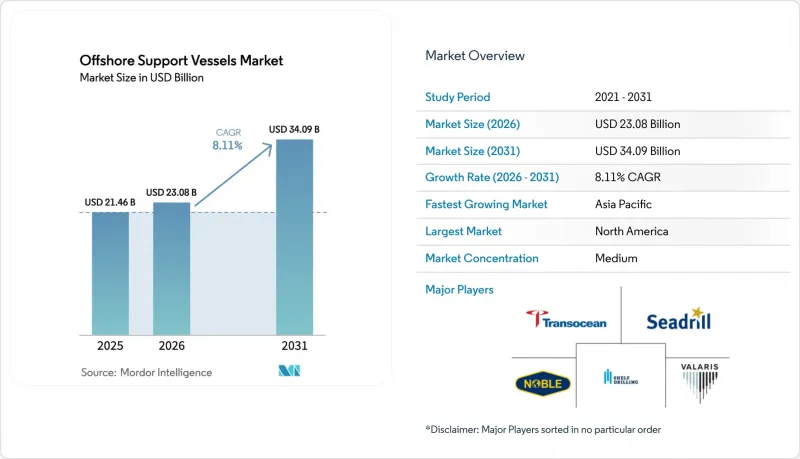
This report is Segmented by Vessel Type (Anchor Handling Tug/Anchor Handling Towing Supply Vessels, Platform Supply Vessels, and Other Types), Application (Offshore Oil and Gas, Offshore Wind, Offshore Decommissioning, and Other Applications), and Geography (North America, Europe, Asia-Pacific, Middle East and Africa, and More). The Market Sizes and Forecasts are Provided in Terms of Value (USD).
Global Offshore Support Vessels Market Trends and Insights
Up-cycle in Offshore E&P CAPEX
Offshore exploration budgets rebounded in 2024-2025 as operators sanctioned projects deferred during the 2020 downturn, supporting the offshore support vessels market. Chevron allocated USD 7 billion for Gulf of Mexico tie-backs set to commence in 2026, while ExxonMobil approved the Hammerhead field in Guyana in early 2025, both programs requiring sustained AHT/AHTS and PSV support.[1] Shell's Bonga North development in Nigeria and BW Energy's Maromba campaign in Brazil exemplify geographic breadth. Rig utilization climbed to 88% by mid-2024, pushing DP-2 day rates beyond USD 25,000 in the North Sea. Vessel owners with young, high-specification fleets are therefore positioned to capture full-rate contracts, whereas aging tonnage faces cold-stacking.
Accelerating Offshore Wind Installations
European and Asian developers are commissioning gigawatt-scale arrays that are strengthening the offshore support vessels market by relying on specialized service-operation vessels, cable-lay support, and crew-transfer units. Cadeler secured a USD 500 million award in 2025 for Orsted's Hornsea 3 project, deploying installation tonnage plus standby and supply craft. China added 6 GW of offshore wind in 2024, raising crew-transfer utilization above 80% in coastal provinces.[2] U.S. Bureau of Ocean Energy Management approval for Empire Wind and Sunrise Wind in 2024 opened a Jones Act-Act-constrained market where compliant vessels command day rates exceeding USD 50,000.[3] These projects require DP-2 or higher capability, large deck areas, and walk-to-work gangways, prompting newbuild orders from Damen and Ulstein.
High Oil-Price Volatility
Brent swings between USD 70 and USD 90 in 2024-2025, with delayed FIDs for higher-cost fields. TotalEnergies postponed the Begonia project in Angola, idling four PSVs earmarked for the campaign. Tidewater disclosed in Q3 2024 that 12% of its fleet faced contract roll-offs without immediate follow-on work, underscoring sensitivity to price uncertainty. Volatility favors short-cycle shale over multi-year offshore commitments, dampening vessel demand in West Africa and the U.S. Gulf.
Other drivers and restraints analyzed in the detailed report include:
- Aging Fleet Renewal & Green Retrofit Demand
- Data-Driven OPEX Optimization
- Shortage of Experienced Crew
For complete list of drivers and restraints, kindly check the Table Of Contents.
Segment Analysis
AHT/AHTS units secured 42.4% offshore support vessels market share in 2025, driven by deepwater rig moves in the Gulf of Mexico, North Sea, and West Africa, with modern >= 15,000 bollard-pull vessels running above 82% utilization at Tidewater's fleet hub. Platform Supply Vessels (PSVs) followed, supporting logistics for drilling fluids and provisions; North Sea PSV utilization climbed to 78% in 2024 on the back of Equinor and Aker BP campaigns.
The "Other Types" cluster, multi-purpose support vessels (MPSVs), subsea-construction units, and standby-crew boats, will outpace headline growth at 9.5% CAGR as owners value assets that pivot between well intervention, cable-lay, and emergency response. Saipem deployed the Constellation III MPSV in 2025 to TotalEnergies' Mero-3 FPSO installation, showcasing DP-3 and 400-ton crane capability. Regulatory mandates in the U.K. and German waters now require dedicated safety vessels within 30 minutes of turbine arrays, expanding demand for standby craft. Damen delivered six Fast Crew Supplier 2710 units in 2024, each moving 26 technicians in sea states up to 2.5 m.
Complete Report Scope:
- By Vessel Type
- Anchor Handling Tug/Anchor Handling Towing Supply Vessels (AHT/AHTSs)
- Platform Supply Vessels (PSV)
- Other Types (MPSV, Subsea, Standy Crew)
- By Application
- Offshore Oil and Gas
- Offshore Wind
- Offshore Decommissioning
- Other Applications
- By Geography
- North America
- United States
- Canada
- Mexico
- Europe
- United Kingdom
- Norway
- Germany
- France
- Italy
- Russia
- Rest of Europe
- Asia-Pacific
- China
- India
- Japan
- South Korea
- ASEAN Countries
- Australia and New Zealand
- Rest of Asia-Pacific
- South America
- Brazil
- Argentina
- Chile
- Rest of South America
- Middle East and Africa
- Saudi Arabia
- United Arab Emirates
- Qatar
- Nigeria
- Angola
- Rest of Middle East and Africa
- North America
Geography Analysis
North America held 33.7% of the offshore support vessels market share in 2025, propelled by 22 active Gulf of Mexico rigs and early-stage U.S. wind projects. The Jones Act limits mean only 12 compliant service-operation vessels are available for a 30-GW Atlantic pipeline, sending charter rates north of USD 50,000 per day and prompting new orders at Gulf Coast yards despite extended delivery slots. Canada's Bay du Nord project, sanctioned in 2025, will need six DP-2 PSVs and two AHTS units from 2028.
Europe combines North Sea drilling intensity with the world's largest installed offshore wind base. Orsted's Hornsea 3 and RWE's Sofia projects together locked in 20 service-operation vessels through 2050, guaranteeing long-duration revenue streams for Cadeler and Seaway 7. Germany cleared 4 GW of new wind capacity in 2024, spurring cable-lay demand. Norway spudded 15 exploration wells in 2024, the highest since 2019, keeping Stavanger-based AHTS utilization above 80%.
Asia-Pacific will post a 9.1% CAGR to 2031, fueled by China's target of 100 GW offshore wind by 2030 and India's Krishna-Godavari deepwater program. China installed 6.3 GW in 2024, driving crew-transfer utilization beyond 85% in coastal bases such as Yangjiang. India's ONGC drilled eight deepwater wells in 2024, chartering DP-2 PSVs from Singapore and Malaysia. Australia's Star of the South wind farm, approved in 2024, will require six service-operation vessels from 2028.
- Bourbon Corporation SA
- Maersk Supply Service AS
- Seacor Marine Holdings Inc.
- Edison Chouest Offshore LLC
- Swire Pacific Limited
- Tidewater Inc.
- Harvey Gulf International Marine LLC
- Solstad Offshore ASA
- Hornbeck Offshore Services Inc.
- PACC Offshore Services Holdings Ltd.
- DOF Group ASA
- Vroon Offshore Services BV
- Siem Offshore Inc.
- Havila Shipping ASA
- Eidesvik Offshore ASA
- Vallianz Holdings Limited
- Companhia Brasileira de Offshore (CBO)
- Zakher Marine International
- Damen Shipyards Group
- Deep Sea Supply Plc
Additional Benefits:
- The market estimate (ME) sheet in Excel format
- 3 months of analyst support
TABLE OF CONTENTS
1 Introduction
- 1.1 Study Assumptions & Market Definition
- 1.2 Scope of the Study
2 Research Methodology
3 Executive Summary
4 Market Landscape
- 4.1 Market Overview
- 4.2 Market Drivers
- 4.2.1 Up-cycle in offshore E&P CAPEX
- 4.2.2 Accelerating offshore wind installations
- 4.2.3 Stricter decommissioning mandates
- 4.2.4 Surge in floating production systems (FPSO, FLNG)
- 4.2.5 Ageing fleet renewal & green retrofit demand
- 4.2.6 Data-driven OPEX optimisation (digital twins, CBM)
- 4.3 Market Restraints
- 4.3.1 High oil-price volatility
- 4.3.2 Capital-intensive newbuild costs
- 4.3.3 Shortage of experienced crew
- 4.3.4 Limited yard capacity & high steel prices
- 4.4 Supply-Chain Analysis
- 4.5 Regulatory Landscape
- 4.6 Technological Outlook
- 4.7 Porter's Five Forces
- 4.7.1 Bargaining Power of Suppliers
- 4.7.2 Bargaining Power of Buyers
- 4.7.3 Threat of New Entrants
- 4.7.4 Threat of Substitutes
- 4.7.5 Intensity of Competitive Rivalry
- 4.8 Fleet Age & Renewal Analysis
- 4.9 Investment Analysis
5 Market Size & Growth Forecasts
- 5.1 By Vessel Type
- 5.1.1 Anchor Handling Tug/Anchor Handling Towing Supply Vessels (AHT/AHTSs)
- 5.1.2 Platform Supply Vessels (PSV)
- 5.1.3 Other Types (MPSV, Subsea, Standy Crew)
- 5.2 By Application
- 5.2.1 Offshore Oil and Gas
- 5.2.2 Offshore Wind
- 5.2.3 Offshore Decommissioning
- 5.2.4 Other Applications
- 5.3 By Geography
- 5.3.1 North America
- 5.3.1.1 United States
- 5.3.1.2 Canada
- 5.3.1.3 Mexico
- 5.3.2 Europe
- 5.3.2.1 United Kingdom
- 5.3.2.2 Norway
- 5.3.2.3 Germany
- 5.3.2.4 France
- 5.3.2.5 Italy
- 5.3.2.6 Russia
- 5.3.2.7 Rest of Europe
- 5.3.3 Asia-Pacific
- 5.3.3.1 China
- 5.3.3.2 India
- 5.3.3.3 Japan
- 5.3.3.4 South Korea
- 5.3.3.5 ASEAN Countries
- 5.3.3.6 Australia and New Zealand
- 5.3.3.7 Rest of Asia-Pacific
- 5.3.4 South America
- 5.3.4.1 Brazil
- 5.3.4.2 Argentina
- 5.3.4.3 Chile
- 5.3.4.4 Rest of South America
- 5.3.5 Middle East and Africa
- 5.3.5.1 Saudi Arabia
- 5.3.5.2 United Arab Emirates
- 5.3.5.3 Qatar
- 5.3.5.4 Nigeria
- 5.3.5.5 Angola
- 5.3.5.6 Rest of Middle East and Africa
- 5.3.1 North America
6 Competitive Landscape
- 6.1 Market Concentration
- 6.2 Strategic Moves (M&A, Partnerships, PPAs)
- 6.3 Market Share Analysis (Market Rank/Share for key companies)
- 6.4 Company Profiles (includes Global level Overview, Market level overview, Core Segments, Financials as available, Strategic Information, Products & Services, and Recent Developments)
- 6.4.1 Bourbon Corporation SA
- 6.4.2 Maersk Supply Service AS
- 6.4.3 Seacor Marine Holdings Inc.
- 6.4.4 Edison Chouest Offshore LLC
- 6.4.5 Swire Pacific Limited
- 6.4.6 Tidewater Inc.
- 6.4.7 Harvey Gulf International Marine LLC
- 6.4.8 Solstad Offshore ASA
- 6.4.9 Hornbeck Offshore Services Inc.
- 6.4.10 PACC Offshore Services Holdings Ltd.
- 6.4.11 DOF Group ASA
- 6.4.12 Vroon Offshore Services BV
- 6.4.13 Siem Offshore Inc.
- 6.4.14 Havila Shipping ASA
- 6.4.15 Eidesvik Offshore ASA
- 6.4.16 Vallianz Holdings Limited
- 6.4.17 Companhia Brasileira de Offshore (CBO)
- 6.4.18 Zakher Marine International
- 6.4.19 Damen Shipyards Group
- 6.4.20 Deep Sea Supply Plc
7 Market Opportunities & Future Outlook
- 7.1 White-space & Unmet-Need Assessment

