PUBLISHER: Mordor Intelligence | PRODUCT CODE: 2121321

PUBLISHER: Mordor Intelligence | PRODUCT CODE: 2121321
Middle East Offshore Support Vessels - Market Share Analysis, Industry Trends & Statistics, Growth Forecasts (2026 - 2031)
According to Mordor Intelligence, the Middle East offshore support vessels market size is projected to be USD 2.47 billion in 2025, USD 2.71 billion in 2026, and reach USD 4.24 billion by 2031, growing at a CAGR of 9.35% from 2026 to 2031.
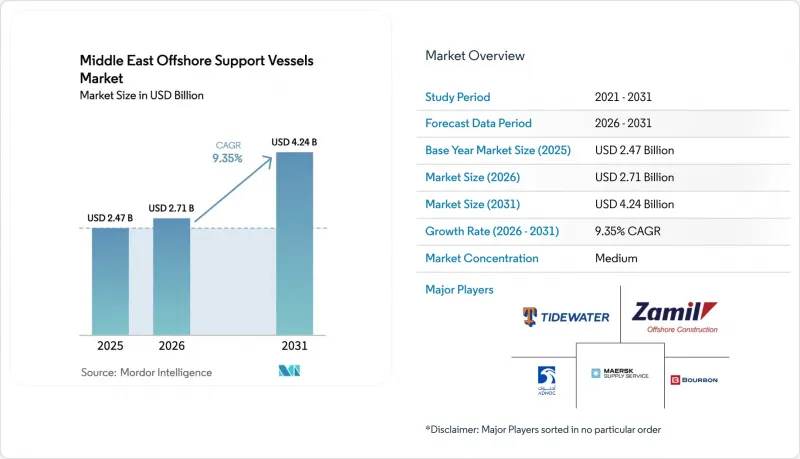
This report is Segmented by Vessel Type (Anchor Handling Tug/Anchor Handling Towing Supply Vessels, Platform Supply Vessels, and Other Types), Application (Offshore Oil and Gas, Offshore Wind, Offshore Decommissioning, and Other Applications), and Geography (Saudi Arabia, United Arab Emirates, Qatar, Oman, Kuwait, Bahrain, Iran, and Rest of Middle East)
Middle East Offshore Support Vessels Market Trends and Insights
Increasing Offshore E&P Spending Rebound
Saudi Aramco finalized USD 12.4 billion in funding for the Marjan increment, targeting 300,000 bpd by late 2025 and requiring more than 18 PSVs and six anchor-handling tugs across the construction window. ADNOC sanctioned the Hail & Ghasha sour-gas project, which needs high-specification subsea construction units for 180 km of pipeline lay. QatarEnergy's North Field expansion schedules 80-100 dedicated vessels to support drilling and subsea tie-ins through 2027. These commitments reduce spot availability and keep utilization elevated across platform supply and anchor-handling segments. Rising gas demand from Asia strengthens long-term charter tenors, allowing owners to justify hybrid-propulsion retrofits that improve carbon intensity scores. The spending cycle is therefore both a revenue catalyst and a technology-upgrade trigger.
Offshore Wind Farm Build-Out in Red Sea & Gulf
The NEOM Green Hydrogen Company is progressing a 4 GW wind-and-solar complex in the Gulf of Aqaba, with turbine installation slated for 2027. Egypt's 500 MW Red Sea wind farm follows on a 2028 timeline. Each gigawatt of offshore wind construction typically mobilizes 15-20 specialized support vessels, translating to 60-80 units for NEOM alone. Current regional supply of wind-certified tonnage is under 20 units, prompting PSV retrofits with A-frames and motion-compensated gangways. Certification under DNV or Bureau Veritas standards can take up to 18 months, creating a near-term equipment gap that favors operators able to fast-track modifications in Gulf yards. Long term, wind projects diversify revenue streams and lessen dependence on oil-price cycles.
Volatile Oil Price Outlook
Brent futures ranged between USD 70-90 per barrel through 2025, hampering budget visibility for exploration programs. Saudi Aramco postponed final investment decisions on three offshore blocks in Q2 2025 amid price swings, directly trimming PSV utilization. Tidewater reports that every USD 10 decline in Brent contracts average charter rates by 6-8% within a quarter. Operators hedge by prioritizing multi-year fixtures with national oil companies, yet spot exposure remains high for smaller fleets. If prices fall below USD 65, cold-stacking and lay-ups could reverse utilization gains achieved since 2023. Conversely, sustained prices above USD 95 would unlock deferred projects, underlining the double-edged nature of volatility.
Other drivers and restraints analyzed in the detailed report include:
- Fleet Renewal to Meet IMO CII/EEXI Rules
- Localization & In-Country-Value Mandates
- Surge in DP-Rig Spot Chartering Crowds Out OSVs
For complete list of drivers and restraints, kindly check the Table Of Contents.
Segment Analysis
Platform supply vessels controlled 44.4% of the Middle East offshore support vessels market in 2025, reflecting their versatility in transporting drilling fluids, cement, and tubulars to rigs from Safaniya to Zakum. Hybrid-propulsion upgrades allowed Maersk Supply Service to introduce four DP2-class PSVs that cut fuel use by 20% and meet CII-A targets now required on multi-year Saudi Aramco charters. Anchor-handling tug supply vessels serve deep-water block positioning beyond 1,500 m, but demand is episodic. The Other Types segment, including subsea construction units and crew-transfer boats, will grow fastest at an 11.8% CAGR, propelled by NEOM's wind timetable and Qatar's subsea tie-backs. Subsea vessels equipped with remotely operated vehicles are increasingly chartered for pipeline inspection on the Hail & Ghasha project, underscoring specialization as a competitive moat.
Fleet operators are re-evaluating capital allocation as the Middle East offshore support vessels market size for Other Types rises quickly. Bourbon plans USD 3-4 million A-frame retrofits on six PSVs to gain wind-project eligibility. Standby crew boats, though small in revenue terms, enjoy peaks during turbine-installation seasons that require 24-hour personnel shuttle capability. Growth in these specialty categories tilts yard demand toward cranes, gangways, and battery systems rather than pure bollard-pull metrics, signaling a structural shift in specification priorities.
Complete Report Scope:
- By Vessel Type
- Anchor Handling Tug/Anchor Handling Towing Supply Vessels (AHT/AHTSs)
- Platform Supply Vessels (PSV)
- Other Types (MPSV, Subsea, Standy Crew)
- By Application
- Offshore Oil and Gas
- Offshore Wind
- Offshore Decommissioning
- Other Applications
- By Geography
- Saudi Arabia
- United Arab Emirates
- Qatar
- Oman
- Kuwait
- Bahrain
- Iran
- Rest of Middle East
List of Companies Covered in this Report:
- Tidewater Inc.
- Bourbon Corp. SA
- ADNOC Logistics & Services
- Maersk Supply Service
- Seacor Marine Holdings
- OFCO Offshore International
- Baltic Marine Services LLC
- Zamil Offshore Services
- Zakher Marine International
- Halul Offshore Services
- Topaz Energy & Marine (P&O Maritime Logistics)
- Swire Pacific Offshore
- Vallianz Holdings
- Rawabi Vallianz Offshore
- Solstad Offshore ASA
- DOF Group ASA
- Boskalis Westminster
- MMA Offshore Ltd
- Al Seer Marine
- Bahri - National Shipping Co. of Saudi Arabia
Additional Benefits:
- The market estimate (ME) sheet in Excel format
- 3 months of analyst support
TABLE OF CONTENTS
1 Introduction
- 1.1 Study Assumptions & Market Definition
- 1.2 Scope of the Study
2 Research Methodology
3 Executive Summary
4 Market Landscape
- 4.1 Market Overview
- 4.2 Market Drivers
- 4.2.1 Increasing offshore E&P spending rebound
- 4.2.2 Offshore wind farm build-out in Red Sea & Gulf
- 4.2.3 Fleet renewal to meet IMO CII/EEXI rules
- 4.2.4 Localization & in-country-value mandates
- 4.2.5 Port & yard capacity upgrades in KSA & UAE
- 4.3 Market Restraints
- 4.3.1 Volatile oil price outlook
- 4.3.2 Surge in DP-rig spot chartering crowds out OSVs
- 4.3.3 Tightening regional carbon-intensity limits
- 4.3.4 Geopolitical choke-point disruptions
- 4.4 Supply-Chain Analysis
- 4.5 Regulatory Landscape
- 4.6 Technological Outlook
- 4.7 Porter's Five Forces
- 4.7.1 Bargaining Power of Suppliers
- 4.7.2 Bargaining Power of Buyers
- 4.7.3 Threat of New Entrants
- 4.7.4 Threat of Substitutes
- 4.7.5 Intensity of Rivalry
5 Market Size & Growth Forecasts
- 5.1 By Vessel Type
- 5.1.1 Anchor Handling Tug/Anchor Handling Towing Supply Vessels (AHT/AHTSs)
- 5.1.2 Platform Supply Vessels (PSV)
- 5.1.3 Other Types (MPSV, Subsea, Standy Crew)
- 5.2 By Application
- 5.2.1 Offshore Oil and Gas
- 5.2.2 Offshore Wind
- 5.2.3 Offshore Decommissioning
- 5.2.4 Other Applications
- 5.3 By Geography
- 5.3.1 Saudi Arabia
- 5.3.2 United Arab Emirates
- 5.3.3 Qatar
- 5.3.4 Oman
- 5.3.5 Kuwait
- 5.3.6 Bahrain
- 5.3.7 Iran
- 5.3.8 Rest of Middle East
6 Competitive Landscape
- 6.1 Market Concentration
- 6.2 Strategic Moves (M&A, Partnerships, PPAs)
- 6.3 Market Share Analysis (Market Rank/Share for key companies)
- 6.4 Company Profiles (includes Global level Overview, Market level overview, Core Segments, Financials as available, Strategic Information, Products & Services, and Recent Developments)
- 6.4.1 Tidewater Inc.
- 6.4.2 Bourbon Corp. SA
- 6.4.3 ADNOC Logistics & Services
- 6.4.4 Maersk Supply Service
- 6.4.5 Seacor Marine Holdings
- 6.4.6 OFCO Offshore International
- 6.4.7 Baltic Marine Services LLC
- 6.4.8 Zamil Offshore Services
- 6.4.9 Zakher Marine International
- 6.4.10 Halul Offshore Services
- 6.4.11 Topaz Energy & Marine (P&O Maritime Logistics)
- 6.4.12 Swire Pacific Offshore
- 6.4.13 Vallianz Holdings
- 6.4.14 Rawabi Vallianz Offshore
- 6.4.15 Solstad Offshore ASA
- 6.4.16 DOF Group ASA
- 6.4.17 Boskalis Westminster
- 6.4.18 MMA Offshore Ltd
- 6.4.19 Al Seer Marine
- 6.4.20 Bahri - National Shipping Co. of Saudi Arabia
7 Market Opportunities & Future Outlook
- 7.1 White-space & Unmet-Need Assessment

