PUBLISHER: Mordor Intelligence | PRODUCT CODE: 2100582

PUBLISHER: Mordor Intelligence | PRODUCT CODE: 2100582
Golf Equipment - Market Share Analysis, Industry Trends & Statistics, Growth Forecasts (2026 - 2031)
According to Mordor Intelligence, the golf equipment market size is expected to grow from USD 15.11 billion in 2025 to USD 15.86 billion in 2026 and is forecast to reach USD 20.27 billion by 2031 at 5.03% CAGR over 2026-2031.
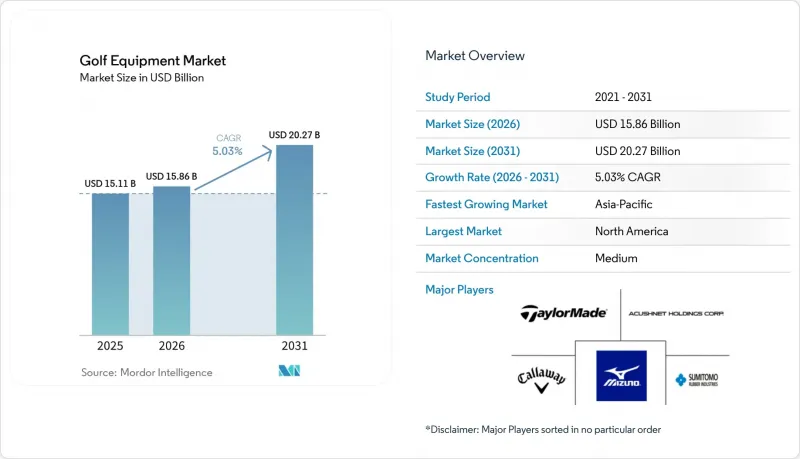
This report is Segmented by Product Type (Golf Clubs, Golf Balls, Golf Bags and Accessories), Category (Mass and Premium), End User (Adults and Kids/Children), Distribution Channel (Offline Retail Stores and Online Retail Stores), and Geography (North America, Europe, Asia-Pacific, South America, and Middle East and Africa). The Market Forecasts are Provided in Terms of Value (USD).
Global Golf Equipment Market Trends and Insights
Growing participation in golf across emerging markets
Increasing participation in previously smaller markets is driving growth in the golf equipment market. The Royal and Ancient Golf Club of St Andrews reported in its June 2026 update that 112.2 million adults and juniors actively played golf outside the U.S. and Mexico, reflecting an annual increase of 4.2 million players. Junior participation experienced a 6% rise, reaching 47.1 million. This growth is crucial for the golf equipment market, as younger players often begin with affordable equipment and progress through multiple replacement cycles as their skills improve and their purchasing power increases. Asia recorded 26.2 million adult golfers, while Central and South America achieved an impressive 20% year-over-year growth in participation. These developments highlight a shift in demand, which is no longer concentrated solely in traditional, mature golf economies. This diversification supports both entry-level sales and future trade-ups, strengthening the market's foundation for repeat purchases over the next several years.
Increasing investment in golf course development and expansion
Increasing investment in golf course development and expansion is a significant driver of the golf equipment market, as improved infrastructure enhances access to the sport and attracts new participants. Governments, private developers, and golf resort operators are investing in new courses, practice facilities, and technology-enabled golf venues to meet growing consumer interest. The expansion of golf infrastructure encourages higher participation rates, which directly increases demand for golf clubs, balls, bags, and related equipment. According to the National Golf Foundation, a record 48.1 million Americans aged 6 and above participated in golf activities in 2025, including 29.1 million on-course golfers and 19 million individuals engaged exclusively in off-course formats such as driving ranges, indoor simulators, and golf entertainment venues. The growing popularity of these facilities creates more opportunities for equipment purchases by both new and experienced players. Additionally, investments in golf tourism destinations and premium golf resorts further stimulate equipment sales by encouraging frequent play and equipment upgrades.
High cost of premium golf clubs and equipment
The high cost of premium golf clubs and equipment remains a significant restraint on the growth of the golf equipment market. Advanced golf clubs incorporating technologies such as carbon composite materials, adjustable weighting systems, and custom-fitting features often carry premium price tags that can be prohibitive for many consumers. A complete set of high-end clubs, along with golf balls, bags, and accessories, represents a substantial financial investment, particularly for beginners and occasional players. This cost barrier can discourage new participants from entering the sport and limit equipment upgrades among budget-conscious golfers. The challenge is especially pronounced in emerging markets, where disposable incomes and golf participation rates are comparatively lower. Additionally, recurring expenses related to course fees, memberships, and lessons further increase the overall cost of engagement.
Other drivers and restraints analyzed in the detailed report include:
- Rising demand for technologically advanced golf clubs
- Growing popularity of custom-fitted golf equipment
- Limited accessibility to golf courses in many regions
For complete list of drivers and restraints, kindly check the Table Of Contents.
Segment Analysis
Golf clubs represented the largest product segment in the golf equipment market, accounting for 52.06% of total revenue in 2025. The segment's dominance is primarily attributed to the high average selling price of clubs compared to other equipment categories and the frequent introduction of technologically advanced products. Manufacturers continuously invest in innovations such as lightweight composite materials, adjustable club heads, enhanced aerodynamics, and custom-fitting solutions to improve player performance. Professional endorsements and equipment upgrades by both amateur and experienced golfers further support demand. The replacement cycle for drivers, irons, wedges, and putters also contributes significantly to recurring sales.
Golf balls are projected to be the fastest-growing product segment, expanding at a CAGR of 5.39% through 2031. Growth is driven by the consumable nature of golf balls, which require frequent replacement due to wear, loss, and regular usage. Rising participation in golf across both mature and emerging markets is increasing the volume of balls purchased by recreational and professional players alike. Manufacturers are introducing advanced ball technologies designed to improve spin control, distance, durability, and overall performance, encouraging product upgrades. The expansion of golf courses, driving ranges, and simulator-based golf activities is also contributing to higher consumption rates.
The mass category dominated the golf equipment market in 2025, accounting for 63.89% of total revenue. The segment's leadership is primarily driven by its broad accessibility and affordability, making golf equipment available to a larger base of recreational and entry-level golfers. Mass-market products are widely distributed through sporting goods retailers, specialty golf stores, and online platforms, ensuring strong market penetration across developed and emerging regions. Manufacturers continue to focus on offering reliable performance, durability, and value-oriented pricing to attract cost-conscious consumers. The growing popularity of golf as a recreational activity has further expanded demand for equipment within this category.
The premium category is anticipated to be the fastest-growing segment, registering a CAGR of 5.61% through 2031. Growth is being driven by increasing consumer willingness to invest in high-performance equipment featuring advanced materials, precision engineering, and customized fitting options. Experienced golfers and enthusiasts are increasingly seeking premium clubs, balls, and accessories designed to enhance distance, accuracy, and overall gameplay. Leading manufacturers are continuously introducing technologically sophisticated products that command higher price points and appeal to performance-focused consumers. The expansion of golf tourism, rising disposable incomes, and growing participation among affluent demographics are also supporting demand for premium equipment.
Complete Report Scope:
- By Product Type
- Golf Clubs
- Golf Balls
- Golf Bags and Accessories
- By Category
- Mass
- Premium
- By End User
- Adults
- Kids/Children
- By Distribution Channel
- Offline Retail Stores
- Online Retail Stores
- By Geography
- North America
- United States
- Canada
- Mexico
- Rest of North America
- Europe
- United Kingdom
- Germany
- Spain
- France
- Italy
- Sweden
- Ireland
- Austria
- Rest of Europe
- Asia-Pacific
- China
- Japan
- South Korea
- New Zealand
- Australia
- Rest of Asia-Pacific
- South America
- Brazil
- Argentina
- Rest of South America
- Middle East and Africa
- United Arab Emirates
- South Africa
- Rest of Middle East and Africa
- North America
Geography Analysis
North America dominated the golf equipment market in 2025, accounting for 47.68% of global revenue. The region benefits from a well-established golfing culture, a large base of recreational and professional players, and extensive golf course infrastructure. The United States remains the largest contributor, supported by strong consumer spending on premium golf clubs, balls, and accessories. High participation rates across various age groups, combined with widespread adoption of custom-fitting services and advanced equipment technologies, continue to drive demand. The presence of leading equipment manufacturers and strong retail distribution networks further reinforces the region's leadership position. Additionally, growing interest in simulator golf and year-round training facilities supports sustained equipment sales across North America.
Asia-Pacific is projected to be the fastest-growing regional market, registering a CAGR of 5.39% through 2031. Growth is being fueled by rising disposable incomes, expanding middle-class populations, and increasing participation in golf across countries such as Japan, South Korea, China, and Australia. Governments and private investors are supporting the development of golf courses, resorts, and training facilities, improving access to the sport. Younger consumers are increasingly engaging with golf through technology-enabled experiences, including indoor simulators and driving ranges. The growing popularity of golf tourism and international tournaments is also enhancing awareness and equipment demand. As a result, manufacturers are strengthening their presence in the region through localized product offerings and distribution partnerships.
Europe, South America, and the Middle East and Africa collectively represent important growth opportunities within the golf equipment market. Europe benefits from a mature golfing tradition, particularly in the United Kingdom, Germany, Spain, and Scandinavia, where participation rates remain stable and demand for premium equipment remains strong. South America is witnessing gradual growth, supported by increasing golf tourism and rising interest in the sport among affluent consumers. In the Middle East and Africa, investments in luxury golf resorts, international tournaments, and tourism-focused developments are contributing to market expansion. Countries such as the United Arab Emirates and South Africa continue to attract both local and international golfers.
- The Callaway Golf Company
- Acushnet Holdings Corp.
- Taylor Made Golf Company, Inc.
- Sumitomo Rubber Industries, Ltd.
- Mizuno Corporation
- PING, Inc.
- Bridgestone Sports Co., Ltd.
- PXG Holdings, LLC
- Cobra Golf Incorporated
- Honma Golf Limited
- YONEX CO., LTD.
- Wilson Sporting Goods Co.
- Tour Edge Golf Manufacturing, Inc.
- FILA Golf Co., Ltd.
- MAJESTY GOLF CO., LTD.
- Fourteen Co., Ltd.
- Epon Golf Co., Ltd.
- Miura Golf Inc.
- Cleveland Golf Company, Inc.
- Bettinardi Golf, LLC
Additional Benefits:
- The market estimate (ME) sheet in Excel format
- 3 months of analyst support
TABLE OF CONTENTS
1 INTRODUCTION
- 1.1 Study Assumptions and Market Definition
- 1.2 Scope of the Study
2 RESEARCH METHODOLOGY
3 EXECUTIVE SUMMARY
4 MARKET LANDSCAPE
- 4.1 Market Overview
- 4.2 Market Drivers
- 4.2.1 Growing participation in golf across emerging markets
- 4.2.2 Increasing investment in golf course development and expansion
- 4.2.3 Rising demand for technologically advanced golf clubs
- 4.2.4 Growing popularity of custom-fitted golf equipment
- 4.2.5 Expansion of indoor golf simulators driving equipment purchases
- 4.2.6 Increasing number of junior golf development programs
- 4.3 Market Restraints
- 4.3.1 High cost of premium golf clubs and equipment
- 4.3.2 Limited accessibility to golf courses in many regions
- 4.3.3 High maintenance and storage requirements for equipment
- 4.3.4 Economic downturns reducing discretionary spending on golf gear
- 4.4 Consumer Behaviour Analysis
- 4.5 Regulatory Landscape
- 4.6 Technological Outlook
- 4.7 Porter's Five Forces Analysis
- 4.7.1 Bargaining Power of Suppliers
- 4.7.2 Bargaining Power of Buyers
- 4.7.3 Threat of New Entrants
- 4.7.4 Threat of Substitutes
- 4.7.5 Intensity of Competitive Rivalry
5 MARKET SIZE AND GROWTH FORECASTS (VALUE)
- 5.1 By Product Type
- 5.1.1 Golf Clubs
- 5.1.2 Golf Balls
- 5.1.3 Golf Bags and Accessories
- 5.2 By Category
- 5.2.1 Mass
- 5.2.2 Premium
- 5.3 By End User
- 5.3.1 Adults
- 5.3.2 Kids/Children
- 5.4 By Distribution Channel
- 5.4.1 Offline Retail Stores
- 5.4.2 Online Retail Stores
- 5.5 By Geography
- 5.5.1 North America
- 5.5.1.1 United States
- 5.5.1.2 Canada
- 5.5.1.3 Mexico
- 5.5.1.4 Rest of North America
- 5.5.2 Europe
- 5.5.2.1 United Kingdom
- 5.5.2.2 Germany
- 5.5.2.3 Spain
- 5.5.2.4 France
- 5.5.2.5 Italy
- 5.5.2.6 Sweden
- 5.5.2.7 Ireland
- 5.5.2.8 Austria
- 5.5.2.9 Rest of Europe
- 5.5.3 Asia-Pacific
- 5.5.3.1 China
- 5.5.3.2 Japan
- 5.5.3.3 South Korea
- 5.5.3.4 New Zealand
- 5.5.3.5 Australia
- 5.5.3.6 Rest of Asia-Pacific
- 5.5.4 South America
- 5.5.4.1 Brazil
- 5.5.4.2 Argentina
- 5.5.4.3 Rest of South America
- 5.5.5 Middle East and Africa
- 5.5.5.1 United Arab Emirates
- 5.5.5.2 South Africa
- 5.5.5.3 Rest of Middle East and Africa
- 5.5.1 North America
6 COMPETITIVE LANDSCAPE
- 6.1 Market Concentration
- 6.2 Strategic Moves
- 6.3 Market Share Analysis
- 6.4 Company Profiles (Includes Company Highlights, Strategic Information, Core Segments, Financials, Products & Services, Recent Developments)
- 6.4.1 The Callaway Golf Company
- 6.4.2 Acushnet Holdings Corp.
- 6.4.3 Taylor Made Golf Company, Inc.
- 6.4.4 Sumitomo Rubber Industries, Ltd.
- 6.4.5 Mizuno Corporation
- 6.4.6 PING, Inc.
- 6.4.7 Bridgestone Sports Co., Ltd.
- 6.4.8 PXG Holdings, LLC
- 6.4.9 Cobra Golf Incorporated
- 6.4.10 Honma Golf Limited
- 6.4.11 YONEX CO., LTD.
- 6.4.12 Wilson Sporting Goods Co.
- 6.4.13 Tour Edge Golf Manufacturing, Inc.
- 6.4.14 FILA Golf Co., Ltd.
- 6.4.15 MAJESTY GOLF CO., LTD.
- 6.4.16 Fourteen Co., Ltd.
- 6.4.17 Epon Golf Co., Ltd.
- 6.4.18 Miura Golf Inc.
- 6.4.19 Cleveland Golf Company, Inc.
- 6.4.20 Bettinardi Golf, LLC
7 MARKET OPPORTUNITIES AND FUTURE OUTLOOK

