PUBLISHER: Mordor Intelligence | PRODUCT CODE: 2100631

PUBLISHER: Mordor Intelligence | PRODUCT CODE: 2100631
US Aerospace and Defense - Market Share Analysis, Industry Trends & Statistics, Growth Forecasts (2026 - 2031)
According to Mordor Intelligence, the US aerospace and defense market size is USD 463.06 billion in 2026 and, at a forecast CAGR of 5.67%, is projected to reach USD 610.15 billion by 2031.
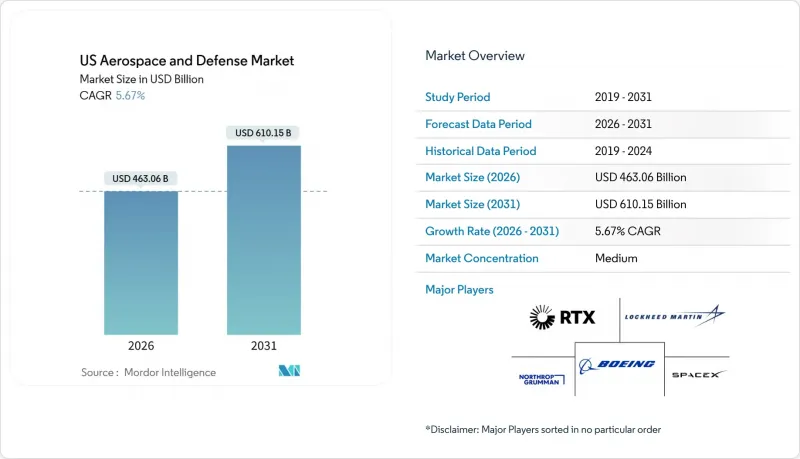
This report is Segmented by Sector (Aerospace, Defense), Platform (Aerial, Terrestrial, Naval, Space), Service Type (Manufacturing, MRO), Component (Airframes and Structures, Propulsion Systems and Engines, Electronics and Mission Systems, Composite and Carbon Fibre Components and More), and Geography (United States). Market Forecasts are Provided in Terms of Value (USD).
US Aerospace and Defense Market Trends and Insights
Surging DoD Procurement And RDT&E Budgets
Fiscal-year 2024 legislation appropriated USD 849.8 billion for national defense, raising RDT&E to a record USD 145 billion. These funds are propelling programs such as the B-21 Raider, Columbia-class submarines, and the Replicator autonomous systems initiative. Multi-year procurement contracts are insulating prime contractors from demand shocks, while higher technology readiness levels are accelerating the transition of hypersonic, electronic-warfare, and counter-UAS prototypes into production. The surge is also heightening cybersecurity requirements; companies that have secured Cybersecurity Maturity Model Certification Level 3 are winning sole-source classified awards, reinforcing competitive moats. Although compliance adds 5-8% to program costs, the visibility of a long-term budget topline continues to attract commercial suppliers into defense work.
Commercial and General-Aviation Fleet-Modernization Cycles
The Boeing and Airbus backlogs stood at 14,773 jets at the end of 2025, with narrow-body models representing over 80% of the orders. Delivery rates are normalizing as supply-chain bottlenecks ease; combined hand-overs are targeted at 1,400 aircraft in 2026. The US fleet averaged 14.2 years in 2025, stimulating retirements of older 757s and 737NGs and lifting demand for engines, avionics, and cabin retrofits. General-aviation deliveries are improving in tandem, supported by FAA certification of synthetic vision cockpits that reduce pilot workload. Sustainable aviation fuel mandates are adding 15% to fuel bills but are encouraging the purchase of more efficient models, thereby reinforcing the replacement cycle.
Chronic Aerospace Supply-Chain Bottlenecks and Skilled-Labor Shortages
Spirit AeroSystems operated at 70% of its planned fuselage output in 2024 due to shortages of fasteners, hydraulic fittings, and prepreg, highlighting ongoing supply chain and workforce challenges across the US Aerospace and Defense Industry. Bureau of Labor Statistics data indicate that there will be 35,000 unfilled machinist and composite-technician roles by 2028, resulting in a 15% workforce gap. Titanium sponge prices jumped 22% in 2024 after Russian export restrictions, and lead times for aluminum extrusions stretched to 52 weeks. Apprenticeship programs initiated by Boeing and Lockheed Martin will not yield journey-level staff until late in the decade, prolonging existing constraints. Resulting schedule slips have pushed initial operating capability for platforms such as the F-15EX and CH-53K by up to 12 months.
Other drivers and restraints analyzed in the detailed report include:
- Rapid Growth in Commercial Launch and Satellite Constellations
- Supply-Chain Reshoring Incentives and DPA Funding
- Tightening Export-Control and Cybersecurity Compliance Costs
For complete list of drivers and restraints, kindly check the Table Of Contents.
Segment Analysis
Defense revenues accounted for 69.78% of the US aerospace and defense market in 2025, supported by committed outlays for the B-21 Raider, Columbia-class submarine, and Next-Generation Air Dominance programs. Stable, multi-year contracts shield prime contractors from cyclical shocks and provide visibility into long-term cash flows. Land-system upgrades, such as the Army's Optionally Manned Fighting Vehicle, and naval programs, including Virginia-class submarine block buys, further anchor growth. Regulatory pressure via cybersecurity mandates is raising barriers to entry, limiting foreign competition yet intensifying compliance costs for domestic suppliers.
Aerospace, covering civil and military aviation, is posting a 5.82% CAGR to 2031, outpacing Defense's 5.54%. Narrow-body backlogs, led by the 737 MAX and A320neo, underpin production ramps toward 50 and 65 units per month by 2026. Military aviation benefits from fighter recapitalization, with the Air Force buying 80 F-35As annually and B-21 entering low-rate production. While Defense retains the lion's share of revenue, commercial jetliner deliveries and general aviation modernization are expanding the overall US aerospace and defense market size at a steady pace.
Space platforms posted the highest 7.12% CAGR, propelled by proliferated low-Earth-orbit constellations and heavy-lift launch vehicles. The Space Development Agency's 300-satellite tranche and commercial broadband networks such as Starlink and Kuiper validate mesh-network economics. Aerial platforms still account for 31.25% of the US aerospace and defense market size, driven by narrow-body deliveries and fighter procurement. Unmanned aerial systems are expanding at a rate of 6.2%, while rotary-wing programs, such as the V-280 Valor, reinforce helicopter demand.
Fixed-wing production remains the revenue backbone of aerial platforms, yet the shift to attritable drones signals a future transformation in the mix. Terrestrial and naval platforms continue to grow at a rate of 5-6% on the back of armored-vehicle modernization and surface-combatant construction, but neither category matches the momentum seen in space.
Complete Report Scope:
- By Sector
- Aerospace
- Civil Aerospace
- Military Aerospace
- Defense
- Land Systems
- Naval Systems
- Air Combat Systems
- Aerospace
- By Platform
- Aerial
- Fixed Wing Aircraft
- Rotary Wing Aircraft
- Unmanned Aerial Systems
- Terrestrial
- Armored Vehicles
- Artillery and Missile Systems
- Soldier Systems and Electronics
- Naval
- Surface Combatants
- Submarines
- Naval Aviation
- Space
- Navigation Satellites
- Earth Observation/Remote Sensing Satellites
- Scientific Research/Astronomical Satellites
- Communication Satellites
- Aerial
- By Service Type
- Manufacturing
- Maintenance, Repair, and Overhaul (MRO)
- By Component
- Airframes and Structures
- Propulsion Systems and Engines
- Electronics and Mission Systems
- Composite and Carbon Fibre Components
- Electronic Warfare (EW) and Sensors
List of Companies Covered in this Report:
- Lockheed Martin Corporation
- RTX Corporation
- The Boeing Company
- General Dynamics Corporation
- Northrop Grumman Corporation
- L3Harris Technologies, Inc.
- AeroVironment Inc.
- Huntington Ingalls Industries, Inc.
- Textron Inc.
- Kratos Defense & Security Solutions, Inc.
- Space Exploration Technologies Corp. (SpaceX)
- Blue Origin Enterprises, L.P.
- Rocket Lab USA, Inc.
- GE Aerospace
- Rolls-Royce plc
- Leidos, Inc.
- Oshkosh Corporation
- General Atomics
- Safran SA
- Honeywell International Inc.
Additional Benefits:
- The market estimate (ME) sheet in Excel format
- 3 months of analyst support
TABLE OF CONTENTS
1 INTRODUCTION
- 1.1 Study Assumptions and Market Definition
- 1.2 Scope of the Study
2 RESEARCH METHODOLOGY
3 EXECUTIVE SUMMARY
4 MARKET LANDSCAPE
- 4.1 Market Overview
- 4.2 Market Drivers
- 4.2.1 Surging DoD procurement and RDT&E budgets
- 4.2.2 Commercial and general-aviation fleet-modernization cycles
- 4.2.3 Rapid growth in commercial launch and satellite constellations
- 4.2.4 Supply-chain reshoring incentives and Defense Production Act funding
- 4.2.5 AI-enabled digital MRO twins lowering lifecycle costs
- 4.2.6 Demand for low-cost attritable autonomous aircraft programs
- 4.3 Market Restraints
- 4.3.1 Chronic aerospace supply-chain bottlenecks and skilled-labor shortages
- 4.3.2 Tightening export-control and cybersecurity compliance costs
- 4.3.3 Launch-services overcapacity driving price compression
- 4.3.4 Environmental mandates (SAF, PFAS clean-up) escalating compliance spend
- 4.4 Value Chain Analysis
- 4.5 Regulatory Landscape
- 4.6 Technological Outlook
- 4.7 Porter's Five Forces Analysis
- 4.7.1 Threat of New Entrants
- 4.7.2 Bargaining Power of Buyers
- 4.7.3 Bargaining Power of Suppliers
- 4.7.4 Threat of Substitutes
- 4.7.5 Intensity of Competitive Rivalry
5 MARKET SIZE AND GROWTH FORECASTS (VALUE)
- 5.1 By Sector
- 5.1.1 Aerospace
- 5.1.1.1 Civil Aerospace
- 5.1.1.2 Military Aerospace
- 5.1.2 Defense
- 5.1.2.1 Land Systems
- 5.1.2.2 Naval Systems
- 5.1.2.3 Air Combat Systems
- 5.1.1 Aerospace
- 5.2 By Platform
- 5.2.1 Aerial
- 5.2.1.1 Fixed Wing Aircraft
- 5.2.1.2 Rotary Wing Aircraft
- 5.2.1.3 Unmanned Aerial Systems
- 5.2.2 Terrestrial
- 5.2.2.1 Armored Vehicles
- 5.2.2.2 Artillery and Missile Systems
- 5.2.2.3 Soldier Systems and Electronics
- 5.2.3 Naval
- 5.2.3.1 Surface Combatants
- 5.2.3.2 Submarines
- 5.2.3.3 Naval Aviation
- 5.2.4 Space
- 5.2.4.1 Navigation Satellites
- 5.2.4.2 Earth Observation/Remote Sensing Satellites
- 5.2.4.3 Scientific Research/Astronomical Satellites
- 5.2.4.4 Communication Satellites
- 5.2.1 Aerial
- 5.3 By Service Type
- 5.3.1 Manufacturing
- 5.3.2 Maintenance, Repair, and Overhaul (MRO)
- 5.4 By Component
- 5.4.1 Airframes and Structures
- 5.4.2 Propulsion Systems and Engines
- 5.4.3 Electronics and Mission Systems
- 5.4.4 Composite and Carbon Fibre Components
- 5.4.5 Electronic Warfare (EW) and Sensors
6 COMPETITIVE LANDSCAPE
- 6.1 Market Concentration
- 6.2 Strategic Moves
- 6.3 Market Share Analysis
- 6.4 Company Profiles (includes Global-level Overview, Market-level Overview, Core Segments, Financials, Strategic Information, Market Rank/Share, Products and Services, Recent Developments)
- 6.4.1 Lockheed Martin Corporation
- 6.4.2 RTX Corporation
- 6.4.3 The Boeing Company
- 6.4.4 General Dynamics Corporation
- 6.4.5 Northrop Grumman Corporation
- 6.4.6 L3Harris Technologies, Inc.
- 6.4.7 AeroVironment Inc.
- 6.4.8 Huntington Ingalls Industries, Inc.
- 6.4.9 Textron Inc.
- 6.4.10 Kratos Defense & Security Solutions, Inc.
- 6.4.11 Space Exploration Technologies Corp. (SpaceX)
- 6.4.12 Blue Origin Enterprises, L.P.
- 6.4.13 Rocket Lab USA, Inc.
- 6.4.14 GE Aerospace
- 6.4.15 Rolls-Royce plc
- 6.4.16 Leidos, Inc.
- 6.4.17 Oshkosh Corporation
- 6.4.18 General Atomics
- 6.4.19 Safran SA
- 6.4.20 Honeywell International Inc.
7 MARKET OPPORTUNITIES AND FUTURE OUTLOOK
- 7.1 White-space and Unmet-Need Assessment

