PUBLISHER: Mordor Intelligence | PRODUCT CODE: 2100661

PUBLISHER: Mordor Intelligence | PRODUCT CODE: 2100661
Europe Craft Spirits - Market Share Analysis, Industry Trends & Statistics, Growth Forecasts (2026 - 2031)
According to Mordor Intelligence, the Europe craft spirits market size was valued at USD 4.49 billion in 2025 and estimated to grow from USD 5.07 billion in 2026 to reach USD 9.26 billion by 2031, at a CAGR of 12.83% during the forecast period (2026-2031).
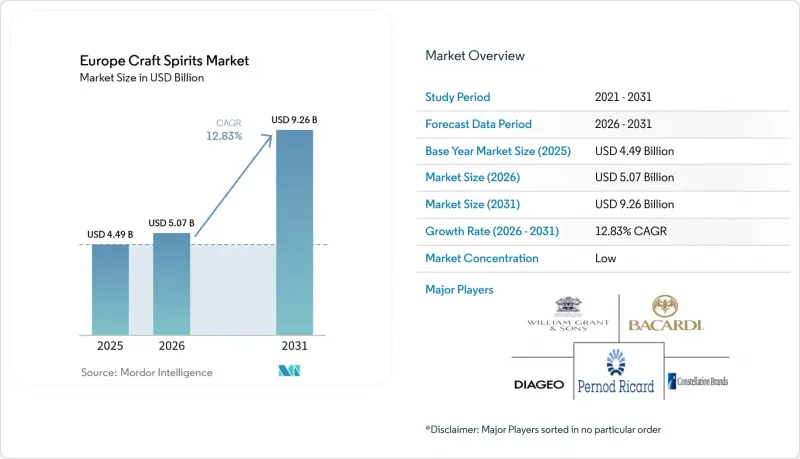
This report is Segmented by Product Type (Whiskey, Gin, Vodka, Brandy, and Other Types), Ingredient (Grain-Based, Fruit-Based, Agave-Based, and Others). Distribution Channel (On-Trade Channels and Off-Trade Channels), and Geography (Germany, France, United Kingdom, Spain, Netherlands, Italy, Sweden, Poland, and More). The Market Forecasts are Provided in Terms of Value (USD).
Europe Craft Spirits Market Trends and Insights
Growing tourism and hospitality impact positive growth
Tourism and hospitality sector growth drives expansion in the Europe craft spirits market. The rise in international and domestic tourism across Europe increases demand for authentic, high-quality beverages that represent local traditions and craftsmanship. Tourists seek unique drinking experiences featuring regional flavors, particularly from local distilleries. This trend is prominent in tourist destinations and cities, where bars, pubs, and specialized craft spirit venues introduce visitors to diverse European craft spirits. According to the World Tourism Organization (UN Tourism), international tourist arrivals in Europe increased significantly in 2024 compared to the previous year. In 2024, inbound arrivals in Europe reached approximately 747 million .
Product differentiation in terms of ingredients and alcohol content
Europe craft spirits manufacturers actively create unique products by developing innovative ingredients and offering diverse alcohol content options. These companies build extensive product portfolios that combine premium spirits with low and non-alcoholic alternatives to meet various consumer preferences and drinking occasions. The market responds to growing health awareness trends, as documented in Diageo's 2025 Foresight Report, which shows younger consumers adopting "zebra striping" behaviors. This practice involves consumers deliberately alternating between alcoholic and non-alcoholic beverages during social occasions, reflecting a broader shift toward balanced consumption habits. The trend demonstrates that health-conscious decisions influence purchasing patterns and shape product development strategies in the craft spirits market, particularly among younger demographic groups that prioritize both enjoyment and well-being in their beverage choices.
Stringent government regulations
The Europe spirits market faces increasing regulatory pressures that create compliance challenges and potential market access barriers. The United Kingdom's implementation of an alcohol duty system bases taxation on alcohol content instead of product category, affecting pricing strategies across spirits portfolios. The European Union's consideration to classify ethanol as a carcinogenic, mutagenic, or toxic for reproduction (CMR) substance may significantly impact product formulations and marketing claims. Belgium's 2024 introduction of alcohol sales restrictions limits product availability and imposes stricter penalties for violations . These regulatory changes create a complex compliance environment, increasing operational costs and constraining marketing flexibility, particularly affecting smaller producers with limited regulatory resources.
Other drivers and restraints analyzed in the detailed report include:
- Surge in demand for premium alcoholic beverages
- Increasing preference for innovative flavors
- Health concern over excessive consumption
For complete list of drivers and restraints, kindly check the Table Of Contents.
Segment Analysis
Whiskey holds a 34.32% market share in the Europe spirits market in 2025, maintaining its position as the leading product category. This dominance stems from its strong heritage and effective premium positioning strategies. Gin demonstrates significant momentum with a projected CAGR of 13.03% from 2026-2031, driven by botanical innovations and craft production methods that resonate with consumers seeking unique experiences. Vodka remains a substantial market presence through its flavor variations and mixability attributes, while brandy sustains its premium status in France and Spain. Tequila and rum categories are expanding through premium offerings and increased presence in cocktail culture.
The market structure is transforming as product categories become increasingly interconnected through cross-category innovation. Diageo exemplifies this trend, with its premium portfolio strategy yielding notable results, particularly in its tequila segment, where Don Julio showed substantial growth in fiscal 2024. Companies manage diverse spirit portfolios rather than focusing on single categories, necessitating refined brand architecture and portfolio management approaches to establish distinct market positions.
Complete Report Scope:
- By Product Type
- Whiskey
- Gin
- Vodka
- Brandy
- Other Types
- By Ingredient
- Grain-based
- Fruit-based
- Agave-based
- Others
- By Distribution Channel
- On-Trade
- Off-Trade
- Specialty/Liquor Stores
- Other Off Trade Channels
- By Geography
- Germany
- France
- United Kingdom
- Spain
- Netherlands
- Italy
- Sweden
- Poland
- Belgium
- Rest of Europe
List of Companies Covered in this Report:
- Pernod Ricard SA
- Bacardi Limited
- Diageo PLC
- William Grant and Sons Ltd
- Constellation Brands Inc.
- Suntory Holdings Ltd
- The Edrington Group Limited
- Remy Cointreau SA
- Mast-Jagermeister SE
- Loch Lomond Group
- Ian MacLeod Distillers Ltd
- Copper Rivet Distillery Ltd
- Cotswolds Distillery Ltd
- Herno Gin AB
- Spirit of Yorkshire Distillery Ltd
- Davide Campari-Milano NV
- Kweichow Moutai Co. Ltd.
- Quintessential Brands Group
- Duncan Taylor Scotch Whisky Limited
- Stoli Group Sarl
Additional Benefits:
- The market estimate (ME) sheet in Excel format
- 3 months of analyst support
TABLE OF CONTENTS
1 INTRODUCTION
- 1.1 Study Assumptions and Market Definition
- 1.2 Scope of the Study
2 RESEARCH METHODOLOGY
3 EXECUTIVE SUMMARY
4 MARKET LANDSCAPE
- 4.1 Market Overview
- 4.2 Market Drivers
- 4.2.1 Growing tourism and hospitality impact positive growth
- 4.2.2 Product diffrentiation in terms of ingredients and alcohol content
- 4.2.3 Surge in demand for premium alcoholic beverages
- 4.2.4 Increasing preference for innovative flavors
- 4.2.5 Increased focus on sustainable production methods in spirit manufacturing
- 4.2.6 Enhanced market accessibility through e-commerce and direct-to-consumer channels
- 4.3 Market Restraints
- 4.3.1 Stringent government regulations
- 4.3.2 Health concern over excessive consumption
- 4.3.3 Premium pricing of craft spirits faces resistance from price-sensitive consumers
- 4.3.4 Storage and aging requirements increase production cycles and operational costs
- 4.4 Consumer Behaviour Analysis
- 4.5 Regulatory Outlook
- 4.6 Porter's Five Forces Analysis
- 4.6.1 Threat of New Entrants
- 4.6.2 Bargaining Power of Buyers/Consumers
- 4.6.3 Bargaining Power of Suppliers
- 4.6.4 Threat of Substitute Products
- 4.6.5 Intensity of Competitive Rivalry
5 MARKET SIZE AND GROWTH FORECASTS (VALUE)
- 5.1 By Product Type
- 5.1.1 Whiskey
- 5.1.2 Gin
- 5.1.3 Vodka
- 5.1.4 Brandy
- 5.1.5 Other Types
- 5.2 By Ingredient
- 5.2.1 Grain-based
- 5.2.2 Fruit-based
- 5.2.3 Agave-based
- 5.2.4 Others
- 5.3 By Distribution Channel
- 5.3.1 On-Trade
- 5.3.2 Off-Trade
- 5.3.2.1 Specialty/Liquor Stores
- 5.3.2.2 Other Off Trade Channels
- 5.4 By Geography
- 5.4.1 Germany
- 5.4.2 France
- 5.4.3 United Kingdom
- 5.4.4 Spain
- 5.4.5 Netherlands
- 5.4.6 Italy
- 5.4.7 Sweden
- 5.4.8 Poland
- 5.4.9 Belgium
- 5.4.10 Rest of Europe
6 COMPETITIVE LANDSCAPE
- 6.1 Market Concentration
- 6.2 Strategic Moves
- 6.3 Market Share Analysis
- 6.4 Company Profiles (includes Global level Overview, Market level overview, Core Segments, Financials as available, Strategic Information, Market Rank/Share for key companies, Products and Services, and Recent Developments)
- 6.4.1 Pernod Ricard SA
- 6.4.2 Bacardi Limited
- 6.4.3 Diageo PLC
- 6.4.4 William Grant and Sons Ltd
- 6.4.5 Constellation Brands Inc.
- 6.4.6 Suntory Holdings Ltd
- 6.4.7 The Edrington Group Limited
- 6.4.8 Remy Cointreau SA
- 6.4.9 Mast-Jagermeister SE
- 6.4.10 Loch Lomond Group
- 6.4.11 Ian MacLeod Distillers Ltd
- 6.4.12 Copper Rivet Distillery Ltd
- 6.4.13 Cotswolds Distillery Ltd
- 6.4.14 Herno Gin AB
- 6.4.15 Spirit of Yorkshire Distillery Ltd
- 6.4.16 Davide Campari-Milano NV
- 6.4.17 Kweichow Moutai Co. Ltd.
- 6.4.18 Quintessential Brands Group
- 6.4.19 Duncan Taylor Scotch Whisky Limited
- 6.4.20 Stoli Group Sarl
7 MARKET OPPORTUNITIES AND FUTURE OUTLOOK

