PUBLISHER: Mordor Intelligence | PRODUCT CODE: 2100662

PUBLISHER: Mordor Intelligence | PRODUCT CODE: 2100662
Conveyor Belt In Mining Industry - Market Share Analysis, Industry Trends & Statistics, Growth Forecasts (2026 - 2031)
According to Mordor Intelligence, the conveyor belt market size in mining industry size is projected to be USD 1.95 billion in 2025, USD 2.03 billion in 2026, and reach USD 2.44 billion by 2031, growing at a CAGR of 3.75% from 2026 to 2031.
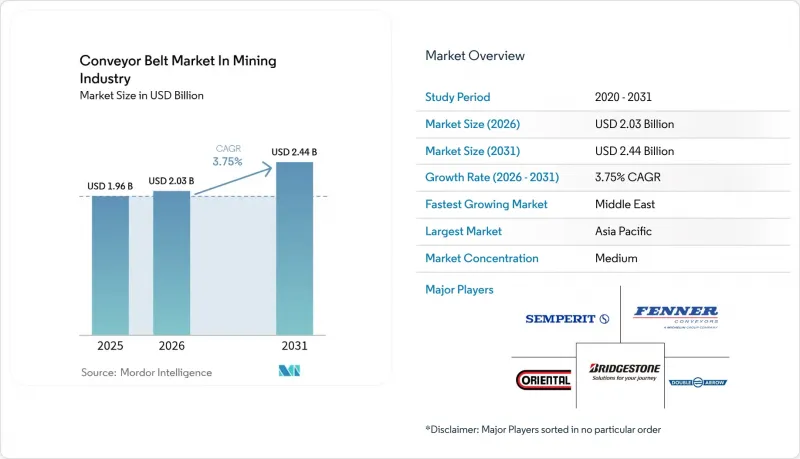
This report is Segmented by Product Type (Steel Cord, Textile Reinforced, Aramid/Hybrid, Bucket and Side Wall, and More), Drive Type (Geared, and Gearless), Service Type (In-Pit, In-Plant, Overland, Pipe, Stackers, and Feed Conveyors), Application (Open-Pit, and Underground), and Geography. The Market Forecasts are Provided in Terms of Value (USD).
Insights and Trends of Conveyor Belt Market In Mining Industry
Heavy Expansion of Surface and Underground Mining CAPEX
Global mining capital expenditure aligned to conveyor installations is entering a multi-year surge, with USD 406 billion in active and planned projects logged for 2025. Flagship developments in the Pilbara and Atacama are shifting more than 10 kilometers of material per flight, confirming a scale at which conveyors outcompete diesel trucks on unit cost. Underground transitions at deep copper and gold deposits are ordering steel cord belts with breaking strengths surpassing 6,000 kN m-1 to lift ore more than 1,000 meters without transfer points. Multinational miners such as Rio Tinto and BHP locked in 2025 procurement budgets for belt upgrades that stretch through 2030, signalling sustained order pipelines. Smaller producers still face financing gaps, yet their project feasibility studies increasingly benchmark conveyors as the long-run cost baseline.
Surge In Bulk-Material Throughput Requirements of Autonomous Haulage Systems
Autonomous truck networks rely on steady feed rates, pushing mines to designate conveyors as the fixed spine of material flow. Inline ore-grade analysers that require belt-speed stability within +-2% now influence rubber compound selection because vibration dampening secures sensor accuracy. Gearless drives commissioned at Codelco's Chuquicamata in 2025 run 20 MW on a single flight, delivering 11,000 t h-1 while trimming vibration by 30% versus geared sets. Early adopters in Australia and Chile report that the sensor-ready belts improve mill scheduling and reduce over-grinding losses, reinforcing the business case for higher-spec platforms.
High Upfront CAPEX And Long Payback Periods
Overland or pipe conveyors can cost USD 5-15 million per kilometer, with multi-flight systems topping USD 300 million. Finance committees for mid-tier producers prefer shorter-cycle truck fleets, despite higher long-run operating expense, because loan covenants emphasize near-term cash flow. Currency swings and steel price spikes during the 2024-2025 window eroded contingency budgets on several African copper projects, leading to schedule slippage. Digital-twin software marketed by FLSmidth now models lifecycle savings to de-risk decisions, yet adoption is still confined to tier-1 miners with robust engineering departments.
Other drivers and restraints analyzed in the detailed report include:
- Tighter Occupational-Safety Mandates in High-Risk Mining Zones
- Growing Demand for Energy-Efficient Abrasion-Resistant Belts
For complete list of drivers and restraints, kindly check the Table Of Contents.
Segment Analysis
Steel cord belts accounted for 47.17% of the conveyor belt market share in 2025 because their tensile capacity fits high-load, long-distance haulage. The conveyor belt market in mining industry is witnessing a 4.22% CAGR tilt toward aramid and hybrid belts that trim weight and energy demand without compromising breaking strength. Underground copper and gold mines opt for these lighter carcasses to ease installation in confined declines, while overland routes with compound curves appreciate the higher fatigue resistance. Suppliers are responding with modular platforms that pair aramid warp layers with sensor loops, an architecture that supports on-belt grade analyzers.
Fenner's delivery of an ST6300 steel cord unit to a New South Wales gold mine illustrates ongoing demand for extreme-strength belts where vertical lifts exceed 1,000 meters. Continental's Brazil plant expansion adds heavy-duty capacity to cut lead times for South American copper projects. Specialty textiles and solid-woven belts retain footholds in short in-plant circuits, but their share edges down as mines consolidate material-handling routes into fewer, more powerful flights. The conveyor belt market in mining industry therefore reflects a coexistence model in which steel cord remains the backbone of ultra-high-tension duties while aramid gains share in energy-sensitive or space-constrained installations.
Geared drives still held 72.84% share of the 2025 installed base thanks to price advantage and widespread maintenance know-how. However, gearless drives are expanding at a 4.51% CAGR as mines push beyond the 15-MW threshold where gearbox life-cycle economics deteriorate. The conveyor belt market in mining industry increasingly favours synchronous-motor designs paired with variable-frequency control that eliminate oil-bath gearboxes, cut vibration, and surface live torque data for predictive analytics. ABB's 20-MW system at Chuquicamata set a new benchmark for single-flight capacity, reducing gearbox downtime risk and slashing CO2 by 70% relative to diesel haulage.
In regions with reliable grids and OEM service depots, gearless penetration accelerates as procurement teams internalize lower spares inventories and extended maintenance intervals. Smaller mines in Africa and Southeast Asia still specify geared units because initial capital outlay for gearless can run 20-30% higher. As digital-twin commissioning shortens ramp-up time and warranty clauses extend to ten years, gearless value propositions strengthen, but technician reskilling remains a gating factor for widespread uptake.
Complete Report Scope:
- By Product Type
- Steel Cord
- Textile Reinforced
- Aramid/Hybrid
- Bucket and Side Wall
- Others Product Type
- By Drive Type
- Geared
- Gearless
- By Service Type
- In-Pit
- In-Plant
- Overland
- Pipe
- Stackers
- Feed Conveyors
- By Application
- Open-Pit
- Underground
- By Geography
- North America
- United States
- Canada
- Mexico
- South America
- Brazil
- Argentina
- Rest of South America
- Europe
- Germany
- United Kingdom
- France
- Italy
- Spain
- Rest of Europe
- Asia-Pacific
- China
- Japan
- India
- Singapore
- Australia
- Malaysia
- Rest of Asia-Pacific
- Middle East
- Saudi Arabia
- United Arab Emirates
- Rest of Middle East
- Africa
- South Africa
- Egypt
- Rest of Africa
- North America
Geography Analysis
Asia-Pacific remained the epicentre of conveyor investment in 2025, accounting for 38.64% of global revenue. Chinese coal producers fitted overland conveyors in Inner Mongolia to meet stricter truck-emission caps, while Indian iron-ore miners upgraded aging belts with ISO 340-compliant fire-resistant covers ahead of tighter national codes. Australian iron-ore majors integrated gearless drives and low-rolling-resistance belts that shave diesel burn, aligning with net-zero targets. Japan and South Korea, though smaller in tonnage, export high-spec belts to Southeast Asian nickel projects, cementing the region's technology incubator role.
Africa records the fastest regional CAGR at 4.19%, lifted by copper projects in the Democratic Republic of Congo, phosphate expansions in Egypt, and gold shafts in South Africa. Simandou's in-pit crushing and conveying complex headlines West Africa's greenfield boom, while retrofit cycles in South Africa upgrade 1990s-era belts with digital monitoring to reduce unplanned downtime. The region's challenges, notably grid instability and technician shortages, temper gearless penetration but also open opportunities for modular, quick-splice textile belts that tolerate variable loading.
North America and Europe exhibit replacement-driven demand as mines retire 20-year-old belts and retrofit safety systems. Continental's USD 85 million compounding expansion in Iowa underscores a stable, high-performance aftermarket for abrasion-resistant covers. South America continues to pivot toward underground copper and lithium, with Brazil and Chile adding local steel cord capacity to shorten import lead times. The Middle East shows limited near-term influence, though Saudi Arabia's Vision 2030 mining diversification may unlock sizable conveyor contracts post-2030.
- ContiTech GmbH (Continental AG)
- Bridgestone Corporation
- Fenner Dunlop Australia Pty Ltd (Michelin Group)
- Zhejiang Double Arrow Rubber Co. Ltd
- Semperit AG Holding
- Phoenix Conveyor Belt Systems GmbH
- Bando Chemical Industries Ltd
- Yokohama Rubber Co. Ltd
- Tenova SpA (Techint Group)
- ABB Ltd
- FLSmidth & Co. A/S
- Metso Outotec Corporation
- NEPEAN Conveyors Pty Ltd
- Takraf GmbH
- Oriental Rubber Industries Pvt Ltd
- Sanwei Holding Group Co. Ltd
- Dynamic Rubbers Pvt Ltd
- Rema Tip Top AG
- Habasit AG
- Kale Conveyor Ltd.
- Smiley Monroe Ltd
- Qingdao Rubber Six Conveyor Belt Co. Ltd
Additional Benefits:
- The market estimate (ME) sheet in Excel format
- 3 months of analyst support
TABLE OF CONTENTS
1 INTRODUCTION
- 1.1 Study Assumptions and Market Definition
- 1.2 Scope of the Study
2 RESEARCH METHODOLOGY
3 EXECUTIVE SUMMARY
4 MARKET LANDSCAPE
- 4.1 Market Overview
- 4.2 Market Drivers
- 4.2.1 Heavy Expansion of Surface and Underground Mining CAPEX (2025-2030)
- 4.2.2 Surge in Bulk-Material Throughput Requirements of Autonomous Haulage Systems
- 4.2.3 Tighter Occupational-Safety Mandates in High-Risk Mining Zones
- 4.2.4 Growing Demand for Energy-Efficient Abrasion-Resistant Belts
- 4.2.5 On-Conveyor Ore-Grade Sensing Driving Adoption of Low-Vibration Belt Designs
- 4.2.6 ESG-Linked Financing Tied to Low-Noise, Recyclable Belt Materials
- 4.3 Market Restraints
- 4.3.1 High Upfront CAPEX and Long Payback Periods
- 4.3.2 Persistent Shortage of Trained Belt-Maintenance Technicians
- 4.3.3 Belt Fire-Risk Clauses Raising Insurance Premiums
- 4.3.4 Volatile Raw-Material (Steel and Aramid) Supply Due to Geo-Political Shocks
- 4.4 Industry Value-Chain Analysis
- 4.5 Regulatory Landscape
- 4.6 Technological Outlook
- 4.7 Porter's Five Forces Analysis
- 4.7.1 Bargaining Power of Suppliers
- 4.7.2 Bargaining Power of Buyers
- 4.7.3 Threat of New Entrants
- 4.7.4 Threat of Substitutes
- 4.7.5 Intensity of Competitive Rivalry
- 4.8 Impact of Macroeconomic Factors on the Market
5 MARKET SIZE AND GROWTH FORECASTS (VALUE)
- 5.1 By Product Type
- 5.1.1 Steel Cord
- 5.1.2 Textile Reinforced
- 5.1.3 Aramid/Hybrid
- 5.1.4 Bucket and Side Wall
- 5.1.5 Others Product Type
- 5.2 By Drive Type
- 5.2.1 Geared
- 5.2.2 Gearless
- 5.3 By Service Type
- 5.3.1 In-Pit
- 5.3.2 In-Plant
- 5.3.3 Overland
- 5.3.4 Pipe
- 5.3.5 Stackers
- 5.3.6 Feed Conveyors
- 5.4 By Application
- 5.4.1 Open-Pit
- 5.4.2 Underground
- 5.5 By Geography
- 5.5.1 North America
- 5.5.1.1 United States
- 5.5.1.2 Canada
- 5.5.1.3 Mexico
- 5.5.2 South America
- 5.5.2.1 Brazil
- 5.5.2.2 Argentina
- 5.5.2.3 Rest of South America
- 5.5.3 Europe
- 5.5.3.1 Germany
- 5.5.3.2 United Kingdom
- 5.5.3.3 France
- 5.5.3.4 Italy
- 5.5.3.5 Spain
- 5.5.3.6 Rest of Europe
- 5.5.4 Asia-Pacific
- 5.5.4.1 China
- 5.5.4.2 Japan
- 5.5.4.3 India
- 5.5.4.4 Singapore
- 5.5.4.5 Australia
- 5.5.4.6 Malaysia
- 5.5.4.7 Rest of Asia-Pacific
- 5.5.5 Middle East
- 5.5.5.1 Saudi Arabia
- 5.5.5.2 United Arab Emirates
- 5.5.5.3 Rest of Middle East
- 5.5.6 Africa
- 5.5.6.1 South Africa
- 5.5.6.2 Egypt
- 5.5.6.3 Rest of Africa
- 5.5.1 North America
6 COMPETITIVE LANDSCAPE
- 6.1 Market Concentration
- 6.2 Strategic Moves
- 6.3 Market Share Analysis
- 6.4 Company Profiles (includes Global Level Overview, Market Level Overview, Core Segments, Financials as available, Strategic Information, Market Rank/Share, Products and Services, Recent Developments)
- 6.4.1 ContiTech GmbH (Continental AG)
- 6.4.2 Bridgestone Corporation
- 6.4.3 Fenner Dunlop Australia Pty Ltd (Michelin Group)
- 6.4.4 Zhejiang Double Arrow Rubber Co. Ltd
- 6.4.5 Semperit AG Holding
- 6.4.6 Phoenix Conveyor Belt Systems GmbH
- 6.4.7 Bando Chemical Industries Ltd
- 6.4.8 Yokohama Rubber Co. Ltd
- 6.4.9 Tenova SpA (Techint Group)
- 6.4.10 ABB Ltd
- 6.4.11 FLSmidth & Co. A/S
- 6.4.12 Metso Outotec Corporation
- 6.4.13 NEPEAN Conveyors Pty Ltd
- 6.4.14 Takraf GmbH
- 6.4.15 Oriental Rubber Industries Pvt Ltd
- 6.4.16 Sanwei Holding Group Co. Ltd
- 6.4.17 Dynamic Rubbers Pvt Ltd
- 6.4.18 Rema Tip Top AG
- 6.4.19 Habasit AG
- 6.4.20 Kale Conveyor Ltd.
- 6.4.21 Smiley Monroe Ltd
- 6.4.22 Qingdao Rubber Six Conveyor Belt Co. Ltd
7 MARKET OPPORTUNITIES AND FUTURE OUTLOOK
- 7.1 White-Space and Unmet-Need Assessment

