PUBLISHER: Mordor Intelligence | PRODUCT CODE: 2100671

PUBLISHER: Mordor Intelligence | PRODUCT CODE: 2100671
Water and Wastewater Sensors - Market Share Analysis, Industry Trends & Statistics, Growth Forecasts (2026 - 2031)
According to Mordor Intelligence, the water and wastewater sensors market size is projected to expand from USD 6.42 billion in 2025 and USD 6.76 billion in 2026 to USD 8.88 billion by 2031, registering a CAGR of 5.61% between 2026 to 2031.
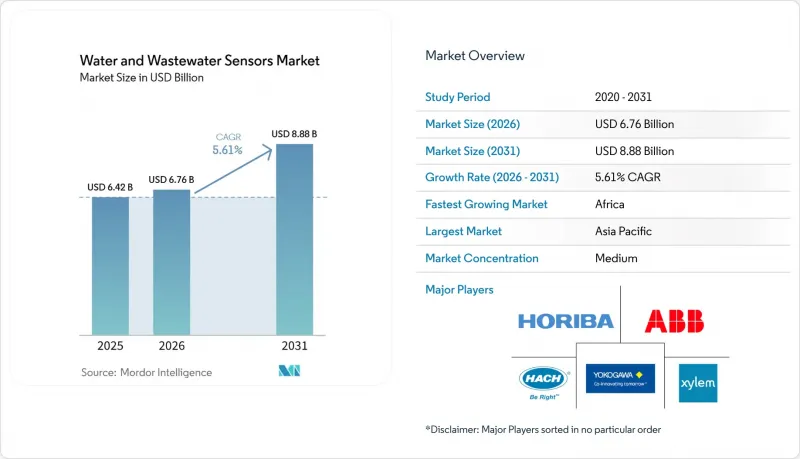
This report is Segmented by Sensor Type (Optical Sensors, Ultrasonic Sensors, and More), Parameter Monitored (pH, Turbidity, and More), End-Use Industry (Industrial Water and Wastewater Treatment, Aquaculture, and More), Installation Point (In-Line, Submersible, Handheld or Portable, Remote or IoT-Enabled Units), and Geography. Market Forecasts are Provided in Terms of Value (USD).
Global Water and Wastewater Sensors Market Trends and Insights
Accelerating Digitization Of Water Utilities
Continuous sensor networks now feed live data into digital twins, letting operators simulate process changes before rolling them out at full scale. The United States Environmental Protection Agency's 2024 cybersecurity guidance obliges utilities that deploy networked probes to segment operational and information-technology traffic, raising entry barriers for small municipalities while speeding consolidation. Xylem's 2023 purchase of Evoqua formed a vertically integrated platform combining probes, managed calibration, and analytics, a blend that utilities prefer because it centralizes accountability. Cloud dashboards provide regional views of turbidity, conductivity, and oxidation-reduction potential; however, Europe's data-protection laws are prompting the migration of inference workloads from the cloud to local gateways to avoid cross-border data transfers. Edge-embedded analytics reduce latency, shrink bandwidth costs, and cut regulatory complexity, turning the sensor node into the primary decision point. This digitization wave anchors the water and wastewater sensors market as a strategic lever rather than a compliance checkbox.
Tightening Industrial Discharge Regulations
Governments across the Asia-Pacific region have upgraded effluent rules for heavy metals, biochemical oxygen demand, and suspended solids, obliging factories to install multi-parameter probes at their outlet pipes. China now mandates the installation of round-the-clock chemical-oxygen-demand analyzers at every industrial park in the Yangtze River Economic Belt, affecting more than 15,000 facilities. India's Central Pollution Control Board requires textile and drug plants to log readings every 15 minutes and trigger alarms within 30 seconds. These directives compress decision cycles, forcing the adoption of electrochemical and optical sensors that can run unattended for months. Demand is spilling over to the Middle East, where Saudi Arabia's utility regulator now requires continuous monitoring of boron and bromide at desalination outlets. Tougher limits underline why the water and wastewater sensors market continues to expand at a healthy pace.
Capital-Intensive Retrofitting Of Legacy Plants
Modernizing plants built decades ago often entails power upgrades, communications cabling, and parallel operations while new and old systems overlap, a package that can exceed USD 500,000 for mid-sized utilities. European operators must also translate heritage supervisory control and data acquisition protocols into modern fieldbus standards, which inflates deployment hours. Smaller municipalities cope by rotating shared sensor trailers across multiple sites, yet this compromises continuous oversight and slows incident response. Budget rigidity, therefore, delays adoption and tempers short-term gains in the water and wastewater sensors market.
Other drivers and restraints analyzed in the detailed report include:
- Rapid Expansion of Smart Irrigation Networks
- Cost Decline Of Optical And MEMS Components
- Scarcity Of Skilled Calibration Technicians
For complete list of drivers and restraints, kindly check the Table Of Contents.
Segment Analysis
Electrochemical sensors retained 39.12% of the 2025 revenue, thanks to sub-10-second response times, which are critical for pH and ion-selective electrode control loops. Optical designs are growing at an 8.31% CAGR, primarily because luminescent dissolved-oxygen probes overcome membrane fouling and provide year-long calibration stability. Ultrasonic units address open-channel flow and sludge-blanket depth, avoiding biofouling because no wetted parts intrude. Capacitive probes excel at level detection in oil-water separators, where dielectric contrasts sharpen accuracy. Other niche formats hold less than 5% combined share but solve specialty measures such as ammonia and volatile organic compounds.
Utilities are gravitating toward optical options after tiring of membrane swaps every three to six months in high-solids basins. Yokogawa's dual-wavelength probe, launched in 2024, counters turbidity interference and stretches calibration to 12 months. Even so, electrochemical cells remain relevant for parts-per-billion trace-metal targets, where stripping voltammetry paired with ion-selective electrodes achieves sensitivities that optical methods cannot. Regulatory alignment with ISO 10530 ensures a durable demand floor, allowing both sensor families to coexist within the water and wastewater sensors market.
Complete Report Scope:
- By Sensor Type
- Electrochemical Sensors
- Optical Sensors
- Ultrasonic Sensors
- Capacitive Sensors
- Other Sensor Type
- By Parameter Monitored
- pH
- Dissolved Oxygen
- Turbidity
- Conductivity
- Oxidation-Reduction Potential (ORP)
- Temperature
- Other Parameter Monitored
- By End-Use Industry
- Municipal Water and Wastewater Treatment
- Industrial Water and Wastewater Treatment
- Environmental Monitoring Agencies
- Aquaculture
- Other End-Use Industry
- By Geography
- North America
- United States
- Canada
- Mexico
- Europe
- Germany
- United Kingdom
- France
- Russia
- Rest of Europe
- Asia-Pacific
- China
- Japan
- India
- South Korea
- Australia
- Rest of Asia-Pacific
- Middle East and Africa
- Middle East
- Saudi Arabia
- United Arab Emirates
- Rest of Middle East
- Africa
- South Africa
- Egypt
- Rest of Africa
- Middle East
- South America
- Brazil
- Argentina
- Rest of South America
- North America
Geography Analysis
The Asia-Pacific region delivered 35.22% of global revenue in 2025 and continues to combine component manufacturing strength with the largest pool of new installations. China enforces 15-minute reporting intervals at industrial parks along the Yangtze River Economic Belt, cementing a home-market advantage for domestic probe makers. India's Jal Jeevan Mission deploys turbidity and residual-chlorine probes at village plants, though patchy power and scarce service staff shorten sensor uptimes. Japan focuses on replacing aging sensors from the 1980s, buoying local champions such as Yokogawa.
Africa is forecast to grow, anchored by donor-funded smart-metering programs in Nairobi, Lagos, and Addis Ababa that bundle flow, pressure, turbidity, and conductivity sensors. South Africa mandates continuous monitoring for plants serving more than 10,000 residents, yet funding gaps delay rollouts. Egypt's new administrative capital features a fully instrumented network that other North African cities now benchmark.
North America and Europe exhibit steady, but slower growth as operators shift their focus toward analytics layers that extract added value from mature hardware fleets. The United States Environmental Protection Agency's 2024 security rules accelerate upgrades to secure field protocols, favoring vendors with both sensors and cyber-hardened gateways. Germany pilots digital twins that integrate sensor feeds with hydraulic models, trimming unplanned downtime by 30%. The Middle East buys specialized boron analyzers and fouling monitors for desalination trains that supply over 70% of municipal water. South American growth is driven by Brazilian and Argentine farms that utilize soil-moisture networks to meet European sustainability certifications.
- Xylem Inc.
- Hach Company
- Horiba Ltd.
- Endress+Hauser Group Services AG
- ABB Ltd.
- Yokogawa Electric Corporation
- Thermo Fisher Scientific Inc.
- Teledyne Technologies Incorporated
- In-Situ Inc.
- Sensorex Inc.
- Aquaread Limited
- Atlas Scientific LLC
- Campbell Scientific, Inc.
- Swan Analytical Instruments AG
- KROHNE Messtechnik GmbH
- Analytical Technology, Inc.
- Evoqua Water Technologies LLC
- Libelium Comunicaciones Distribuidas S.L.
- Nivus GmbH
- Hubei Sensorthings Technology Co., Ltd.
Additional Benefits:
- The market estimate (ME) sheet in Excel format
- 3 months of analyst support
TABLE OF CONTENTS
1 INTRODUCTION
- 1.1 Study Assumptions and Market Definition
- 1.2 Scope of the Study
2 RESEARCH METHODOLOGY
3 EXECUTIVE SUMMARY
4 MARKET LANDSCAPE
- 4.1 Market Overview
- 4.2 Market Drivers
- 4.2.1 Accelerating Digitization of Water Utilities
- 4.2.2 Tightening Industrial Discharge Regulations
- 4.2.3 Rapid Expansion of Smart Irrigation Networks
- 4.2.4 Cost Decline of Optical and MEMS Sensor Components
- 4.2.5 Integration of Edge AI for On-Site Anomaly Detection
- 4.2.6 Rise of Performance-Based Water-Service Contracts
- 4.3 Market Restraints
- 4.3.1 Capital-Intensive Retrofitting of Legacy Plants
- 4.3.2 Scarcity of Skilled Calibration Technicians
- 4.3.3 Data-Security Concerns in Cloud-Connected Probes
- 4.3.4 Limited Sensor Longevity in High-Salinity Effluents
- 4.4 Industry Value Chain Analysis
- 4.5 Regulatory Landscape
- 4.6 Technological Outlook
- 4.7 Impact of Macroeconomic Factors
- 4.8 Porter's Five Forces Analysis
- 4.8.1 Threat of New Entrants
- 4.8.2 Bargaining Power of Suppliers
- 4.8.3 Bargaining Power of Buyers
- 4.8.4 Threat of Substitutes
- 4.8.5 Competitive Rivalry
5 MARKET SIZE AND GROWTH FORECASTS (VALUE)
- 5.1 By Sensor Type
- 5.1.1 Electrochemical Sensors
- 5.1.2 Optical Sensors
- 5.1.3 Ultrasonic Sensors
- 5.1.4 Capacitive Sensors
- 5.1.5 Other Sensor Type
- 5.2 By Parameter Monitored
- 5.2.1 pH
- 5.2.2 Dissolved Oxygen
- 5.2.3 Turbidity
- 5.2.4 Conductivity
- 5.2.5 Oxidation-Reduction Potential (ORP)
- 5.2.6 Temperature
- 5.2.7 Other Parameter Monitored
- 5.3 By End-Use Industry
- 5.3.1 Municipal Water and Wastewater Treatment
- 5.3.2 Industrial Water and Wastewater Treatment
- 5.3.3 Environmental Monitoring Agencies
- 5.3.4 Aquaculture
- 5.3.5 Other End-Use Industry
- 5.4 By Geography
- 5.4.1 North America
- 5.4.1.1 United States
- 5.4.1.2 Canada
- 5.4.1.3 Mexico
- 5.4.2 Europe
- 5.4.2.1 Germany
- 5.4.2.2 United Kingdom
- 5.4.2.3 France
- 5.4.2.4 Russia
- 5.4.2.5 Rest of Europe
- 5.4.3 Asia-Pacific
- 5.4.3.1 China
- 5.4.3.2 Japan
- 5.4.3.3 India
- 5.4.3.4 South Korea
- 5.4.3.5 Australia
- 5.4.3.6 Rest of Asia-Pacific
- 5.4.4 Middle East and Africa
- 5.4.4.1 Middle East
- 5.4.4.1.1 Saudi Arabia
- 5.4.4.1.2 United Arab Emirates
- 5.4.4.1.3 Rest of Middle East
- 5.4.4.2 Africa
- 5.4.4.2.1 South Africa
- 5.4.4.2.2 Egypt
- 5.4.4.2.3 Rest of Africa
- 5.4.4.1 Middle East
- 5.4.5 South America
- 5.4.5.1 Brazil
- 5.4.5.2 Argentina
- 5.4.5.3 Rest of South America
- 5.4.1 North America
6 COMPETITIVE LANDSCAPE
- 6.1 Market Concentration
- 6.2 Strategic Moves
- 6.3 Vendor Positioning Analysis
- 6.4 Company Profiles (includes Global level Overview, Market level overview, Core Segments, Financials as available, Strategic Information, Market Rank/Share for key companies, Products and Services, and Recent Developments)
- 6.4.1 Xylem Inc.
- 6.4.2 Hach Company
- 6.4.3 Horiba Ltd.
- 6.4.4 Endress+Hauser Group Services AG
- 6.4.5 ABB Ltd.
- 6.4.6 Yokogawa Electric Corporation
- 6.4.7 Thermo Fisher Scientific Inc.
- 6.4.8 Teledyne Technologies Incorporated
- 6.4.9 In-Situ Inc.
- 6.4.10 Sensorex Inc.
- 6.4.11 Aquaread Limited
- 6.4.12 Atlas Scientific LLC
- 6.4.13 Campbell Scientific, Inc.
- 6.4.14 Swan Analytical Instruments AG
- 6.4.15 KROHNE Messtechnik GmbH
- 6.4.16 Analytical Technology, Inc.
- 6.4.17 Evoqua Water Technologies LLC
- 6.4.18 Libelium Comunicaciones Distribuidas S.L.
- 6.4.19 Nivus GmbH
- 6.4.20 Hubei Sensorthings Technology Co., Ltd.
7 MARKET OPPORTUNITIES AND FUTURE OUTLOOK
- 7.1 White-Space and Unmet-Need Assessment

