PUBLISHER: Mordor Intelligence | PRODUCT CODE: 2100700

PUBLISHER: Mordor Intelligence | PRODUCT CODE: 2100700
Flow Control in Semiconductor Industry - Market Share Analysis, Industry Trends & Statistics, Growth Forecasts (2026 - 2031)
According to Mordor Intelligence, flow control market size in semiconductor industry market size in 2026 is estimated at USD 6.39 billion, growing from 2025 value of USD 6.03 billion with 2031 projections showing USD 8.55 billion, growing at 6.02% CAGR over 2026-2031.
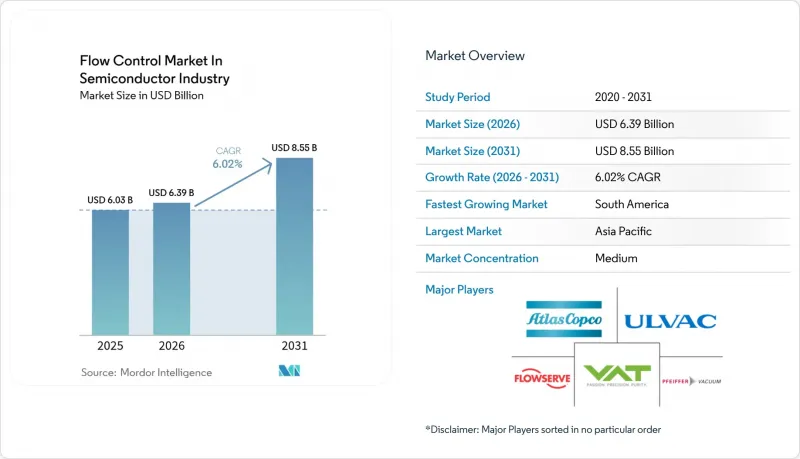
This report is Segmented by Component (Vacuum Systems, Valves, Mechanical Seals, and More), Process Step (Deposition, Etching, Ion Implantation, Lithography, and More), Flow Medium (Gases, Liquids), Cleanliness Rating (High-Purity, Standard-Purity), Valve Actuation Type (Manual, Pneumatic, Electric), and Geography. The Market Forecasts are Provided in Terms of Value (USD).
Global Flow Control in Semiconductor Industry Trends and Insights
Explosive EUV Lithography Vacuum Requirements in Korean and Taiwanese Fabs
Korean and Taiwanese semiconductor manufacturers are driving unprecedented demand for ultra-high vacuum fluid handling systems as they scale EUV lithography capacity. TSMC's transition to High-NA EUV technology requires vacuum levels below 10^-11 torr, demanding specialized valve configurations that prevent hydrocarbon contamination during photoresist processing. Samsung's EUV roadmap includes 15 new EUV scanners by 2026, each requiring dedicated fluid handling infrastructure worth approximately USD 2-3 million per tool. The technical complexity stems from EUV's sensitivity to molecular contamination, where even trace amounts of organic compounds can degrade mirror reflectivity and reduce lithography yield.
3D-NAND Transition Beyond 200 Layers Boosting High-Flow ALD Valves (China)
China's aggressive pursuit of 3D-NAND technology beyond 200 layers is creating substantial demand for high-flow atomic layer deposition valves capable of handling precursor delivery at unprecedented scales. YMTC's development of 232-layer 3D-NAND requires ALD processes with deposition rates exceeding 50 nm/hour, necessitating valve systems with flow rates 3-4 times higher than conventional 128-layer processes. The technical challenge lies in maintaining precursor uniformity across 300mm wafers while preventing cross-contamination between different chemical species. Chinese manufacturers are investing heavily in domestic fluid handling capabilities to reduce dependence on foreign suppliers, with companies like NAURA and AMEC developing indigenous valve technologies. However, the transition faces significant hurdles in high-purity material sourcing, as China imports over 80% of its fluoro-elastomer seals from Japanese and German suppliers.
EU PFAS Phase-Out Proposals Increasing Material Redesign Costs
EU plans to remove 4,000 fluorinated compounds by 2029, forcing valve makers to substitute DuPont Kalrez and similar seals. European firms report 40-80% higher material costs and 18-24 month qualification cycles while also navigating Dutch export controls effective April 2025.
Other drivers and restraints analyzed in the detailed report include:
- U.S. CHIPS Act Fab Build-out Raising Chemical-Distribution Valve Demand
- Dry Vacuum Pump Adoption to Meet PFAS-Emission Rules (Japan)
- Tight High-Purity Fluoro-Elastomer Supply Inflating Seal Prices
For complete list of drivers and restraints, kindly check the Table Of Contents.
Segment Analysis
Valves held 45.40% semiconductor fluid handling market share in 2025. Vacuum system revenue is rising at a 6.95% CAGR because EUV lithography and advanced packaging rely on ultra-high vacuum.
Demand for all-metal gate valves able to hold leak rates below 10-12 mbar*l/s grows quickly, with VAT and Fujikin leading adoption. The semiconductor fluid handling market size for vacuum systems is poised to expand fastest, supported by new dry pumps with magnetic bearings that reach 2,000 l/s and exceed 50,000 hours MTBF.
Suppliers increasingly bundle valves, pumps, and mass-flow controllers in modular skids that cut fab install time by 30%. Predictive analytics embedded in smart valves improve throughput and extend seal life, reducing total cost of ownership for fab operators. R&D focus has shifted toward PFAS-free elastomers and electropolished wetted paths that meet ISO-1 cleanliness.
Deposition processes generated 20.80% of 2025 revenue, while lithography is growing at 7.6% CAGR and becoming the fastest driver of semiconductor fluid handling market demand.
Atomic-layer deposition requires millisecond valve switching with parts-per-billion impurity control. Selective deposition platforms from Applied Materials must alternate precursors rapidly, necessitating advanced valve manifolds. Conversely, the semiconductor fluid handling market size for lithography tools increases alongside High-NA EUV because contamination-free photoresist lines directly impact yield.
Etch, ion implant, and wet clean remain essential but mature; upgrades here primarily follow capacity additions. Load-lock upgrades tied to automated material transfer are experiencing renewed investment as 300 mm automation spreads to 200 mm fabs seeking productivity gains.
Complete Report Scope:
- By Component
- Vacuum Systems
- Valves
- Ball
- Butterfly
- Gate
- Globe
- Other Valves
- Mechanical Seals
- Mass Flow Controllers
- Flow Meters
- By Process Step
- Deposition (PVD / CVD / ALD)
- Etching and Dry Strip
- Ion Implantation
- Lithography
- Wafer Cleaning and CMP
- Metrology and Inspection
- Load Lock and Transfer
- Water and Waste Treatment
- By Flow Medium
- Gases
- Liquids
- By Cleanliness Rating
- High-Purity (ISO 1-3)
- Standard-Purity (ISO 4+)
- By Valve Actuation Type
- Manual
- Pneumatic
- Electric
- Solenoid
- By Geography
- North America
- United States
- Canada
- Mexico
- Europe
- Germany
- France
- Netherlands
- United Kingdom
- Rest of Europe
- Asia-Pacific
- China
- Taiwan
- South Korea
- Australia
- Japan
- India
- Southeast Asia
- Middle East
- Israel
- Saudi Arabia
- United Arab Emirates
- Africa
- South Africa
- Rest of Africa
- South America
- Brazil
- Argentina
- Rest of South America
- North America
Geography Analysis
Asia-Pacific held 33.60% semiconductor fluid handling market share in 2025, anchored by Taiwan and South Korea. TSMC's nine-fab expansion and Samsung's EUV scale-up are foremost demand engines. China remains a colossal growth prospect despite export controls, with YMTC and SMIC building indigenous supply chains. Japan's equipment sector and materials expertise also sustain high valve and pump requirements. North America enjoys renewed momentum through the CHIPS Act. Intel, Micron, and GlobalFoundries projects each require USD 150-200 million in fluid systems, fostering regional clusters that shorten lead times and bolster resilience. Europe's market confronts PFAS restrictions that inflate material redesign costs yet also create competitive moats for compliant suppliers; ASML's Dutch base sustains specialized orders for EUV-ready components.
South America, led by Brazil, registers the fastest 7.55% CAGR as governments court semiconductor assembly and test investments to diversify supply chains. Infrastructure gaps and skills shortages remain hurdles but targeted incentives and multinational partnerships are stimulating incremental demand for modular, lower-cost fluid handling packages suited to emerging fab environments.
- Pfeiffer Vacuum GmbH
- Atlas Copco AB
- Gardner Denver (Ingersoll Rand)
- Flowserve Corporation
- Busch Holding GmbH
- Kurt J. Lesker Company
- ULVAC Inc.
- Edwards Vacuum Ltd.
- Ebara Corporation
- MKS Instruments Inc.
- INFICON Holding AG
- SMC Corporation
- VAT Vakuumventile AG
- Fujikin Incorporation
- GEMU Holding GmbH and Co. KG
- Swagelok Company
- Festo SE and Co. KG
- CKD Corporation
- Parker-Hannifin Corporation
- AESSEAL plc
- EKK Eagle Industry Co.
- DuPont de Nemours Inc.
- Freudenberg Group
- Greene Tweed and Co. Inc.
- Jordan Valve (Richards Industries)
Additional Benefits:
- The market estimate (ME) sheet in Excel format
- 3 months of analyst support
TABLE OF CONTENTS
1 INTRODUCTION
- 1.1 Study Assumptions and Market Definition
- 1.2 Scope of the Study
2 RESEARCH METHODOLOGY
3 EXECUTIVE SUMMARY
4 MARKET LANDSCAPE
- 4.1 Market Overview
- 4.2 Market Drivers
- 4.2.1 Explosive EUV Lithography Vacuum Requirements in Korean and Taiwanese Fabs
- 4.2.2 3D-NAND Transition Beyond 200 Layers Boosting High-Flow ALD Valves (China)
- 4.2.3 U.S. CHIPS Act Fab Build-out Raising Chemical-Distribution Valve Demand
- 4.2.4 Dry Vacuum Pump Adoption to Meet PFAS-Emission Rules (Japan)
- 4.2.5 Hybrid-Bonding Packaging Needs Sub-1 Torr Micro-Flow Controls (Global)
- 4.2.6 IIoT-Enabled Smart Valves for Predictive Maintenance (Europe)
- 4.3 Market Restraints
- 4.3.1 EU PFAS Phase-Out Proposals Increasing Material Redesign Costs
- 4.3.2 Tight High-Purity Fluoro-Elastomer Supply Inflating Seal Prices
- 4.3.3 Capex-Intensive Ultra-High-Vacuum Valves Limiting Adoption in South America
- 4.3.4 18-24 Month Qualification Cycles with Tier-1 Tool OEMs
- 4.4 Value / Supply-Chain Analysis
- 4.5 Regulatory Outlook
- 4.6 Technological Outlook
- 4.7 Porter's Five Forces Analysis
- 4.7.1 Bargaining Power of Suppliers
- 4.7.2 Bargaining Power of Buyers
- 4.7.3 Threat of New Entrants
- 4.7.4 Threat of Substitutes
- 4.7.5 Intensity of Rivalry
5 MARKET SIZE AND GROWTH FORECASTS (VALUE)
- 5.1 By Component
- 5.1.1 Vacuum Systems
- 5.1.2 Valves
- 5.1.2.1 Ball
- 5.1.2.2 Butterfly
- 5.1.2.3 Gate
- 5.1.2.4 Globe
- 5.1.2.5 Other Valves
- 5.1.3 Mechanical Seals
- 5.1.4 Mass Flow Controllers
- 5.1.5 Flow Meters
- 5.2 By Process Step
- 5.2.1 Deposition (PVD / CVD / ALD)
- 5.2.2 Etching and Dry Strip
- 5.2.3 Ion Implantation
- 5.2.4 Lithography
- 5.2.5 Wafer Cleaning and CMP
- 5.2.6 Metrology and Inspection
- 5.2.7 Load Lock and Transfer
- 5.2.8 Water and Waste Treatment
- 5.3 By Flow Medium
- 5.3.1 Gases
- 5.3.2 Liquids
- 5.4 By Cleanliness Rating
- 5.4.1 High-Purity (ISO 1-3)
- 5.4.2 Standard-Purity (ISO 4+)
- 5.5 By Valve Actuation Type
- 5.5.1 Manual
- 5.5.2 Pneumatic
- 5.5.3 Electric
- 5.5.4 Solenoid
- 5.6 By Geography
- 5.6.1 North America
- 5.6.1.1 United States
- 5.6.1.2 Canada
- 5.6.1.3 Mexico
- 5.6.2 Europe
- 5.6.2.1 Germany
- 5.6.2.2 France
- 5.6.2.3 Netherlands
- 5.6.2.4 United Kingdom
- 5.6.2.5 Rest of Europe
- 5.6.3 Asia-Pacific
- 5.6.3.1 China
- 5.6.3.2 Taiwan
- 5.6.3.3 South Korea
- 5.6.3.4 Australia
- 5.6.3.5 Japan
- 5.6.3.6 India
- 5.6.3.7 Southeast Asia
- 5.6.4 Middle East
- 5.6.4.1 Israel
- 5.6.4.2 Saudi Arabia
- 5.6.4.3 United Arab Emirates
- 5.6.5 Africa
- 5.6.5.1 South Africa
- 5.6.5.2 Rest of Africa
- 5.6.6 South America
- 5.6.6.1 Brazil
- 5.6.6.2 Argentina
- 5.6.6.3 Rest of South America
- 5.6.1 North America
6 COMPETITIVE LANDSCAPE
- 6.1 Market Concentration
- 6.2 Strategic Moves (M&A, JVs, Funding)
- 6.3 Market Share Analysis
- 6.4 Company Profiles (includes Global level Overview, Market level overview, Core Segments, Financials as available, Strategic Information, Market Rank/Share for key companies, Products and Services, and Recent Developments)
- 6.4.1 Pfeiffer Vacuum GmbH
- 6.4.2 Atlas Copco AB
- 6.4.3 Gardner Denver (Ingersoll Rand)
- 6.4.4 Flowserve Corporation
- 6.4.5 Busch Holding GmbH
- 6.4.6 Kurt J. Lesker Company
- 6.4.7 ULVAC Inc.
- 6.4.8 Edwards Vacuum Ltd.
- 6.4.9 Ebara Corporation
- 6.4.10 MKS Instruments Inc.
- 6.4.11 INFICON Holding AG
- 6.4.12 SMC Corporation
- 6.4.13 VAT Vakuumventile AG
- 6.4.14 Fujikin Incorporation
- 6.4.15 GEMU Holding GmbH and Co. KG
- 6.4.16 Swagelok Company
- 6.4.17 Festo SE and Co. KG
- 6.4.18 CKD Corporation
- 6.4.19 Parker-Hannifin Corporation
- 6.4.20 AESSEAL plc
- 6.4.21 EKK Eagle Industry Co.
- 6.4.22 DuPont de Nemours Inc.
- 6.4.23 Freudenberg Group
- 6.4.24 Greene Tweed and Co. Inc.
- 6.4.25 Jordan Valve (Richards Industries)
7 MARKET OPPORTUNITIES AND FUTURE OUTLOOK
- 7.1 White-Space and Unmet-Need Assessment

