PUBLISHER: Mordor Intelligence | PRODUCT CODE: 2100710

PUBLISHER: Mordor Intelligence | PRODUCT CODE: 2100710
India Gift Card and Incentive Card - Market Share Analysis, Industry Trends & Statistics, Growth Forecasts (2026 - 2031)
According to Mordor Intelligence, the India gift card and incentive card market size is expected to grow from USD 12.65 billion in 2025 to USD 13.65 billion in 2026 and is forecast to reach USD 20.71 billion by 2030 at 8.70% CAGR over 2026-2030.
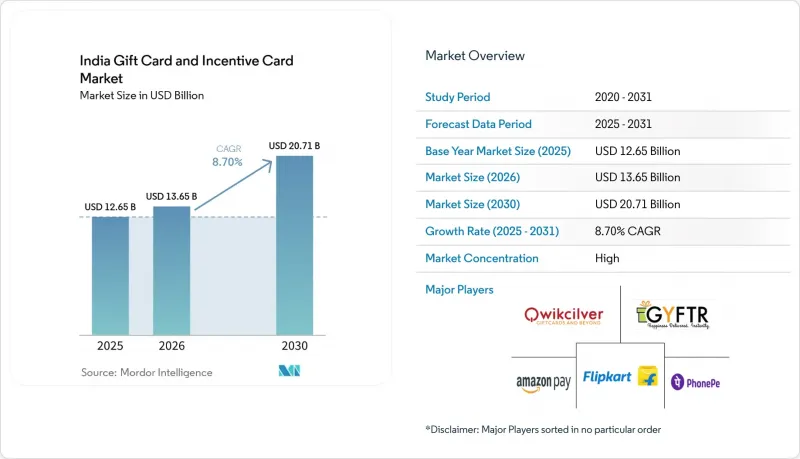
This report is Segmented Based On the Card Type (e-Gift Card, Physical Card), Consumer Type (retail Consumer, Corporate Consumer), and Distribution Channel (online, Offline). The Market Sizes and Forecasts are Provided in Terms of Value (USD Million) for all the Above Segments.
India Gift Card and Incentive Card Market Trends and Insights
E-gift Migration via Marketplaces and Super-apps Redefines Consumer Expectations
Marketplace integration reduced the steps between intent and delivery, boosting conversion for instant vouchers during peak events. Amazon Pay reported a 40% year-over-year increase in gift card purchases during the 2024 Great Indian Festival. It cited more than 1 billion gift cards delivered since 2014, which signals deep embeddedness at checkout and in stored payment credentials for repeat buyers. Tier-2 and Tier-3 cities are contributing a growing share of digital spending, supported by smartphone adoption and broadband subscriber growth, which improve the reliability of e-voucher delivery and redemption flows. Super-apps, wallet ecosystems, and bank portals now position gift cards as multi-category liquidity spanning groceries, subscriptions, gaming credits, and travel services, broadening their appeal beyond single-brand retail. Push notifications tied to seasonal festivals and social occasions help capture last-minute gifting demand without the logistical burden. Brands that secure prominent placement within marketplace gift hubs gain share of spontaneous occasions and reduce customer acquisition costs over time.
Corporate R&R and Channel Incentive Digitization Displace Cash and Cheques
Enterprises have shifted from infrequent cash payouts to real-time digital vouchers that link rewards to verified outcomes and compress redemption cycles to minutes. Public programs validated instant e-voucher delivery at scale, which reinforced corporate confidence in performance-linked instruments for employees and channel partners. Scaled platforms reported thousands of annual programs across automotive, pharma, and consumer goods that replaced physical gifts with multi-brand e-vouchers and UPI-linked rewards, thereby improving repeat participation and reducing pilferage risk. Case studies show structured reward slabs, multiple redemption options per tier, and automated issuance from ERP-validated invoices, which together deliver faster feedback loops and better MIS visibility to program owners . HR-tech integrations and API-first catalogs enable plug-in deployments for mid-sized enterprises seeking enterprise-grade controls without high setup costs. Broader loyalty and total-rewards stacks now bundle gift vouchers with meal, wellness, and lifestyle benefits, thereby raising perceived value and retention among competitive talent.
Fraud and Scam Risk Erodes Consumer Confidence in Digital Gift Instruments
UPI-linked fraud losses rose across both value and case counts through FY2024, prompting rule changes such as removing person-to-person collect requests that were abused to mimic legitimate redemption prompts . SMS and messaging scams impersonating gift support teams continue to target lower digital literacy segments, where QR code deployment is high, but user education lags. Risk controls have improved at the system level through Mule detection and verification mandates, yet pre-redemption identity checks are uneven across voucher platforms. Corporate issuers mitigate exposure by restricting redemption to known merchant catalogs and enforcing OTP on high-value instruments, while individual buyers on marketplaces receive limited security guidance at checkout. The proposed Digital Payment Intelligence Platform is under consultation and does not yet provide cross-issuer signal sharing to suppress coordinated fraud patterns.
Other drivers and restraints analyzed in the detailed report include:
- RBI-Backed PPI Expansion Sustains Prepaid Usage Despite Wallet Decline
- ONDC Network Gift Card Pilots Multi-Merchant Acceptance for SME Ecosystems
- GST ITC Blockage Turns Corporate Gift Cards Into Non-Recoverable Expense Lines
For complete list of drivers and restraints, kindly check the Table Of Contents.
Segment Analysis
Corporate buyers captured 61% of the Indian gift card and incentive card market share in 2025 and are projected to grow at a 19.36% CAGR through 2031, which confirms that enterprise-led digital rewards are the primary growth flywheel for the category. The India gift card and incentive card market size for corporate programs is expected to expand as HR, sales, and channel teams consolidate recognition, promotions, and loyalty into unified stacks that issue instant vouchers tied to validated triggers. Large enterprises anchor absolute spend, while mid-sized companies post faster growth due to interoperable APIs and prebuilt HRMS connectors that shorten deployment time. Automotive and FMCG networks that once used quarterly cheques now deliver mobile-first vouchers within days of sales milestones, improving redemption velocity and transparency. The India gift card and incentive card market benefits when program owners can tune catalogs across food, travel, wellness, and electronics without the risk of physical inventory or shipping delays.
Small enterprises often use bank-operated voucher stores to buy retail gift cards without negotiated discounts or MIS dashboards, which limits control over redemption analytics. Individual buyers continue to use marketplace hubs for festivals and personal occasions, yet varied brand rules on validity and exclusions create friction for recipients in smaller cities. The India gift card and incentive card industry increasingly bundles gifting with meal and lifestyle benefits within broader employee value propositions to raise retention in services hubs. Policy-led pilots for multi-merchant instruments are visible through the ONDC network, although private adoption is restrained until merchant quality and support stabilize at scale. Over the forecast horizon, the India gift card and incentive card market will continue to favor enterprise-led deployments where automation and data insights justify higher budgets.
Complete Report Scope:
- By Consumer
- Individual
- Corporate
- Small-scale Enterprises
- Mid-tier Enterprises
- Large Enterprises
- By Distribution Channel
- Online
- Offline
- By Product
- E-gift Card
- Physical Card
- By Geography
- North India
- South India
- East India
- West India
- Central India
- Northeast India
List of Companies Covered in this Report:
- Pine Labs (Qwikcilver)
- GyFTR (Vouchagram India)
- Amazon Pay (India)
- Flipkart
- PhonePe
- Paytm
- Pluxee (Sodexo India)
- Edenred India
- Xoxoday (Plum)
- HDFC Bank (GiftPlus)
- ICICI Bank (Gift Card)
- Axis Bank (Prepaid/Gift)
- Kotak Mahindra Bank (Gift Card)
- RBL Bank (Prepaid/Gift
- Luxe GC partner)
- YES Bank (ONDC Network Gift Card)
- Woohoo (Pine Labs brand)
- Zingoy
- HDFC SmartBuy Instant Vouchers (powered by GyFTR)
- Axis EDGE GyFTR Store
- SBI Card GyFTR Store
- Amazon Corporate Gift Cards
- Pine Labs Luxe Gift Card
Additional Benefits:
- The market estimate (ME) sheet in Excel format
- 3 months of analyst support
TABLE OF CONTENTS
1 Introduction
- 1.1 Study Assumptions & Market Definition
- 1.2 Scope of the Study
2 Research Methodology
3 Executive Summary
4 Market Landscape
- 4.1 Market Overview
- 4.2 Market Drivers
- 4.2.1 E-gift migration via marketplaces and super-apps
- 4.2.2 Corporate R&R and channel incentive digitization
- 4.2.3 RBI-backed PPI expansion sustaining prepaid usage
- 4.2.4 Omnichannel issuance and distribution via POS/banks
- 4.2.5 UPI-enabled third-party access for full-KYC PPIs (under-the-radar)
- 4.2.6 ONDC Network Gift Card enabling multi-merchant acceptance (under-the-radar)
- 4.3 Market Restraints
- 4.3.1 Fraud/scam risk and consumer trust gaps
- 4.3.2 PPI KYC, load, and validity limits for Gift PPIs
- 4.3.3 GST ITC restrictions on employer gifting
- 4.3.4 DPDP Act compliance obligations for issuers/distributors
- 4.4 Value / Supply-Chain Analysis
- 4.5 Regulatory Landscape
- 4.6 Technological Outlook
- 4.7 Porter's Five Forces
- 4.7.1 Competitive Rivalry
- 4.7.2 Threat of New Entrants
- 4.7.3 Bargaining Power of Buyers
- 4.7.4 Bargaining Power of Suppliers
- 4.7.5 Threat of Substitutes
5 Market Size & Growth Forecasts (Value in INR; Volume in cards)
- 5.1 By Consumer
- 5.1.1 Individual
- 5.1.2 Corporate
- 5.1.2.1 Small-scale Enterprises
- 5.1.2.2 Mid-tier Enterprises
- 5.1.2.3 Large Enterprises
- 5.2 By Distribution Channel
- 5.2.1 Online
- 5.2.2 Offline
- 5.3 By Product
- 5.3.1 E-gift Card
- 5.3.2 Physical Card
- 5.4 By Geography
- 5.4.1 North India
- 5.4.2 South India
- 5.4.3 East India
- 5.4.4 West India
- 5.4.5 Central India
- 5.4.6 Northeast India
6 Competitive Landscape
- 6.1 Market Concentration
- 6.2 Strategic Moves
- 6.3 Market Share Analysis
- 6.4 Company Profiles {(includes Global level Overview, Market level overview, Core Segments, Financials as available, Strategic Information, Market Rank/Share for key companies, Products & Services, and Recent Developments)}
- 6.4.1 Pine Labs (Qwikcilver)
- 6.4.2 GyFTR (Vouchagram India)
- 6.4.3 Amazon Pay (India)
- 6.4.4 Flipkart
- 6.4.5 PhonePe
- 6.4.6 Paytm
- 6.4.7 Pluxee (Sodexo India)
- 6.4.8 Edenred India
- 6.4.9 Xoxoday (Plum)
- 6.4.10 HDFC Bank (GiftPlus)
- 6.4.11 ICICI Bank (Gift Card)
- 6.4.12 Axis Bank (Prepaid/Gift)
- 6.4.13 Kotak Mahindra Bank (Gift Card)
- 6.4.14 RBL Bank (Prepaid/Gift; Luxe GC partner)
- 6.4.15 YES Bank (ONDC Network Gift Card)
- 6.4.16 Woohoo (Pine Labs brand)
- 6.4.17 Zingoy
- 6.4.18 HDFC SmartBuy Instant Vouchers (powered by GyFTR)
- 6.4.19 Axis EDGE GyFTR Store
- 6.4.20 SBI Card GyFTR Store
- 6.4.21 Amazon Corporate Gift Cards
- 6.4.22 Pine Labs Luxe Gift Card
7 Market Opportunities & Future Outlook
- 7.1 White-space & unmet-need assessment

