PUBLISHER: Mordor Intelligence | PRODUCT CODE: 2100745

PUBLISHER: Mordor Intelligence | PRODUCT CODE: 2100745
Asia-Pacific Fluoropolymer - Market Share Analysis, Industry Trends & Statistics, Growth Forecasts (2026 - 2031)
According to Mordor Intelligence, the Asia-Pacific fluoropolymer market size was valued at 256.25 kilotons in 2025 and estimated to grow from 277.65 kilotons in 2026 to reach 414.37 kilotons by 2031, at a CAGR of 8.35% during the forecast period (2026-2031).
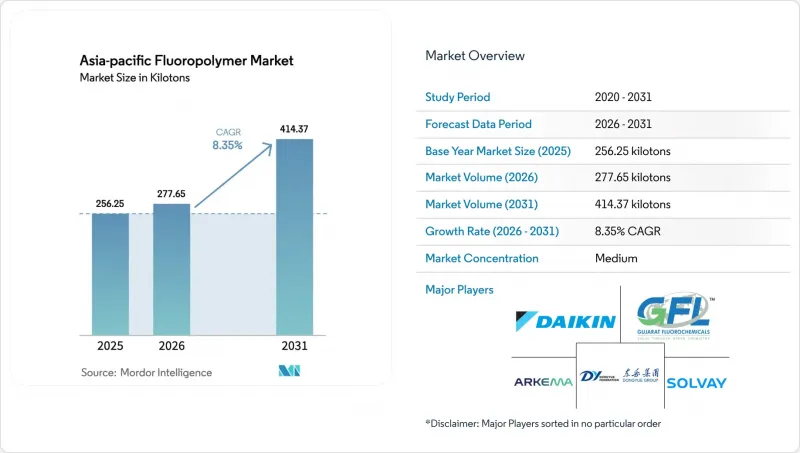
This report is Segmented by Sub-Resin Type (ETFE, FEP, PTFE, PVF, PVDF, and Other Sub-Resin Types), End-User Industry (Aerospace, Automotive, Building and Construction, Industrial and Machinery, and More), and Geography (China, India, Japan, South Korea, Australia, Malaysia, and Rest of Asia-Pacific). The Market Forecasts are Provided in Terms of Volume (Tons) and Value (USD).
Asia-Pacific Fluoropolymer Market Trends and Insights
EV-Grade PVDF Demand Surge from Asia's Battery Supply-Chain
Asia-Pacific's lithium-ion battery capacity reached 1,200 GWh in 2024, and China alone accounted for 850 GWh. This scale requires battery-grade PVDF for separators and binders that meet purity levels of under 500 ppm of metals, driving premiums of over 30% compared to industrial grades. CATL's plan to add 500 GWh by 2027 signals a widening supply gap that spurs capacity additions by Solvay in Changshu and Arkema across the region. Chinese producers such as Dongyue Group have earmarked dedicated high-purity PVDF lines to secure domestic demand and eventually displace imports. The ongoing race to localize raw materials for electric vehicles anchors the Asia-Pacific Fluoropolymer Market to long-term structural volume growth.
Electronics Miniaturization Driving High-Purity PTFE & FEP
The shift to 3-nanometer logic, advanced packaging, and high-frequency 5G modules intensifies the need for purity requirements below 10 ppb for consumables and films. Foundry giants in Taiwan and South Korea set stringent benchmarks that only a handful of fluoropolymer grades can satisfy. Premium pricing and low tolerance for contamination have encouraged Chemours and Daikin to ring-fence dedicated semiconductor-grade output, essentially quarantining these lines from bulk industrial streams. Malaysia and Thailand's contract manufacturers follow suit, adopting FEP films for flexible printed boards used in smartphones and automotive LiDAR. The Asia-Pacific Fluoropolymer Market, therefore, benefits from both top-end specification pull and volume ramp-up in the consumer electronics sector.
Volatile R-142b & R-22 Feedstock Availability
Montreal Protocol enforcement cut Chinese R-142b output by 60% since 2023, spiking prices 40% and disrupting small- and mid-tier fluoropolymer plants. Import dependence exposes producers to logistics shocks, while plant retrofits to non-ODS routes need 18-24 months. Integrated giants with captive HF units, including Chemours and Daikin, leverage backward integration to preserve margins, precipitating market consolidation. Short-term volatility affects order predictability and can delay downstream projects in the Asia-Pacific Fluoropolymer Market, particularly among electronics subcontractors that require just-in-time inventory management.
Other drivers and restraints analyzed in the detailed report include:
- Rapid Build-Out of Semiconductor Fabs in China & South Korea
- Construction Shift to ETFE/PVF Architectural Membranes
- Escalating PFAS Compliance Costs in Japan & Australia
For complete list of drivers and restraints, kindly check the Table Of Contents.
Segment Analysis
Polytetrafluoroethylene (PTFE) claimed 46.98% of the Asia-Pacific Fluoropolymer Market share in 2025, driven by its applications in high-temperature seals, automotive gaskets, and chemical-processing linings. Mature end-uses ensure baseline growth aligned with industrial output across China, India, and Southeast Asia. Meanwhile, polyvinylidene fluoride is expected to register the fastest growth, with a 19.34% CAGR to 2031, driven by the demand for lithium-ion battery separators and binders, which account for 70% of the global cell capacity in the region. The Asia-Pacific Fluoropolymer Market size for PVDF is projected to increase alongside the growth of electric vehicle penetration and the expansion of stationary storage installations. Fluorinated ethylene-propylene (FEP) gains moderate momentum in wire-and-cable insulation for hyperscale data centers, whereas ETFE growth is tied to architectural membranes and chemical-tank linings, which require elevated chemical resistance.
Historical comparisons underline the shift: PVDF's CAGR leapt from 12.8% during 2019-2024 to 19.34% through 2031. Polyvinyl fluoride strengthens via solar backsheets and facade films, while niche materials like perfluoroalkoxy and ECTFE carve a foothold in semiconductor wet benches and corrosion-prone pipelines. Regulatory pressure around PFAS persistence spurs R&D into modified PVDF architectures that degrade faster yet maintain electrochemical stability. Suppliers therefore allocate capital toward specialized grades with trace-metal thresholds under 100 ppb, positioning the Asia-Pacific Fluoropolymer Market for higher value capture per kilogram.
Complete Report Scope:
- By Sub-Resin Type
- Ethylenetetrafluoroethylene (ETFE)
- Fluorinated Ethylene-propylene (FEP)
- Polytetrafluoroethylene (PTFE)
- Polyvinyl Fluoride (PVF)
- Polyvinylidene Fluoride (PVDF)
- Other Sub-Resin Types
- By End-User Industry
- Aerospace
- Automotive
- Building and Construction
- Electrical and Electronics
- Industrial and Machinery
- Packaging
- Other End-user Industries
- By Geography
- China
- India
- Japan
- South Korea
- Australia
- Malaysia
- Rest of Asia-Pacific
List of Companies Covered in this Report:
- AGC Inc.
- Arkema
- Daikin Industries Ltd.
- Dongyue Group
- Gujarat Fluorochemicals Limited
- Halopolymer
- Kureha Corporation
- Shanghai Huayi 3F New Materials Co., Ltd.
- Sinochem Holdings
- Solvay
- Syensqo
- The Chemours Company
- Wuhan Everflon Fluoropolymers Co.,Ltd
Additional Benefits:
- The market estimate (ME) sheet in Excel format
- 3 months of analyst support
TABLE OF CONTENTS
1 Introduction
- 1.1 Study Assumptions & Market Definition
- 1.2 Scope of the Study
2 Research Methodology
3 Executive Summary
4 Market Landscape
- 4.1 Market Overview
- 4.2 Market Drivers
- 4.2.1 EV-grade PVDF demand surge from Asia's battery supply-chain
- 4.2.2 Electronics miniaturisation driving high-purity PTFE & FEP
- 4.2.3 Rapid build-out of semiconductor fabs in China & South Korea
- 4.2.4 Construction shift to ETFE/PVF architectural membranes
- 4.2.5 Sodium-ion battery separator pilots using modified PVDF
- 4.3 Market Restraints
- 4.3.1 Volatile R-142b & R-22 feedstock availability
- 4.3.2 Escalating PFAS compliance costs in Japan & Australia
- 4.3.3 Unplanned outages at key HF plants in Shandong
- 4.4 Value Chain Analysis
- 4.5 Porter's Five Forces
- 4.5.1 Threat of New Entrants
- 4.5.2 Bargaining Power of Suppliers
- 4.5.3 Bargaining Power of Buyers
- 4.5.4 Threat of Substitutes
- 4.5.5 Competitive Rivalry
- 4.6 End-use Sector Trends
- 4.6.1 Aerospace (Aerospace Component Production Revenue)
- 4.6.2 Automotive (Automobile Production)
- 4.6.3 Building and Construction (New Construction Floor Area)
- 4.6.4 Electrical and Electronics (Electrical and Electronics Production Revenue)
- 4.6.5 Packaging(Plastic Packaging Volume)
- 4.7 Import and Export Trends
- 4.8 Regulatory Framework
- 4.8.1 Australia
- 4.8.2 China
- 4.8.3 India
- 4.8.4 Japan
- 4.8.5 Malaysia
- 4.8.6 South Korea
5 Market Size & Growth Forecasts (Value and Volume)
- 5.1 By Sub-Resin Type
- 5.1.1 Ethylenetetrafluoroethylene (ETFE)
- 5.1.2 Fluorinated Ethylene-propylene (FEP)
- 5.1.3 Polytetrafluoroethylene (PTFE)
- 5.1.4 Polyvinyl Fluoride (PVF)
- 5.1.5 Polyvinylidene Fluoride (PVDF)
- 5.1.6 Other Sub-Resin Types
- 5.2 By End-User Industry
- 5.2.1 Aerospace
- 5.2.2 Automotive
- 5.2.3 Building and Construction
- 5.2.4 Electrical and Electronics
- 5.2.5 Industrial and Machinery
- 5.2.6 Packaging
- 5.2.7 Other End-user Industries
- 5.3 By Geography
- 5.3.1 China
- 5.3.2 India
- 5.3.3 Japan
- 5.3.4 South Korea
- 5.3.5 Australia
- 5.3.6 Malaysia
- 5.3.7 Rest of Asia-Pacific
6 Competitive Landscape
- 6.1 Market Concentration
- 6.2 Strategic Moves
- 6.3 Market Share (%)**/Ranking Analysis
- 6.4 Company Profiles (includes Global level Overview, Market level overview, Core Segments, Financials as available, Strategic Information, Market Rank/Share for key companies, Products & Services, and Recent Developments)
- 6.4.1 AGC Inc.
- 6.4.2 Arkema
- 6.4.3 Daikin Industries Ltd.
- 6.4.4 Dongyue Group
- 6.4.5 Gujarat Fluorochemicals Limited
- 6.4.6 Halopolymer
- 6.4.7 Kureha Corporation
- 6.4.8 Shanghai Huayi 3F New Materials Co., Ltd.
- 6.4.9 Sinochem Holdings
- 6.4.10 Solvay
- 6.4.11 Syensqo
- 6.4.12 The Chemours Company
- 6.4.13 Wuhan Everflon Fluoropolymers Co.,Ltd
7 Market Opportunities & Future Outlook
- 7.1 White-space & Unmet-Need Assessment
8 Key Strategic Questions for CEOs

