PUBLISHER: Mordor Intelligence | PRODUCT CODE: 2100747

PUBLISHER: Mordor Intelligence | PRODUCT CODE: 2100747
Europe Polyether Ether Ketone (PEEK) - Market Share Analysis, Industry Trends & Statistics, Growth Forecasts (2026 - 2031)
According to Mordor Intelligence, Europe polyether ether ketone market size in 2026 is estimated at 3.22 kilotons, growing from 2025 value of 3.07 kilotons with 2031 projections showing 4.1 kilotons, growing at 4.92% CAGR over 2026-2031.
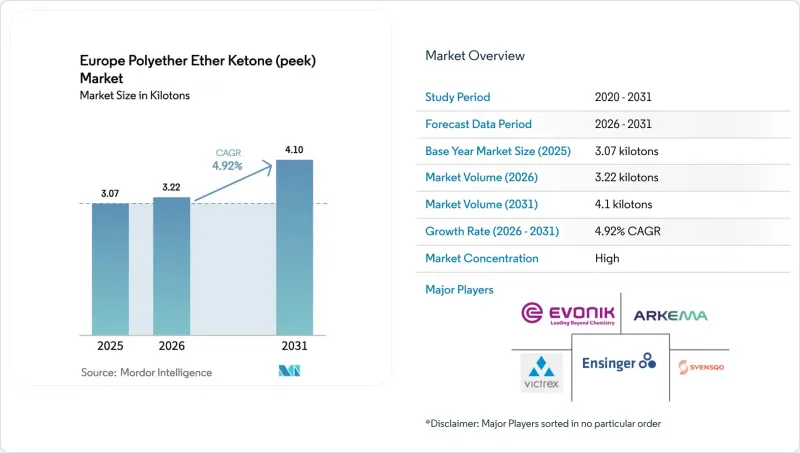
This report is Segmented by End-User Industry (Aerospace, Automotive, Electrical and Electronics, Industrial and Machinery, and Other End-User Industries), Reinforcement (Unfilled, Glass-Filled, Carbon-Filled, and Other), and Geography (Germany, France, United Kingdom, Italy, Russia, and Rest of Europe). The Market Forecasts are Provided in Terms of Volume (Tons) and Value (USD).
Europe Polyether Ether Ketone (PEEK) Market Trends and Insights
Robust EU Aerospace Production Resurgence
European OEMs restarted wide-body and narrow-body programs in 2024, fueling record orders for thermoplastic composites. Airbus raised monthly A320neo output targets, while Boeing qualified Syensqo's KetaSpire PEEK for secondary structures. Airframe suppliers now specify PEEK brackets, clamps, and electrical insulation systems because each kilogram trimmed translates to lower fuel burn. Defense contractors follow suit, adopting PEEK in helicopter rotor components and satellite subsystems. This trend revives demand across Germany and France, the region's twin aerospace hubs.
Accelerated EV Component Lightweighting Push
Europe's 2035 internal-combustion phase-out accelerates the use of lightweight parts. Evonik developed high-torque PEEK gears that cut drivetrain mass by 60% versus steel. Syensqo's Ajedium PEEK film boosts e-motor efficiency by enabling higher slot fill factors in magnet wire insulation. Battery housings, busbars, and coolant manifolds also migrate to PEEK to withstand electrolytes and repeated charge cycles. German automakers account for the bulk of this incremental volume, but French and Spanish plants are rapidly certifying similar designs.
EU REACH Red-tape for High-temperature Polymers
Polymer microparticle rules add reporting layers that lift compliance budgets 15-20% for PEEK producers. Smaller firms struggle to finance toxicological dossiers, cementing incumbent advantages. OEM design cycles also lengthen as suppliers compile safety data across aerospace, medical, and electronics contexts. Nonetheless, PEEK's halogen-free profile helps end-users meet substance restrictions more readily than fluorinated alternatives.
Other drivers and restraints analyzed in the detailed report include:
- Miniaturization in High-Frequency 5G Electronics
- Shift Toward Metal-free Surgical Implants
- Volatile Fluoro-aromatic Precursor Prices
For complete list of drivers and restraints, kindly check the Table Of Contents.
Segment Analysis
Industrial machinery represented 34.88% of the European PEEK market in 2025, reflecting widespread use in pumps, valves, and chemical-processing components that face 250 °C fluids. This segment's installed base creates repeat-purchase demand for replacement parts, anchoring overall tonnage. The aerospace category, although smaller, achieves the highest 5.67% CAGR as OEMs convert metallic clips and brackets to PEEK composites for fuel-efficiency gains. Automotive applications gain momentum from battery-electric models, with PEEK gears and e-axle bearings extending drivetrain life under high torque.
Electrical and electronics consumption scales gradually alongside 5G rollout. Medical devices contribute to a fast-growing niche, exemplified by 3D-printed patient-specific implants scheduled for wider EU adoption by 2026. The European PEEK market size for medical devices is poised to expand as hospital purchasing committees emphasize biocompatibility and MRI clarity.
Complete Report Scope:
- By End-User Industry
- Aerospace
- Automotive
- Electrical and Electronics
- Industrial and Machinery
- Other End-User Industries
- By Reinforcement
- Unfilled
- Glass-filled
- Carbon-filled
- Other
- By Geography
- Germany
- France
- United Kingdom
- Italy
- Russia
- Rest of Europe
List of Companies Covered in this Report:
- Arkema
- BARLOG Plastics GmbH
- Celanese Corporation
- Ensinger GmbH
- Essentra Components
- Evonik Industries AG
- Jilin Joinature Polymer Co., Ltd.
- Mitsubishi Chemical Group
- Pan Jin Zhongrun High Performance Polymer Co., Ltd.
- Rochling
- RTP Company
- SABIC
- Syensqo
- Toray Industries Inc.
- Victrex plc
- Zhejiang Pfluon Technology Co., Ltd.
Additional Benefits:
- The market estimate (ME) sheet in Excel format
- 3 months of analyst support
TABLE OF CONTENTS
1 Introduction
- 1.1 Study Assumptions and Market Definition
- 1.2 Scope of the Study
2 Research Methodology
3 Executive Summary
4 Market Landscape
- 4.1 Market Overview
- 4.2 Market Drivers
- 4.2.1 Robust EU aerospace production resurgence
- 4.2.2 Accelerated EV component light-weighting push
- 4.2.3 Miniaturisation in high-frequency 5G electronics
- 4.2.4 Shift toward metal-free surgical implants
- 4.2.5 OEM demand for chemical-resistant process line parts
- 4.3 Market Restraints
- 4.3.1 EU REACH red-tape for high-temperature polymers
- 4.3.2 Volatile fluoro-aromatic precursor prices
- 4.3.3 Emerging bio-based PPS substitutes
- 4.4 Value Chain Analysis
- 4.5 Porter's Five Forces
- 4.5.1 Threat of New Entrants
- 4.5.2 Bargaining Power of Suppliers
- 4.5.3 Bargaining Power of Buyers
- 4.5.4 Threat of Substitutes
- 4.5.5 Competitive Rivalry
- 4.6 Regulatory Landscape
- 4.6.1 EU
- 4.6.2 France
- 4.6.3 Germany
- 4.6.4 Italy
- 4.6.5 Russia
- 4.6.6 United Kingdom
- 4.7 End-use Sector Trends
- 4.7.1 Aerospace (Aerospace Component Production Revenue)
- 4.7.2 Automotive (Automobile Production)
- 4.7.3 Building and Construction (New Construction Floor Area)
- 4.7.4 Electrical and Electronics (Electrical and Electronics Production Revenue)
- 4.7.5 Packaging(Plastic Packaging Volume)
5 Market Size and Growth Forecasts (Value and Volume)
- 5.1 By End-User Industry
- 5.1.1 Aerospace
- 5.1.2 Automotive
- 5.1.3 Electrical and Electronics
- 5.1.4 Industrial and Machinery
- 5.1.5 Other End-User Industries
- 5.2 By Reinforcement
- 5.2.1 Unfilled
- 5.2.2 Glass-filled
- 5.2.3 Carbon-filled
- 5.2.4 Other
- 5.3 By Geography
- 5.3.1 Germany
- 5.3.2 France
- 5.3.3 United Kingdom
- 5.3.4 Italy
- 5.3.5 Russia
- 5.3.6 Rest of Europe
6 Competitive Landscape
- 6.1 Market Concentration
- 6.2 Strategic Moves
- 6.3 Market Share (%)/Ranking Analysis
- 6.4 Company Profiles (includes Global level Overview, Market level overview, Core Segments, Financials as available, Strategic Information, Market Rank/Share for key companies, Products and Services, and Recent Developments)
- 6.4.1 Arkema
- 6.4.2 BARLOG Plastics GmbH
- 6.4.3 Celanese Corporation
- 6.4.4 Ensinger GmbH
- 6.4.5 Essentra Components
- 6.4.6 Evonik Industries AG
- 6.4.7 Jilin Joinature Polymer Co., Ltd.
- 6.4.8 Mitsubishi Chemical Group
- 6.4.9 Pan Jin Zhongrun High Performance Polymer Co., Ltd.
- 6.4.10 Rochling
- 6.4.11 RTP Company
- 6.4.12 SABIC
- 6.4.13 Syensqo
- 6.4.14 Toray Industries Inc.
- 6.4.15 Victrex plc
- 6.4.16 Zhejiang Pfluon Technology Co., Ltd.
7 Market Opportunities and Future Outlook
- 7.1 White-space and Unmet-Need Assessment
8 Key Strategic Questions for CEOs

