PUBLISHER: Mordor Intelligence | PRODUCT CODE: 2100748

PUBLISHER: Mordor Intelligence | PRODUCT CODE: 2100748
Asia-Pacific Polyether Ether Ketone (PEEK) - Market Share Analysis, Industry Trends & Statistics, Growth Forecasts (2026 - 2031)
According to Mordor Intelligence, the Asia-Pacific polyether ether ketone market size was valued at 3.55 kilotons in 2025 and estimated to grow from 3.74 kilotons in 2026 to reach 4.89 kilotons by 2031, at a CAGR of 5.47% during the forecast period (2026-2031).
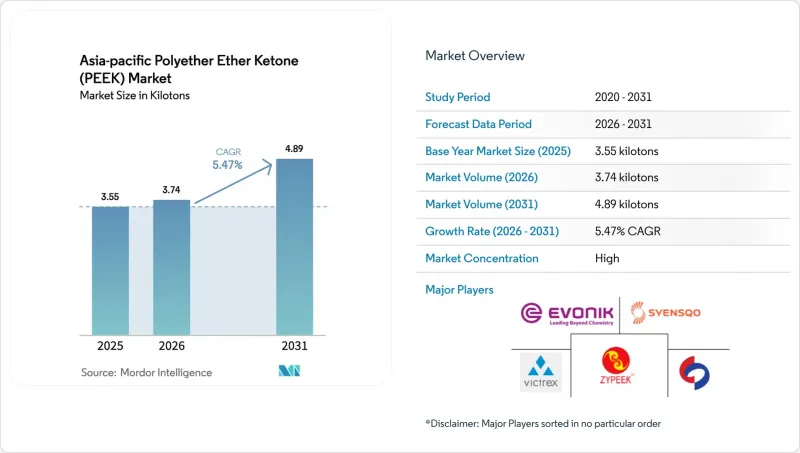
This report is Segmented by End-User Industry (Aerospace, Automotive, Electrical and Electronics, Industrial and Machinery, and Others), Reinforcement (Unfilled, Glass-Filled, Carbon-Filled, and Other), and Geography (China, India, Japan, South Korea, Malaysia, Australia, and Rest of Asia-Pacific). The Market Forecasts are Provided in Terms of Volume (Tons) and Value (USD).
Asia-Pacific Polyether Ether Ketone (PEEK) Market Trends and Insights
Electronics and Semiconductor Capacity Boom
Semiconductor fabs across China, South Korea, and Japan add multiple 300 mm lines, each consuming several tonnes of ultra-high-purity PEEK for CMP retaining rings, wafer carriers, and plasma-etch fixtures. Government incentive packages accelerate greenfield projects, while fab toolmakers specify PEEK for thermal stability above 250 °C and dimensional retention under corrosive chemistries. On-board 800 V EV inverter designs also capitalize on PEEK's dielectric profile, reinforcing demand synergies between automotive and chip industries. Rapid commissioning timelines favor localized resin supply, tightening the link between electronic capital expenditure and near-term volume gains for the Asia-Pacific PEEK market. Materials suppliers that certify contamination-free grades capture sticky qualification positions, thereby embedding long-run offtake.
Lightweighting Push in Aerospace and Automotive
Asia-Pacific carriers ordered 1,365 aircraft in 2023, exceeding the prior year by 133%, and each single-aisle platform integrates 20-25 kg of PEEK across brackets, ducts, and seat structures to cut fuel burn. Electric vehicle makers in China, Japan, and South Korea substitute metal for carbon-filled PEEK in battery housings and e-motor insulation, shaving 1-2 kg per vehicle without compromising crash integrity. OEMs report that a 10% weight reduction in propulsion components can extend EV range by roughly 5%, enhancing regulatory compliance and consumer acceptance. Composite leaf springs, thermal-runaway shields, and power-electronics mounts now routinely specify PEEK, pushing the Asia-Pacific PEEK market toward higher-margin formulations. As aerospace recovery sustains double-digit growth in Asia, lightweighting remains a long-cycle catalyst for continuous volume escalation.
High Resin and Processing Cost
Even after the recent decline, unfilled PEEK resin trades at a premium multiple times that of standard engineering plastics because DFBP synthesis requires high-temperature fluorination and strict moisture control. Injection processors must run barrel temperatures above 400 °C, consuming 10-15% more energy than polyamide molding, and screw metallurgy upgrades add capital cost. Price sensitivity caps adoption in commodity housings, leaving the Asia-Pacific PEEK market focused on mission-critical applications that justify elevated cost through performance or weight savings. Tier-2 OEMs with low volume often delay material switchovers until resin price volatility stabilizes. Cost remains the most immediate brake on widespread substitution despite unit costs inching downward on domestic expansions.
Other drivers and restraints analyzed in the detailed report include:
- Growth in Medical Implants and Devices
- Local Chinese Capacity Expansions Lowering Cost
- Stringent Medical/Aerospace Certification
For complete list of drivers and restraints, kindly check the Table Of Contents.
Segment Analysis
The industrial and machinery segments led with a 26.88% share of the Asia-Pacific PEEK market in 2025, driven by chemical plant retrofits and factory automation investments that favor long-life, self-lubricating materials. Robotics, compressor seals, and centrifugal pump wear rings exemplify applications where downtime costs dwarf resin premiums. Yet automotive parts show the highest 5.99% CAGR to 2031 because EV powertrains expose components to 180 °C-200 °C continuous temperatures and aggressive coolants that exceed the capabilities of PPS or PA. Busbars made from PEEK carry 800 V loads while remaining lightweight and corrosion-free, and battery-module side plates insulate against thermal runaway.
Electronics and semiconductor tooling maintain strong single-digit expansion, adding stable baseline volume to the Asia-Pacific PEEK market. Aerospace remains a strategic beachhead, and medical devices absorb specialized high-margin grades such as radiopaque barium-sulfate-loaded PEEK for trauma screws. In downstream verticals where regulatory barriers loom, close teamwork between resin suppliers and OEMs accelerates qualification, but the payoff includes multi-year exclusivity and sticky EBITDA streams. Across sectors, convergence of electrification, automation, and sustainability themes keeps the addressable opportunity set expanding well past 2031.
Complete Report Scope:
- By End-User Industry
- Aerospace
- Automotive
- Electrical and Electronics
- Industrial and Machinery
- Other End-User Industries
- By Reinforcement
- Unfilled
- Glass-filled
- Carbon-filled
- Other
- By Geography
- China
- India
- Japan
- South Korea
- Malaysia
- Australia
- Rest of Asia-Pacific
List of Companies Covered in this Report:
- Arkema
- Celanese Corporation
- Ensinger
- Essentra Components
- Evonik Industries AG
- JiangSu JunHua HPP Co., Ltd.
- Jilin Joinature Polymer Co., Ltd.
- Kingfa Sci & Tech Co., Ltd.
- Pan Jin Zhongrun High Performance Polymer Co., Ltd.
- PBI Advanced Materials Co., Ltd.
- RTP Company
- Shandong Haoran Special Plastic Co., Ltd.
- Syensqo
- the Mitsubishi Chemical Group of companies
- TORAY INDUSTRIES, INC.
- Victrex plc
- Zhejiang Pfluon Technology Co., Ltd.
- Zhongyan High Performance Materials Co., Ltd.
- Zibo Bainaisi Chemical Co.,Ltd
Additional Benefits:
- The market estimate (ME) sheet in Excel format
- 3 months of analyst support
TABLE OF CONTENTS
1 Introduction
- 1.1 Study Assumptions and Market Definition
- 1.2 Scope of the Study
2 Research Methodology
3 Executive Summary
4 Market Landscape
- 4.1 Market Overview
- 4.2 Market Drivers
- 4.2.1 Lightweighting push in aerospace and automotive
- 4.2.2 Electronics and semiconductor capacity boom
- 4.2.3 Growth in medical implants and devices
- 4.2.4 Local Chinese capacity expansions lowering cost
- 4.2.5 China "New Materials" localisation incentives
- 4.3 Market Restraints
- 4.3.1 High resin and processing cost
- 4.3.2 Stringent medical/aerospace certification
- 4.3.3 Volatile DFBP feedstock supply
- 4.4 Value Chain Analysis
- 4.5 Porter's Five Forces
- 4.5.1 Threat of New Entrants
- 4.5.2 Bargaining Power of Suppliers
- 4.5.3 Bargaining Power of Buyers
- 4.5.4 Threat of Substitutes
- 4.5.5 Competitive Rivalry
- 4.6 Regulatory Landscape
- 4.6.1 Australia
- 4.6.2 China
- 4.6.3 India
- 4.6.4 Japan
- 4.6.5 Malaysia
- 4.6.6 South Korea
- 4.7 End-use Sector Trends
- 4.7.1 Aerospace (Aerospace Component Production Revenue)
- 4.7.2 Automotive (Automobile Production)
- 4.7.3 Building and Construction (New Construction Floor Area)
- 4.7.4 Electrical and Electronics (Electrical and Electronics Production Revenue)
- 4.7.5 Packaging(Plastic Packaging Volume)
5 Market Size and Growth Forecasts (Value and Volume)
- 5.1 By End-User Industry
- 5.1.1 Aerospace
- 5.1.2 Automotive
- 5.1.3 Electrical and Electronics
- 5.1.4 Industrial and Machinery
- 5.1.5 Other End-User Industries
- 5.2 By Reinforcement
- 5.2.1 Unfilled
- 5.2.2 Glass-filled
- 5.2.3 Carbon-filled
- 5.2.4 Other
- 5.3 By Geography
- 5.3.1 China
- 5.3.2 India
- 5.3.3 Japan
- 5.3.4 South Korea
- 5.3.5 Malaysia
- 5.3.6 Australia
- 5.3.7 Rest of Asia-Pacific
6 Competitive Landscape
- 6.1 Market Concentration
- 6.2 Strategic Moves
- 6.3 Market Share (%)/Ranking Analysis
- 6.4 Company Profiles (includes Global level Overview, Market level overview, Core Segments, Financials as available, Strategic Information, Market Rank/Share for key companies, Products and Services, and Recent Developments)
- 6.4.1 Arkema
- 6.4.2 Celanese Corporation
- 6.4.3 Ensinger
- 6.4.4 Essentra Components
- 6.4.5 Evonik Industries AG
- 6.4.6 JiangSu JunHua HPP Co., Ltd.
- 6.4.7 Jilin Joinature Polymer Co., Ltd.
- 6.4.8 Kingfa Sci & Tech Co., Ltd.
- 6.4.9 Pan Jin Zhongrun High Performance Polymer Co., Ltd.
- 6.4.10 PBI Advanced Materials Co., Ltd.
- 6.4.11 RTP Company
- 6.4.12 Shandong Haoran Special Plastic Co., Ltd.
- 6.4.13 Syensqo
- 6.4.14 the Mitsubishi Chemical Group of companies
- 6.4.15 TORAY INDUSTRIES, INC.
- 6.4.16 Victrex plc
- 6.4.17 Zhejiang Pfluon Technology Co., Ltd.
- 6.4.18 Zhongyan High Performance Materials Co., Ltd.
- 6.4.19 Zibo Bainaisi Chemical Co.,Ltd
7 Market Opportunities and Future Outlook
- 7.1 White-space and Unmet-Need Assessment
8 Key Strategic Questions for CEOs

