PUBLISHER: Mordor Intelligence | PRODUCT CODE: 2113225

PUBLISHER: Mordor Intelligence | PRODUCT CODE: 2113225
US Hospitality Real Estate - Market Share Analysis, Industry Trends & Statistics, Growth Forecasts (2026 - 2031)
According to Mordor Intelligence, the USA hospitality real estate market size is expected to grow from USD 1.03 trillion in 2025 to USD 1.08 trillion in 2026 and is forecast to reach USD 1.39 trillion by 2031 at 5.11% CAGR over 2026-2031.
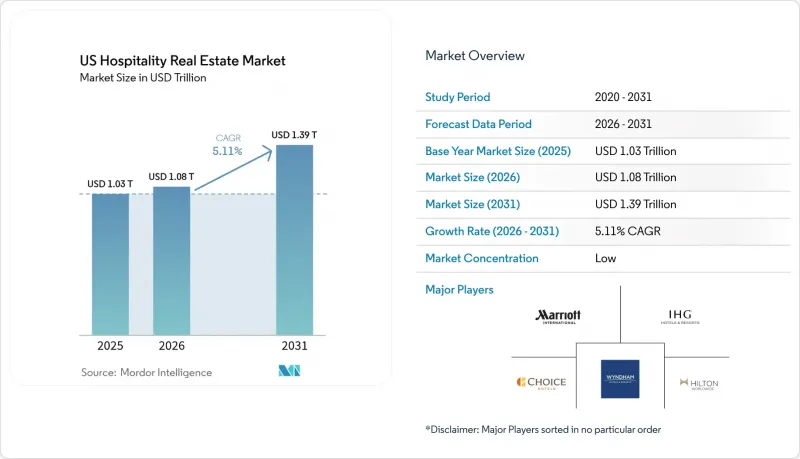
This report is Segmented by Property Type (Hotels, Resorts & Spas, Others), by Type (Chain Hotels, Independent Hotels), by Asset Class (Affordable/Budget, Midscale, Luxury), and by Geography (Texas, California, Florida, New York, Illinois, Rest of US). The Market Forecasts are Provided in Terms of Value (USD).
US Hospitality Real Estate Market Trends and Insights
Leisure, Business, and "Bleisure" Travel Recovery Sustaining RevPAR and Occupancy in Core Markets
The convergence of leisure travel demand and the gradual recovery of corporate travel itineraries is fostering extended "bleisure" stays. These stays are diminishing the distinction between weekdays and weekends, contributing to an increase in average daily rates. In January 2025, RevPAR recorded a year-on-year growth of 4.5%. Urban room supply is anticipated to surpass suburban supply with an additional 2.8% growth. The resurgence of group business is evident in Marriott's improved food-and-beverage revenue from convention bookings. Hospitality operators who successfully attract flexible workers for mid-week stays are achieving more consistent cash flows and optimized labor scheduling. The continuation of these positive trends will depend on the pace at which global corporate travel budgets stabilize and the persistence of hybrid work models.
Strength of Select-Service and Extended-Stay Formats Underpinning Development Pipelines
Amid 10-12% construction debt costs, developers are increasingly prioritizing select-service and extended-stay hotel formats. These models require lower capital investment per key, operate with streamlined staffing structures, and deliver strong profit margins. As of early 2025, approximately 157,000 hotel rooms were under construction across the United States, with a substantial share concentrated in these segments. Marriott's USD 355 million acquisition of citizenM, along with its licensing agreement with Sonder, is set to add nearly 19,000 technologically advanced rooms, catering to the preferences of digitally oriented travelers. Sun Belt metropolitan areas, including Phoenix, Charlotte, and Nashville, continue to attract these developments due to competitive land costs and favorable demographic trends.
Labor Shortages and Wage Inflation Pressuring Operating Margins
Hotels are still short by about 190,000 positions compared to their 2019 headcount and are resorting to higher wages to attract talent. In 2023, the sector's average hourly wage hit USD 17.16, marking a 26.7% increase since the pandemic. This wage hike has compelled operators to boost productivity in housekeeping and adopt digital check-in processes. By 2025, total payroll expenses are set to near USD 128.47 billion, consuming a significant portion of the revenue gains from Average Daily Rate (ADR) increases. While industry groups push for larger visa quotas and more apprenticeship incentives, the persistent workforce gaps indicate that elevated compensation has become the norm. This trend is particularly straining the margins of midscale and economy segments.
Other drivers and restraints analyzed in the detailed report include:
- Data-Driven Revenue Management and Loyalty Ecosystems Enhancing Yield Optimization
- Brand Conversions and Repositioning Improving NOI and Asset Competitiveness
- High Construction Costs and Financing Rates Slowing New Project Starts
For complete list of drivers and restraints, kindly check the Table Of Contents.
Segment Analysis
In 2025, hotels held 71.45% of the U.S. hospitality real estate market, driven by strong brand equity, distribution networks, and operational efficiency. The remaining market share was split among resorts, spas, conference centers, and the "Others" category, which includes serviced apartments and boutique accommodations. The "Others" segment, growing at a 5.62% CAGR, is projected to account for 12.5% of new supply by 2031, fueled by demand for unique ambiances and flexible layouts. Major hotel chains are leasing inventory to operators like Sonder and enhancing loyalty programs to attract new customers. Traditional hotels retain pricing power, optimizing rates during peak periods to sustain revenue dominance.
Alternative accommodations are gaining traction, but hotels' pricing resilience supports cash flows. Resorts and spas benefit from wellness tourism and affluent leisure travel, with Host Hotels & Resorts investing over USD 400 million in 2025 to upgrade spa, dining, and sustainability offerings. The "Others" segment's growth reflects a shift toward longer stays and home-like amenities, boosting mid-term rentals in urban markets. Investors monitor income volatility across segments, noting traditional hotels' stronger weekday occupancy and serviced apartments' consistent weekend and extended-stay performance.
Complete Report Scope:
- By Property Type
- Hotels
- Resorts & Spas
- Others (Serviced Apartments, boutique inns, etc)
- By Type
- Chain Hotels
- Independent Hotels
- By Asset Class
- Affordable/Budget
- Midscale
- Luxury
- By States
- Texas
- California
- Florida
- New York
- Illinois
- Rest of US
List of Companies Covered in this Report:
- Marriott International
- Hilton Worldwide Holdings
- IHG Hotels & Resorts
- Wyndham Hotels & Resorts
- Choice Hotels International
- Hyatt Hotels Corporation
- Best Western (BWH) Hotels
- RLH Corporation
- G6 Hospitality
- Host Hotels & Resorts
- Park Hotels & Resorts
- Pebblebrook Hotel Trust
- Apple Hospitality REIT
- Xenia Hotels & Resorts
- RLJ Lodging Trust
- Ashford Hospitality Trust
- DiamondRock Hospitality
- Aimbridge Hospitality
- Brookfield Asset Management - Hospitality
- Blackstone Real Estate - Hospitality
Additional Benefits:
- The market estimate (ME) sheet in Excel format
- 3 months of analyst support
TABLE OF CONTENTS
1 Introduction
- 1.1 Study Assumptions & Market Definition
- 1.2 Scope of the Study
2 Research Methodology
3 Executive Summary
4 Market Insights and Dynamics
- 4.1 Market Overview
- 4.2 Market Drivers
- 4.2.1 Leisure, business, and "bleisure" travel recovery sustaining RevPAR and occupancy in core markets
- 4.2.2 Strength of select-service and extended-stay formats underpinning development pipelines
- 4.2.3 Brand conversions and repositionings improving NOI and asset competitiveness
- 4.2.4 Data-driven revenue management and loyalty ecosystems enhancing yield optimization
- 4.2.5 Adaptive reuse (office/retail to hotel) creating accretive supply in urban cores
- 4.3 Market Restraints
- 4.3.1 Labor shortages and wage inflation pressuring operating margins
- 4.3.2 High construction costs and financing rates slowing new project starts
- 4.3.3 Demand sensitivity to macro uncertainty and corporate travel normalization cycles
- 4.4 Value / Supply-Chain Analysis
- 4.5 Regulatory & Policy Landscape
- 4.6 Technological Outlook
- 4.7 ESG & Sustainability Imperatives
- 4.8 Investments (Real Estate, FDI and Others) in Hospitality Industry
- 4.9 Porter's Five Forces
- 4.9.1 Bargaining Power of Suppliers
- 4.9.2 Bargaining Power of Buyers
- 4.9.3 Threat of New Entrants
- 4.9.4 Threat of Substitutes
- 4.9.5 Intensity of Competitive Rivalry
5 Market Size & Growth Forecasts (Value,USD)
- 5.1 By Property Type
- 5.1.1 Hotels
- 5.1.2 Resorts & Spas
- 5.1.3 Others (Serviced Apartments, boutique inns, etc)
- 5.2 By Type
- 5.2.1 Chain Hotels
- 5.2.2 Independent Hotels
- 5.3 By Asset Class
- 5.3.1 Affordable/Budget
- 5.3.2 Midscale
- 5.3.3 Luxury
- 5.4 By States
- 5.4.1 Texas
- 5.4.2 California
- 5.4.3 Florida
- 5.4.4 New York
- 5.4.5 Illinois
- 5.4.6 Rest of US
6 Competitive Landscape
- 6.1 Market Concentration
- 6.2 Strategic Moves
- 6.3 Company Profiles (includes Global level Overview, Market level overview, Core Segments, Financials as available, Strategic Information, and Recent Developments)
- 6.3.1 Marriott International
- 6.3.2 Hilton Worldwide Holdings
- 6.3.3 IHG Hotels & Resorts
- 6.3.4 Wyndham Hotels & Resorts
- 6.3.5 Choice Hotels International
- 6.3.6 Hyatt Hotels Corporation
- 6.3.7 Best Western (BWH) Hotels
- 6.3.8 RLH Corporation
- 6.3.9 G6 Hospitality
- 6.3.10 Host Hotels & Resorts
- 6.3.11 Park Hotels & Resorts
- 6.3.12 Pebblebrook Hotel Trust
- 6.3.13 Apple Hospitality REIT
- 6.3.14 Xenia Hotels & Resorts
- 6.3.15 RLJ Lodging Trust
- 6.3.16 Ashford Hospitality Trust
- 6.3.17 DiamondRock Hospitality
- 6.3.18 Aimbridge Hospitality
- 6.3.19 Brookfield Asset Management - Hospitality
- 6.3.20 Blackstone Real Estate - Hospitality
7 Market Opportunities & Future Outlook
- 7.1 White-space & Unmet-Need Assessment

