PUBLISHER: Mordor Intelligence | PRODUCT CODE: 2113491

PUBLISHER: Mordor Intelligence | PRODUCT CODE: 2113491
United Kingdom Hospitality Real Estate - Market Share Analysis, Industry Trends & Statistics, Growth Forecasts (2026 - 2031)
According to Mordor Intelligence, the United Kingdom hospitality real estate market size was valued at USD 81.23 billion in 2025 and estimated to grow from USD 84.57 billion in 2026 to reach USD 103.41 billion by 2031, at a CAGR of 4.11% during the forecast period (2026-2031).
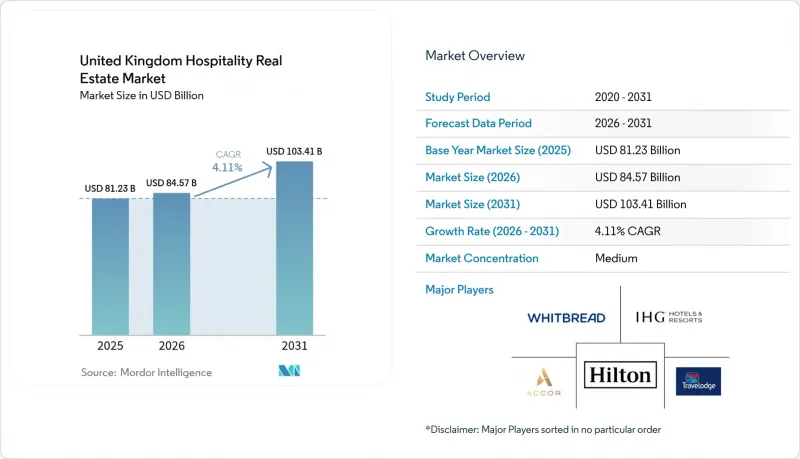
This report is Segmented by Property Type (Hotels, Resorts & Spas, Others), by Type (Chain Hotels, Independent Hotels), by Asset Class (Affordable/Budget, Midscale, Luxury), and by Geography (England, Scotland, Wales, Northern Ireland). The Market Forecasts are Provided in Terms of Value (USD).
United Kingdom Hospitality Real Estate Market Trends and Insights
International Tourism Rebound Elevating Occupancy and RevPAR
International visits are recovering toward pre-pandemic peaks, with 43.4 million arrivals projected for 2025, a level that channels higher-value travelers into luxury and upscale hotels. Quarter-on-quarter volatility persists, yet spend per guest keeps rising, enhancing RevPAR resilience. Airport-gateway markets benefit most from the lift in inbound demand, especially around major sporting and cultural events that spike short-stay bookings. Operators are refining price-optimization algorithms to capture this uplift without eroding brand loyalty. Sustained high-spend international demand has become the cornerstone of revenue strategy, cushioning domestic softness.
Flight Capacity Rebuild and Visa Easing Boosting Long-Haul Demand
Seat capacity on long-haul routes returned faster than intra-European services, funneling travelers through Heathrow, Gatwick, and Edinburgh. Eased visa processing for tourism and seasonal work further supports booking lead-times. Hotel brands have rushed to open or flag conversions near transport hubs, as illustrated by Hilton's 157-room Heathrow property. Budget-friendly select-service formats positioned near rail and air nodes now capture price-sensitive travelers seeking convenience. Sustained capacity growth combined with favorable exchange rates should prolong this demand tailwind over the next two years.
High Financing Costs and Stricter Underwriting
Commercial real estate lending shrank 9.8% as lenders raised coverage ratios and cut leverage, inflating equity requirements for new deals. Debt funds fill the gap yet price 200-250 bps over bank margins. Prolonged diligence elongates closing timelines, discouraging speculative projects. Only scale portfolios like KKR-Baupost's 6,500-key Marriott acquisition can secure favorable structures. Smaller sponsors thus shelve pipelines until rates ease, muting near-term transaction volume.
Other drivers and restraints analyzed in the detailed report include:
- Experiential, Lifestyle, and Extended-Stay Formats Attracting Institutional Capital
- Asset Conversions of Retail and Offices to Lodging Uses
- Construction Inflation and Supply-Chain Delays
For complete list of drivers and restraints, kindly check the Table Of Contents.
Segment Analysis
Hotels accounted for 68.55% of the United Kingdom hospitality real estate market share in 2025, maintaining primacy because chains deliver distribution scale and loyalty capture. Serviced apartments, however, are forecast to post a 4.53% CAGR, the fastest within the category, as remote work and corporate relocations lengthen average stay. Dalata's 834-room UK expansion illustrates how operators layer apartment-style rooms onto select-service footprints for flexibility. Conversions of vacant offices in London and Edinburgh into aparthotels shorten development cycles and lower embodied-carbon, making the model attractive to institutional owners seeking stable yields.
Resorts and spas remain a niche concentrated in rural Wales and coastal England, where performance correlates with leisure demand swings. Yet, upscale countryside spas benefit from wellness tourism that supports higher average daily rates. Hotels confront margin pressure from labor and energy costs, prompting adoption of energy-management tech and partial service concepts. Serviced apartments mitigate that risk by operating with lower staffing ratios and capturing ancillary revenue from co-working leases, positioning the sub-segment for sustained outperformance.
Complete Report Scope:
- By Property Type
- Hotels
- Resorts & Spas
- Others (Serviced Apartments, Boutique Inns, etc.)
- By Type
- Chain Hotels
- Independent Hotels
- By Asset Class
- Affordable/Budget
- Midscale
- Luxury
- By Country
- England
- London
- Rest of England
- Scotland
- Wales
- Northern Ireland
- England
List of Companies Covered in this Report:
- Whitbread PLC (Premier Inn)
- InterContinental Hotels Group PLC
- Accor SA
- Hilton Worldwide Holdings Inc.
- Travelodge Hotels Ltd.
- Marriott International Inc.
- Choice Hotels International Inc.
- Dalata Hotel Group PLC
- PPHE Hotel Group Ltd.
- Britannia Hotels Ltd.
- Edwardian Hotels London
- Red Carnation Hotels
- Ennismore
- Greene King PLC (Inns & Hotels)
- L+R Hotels (London & Regional)
- LRC Group
- Covivio Hotels SCA
- Brookfield Asset Management - Hospitality
- Vivion Capital Partners
- Blackstone Real Estate - Hospitality
Additional Benefits:
- The market estimate (ME) sheet in Excel format
- 3 months of analyst support
TABLE OF CONTENTS
1 Introduction
- 1.1 Study Assumptions & Market Definition
- 1.2 Scope of the Study
2 Research Methodology
3 Executive Summary
4 Market Landscape
- 4.1 Market Overview
- 4.2 Market Drivers
- 4.2.1 International tourism recovery and events-driven travel (concerts, sports) boosting occupancy and RevPAR.
- 4.2.2 Flight capacity rebuild and visa policy tweaks supporting inbound long-haul demand.
- 4.2.3 Experiential, lifestyle, and extended-stay concepts outperforming, attracting institutional capital.
- 4.2.4 Asset repositioning: converting underperforming retail/offices into hotels and aparthotels.
- 4.2.5 Sustainability upgrades (energy efficiency, heat pumps) improving NOI and access to green financing.
- 4.3 Market Restraints
- 4.3.1 High financing costs and tighter underwriting slowing deals and new development starts.
- 4.3.2 Construction inflation and supply-chain delays elevating capex for refurbishments.
- 4.3.3 Labor shortages and wage pressure challenging service delivery and margins
- 4.4 Value / Supply-Chain Analysis
- 4.5 Regulatory Landscape
- 4.6 Technological Outlook
- 4.7 Porter's Five Forces
- 4.7.1 Threat of New Entrants
- 4.7.2 Bargaining Power of Suppliers
- 4.7.3 Bargaining Power of Buyers
- 4.7.4 Threat of Substitutes
- 4.7.5 Competitive Rivalry
5 Market Size & Growth Forecasts (Value, USD)
- 5.1 By Property Type
- 5.1.1 Hotels
- 5.1.2 Resorts & Spas
- 5.1.3 Others (Serviced Apartments, Boutique Inns, etc.)
- 5.2 By Type
- 5.2.1 Chain Hotels
- 5.2.2 Independent Hotels
- 5.3 By Asset Class
- 5.3.1 Affordable/Budget
- 5.3.2 Midscale
- 5.3.3 Luxury
- 5.4 By Country
- 5.4.1 England
- 5.4.1.1 London
- 5.4.1.2 Rest of England
- 5.4.2 Scotland
- 5.4.3 Wales
- 5.4.4 Northern Ireland
- 5.4.1 England
6 Competitive Landscape
- 6.1 Market Concentration
- 6.2 Strategic Moves
- 6.3 Market Share Analysis
- 6.4 Company Profiles (includes Global level Overview, Market level overview, Core Segments, Financials as available, Strategic Information, Market Rank/Share for key companies, Products & Services, and Recent Developments)
- 6.4.1 Whitbread PLC (Premier Inn)
- 6.4.2 InterContinental Hotels Group PLC
- 6.4.3 Accor SA
- 6.4.4 Hilton Worldwide Holdings Inc.
- 6.4.5 Travelodge Hotels Ltd.
- 6.4.6 Marriott International Inc.
- 6.4.7 Choice Hotels International Inc.
- 6.4.8 Dalata Hotel Group PLC
- 6.4.9 PPHE Hotel Group Ltd.
- 6.4.10 Britannia Hotels Ltd.
- 6.4.11 Edwardian Hotels London
- 6.4.12 Red Carnation Hotels
- 6.4.13 Ennismore
- 6.4.14 Greene King PLC (Inns & Hotels)
- 6.4.15 L+R Hotels (London & Regional)
- 6.4.16 LRC Group
- 6.4.17 Covivio Hotels SCA
- 6.4.18 Brookfield Asset Management - Hospitality
- 6.4.19 Vivion Capital Partners
- 6.4.20 Blackstone Real Estate - Hospitality
7 Market Opportunities & Future Outlook
- 7.1 White-space & Unmet-Need Assessment

