PUBLISHER: Mordor Intelligence | PRODUCT CODE: 2113234

PUBLISHER: Mordor Intelligence | PRODUCT CODE: 2113234
Europe Cosmeceuticals - Market Share Analysis, Industry Trends & Statistics, Growth Forecasts (2026 - 2031)
According to Mordor Intelligence, the Europe cosmeceuticals market size was valued at USD 20.58 billion in 2025 and estimated to grow from USD 21.61 billion in 2026 to reach USD 27.62 billion by 2031, at a CAGR of 5.03% during the forecast period (2026-2031).
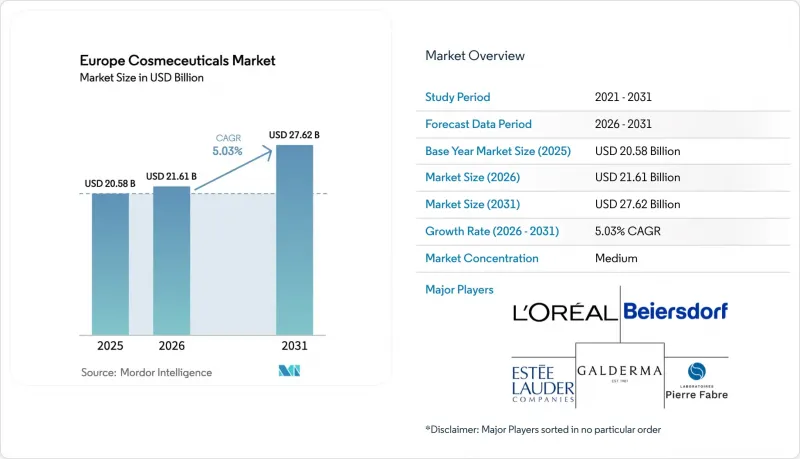
This report is Segmented by Product Type (Skin Care, Hair Care, Lip Care, Oral Care), Category (Natural/Organic, Conventional), End User (Male, Female), Distribution Channel (Supermarkets/Hypermarkets, Beauty and Health Stores, Online Retail, Other), and Geography (Germany, United Kingdom, France, Italy, Spain, Russia, Poland, Belgium, and More). The Market Forecasts are Provided in Terms of Value (USD).
Europe Cosmeceuticals Market Trends and Insights
Ageing Population Expanding Demand for Anti-Ageing Cosmeceuticals
In 2024, Europe's median age hit 44.4 years. Eurostat forecasts that by 2050, individuals aged 65 and older will comprise 30% of the population. This demographic shift is driving a consistent demand for products such as retinoids, peptides, and growth-factor serums, which combat photoaging and help restore dermal density. While Germany and Italy, with over 23% of their populations already aged 65 or older, lead in anti-aging sales, Poland is witnessing a surge. The median age in Poland climbed from 38.2 in 2010 to 42.1 in 2023, spurring double-digit growth in premium skincare categories, according to Polishcosmetics. L'Oreal's Longevity Science platform, set to debut in June 2025, is pivoting the focus from mere surface hydration to deeper cellular interventions. Their approach targets cellular senescence using biotech actives from extremophile microorganisms. Meanwhile, Beiersdorf's Eucerin Hyaluron-Filler Epigenetic Serum, launched in September 2024, showcases the heightened clinical standards in anti-aging products. With dermatology and geroscience merging, efficacy benchmarks are evolving. Peer-reviewed studies, as highlighted by MDPI AG, confirm that combinations of peptide and retinol can diminish wrinkle depth by 28% in just 12 weeks, meeting the rigorous evidence standards set by both regulators and consumers.
Rise in Dermo-Cosmetic Ingredient Awareness and Science-Backed Claims
Ingredient transparency has emerged as a key driver of purchase decisions. Consumers now closely examine INCI lists, favoring actives such as niacinamide, ceramides, and bakuchiol, while shunning formulations that contain parabens or synthetic fragrances. Pierre Fabre's DermaWeb platform, linking 16,000 dermatologists across Europe, facilitates real-time feedback on product efficacy and adverse events. This feedback loop helps refine formulations and substantiate claims. Avene's 2023 sales milestone of EUR 1 billion underscores the pharmacy channel's pivotal role in legitimizing dermo-cosmetics through professional endorsement. Launched in April 2025, Givaudan's RetiLife(TM), a fermentation-derived alternative to retinol, addresses consumer concerns about retinoid irritation. It promises comparable gene-expression modulation, a claim validated in vitro. In January 2024, Symrise bolstered its botanical-extract capabilities by acquiring Schaffelaarbos in the Netherlands. This move highlights the strategic importance of natural actives, prized for both their efficacy and clean-label appeal. Galderma's Nemluvio (nemolizumab) blurs the lines between cosmeceutical and pharmaceutical interventions. The product, approved by the EU in February 2025 for atopic dermatitis, marks a shift from mere marketing claims to rigorous clinical trial substantiation.
Product Misrepresentation and Counterfeit Concerns
In 2024, the EUIPO reported seizing 112 million counterfeit items, valued at a staggering EUR 3.8 billion. Notably, perfumes and cosmetics made up 3.04% of these detained articles. The repercussions for the EU cosmetics sector are severe: an annual loss of EUR 3 billion in sales and the elimination of 32,000 jobs. Key seizure points include Italy, Spain, France, the Netherlands, Portugal, Romania, and Poland, highlighting vulnerabilities in both production hubs and cross-border e-commerce. Launched in February 2024, the UK's "Choose Safe not Fake" campaign highlighted the dangers of counterfeit cosmetics, revealing that they often contain toxic substances such as lead, arsenic, and even bacterial contamination. These pose significant health risks to consumers. While the Commission Recommendation EU 2024/915 advocates for traceability measures, such as unique product identifiers and blockchain-based authentication, the financial burden of implementation disproportionately affects small and medium-sized enterprises. Online marketplaces, particularly platforms like Amazon and eBay, struggle to effectively police third-party sellers, leaving them as weak links in the supply chain. Consequently, consumers frequently find it challenging to differentiate between genuine products and sophisticated counterfeit products, often only realizing the difference after experiencing adverse reactions.
Other drivers and restraints analyzed in the detailed report include:
- Nutricosmetics Convergence of Ingestibles and Topicals
- Blue-Light and Pollution-Shield Product Adoption
- Stringent EU Rules Limiting Quasi-Medical Claims
For complete list of drivers and restraints, kindly check the Table Of Contents.
Segment Analysis
In 2025, skin care dominated the European cosmeceuticals market, claiming a 54.31% share, driven by the popularity of anti-ageing serums, SPF moisturizers, and treatments endorsed by dermatologists. While lip care holds a smaller segment, it's on the rise, advancing at a 5.45% CAGR. This growth is fueled by balms that combine SPF 30+, peptides, and hyaluronic acid, catering to a "minimalist yet clinical" aesthetic. The hair-care segment is witnessing steady growth, with scalp-health lines like DermoCapillaire seamlessly integrating dermatology into daily routines. Meanwhile, oral-care innovations, such as Unilever's enzyme-based whitening paste, are bringing cosmeceutical principles into the realm of dental aesthetics.
Looking ahead, the European market for skin care cosmeceuticals is expected to grow due to advancements in epigenetic actives and precision-fermented ingredients. Products like Melasyl(TM) highlight the shift of pigment modulation from pharmaceuticals to over-the-counter creams. Sun-protection products are experiencing the fastest internal growth, particularly as concerns about UV-A and blue light intensify. The resurgence of lip care can be linked to the post-pandemic trend where the "skinification" of makeup emphasizes functional benefits over mere color variety. Additionally, hair colorants are navigating regulatory pressures, being urged to replace ammonia with plant-based alternatives, all while ensuring effective gray coverage.
In 2025, conventional products dominated the market, accounting for 81.93% of total revenue. Their success stemmed from leveraging pharmacy credibility, boasting a long shelf life, and utilizing cost-efficient preservatives. Meanwhile, organic-certified variants, buoyed by the prestigious COSMOS and Ecocert seals (which mandate 95% organic plant content as per ECOCERT GROUP), are witnessing a steady growth at a 4.94% CAGR. However, Europe's cosmeceuticals market for organic lines faces constraints due to elevated raw material costs and a reduced shelf life. Notably, Germany, France, and the UK lead the way, hosting the bulk of certified SKUs, underscoring a consumer trend willing to pay a premium for clean-label assurance.
Yet, challenges remain: natural preservatives, like potassium sorbate, lag behind their synthetic counterparts, limiting their distribution reach. In response, brands such as Caudalie are channeling investments into proprietary grape-extract complexes, striving to harmonize efficacy with natural appeal. While the EU Ecolabel introduces criteria for packaging and biodegradability, its adoption lingers below 5%, primarily due to the financial burden of compliance. Furthermore, a rising trend sees mainstream shoppers gravitating towards hybrid strategies that reduce petrochemical use, even if it means forgoing full organic certification, all in pursuit of a "clean enough" solution.
Complete Report Scope:
- By Product Type
- Skin Care Products
- Anti-ageing
- Anti-acne
- Sun Protection
- Other Skin-care Products
- Hair Care Products
- Shampoos and Conditioners
- Hair Colorants and Dyes
- Other Hair Care Product Types
- Lip Care Products
- Oral Care Products
- Skin Care Products
- By Category
- Natural/Organic
- Conventional
- By End User
- Male
- Female
- By Distribution Channel
- Supermarkets / Hypermarkets
- Beauty and Health Stores
- Online Retail Stores
- Other Distribution Channel
- By Geography
- Germany
- United Kingdom
- France
- Italy
- Spain
- Russia
- Poland
- Belgium
- Netherlands
- Sweden
- Rest of Europe
List of Companies Covered in this Report:
- L'Oreal S.A.
- Beiersdorf AG
- Estee Lauder Companies Inc.
- Procter & Gamble Co.
- Unilever PLC
- Shiseido Co. Ltd.
- Johnson & Johnson
- Bayer AG
- Groupe Clarins SA
- Galderma S.A.
- Pierre Fabre Dermo-Cosmetique
- Natura Bisse Group
- Caudalie
- ISDIN
- Laboratoire SVR
- Sesderma Laboratories
- Boots No7 Beauty Company
- Dr. Barbara Sturm Molecular Cosmetics
- Bioderma Laboratories
- Dermalogica
Additional Benefits:
- The market estimate (ME) sheet in Excel format
- 3 months of analyst support
TABLE OF CONTENTS
1 INTRODUCTION
- 1.1 Study Assumptions and Market Definition
- 1.2 Scope of the Study
2 RESEARCH METHODOLOGY
3 EXECUTIVE SUMMARY
4 MARKET DYNAMICS
- 4.1 Market Overview
- 4.2 Market Drivers
- 4.2.1 Ageing population expanding demand for anti-ageing cosmeceuticals
- 4.2.2 Rise in dermo-cosmetic ingredient awareness and science-backed claims
- 4.2.3 Expansion of e-commerce and data-driven personalization
- 4.2.4 Nutricosmetics convergence of ingestibles and topicals
- 4.2.5 Blue-light and pollution-shield product adoption
- 4.2.6 Streamlined EU pathways for 'dermatology-light' functional claims
- 4.3 Market Restraints
- 4.3.1 Product misrepresentation and counterfeit concerns
- 4.3.2 Stringent EU rules limiting quasi-medical claims
- 4.3.3 Supply-chain volatility for biotech actives
- 4.3.4 Consumer scepticism over efficacy vs premium pricing
- 4.4 Consumer Behaviour Analaysis
- 4.5 Regulatory Landscape
- 4.6 Technological Outlook
- 4.7 Porter's Five Forces
- 4.7.1 Threat of New Entrants
- 4.7.2 Bargaining Power of Buyers
- 4.7.3 Bargaining Power of Suppliers
- 4.7.4 Threat of Substitute Products
- 4.7.5 Intensity of Competitive Rivalry
5 MARKET SIZE AND GROWTH FORECASTS (VALUE)
- 5.1 By Product Type
- 5.1.1 Skin Care Products
- 5.1.1.1 Anti-ageing
- 5.1.1.2 Anti-acne
- 5.1.1.3 Sun Protection
- 5.1.1.4 Other Skin-care Products
- 5.1.2 Hair Care Products
- 5.1.2.1 Shampoos and Conditioners
- 5.1.2.2 Hair Colorants and Dyes
- 5.1.2.3 Other Hair Care Product Types
- 5.1.3 Lip Care Products
- 5.1.4 Oral Care Products
- 5.1.1 Skin Care Products
- 5.2 By Category
- 5.2.1 Natural/Organic
- 5.2.2 Conventional
- 5.3 By End User
- 5.3.1 Male
- 5.3.2 Female
- 5.4 By Distribution Channel
- 5.4.1 Supermarkets / Hypermarkets
- 5.4.2 Beauty and Health Stores
- 5.4.3 Online Retail Stores
- 5.4.4 Other Distribution Channel
- 5.5 By Geography
- 5.5.1 Germany
- 5.5.2 United Kingdom
- 5.5.3 France
- 5.5.4 Italy
- 5.5.5 Spain
- 5.5.6 Russia
- 5.5.7 Poland
- 5.5.8 Belgium
- 5.5.9 Netherlands
- 5.5.10 Sweden
- 5.5.11 Rest of Europe
6 COMPETITIVE LANDSCAPE
- 6.1 Market Concentration
- 6.2 Strategic Moves
- 6.3 Market Positioning Analysis
- 6.4 Company Profiles (includes Global level Overview, Market level overview, Core Segments, Financials, Strategic Information, Market Rank/Share, Products and Services, Recent Developments)
- 6.4.1 L'Oreal S.A.
- 6.4.2 Beiersdorf AG
- 6.4.3 Estee Lauder Companies Inc.
- 6.4.4 Procter & Gamble Co.
- 6.4.5 Unilever PLC
- 6.4.6 Shiseido Co. Ltd.
- 6.4.7 Johnson & Johnson
- 6.4.8 Bayer AG
- 6.4.9 Groupe Clarins SA
- 6.4.10 Galderma S.A.
- 6.4.11 Pierre Fabre Dermo-Cosmetique
- 6.4.12 Natura Bisse Group
- 6.4.13 Caudalie
- 6.4.14 ISDIN
- 6.4.15 Laboratoire SVR
- 6.4.16 Sesderma Laboratories
- 6.4.17 Boots No7 Beauty Company
- 6.4.18 Dr. Barbara Sturm Molecular Cosmetics
- 6.4.19 Bioderma Laboratories
- 6.4.20 Dermalogica
7 MARKET OPPORTUNITIES AND FUTURE TRENDS

