PUBLISHER: Mordor Intelligence | PRODUCT CODE: 2113282

PUBLISHER: Mordor Intelligence | PRODUCT CODE: 2113282
Vanillin - Market Share Analysis, Industry Trends & Statistics, Growth Forecasts (2026 - 2031)
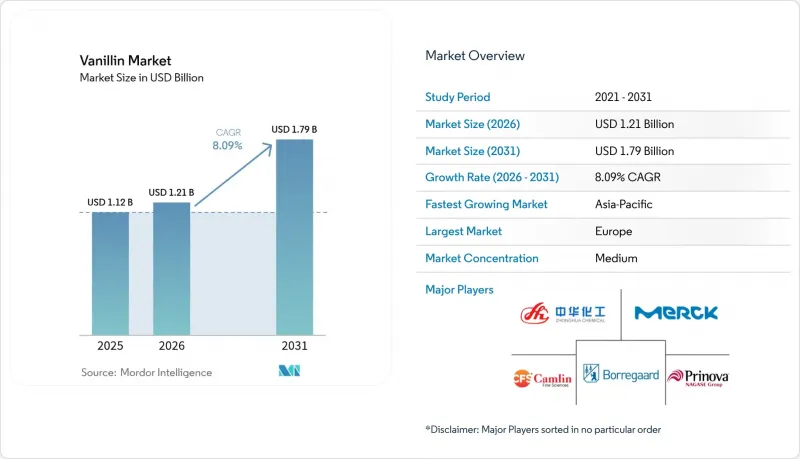
According to Mordor Intelligence, the vanillin market size was valued at USD 1.12 billion in 2025 and estimated to grow from USD 1.21 billion in 2026 to reach USD 1.79 billion by 2031, at a CAGR of 8.09% during the forecast period (2026-2031).
This report is Segmented by Type (Natural Vanillin, Synthetic Vanillin), Form (Powder, Crystal, Liquid), Application (Food & Beverage, Pharmaceuticals, Personal Care & Cosmetics, Dietary Supplements and Sports Nutrition, Animal Feed, Others), and Geography (North America, Europe, Asia Pacific, South America, Middle East and Africa). The Market Forecasts are Provided in Terms of Value (USD).
Global Vanillin Market Trends and Insights
Rising demand for natural ingredients in food, beverages, and personal care
As consumers increasingly prefer natural products over synthetic ones, opportunities for premium pricing in bio-based vanillin production are emerging. Thanks to biotechnological advancements, companies can now produce vanillin labeled as "natural" through fermentation processes, allowing them to charge around USD 700 per kilogram. In contrast, synthetic vanillin retails at just USD 15 per kilogram. Researchers at Tokyo University of Science have bioengineered enzymes that transform ferulic acid, sourced from agricultural waste, into vanillin in a single step. This innovation not only addresses sustainability and supply concerns but also ensures the product retains its "natural" classification under FDA regulations. With this breakthrough, manufacturers can tap into the lucrative price gap of USD 1,200-4,000 per kilogram between natural vanilla extracts and their synthetic counterparts, all while adhering to major market regulations for natural labeling.
Advancements in biotechnology and fermentation
Genetic engineering and fermentation technologies are revolutionizing vanillin production economics by enabling scalable natural production without reliance on agriculture. Engineered microbial systems, particularly Saccharomyces cerevisiae and Escherichia coli, have demonstrated commercial feasibility in producing natural vanillin from renewable feedstocks such as eugenol, ferulic acid, and lignin derivatives. Lignin-based processes achieve a 6.2% yield by weight, providing a sustainable alternative to petroleum-based synthetic vanillin while addressing waste management issues in the pulp and paper industry. These innovations position biotechnology companies to capture a significant market share by delivering cost-effective natural vanillin that meets the increasing environmental sustainability expectations of major food and beverage manufacturers.
Volatile supply of natural vanilla beans
Madagascar's dominance in vanilla bean production creates systemic supply risks that cascade through natural vanillin markets, with climate events and political instability generating extreme price volatility. Uganda's emergence as the second-largest vanilla producer with over 600 metric tonnes exported in 2024 provides limited supply diversification, earning USD 16.6 million while achieving vanillin content exceeding 4%. Price bubble analysis identifies five distinct volatility periods linked to cyclones, market speculation, and regulatory changes, with recommendations for direct company-farmer negotiations to enhance stability. Natural vanillin production requires approximately 500 kilograms of vanilla pods per kilogram of vanillin, corresponding to pollination of 40,000 flowers, highlighting the agricultural intensity that constrains supply scalability and drives biotechnological alternatives.
Other drivers and restraints analyzed in the detailed report include:
- Increase in clean-label and organic product adoption
- Rising use as preservative and antioxidant in pharmaceutical formulations
- Stringent regulatory compliance for food additives and synthetic products
For complete list of drivers and restraints, kindly check the Table Of Contents.
Segment Analysis
Synthetic offerings supplied 56.35% of 2025 volume thanks to petro-based guaiacol economics. This segment delivered steady cash flows as the vanillin market size crossed USD 1.12 billion in 2025. Natural variants, however, recorded the highest 8.42% CAGR and will rise from niche to mainstream by 2031 as fermentation costs dip below USD 300 per kg. Borregaard's lignin route, operational since 1993, exemplifies first-mover advantage; newer entrants now mimic the model with higher yields from electrochemical depolymerization. Clean-label mandates in bakery and premium dairy accelerate adoption even at premium price points.
Consumer studies show willingness to pay up to 15% retail premium for "naturally flavored" chocolate, transferring cost absorption from manufacturer to end-user. As a result, natural volumes are expected to represent 25.60% of the vanillin market share by 2031. Synthetic producers respond by licensing biotech IP or retrofitting guaiacol lines for bio-feedstock compatibility, creating a hybrid supply environment.
Complete Report Scope:
- By Type
- Natural Vanillin
- Synthetic Vanillin
- By Form
- Powder
- Crystal
- Liquid
- By Application
- Food & Beverage
- Bakery and Confectionery
- Beverages
- Dairy and Frozen Products
- Other
- Pharmaceuticals
- Personal Care & Cosmetics
- Dietary Supplements and Sports Nutrition
- Animal Feed
- Others
- Food & Beverage
- By Geography
- North America
- United States
- Canada
- Mexico
- Rest of North America
- Europe
- Germany
- France
- United Kingdom
- Netherlands
- Italy
- Rest of Europe
- Asia Pacific
- China
- India
- Japan
- Australia
- Rest of Asia Pacific
- South America
- Brazil\
- Argentina
- Rest of South America
- Middle East and Africa
- Saudi Arabia
- South Africa
- Rest of Middle East and Africa
- North America
Geography Analysis
In 2025, Europe holds a leading 31.10% market share, supported by its strong manufacturing infrastructure, strict quality standards, and high demand from the food, pharmaceutical, and personal care industries. European producers capitalize on regulatory distinctions between natural and synthetic vanillin, enabling premium positioning for biotechnology-derived products. Key markets such as Germany, France, the Netherlands, and the UK feature advanced supply chains and high-value applications, though regulatory compliance costs pose challenges for smaller competitors. The European market exhibits mature demand patterns, with steady growth driven by clean-label trends and the expansion of pharmaceutical applications.
Asia Pacific is the fastest-growing region, with a 9.30% CAGR projected through 2031. This growth is driven by the region's expanding food processing industries, rising consumer spending, and increasing consumption of packaged foods in countries like China, India, Japan, and Australia. However, trade tensions significantly influence regional dynamics, as U.S. antidumping duties of 190.15% to 379.87% on Chinese vanillin imports reshape supply chains and create opportunities for alternative suppliers, according to the Federal Register. While China faces regulatory challenges as a major vanillin producer, India and Southeast Asian markets show strong growth potential, fueled by urbanization and shifting dietary preferences.
North America represents a mature market with well-established regulatory frameworks and strong demand across food, pharmaceutical, and personal care applications. Meanwhile, South America and the Middle East & Africa present emerging growth opportunities, driven by economic development and the expansion of food processing industries. Uganda, as Africa's second-largest vanilla producer, exported over 600 metric tonnes in 2024, highlighting the continent's potential in natural vanillin supply chains. With vanillin content exceeding 4%, Uganda is increasing its market share in the U.S. and EU markets, emphasizing Africa's growing role in global vanillin supply chains. Regional growth trends reflect economic development, regulatory changes, and supply chain optimization as manufacturers seek cost-effective production locations while maintaining quality standards.
- Merck KGaA
- Evolva Holding SA
- Camlin Fine Sciences Ltd
- Borregaard AS
- Jiaxing Zhonghua Chemical Co Ltd
- Syensqo (ex-Solvay)
- Prinova Group LLC
- FoodChem International Corp.
- Lesaffre Et Compagnie
- Veda Oils
- BASF SE
- Givaudan SA
- International Flavors & Fragrances (IFF)
- Sensient Technologies
- Kerry Group
- Symrise AG
- Fujian Xinhua Co Ltd
- Hubei Shuntian Chemical
- Anhui Bayi Chemical
- Beijing Youjiale Flavor
Additional Benefits:
- The market estimate (ME) sheet in Excel format
- 3 months of analyst support
TABLE OF CONTENTS
1 INTRODUCTION
- 1.1 Study Assumptions & Market Definition
- 1.2 Scope of the Study
2 RESEARCH METHODOLOGY
3 EXECUTIVE SUMMARY
4 MARKET LANDSCAPE
- 4.1 Market Overview
- 4.2 Market Drivers
- 4.2.1 Rising demand for natural ingredients in food, beverages, and personal care.
- 4.2.2 Advancements in biotechnology and fermentation
- 4.2.3 Increase in clean-label and organic product adoption.
- 4.2.4 Rising use as preservative and antioxidant in pharmaceutical formulations.
- 4.2.5 Product innovations and customized flavor blends
- 4.2.6 Growth of packaged and processed foods
- 4.3 Market Restraints
- 4.3.1 Volatile supply of natural vanilla beans
- 4.3.2 Stringent regulatory compliance for food additives and synthetic products.
- 4.3.3 High production costs for natural/bio-vanillin.
- 4.3.4 Competitive pressure from alternative flavoring agents.
- 4.4 Supply-Chain Analysis
- 4.5 Regulatory & Technological Outlook
- 4.6 Porter's Five Forces
- 4.6.1 Threat of New Entrants
- 4.6.2 Bargaining Power of Buyers/Consumers
- 4.6.3 Bargaining Power of Suppliers
- 4.6.4 Threat of Substitute Products
- 4.6.5 Intensity of Competitive Rivalry
5 MARKET SIZE AND GROWTH FORECASTS
- 5.1 By Type
- 5.1.1 Natural Vanillin
- 5.1.2 Synthetic Vanillin
- 5.2 By Form
- 5.2.1 Powder
- 5.2.2 Crystal
- 5.2.3 Liquid
- 5.3 By Application
- 5.3.1 Food & Beverage
- 5.3.1.1 Bakery and Confectionery
- 5.3.1.2 Beverages
- 5.3.1.3 Dairy and Frozen Products
- 5.3.1.4 Other
- 5.3.2 Pharmaceuticals
- 5.3.3 Personal Care & Cosmetics
- 5.3.4 Dietary Supplements and Sports Nutrition
- 5.3.5 Animal Feed
- 5.3.6 Others
- 5.3.1 Food & Beverage
- 5.4 By Geography
- 5.4.1 North America
- 5.4.1.1 United States
- 5.4.1.2 Canada
- 5.4.1.3 Mexico
- 5.4.1.4 Rest of North America
- 5.4.2 Europe
- 5.4.2.1 Germany
- 5.4.2.2 France
- 5.4.2.3 United Kingdom
- 5.4.2.4 Netherlands
- 5.4.2.5 Italy
- 5.4.2.6 Rest of Europe
- 5.4.3 Asia Pacific
- 5.4.3.1 China
- 5.4.3.2 India
- 5.4.3.3 Japan
- 5.4.3.4 Australia
- 5.4.3.5 Rest of Asia Pacific
- 5.4.4 South America
- 5.4.4.1 Brazil\
- 5.4.4.2 Argentina
- 5.4.4.3 Rest of South America
- 5.4.5 Middle East and Africa
- 5.4.5.1 Saudi Arabia
- 5.4.5.2 South Africa
- 5.4.5.3 Rest of Middle East and Africa
- 5.4.1 North America
6 COMPETITIVE LANDSCAPE
- 6.1 Market Concentration
- 6.2 Strategic Moves
- 6.3 Market Ranking Analysis
- 6.4 Company Profiles (includes Global level Overview, Market level overview, Core Segments, Financials as available, Strategic Information, Market Rank/Share for key companies, Products & Services, and Recent Developments)
- 6.4.1 Merck KGaA
- 6.4.2 Evolva Holding SA
- 6.4.3 Camlin Fine Sciences Ltd
- 6.4.4 Borregaard AS
- 6.4.5 Jiaxing Zhonghua Chemical Co Ltd
- 6.4.6 Syensqo (ex-Solvay)
- 6.4.7 Prinova Group LLC
- 6.4.8 FoodChem International Corp.
- 6.4.9 Lesaffre Et Compagnie
- 6.4.10 Veda Oils
- 6.4.11 BASF SE
- 6.4.12 Givaudan SA
- 6.4.13 International Flavors & Fragrances (IFF)
- 6.4.14 Sensient Technologies
- 6.4.15 Kerry Group
- 6.4.16 Symrise AG
- 6.4.17 Fujian Xinhua Co Ltd
- 6.4.18 Hubei Shuntian Chemical
- 6.4.19 Anhui Bayi Chemical
- 6.4.20 Beijing Youjiale Flavor
7 MARKET OPPORTUNITIES AND FUTURE OUTLOOK

