PUBLISHER: Mordor Intelligence | PRODUCT CODE: 2113308

PUBLISHER: Mordor Intelligence | PRODUCT CODE: 2113308
Asia-Pacific Variable Frequency Drives - Market Share Analysis, Industry Trends & Statistics, Growth Forecasts (2026 - 2031)
According to Mordor Intelligence, Asia-Pacific variable frequency drives market size in 2026 is estimated at USD 11.06 billion, growing from 2025 value of USD 10.47 billion with 2031 projections showing USD 14.54 billion, growing at 5.62% CAGR over 2026-2031.
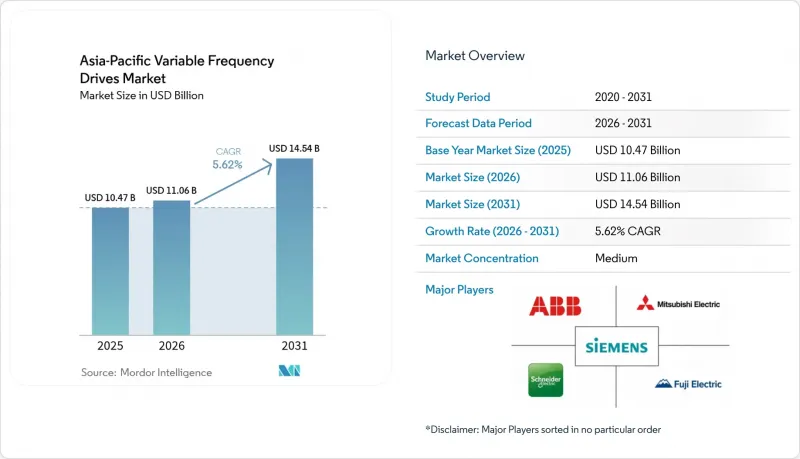
This report is Segmented by Type (AC, DC, and Servo Drives), Voltage Class (Low-Voltage and Medium-Voltage), Power Rating (Micro, Low, Medium, and High), Application (Pumps, Fans, Compressors, Conveyors, HVAC, and Others), End-User Industry (Oil and Gas, Energy and Power, and More), and Geography. The Market Forecasts are Provided in Terms of Value (USD).
Asia-Pacific Variable Frequency Drives Market Trends and Insights
Government-Led Industrial Energy-Efficiency Mandates in China and India
National regulations now tie industrial upgrades to quantified energy-performance targets. China's 2024 specification expansion to 23 product categories obliges factories to adopt premium-efficiency motors and matching drives, prompting a step-change in retrofit volumes. New Delhi's budget sets aside INR 6,500 crore (USD 780 million) to solarize 3.5 million irrigation pumps, directly embedding VFDs into distributed renewable systems. These measures, aligned with China's 2060 carbon-neutrality goal and India's renewable energy push, are cascading through supply chains, prompting local OEMs to certify IEC-compliant, sensor-rich drives at scale. Vendors able to prove 20-40% electricity savings now enjoy priority listing in government procurement.
Rapid Build-Out of Data Centers Requiring Precision HVAC Drives
Asia Pacific data-center capex is projected to surpass USD 75 billion by 2025, overtaking North America. Server-densification elevates thermal loads, so operators are shifting from fixed-speed chillers to VFD-based cooling loops. PUE mandates in Beijing and Singapore encourage dynamic airflow control, and silicon-carbide power stages are cutting HVAC energy draw by up to 17% annually. Drives with embedded fieldbus and cyber-secure firmware enable real-time feedback to building-management systems, turning cooling from a cost center into a performance variable.
Price Competition from Low-Cost Chinese Vendors
Aggressive pricing from Inovance, Hiconics, and other Chinese suppliers erodes margins for premium brands, particularly in the <40 kW bracket. With support from Beijing's green-industrial policy, these firms price 15-25% below global averages. While customers enjoy lower capex, a race-to-the-bottom threatens long-term R&D funding for advanced topologies and cybersecurity features. Tier-one players are countering by bundling drives with digital service contracts and extended warranties, repositioning themselves on lifecycle value rather than upfront cost.
Other drivers and restraints analyzed in the detailed report include:
- Manufacturing-Sector Automation Wave Post-2023
- Rising Electricity Tariffs Prompting Energy-Saving Retrofits
- Skilled Workforce Shortage for VFD Commissioning in ASEAN
For complete list of drivers and restraints, kindly check the Table Of Contents.
Segment Analysis
AC drives retained a 73.40% command of 2025 revenues, anchored by their versatility across pumps, fans, and conveyors. The Asia-Pacific variable frequency drives market size for servo units is forecast to jump at an 8.02% CAGR as robotics, CNC machining, and collaborative cobots proliferate. Lifecycle economics favour AC units in constant-torque uses, but the servo's higher price premium is justified by positional accuracy within +-0.01°. In the current cycle, servo adoption is strongest in electronics assembly lines of South Korea and Japan. Silicon-carbide power stages and embedded encoders now enable microsecond-level feedback, reducing overshoot and scrap rates. As OEMs miniaturize machinery, board-mount drives and PCB stator motors are shrinking cabinet footprints, enabling retrofit into crowded factory floors.
Service models are also diverging. AC drives typically ship with five-year warranties and basic monitoring, while servo packages bundle cloud dashboards that track torque ripple and vibration. Suppliers are upselling maintenance-as-a-service contracts that utilize algorithms to predict bearing wear weeks in advance. This shift from transactional sales to recurring revenue is reshaping channel incentives across the Asia-Pacific variable frequency drives market.
Low-voltage systems <690 V command 86.90% of 2025 shipments, a reflection of the region's concentration of small to mid-sized motors. Yet, the medium-voltage segment is expanding at a forecasted 6.85% CAGR as petrochemical complexes, desalination plants, and metro-rail projects scale up pump duties. IEC's first-ever efficiency grading for high-voltage motors has prompted EPC contractors to integrate active-front-end configurations to comply with THD limits. The Asia-Pacific variable frequency drives market share for air-cooled medium-voltage packages is growing in markets where ambient temperatures exceed 40°C, prompting vendors to develop derating-resistant heat-sink alloys.
Product strategy is converging on modular building blocks. Drawer-style power cells simplify field replacement; digital twins simulate harmonic interaction with weak grids, reducing commissioning time by 20%. Low-voltage platforms continue to innovate with regenerative braking and STO (Safe Torque Off) functions, catering to intralogistics and warehousing clients adopting automated guided vehicles.
Complete Report Scope:
- By Type
- AC Drives
- DC Drives
- Servo Drives
- By Voltage Class
- Low-Voltage (More than 690 V)
- Medium-Voltage (1 - 35 kV)
- By Power Rating (kW)
- Micro (Less than 5 kW)
- Low (6 - 40 kW)
- Medium (41 - 200 kW)
- High (More than 200 kW)
- By Application
- Pumps
- Fans
- Compressors
- Conveyors
- HVAC
- Extruders
- Others
- By End-User Industry
- Oil and Gas
- Energy and Power
- Water and Waste-water Management
- Food and Beverage Processing
- Pulp and Paper
- Metals and Mining
- Chemicals and Petrochemicals
- Marine and Shipbuilding
- Other Industries
- By Country
- China
- Japan
- India
- South Korea
- Rest of Asia-Pacific
List of Companies Covered in this Report:
- ABB Ltd
- Siemens AG
- Mitsubishi Electric Corporation
- Schneider Electric SE
- Fuji Electric Co. Ltd
- Hitachi Ltd
- Toshiba Corporation
- Yaskawa Electric Corp.
- Delta Electronics Inc.
- Danfoss A/S
- Rockwell Automation Inc.
- Eaton Corporation plc
- Emerson Electric Co.
- Johnson Controls International plc
- Parker Hannifin Corp.
- WEG SA
- LS Electric Co. Ltd
- Inovance Technology Co. Ltd
- Nidec (Control Techniques)
- CHINT Group (Hiconics Drive)
Additional Benefits:
- The market estimate (ME) sheet in Excel format
- 3 months of analyst support
TABLE OF CONTENTS
1 INTRODUCTION
- 1.1 Study Assumptions and Market Definition
- 1.2 Scope of the Study
2 RESEARCH METHODOLOGY
3 EXECUTIVE SUMMARY
4 MARKET LANDSCAPE
- 4.1 Market Overview
- 4.2 Market Drivers
- 4.2.1 Government-led Industrial Energy-Efficiency Mandates in China and India
- 4.2.2 Manufacturing-Sector Automation Wave Post-2023
- 4.2.3 Rising Electricity Tariffs Prompting Energy-Saving Retrofits
- 4.2.4 Rapid Build-out of Data Centres Requiring Precision HVAC Drives
- 4.2.5 Infrastructure Boom in Southeast Asia Boosting Pumps and Fans Demand
- 4.2.6 Shift to Electric Propulsion in Mining and Marine Equipment
- 4.3 Market Restraints
- 4.3.1 Price Competition from Low-Cost Chinese Vendors
- 4.3.2 Harmonic and EMI Compliance Challenges in Medium-Voltage Drives
- 4.3.3 Subsidy Withdrawal for Industrial Efficiency Projects in Australia
- 4.3.4 Skilled Workforce Shortage for VFD Commissioning in ASEAN
- 4.4 Value-Chain Analysis
- 4.5 Regulatory and Technological Outlook
- 4.6 Technology Snapshot
- 4.7 Porter's Five Forces Analysis
- 4.7.1 Threat of New Entrants
- 4.7.2 Bargaining Power of Buyers
- 4.7.3 Bargaining Power of Suppliers
- 4.7.4 Threat of Substitute Products
- 4.7.5 Intensity of Competitive Rivalry
5 MARKET SIZE AND GROWTH FORECASTS (VALUE)
- 5.1 By Type
- 5.1.1 AC Drives
- 5.1.2 DC Drives
- 5.1.3 Servo Drives
- 5.2 By Voltage Class
- 5.2.1 Low-Voltage (More than 690 V)
- 5.2.2 Medium-Voltage (1 - 35 kV)
- 5.3 By Power Rating (kW)
- 5.3.1 Micro (Less than 5 kW)
- 5.3.2 Low (6 - 40 kW)
- 5.3.3 Medium (41 - 200 kW)
- 5.3.4 High (More than 200 kW)
- 5.4 By Application
- 5.4.1 Pumps
- 5.4.2 Fans
- 5.4.3 Compressors
- 5.4.4 Conveyors
- 5.4.5 HVAC
- 5.4.6 Extruders
- 5.4.7 Others
- 5.5 By End-User Industry
- 5.5.1 Oil and Gas
- 5.5.2 Energy and Power
- 5.5.3 Water and Waste-water Management
- 5.5.4 Food and Beverage Processing
- 5.5.5 Pulp and Paper
- 5.5.6 Metals and Mining
- 5.5.7 Chemicals and Petrochemicals
- 5.5.8 Marine and Shipbuilding
- 5.5.9 Other Industries
- 5.6 By Country
- 5.6.1 China
- 5.6.2 Japan
- 5.6.3 India
- 5.6.4 South Korea
- 5.6.5 Rest of Asia-Pacific
6 COMPETITIVE LANDSCAPE
- 6.1 Market Concentration
- 6.2 Strategic Moves
- 6.3 Market Share Analysis
- 6.4 Company Profiles (includes Global-level Overview, Market-level Overview, Core Segments, Financials as available, Strategic Information, Market Rank/Share, Products and Services, Recent Developments)
- 6.4.1 ABB Ltd
- 6.4.2 Siemens AG
- 6.4.3 Mitsubishi Electric Corporation
- 6.4.4 Schneider Electric SE
- 6.4.5 Fuji Electric Co. Ltd
- 6.4.6 Hitachi Ltd
- 6.4.7 Toshiba Corporation
- 6.4.8 Yaskawa Electric Corp.
- 6.4.9 Delta Electronics Inc.
- 6.4.10 Danfoss A/S
- 6.4.11 Rockwell Automation Inc.
- 6.4.12 Eaton Corporation plc
- 6.4.13 Emerson Electric Co.
- 6.4.14 Johnson Controls International plc
- 6.4.15 Parker Hannifin Corp.
- 6.4.16 WEG SA
- 6.4.17 LS Electric Co. Ltd
- 6.4.18 Inovance Technology Co. Ltd
- 6.4.19 Nidec (Control Techniques)
- 6.4.20 CHINT Group (Hiconics Drive)
7 MARKET OPPORTUNITIES AND FUTURE OUTLOOK
- 7.1 White-space and Unmet-need Assessment

