PUBLISHER: Mordor Intelligence | PRODUCT CODE: 2113316

PUBLISHER: Mordor Intelligence | PRODUCT CODE: 2113316
Italy Animal Healthcare - Market Share Analysis, Industry Trends & Statistics, Growth Forecasts (2026 - 2031)
According to Mordor Intelligence, Italy animal healthcare market size in 2026 is estimated at USD 1.69 billion, growing from 2025 value of USD 1.61 billion with 2031 projections showing USD 2.17 billion, growing at 5.12% CAGR over 2026-2031.
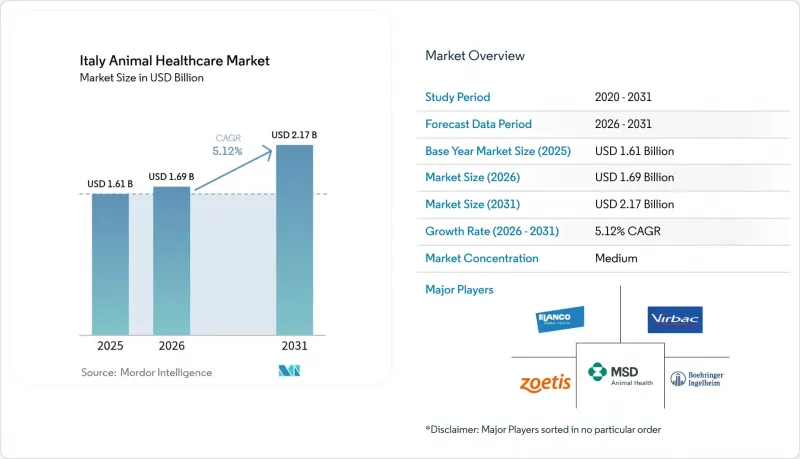
This report is Segmented by Product (Therapeutics (Vaccines, Parasiticides, and More) and Diagnostics (Immunodiagnostic Tests, Molecular Diagnostics, and More)), Animal Type (Dogs & Cats, and More), Route of Administration (Oral, and More), and End User (Veterinary Hospitals & Clinics, and More). The Market Forecasts are Provided in Terms of Value (USD).
Italy Animal Healthcare Market Trends and Insights
Expansion of Companion-Animal Population and Humanization Trends
Italy's pet-care economy is expanding alongside a cultural shift that treats animals as family members. Sixty-three percent of owners consider pet health equal to human health and allocate around EUR 1,000 annually to pet upkeep, of which veterinary visits form a growing slice. The constitutional amendment recognizing animals as sentient beings further legitimizes premium services such as oncology and advanced imaging. Pet-food expenditure rose to EUR 2.53 billion in 2024, reinforcing a willingness to pay for broader wellness packages. Demographically, northern regions possess higher disposable incomes, which translates into more frequent clinic visits and earlier adoption of telehealth. Urban millennials also favor subscription-based wellness plans that bundle vaccinations, diagnostics, and nutritional counseling. Collectively, these factors increase the average revenue per visit and underpin volume growth across both therapeutics and diagnostics in the Italy animal healthcare market.
Rising Expenditure on Preventive Veterinary Care and Insurance Uptake
Preventive care now commands a larger share of wallet as owners appreciate the cost-avoidance value of early intervention. About 32% of households purchase supplements and wellness products, and routine screening packages are becoming standard at corporate clinics. Although pet-insurance penetration lags northern Europe, policy count grew in double digits during 2024-2025, signaling latent demand. Insurers have begun partnering with multi-clinic networks to bundle coverage with annual check-ups, thereby embedding diagnostics and vaccinations into recurring revenue streams. Livestock operators are likewise investing in herd-health plans that emphasize biosecurity and vaccination compliance in response to EU disease-surveillance rules. These structural moves collectively push the Italy animal healthcare market toward a more preventative model, reducing seasonality and stabilizing cash flows for service providers.
Shortfall of Veterinary Professionals and Rural Service Gaps
Veterinary headcount has not kept pace with demand; 78.5% of European countries report shortages, and Italy is no exception. Income disparity versus human-medical peers discourages graduates from livestock practice, while 76% of new veterinarians are women who often prefer urban clinics offering better work-life balance. Rural posts struggle with limited infrastructure and lower earnings, hindering disease surveillance in regions crucial to meat and dairy supply chains. The manpower gap compromises outbreak readiness, evidenced in slower response to the 2025 lumpy-skin-disease episode. The university-reform initiative may widen the talent pipeline, yet longer-term retention in underserved areas will require fiscal incentives and telemedicine support to narrow geographic disparities within the Italy animal healthcare market.
Other drivers and restraints analyzed in the detailed report include:
- Government Incentives and Favorable Animal-Welfare Regulations
- Technological Advancements in Veterinary Pharmaceuticals and Diagnostics
- Escalating Costs of Veterinary Treatments and Pharmaceuticals
For complete list of drivers and restraints, kindly check the Table Of Contents.
Segment Analysis
Therapeutics generated 60.78% of the Italy animal healthcare market size in 2025, reflecting entrenched treatment protocols and reliable reimbursement from livestock operators. Vaccines form the blockbuster subcategory, buoyed by mandatory poultry and bovine immunization programs that mitigate epidemic-scale losses during avian-influenza and lumpy-skin-disease events. Parasiticides enjoy year-round demand given Italy's Mediterranean climate that favors vector proliferation. Anti-infectives remain sizable but face regulatory scrutiny; veterinary antibiotic sales fell 12.7% to 585.4 tonnes in 2022 as stewardship programs intensified. Market attention is shifting to medical-feed additives, nutraceuticals, and targeted biologics that align with zero-antibiotic-residue labels favored by retailers.
Diagnostics, although a smaller base, are posting a 7.29% CAGR through 2031. Immunodiagnostic assays dominate routine screenings, while molecular platforms accelerate in oncology and genetic-disease panels. Diagnostic imaging sales benefit from corporate-clinic refurbishments in affluent northern cities, where computed tomography and digital radiography are becoming standard. Liquid-biopsy services, with 85.7% sensitivity in canine cancer, are opening adjacent demand for confirmatory molecular tests. Collectively, rapid diagnostic expansion adds a recurring-testing dimension that enhances stickiness of the Italy animal healthcare market.
Dogs & cats represented 47.88% of 2025 revenue, supported by 19 million pets and high per-capita spend on wellness plans. Younger owners tend to gravitate toward minimally invasive therapies, driving the uptake of monoclonal antibodies for osteoarthritis and oral JAK inhibitors for dermatitis. Preventive dental care and weight-management programs add ancillary service revenue, deepening clinic-client engagement.
The poultry segment, advancing at a 6.17% CAGR, reflects Italy's 1.3 million-tonne broiler output in 2024, a 10% increase that triggers expanded vaccine schedules. Stringent EU trade rules require disease-free certification, boosting lab testing volumes. The disease shock of 602,200 birds culled in the January 2025 avian influenza wave accelerates biosecurity investments. Swine, ruminants, and horses remain important, but their growth rates are steadier, influenced by commodity prices and targeted sports-medicine demand. Niche pockets such as aquaculture and exotic pets are nascent yet underscore the widening scope of the Italy animal healthcare market.
Complete Report Scope:
- By Product
- Therapeutics
- Vaccines
- Parasiticides
- Anti-Infectives
- Medical Feed Additives
- Other Therapeutics
- Diagnostics
- Immunodiagnostic Tests
- Molecular Diagnostics
- Diagnostic Imaging
- Clinical Chemistry
- Other Diagnostics
- Therapeutics
- By Animal Type
- Dogs & Cats
- Horses
- Ruminants
- Swine
- Poultry
- Other Animal Types
- By Route Of Administration
- Oral
- Parenteral
- Topical
- Other Route of Administrations
- By End User
- Veterinary Hospitals & Clinics
- Reference Laboratories
- Point-Of-Care / In-House Testing Settings
- Academic & Research Institutes
List of Companies Covered in this Report:
- Agrolabo S.p.A.
- BCF Technology (IMV Imaging)
- Boehringer Ingelheim
- Candioli Pharma
- Ceva
- Dechra Veterinary Products
- Dox-al Italia S.p.A.
- Elanco
- Farmina Pet Foods
- Fatro S.p.A.
- Friulchem
- Hill's Pet Nutrition
- IDEXX
- Innovet Italia
- IVC Evidensia
- Livisto
- Mars Petcare (Royal Canin)
- Monge & C. S.p.A.
- MSD Animal Health
- Teknofarma s.r.l.
- Virbac
- Zoetis
Additional Benefits:
- The market estimate (ME) sheet in Excel format
- 3 months of analyst support
TABLE OF CONTENTS
1 Introduction
- 1.1 Study Assumptions & Market Definition
- 1.2 Scope of the Study
2 Research Methodology
3 Executive Summary
4 Market Landscape
- 4.1 Market Overview
- 4.2 Market Drivers
- 4.2.1 Expansion of Companion Animal Population and Humanization Trends
- 4.2.2 Rising Expenditure on Preventive Veterinary Care and Insurance Uptake
- 4.2.3 Government Incentives and Favorable Animal Welfare Regulations
- 4.2.4 Technological Advancements in Veterinary Pharmaceuticals and Diagnostics
- 4.2.5 Intensifying Livestock Productivity and Food Safety Requirements
- 4.2.6 Corporate Consolidation and Investment in Veterinary Service Chains
- 4.3 Market Restraints
- 4.3.1 Shortfall of Veterinary Professionals and Rural Service Gaps
- 4.3.2 Escalating Costs of Veterinary Treatments and Pharmaceuticals
- 4.3.3 Regulatory Complexity and High Taxation on Animal Health Products
- 4.3.4 Emergence of Antimicrobial and Anthelmintic Resistance In Livestock
- 4.4 Supply Chain Analysis
- 4.5 Regulatory Landscape
- 4.6 Porter's Five Forces Analysis
- 4.6.1 Threat of New Entrants
- 4.6.2 Bargaining Power of Buyers/Consumers
- 4.6.3 Bargaining Power of Suppliers
- 4.6.4 Threat of Substitute Products
- 4.6.5 Intensity of Competitive Rivalry
5 Market Size & Growth Forecasts (Value, USD)
- 5.1 By Product
- 5.1.1 Therapeutics
- 5.1.1.1 Vaccines
- 5.1.1.2 Parasiticides
- 5.1.1.3 Anti-Infectives
- 5.1.1.4 Medical Feed Additives
- 5.1.1.5 Other Therapeutics
- 5.1.2 Diagnostics
- 5.1.2.1 Immunodiagnostic Tests
- 5.1.2.2 Molecular Diagnostics
- 5.1.2.3 Diagnostic Imaging
- 5.1.2.4 Clinical Chemistry
- 5.1.2.5 Other Diagnostics
- 5.1.1 Therapeutics
- 5.2 By Animal Type
- 5.2.1 Dogs & Cats
- 5.2.2 Horses
- 5.2.3 Ruminants
- 5.2.4 Swine
- 5.2.5 Poultry
- 5.2.6 Other Animal Types
- 5.3 By Route Of Administration
- 5.3.1 Oral
- 5.3.2 Parenteral
- 5.3.3 Topical
- 5.3.4 Other Route of Administrations
- 5.4 By End User
- 5.4.1 Veterinary Hospitals & Clinics
- 5.4.2 Reference Laboratories
- 5.4.3 Point-Of-Care / In-House Testing Settings
- 5.4.4 Academic & Research Institutes
6 Competitive Landscape
- 6.1 Market Concentration
- 6.2 Market Share Analysis
- 6.3 Company Profiles (includes Global level Overview, Market level overview, Core Segments, Financials as available, Strategic Information, Market Rank/Share, Products & Services, Recent Developments)
- 6.3.1 Agrolabo S.p.A.
- 6.3.2 BCF Technology (IMV Imaging)
- 6.3.3 Boehringer Ingelheim Animal Health
- 6.3.4 Candioli Pharma
- 6.3.5 Ceva Sante Animale
- 6.3.6 Dechra Veterinary Products
- 6.3.7 Dox-al Italia S.p.A.
- 6.3.8 Elanco Animal Health
- 6.3.9 Farmina Pet Foods
- 6.3.10 Fatro S.p.A.
- 6.3.11 Friulchem
- 6.3.12 Hill's Pet Nutrition
- 6.3.13 IDEXX Laboratories
- 6.3.14 Innovet Italia
- 6.3.15 IVC Evidensia
- 6.3.16 Livisto
- 6.3.17 Mars Petcare (Royal Canin)
- 6.3.18 Monge & C. S.p.A.
- 6.3.19 MSD Animal Health
- 6.3.20 Teknofarma s.r.l.
- 6.3.21 Virbac
- 6.3.22 Zoetis Inc.
7 Market Opportunities & Future Outlook
- 7.1 White-space & Unmet-need Assessment

